
Text from The Saint Andrew Daily Missal,
unless stated otherwise.
Saint Edward.
King and Confessor.
Feast Day 13 October.
Semi-Double.
White Vestments.

Saint Edward the Confessor.
Date: 13th-Century.
Source: http://molcat1.bl.uk/IllImages/
Kslides%5Cmid/K066/K066609.jpg
Author: Anonymous.
(Wikimedia Commons)
Edward, called "The Confessor", was a grandson of Saint Edward, King and Martyr, who Reigned 975 A.D. - 978 A.D.
When he was raised to The Throne of England, "it was seen," says a historian, "what can be done by a King, who is the true father of his Subjects. All those who approached him endeavoured to regulate their lives according to his. Neither ambition, nor the love of riches, nor any of the passions which are unfortunately so common among Courtiers, were known at his Court."
He was everywhere called The Father of The Orphans, and of The Poor, and he was never happier than when he could distribute alms (Epistle). He always granted, what was requested of him, in the name of Saint John the Evangelist.
He died in 1066.
Mass: Os justi.

A Sealed Writ of Edward the Confessor,
issued in favour of Westminster Abbey.
This File: 16 April 2007.
User: Canley
(Wikipedia)
The following Text is from Wikipedia - the free encyclopædia.
Edward the Confessor (1003-1066), son of Æthelred the Unready and Emma of Normandy, was one of the last Anglo-Saxon Kings of England and is usually regarded as the last King of The House of Wessex, ruling from 1042 to 1066.
Edward has traditionally been seen as unworldly and pious, and his Reign is notable for the disintegration of Royal power in England and the advance in power of The Godwin Family.

Edward’s Seal:
SIGILLVM EADWARDI ANGLORVM BASILEI
(Seal of Edward. Crowned King of The English).
First Great Seal of Edward the Confessor.
Date: 1915.
Source: http://www.gutenberg.org/
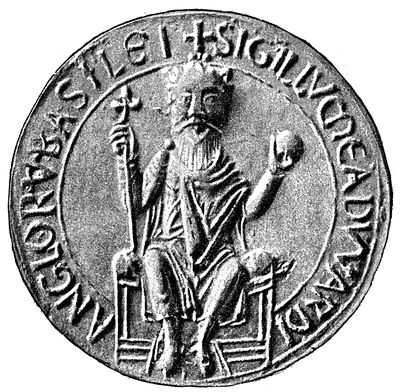
Author:
HISTORY OF ENGLAND by SAMUEL R. GARDINER.
(Wikimedia Commons)
Edward succeeded Cnut the Great’s son, Harthacnut, restoring the Rule of the House of Wessex after the period of Danish Rule since Cnut conquered England in 1016. When Edward died in 1066, he was succeeded by Harold Godwinson, who was defeated and killed in the same year by the Normans, under William the Conqueror, at the Battle of Hastings.
Edward is called Confessor, the name for someone believed to have lived a Saintly life, but who was not a Martyr, in Latin S. Eduardus Confessor rex Anglorum, as opposed to S. Eduardus Martyr rex Anglorum. He was Canonised in 1161 by Pope Alexander III, and is Commemorated on 13 October by both The Church of England and The Roman Catholic Church in England and Wales.
Saint Edward was one of the National Saints of England until King Edward III adopted Saint George as Patron Saint in about 1350.

English: Bayeux Tapestry.
King Edward the Confessor
and Harold Godwinson, at Winchester.
Français: Tapisserie de Bayeux. Scène 1: le roi
Édouard le Confesseur reçoit son beau-frère
Harold Godwinson dans son palais de Winchester
et lui confie une mission.
Photo: 7 March 2013.
Source: Own work.
Author: Myrabella
(Wikimedia Commons)
A fascinating and overlooked life of a truly saintly man; who [this reader of Zephyrinus’ blog did not know that,] even in his marriage to his equally spiritually oriented queen, Edith of Wessex (d. 1075), they committed themselves to a vow of chastity to devote themselves to the liturgy and the Divine Office, as well as caring for the poor.
ReplyDelete(Unfortunately for the people of England as Zephyrinus knows, this left no royal heir to the throne, and subsequent to Edward’s death in 1066, it led to William of Normandy’s challenge to the throne to wage war for the crown against Harold Godwinson: A fact also this reader never connected to the Battle of Hastings.
Dom Gueranger writes that some months before his death, S. John the Evangelist appeared to the King disguised as a beggar asking for alms, and the King having no coin on his person gave him a royal ring. Some years later, two pilgrims who had become lost in the Holy Land were guided to safety by S. John, who told them, “I ask you, brothers, return to your king, and give him the message which I shall send by you. I am John, the Apostle and Evangelist, and I love the holy king Edward for his chastity, for I know him to be near to God.” He also revealed the date and time of his death. On their return to England, they told the King S. John had also appeared to them and asked them to return the ring, and also. telling them to reveal to the King as requested the exact time and date of his death, January 5th of 1066, “Childermas,”so that he would be properly prepared.
A wonderful holy legend. —Comment by Dante P.
A riveting contribution from Dante P, Our Mediæval Liturgical Historical Correspondent, for which we are truly thankful.
ReplyDeleteMuch of this contribution was unknown to Zephyrinus. So, again, a big Thank You.