Notre Dame de Rouen. The façade of the Gothic Church in France. Photographer: Hippo1947. Licence: SHUTTERSTOCK.

16 December, 2012

The Commencement Of The Church's Great O Antiphons Begins, Tomorrow, 17 December.


Text and Illustrations are taken from Wikipedia - the free encyclopaedia,
unless otherwise stated.


"Sapientia".
Picture: From Codex Gigas.
Date: 13th-Century.
Source: Web of The Royal Library, National Library of Sweden 
(Full page image), cropped for usage here.
(Wikimedia Commons)


The O Antiphons are Magnificat Antiphons used at Vespers on the last seven days of Advent in Western Christian traditions.

Each Antiphon is a name of Christ, one of his attributes mentioned in Scripture.

They are:

December 17: O Sapientia (O Wisdom)
December 18: O Adonai (O Lord)
December 19: O Radix Jesse (O Root of Jesse)
December 20: O Clavis David (O Key of David)
December 21: O Oriens (O Dayspring)
December 22: O Rex Gentium (O King of the nations)
December 23: O Emmanuel (O With Us is God)

In the Roman Catholic tradition in which they originated, the O Antiphons are sung or recited at Vespers from 17 December to 23 December, inclusive (but see note, below, on alternative English usage).

In the Church of England, they have traditionally been used as Antiphons to the Magnificat at Evening Prayer during this period, and although not printed in the Book of Common Prayer, have long been part of secondary Anglican Liturgical sources, such as the English Hymnal. More recently, they have found a place in primary Liturgical documents throughout the Anglican Communion, including the Church of England's Common Worship Liturgy.


Fleury Abbey (Floriacum) in Saint-Benoît-sur-Loire, Loiret, France, 
founded about 640 A.D., is one of the most celebrated 
Benedictine Monasteries of Western Europe, 
which possesses the Relics of Saint Benedict of Nursia.
Photo: July 2005.
(Wikimedia Commons)


Use of the O Antiphons also occurs in many Lutheran Churches. In the Book of Common Worship, published by the Presbyterian Church (USA), the Antiphons can be read as a Praise Litany at Morning or Evening Prayer.

The Hymn, O come, O come, Emmanuel (in Latin, Veni Emmanuel) is a lyrical paraphrase of these Antiphons.

The first letters of the titles, taken backwards, form a Latin acrostic of "Ero Cras" which translates to "Tomorrow, I will be there", mirroring the theme of the antiphons.


Isaiah's Lips Anointed With Fire.
Artist: Benjamin West (1738 - 1820).
Current Location: BJU Museum and Gallery.
Source/Photographer: BJU Museum and Gallery.
(Wikimedia Commons)


According to Fr. William Saunders:

“ The exact origin of the "O Antiphons" is not known. Boethius (480 A.D. – 524 A.D.) used language which may be a reference to them, thereby suggesting their presence in the 6th-Century A.D. At the Benedictine Fleury Abbey, these Antiphons were recited by the Abbot and other Abbey leaders in descending Rank, and then a gift was given to each Member of the Community. By the 8th-Century A.D., they were in use in The Liturgical Celebrations in Rome. The usage of the "O Antiphons" was so prevalent in Monasteries that the phrases "Keep your O" and "The Great O Antiphons" were common parlance. One may thereby conclude that, in some fashion, the "O Antiphons" have been part of Western Liturgical Tradition since the very Early-Church.

The Benedictine Monks arranged these Antiphons with a definite purpose. If one starts with the last Title and takes the first letter of each one—Emmanuel, Rex, Oriens, Clavis, Radix, Adonai, Sapientia—the Latin words ero cras are formed, meaning: "Tomorrow, I will come". Therefore, Jesus, Whose coming Christians have prepared for in Advent and Whom they have addressed in these Seven Messianic Titles, now speaks to them: "Tomorrow, I will come." So, the "O Antiphons" not only bring intensity to their Advent preparation, but bring it to a joyful conclusion. ”

A number of other Antiphons were found in various Mediaeval Breviaries.

The importance of the "O Antiphons" is twofold. First, each one is a Title for The Messiah. Secondly, each one refers to the Prophecy of Isaiah of the coming of The Messiah. The Latin Antiphons are from The Breviarium Romanum. The English versions, which are not always literal translations of the Latin, are from The Church of England's Common Worship Liturgy. Biblical quotations are from The NRSV.

15 December, 2012

Duke Paul of Oldenburg in Luxembourg before the country’s fatal legalisation of abortion on demand.


[Flag of Luxembourg]


The National Flag of Luxembourg
(Lëtzebuerg - Grand Duchy of Luxembourg)
(Image taken from http://flagspot.net)


THE FOLLOWING ARTICLE  IS TAKEN FROM THE BLOG http://nobility.org

DATED: DECEMBER 6, 2012


Duke Paul of Oldenburg, distributing flyers in protest against Luxembourg's new abortion law.


LUXEMBOURG, November 23, 2012 (LifeSiteNews.com) – The tiny Principality of Luxembourg has adopted abortion on demand in a vote yesterday of 39 to 21 in the Chamber of Deputies.

The Bill’s promoters in the Chamber of Deputies of the Grand Duchy of Luxembourg said that the relaxation of the law will provide “punishment-free termination” and the “self-determination of women.” It was also intended to bring the country into line with the demands of the Council of Europe to “decriminalize abortion” and “to provide barrier-free access to a legal abortion.”


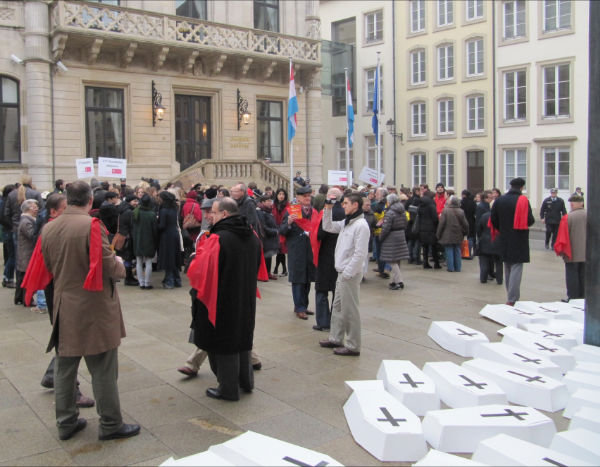
Pro-Life groups demonstrated outside the Chamber of Deputies in Luxembourg, with small white coffins representing the children already killed in the Principality by abortion.


The new law allows a pregnant woman to have an abortion merely by declaring that the pregnancy is creating a situation of “distress.” Minor girls may abort their children without parental consent or knowledge, but the girl must be accompanied by a “trusted” adult.

Pro-Life groups demonstrated outside the Chamber on Thursday as the vote was taken. The Fédération Pro Europa Christiana, based in Brussels, was joined by other European Life Rights groups, including SOS LIVE from Germany. The Pro-Life groups were met with resistance from pro-abortion counter-demonstrators, who attacked and damaged some of the small white coffins meant to represent the children already killed in the Principality by abortion.

The Leader of the Fédération, Paul, Duke of Oldenburg, said, “The behaviour of abortion activists shows that they have a guilty conscience. They know that this is about the lives of unborn children.”


Small group of supporters of the new Abortion law


The Duke of Oldenburg described the method used in parliament to pass the Bill as a “cloak-and-dagger operation” in which key information about the vote was not issued until the last possible minute. If it had not been for this, the Duke said, Pro-Life groups could have “mobilised a much larger number of people against the liberalisation of abortion”.

“Still, that should be prevented. This procedure is contrary to the essential standards of a democratic legal system.”

Proponents of the new law said it is intended to reduce the rate of unintended pregnancies, which have risen steadily since the passage of the 1978 Abortion Act, “despite sex education and prevention”. A government commission has reported that gynaecologists in Luxembourg believe that between 1,500 to 2,000 abortions are committed in the Principality each year, out of a total population of about 500,000.


Member of the Fédération Pro Europa Christiana being interviewed by the media.


Parliamentary abortion activists have been promising for two years to sweep away the remaining restrictions on abortion. 

Until yesterday, the law allowed abortion up to 12 weeks of pregnancy, provided the woman’s health would not be endangered by the abortion. 

Grounds included: 

To “save the woman’s life”; 
to preserve the woman’s “physical or mental health”; 
for pregnancies that are the result of rape or incest; 
for cases in which the unborn child is “severely physically or mentally impaired”; 
or for “economic or social reasons”. 

Abortions after 12 weeks were allowed for “serious” medical reasons with the approval of two physicians and parental or legal guardian consent for minors under 18.

Feminist and Leftist groups are expressing their anger that certain qualifications remain in the law, among which are the requirement for two consultations, one medical and one “psycho-social,” to ensure women are “fully informed” about their legal rights, the risks and available alternatives.


Duke Paul of Oldenburg and other Members of Fédération Pro Europa Christiana.


Meanwhile, European birth rates continue to fall, with Luxembourg following the general pattern of European demographics of extremely low fertility and rising median age. The overall fertility rate in Luxembourg, which remains 87 per cent Catholic, stands at 1.77 children born per woman. The Principality’s crude birth rate, the number of births per 1000 population, was 14.2 in 1968, down from 30.3 in 1905. This year’s statistics show it at 11.7 births/1,000 population.

Europe Needs Mary


THIS ARTICLE WAS TAKEN FROM THE BLOG http://thatthebonesyouhavecrushedmaythrill.blogspot.co.uk


Well done, Bones.


Europe Needs Mary


There. That's better.

14 December, 2012

You want to take on God's Holy Church ?


THIS ARTICLE WAS TAKEN FROM THE BLOG http://thatthebonesyouhavecrushedmaythrill.blogspot.co.uk

Well done, Bones.


Be Afraid, Dave...Be Very Afraid...


Seriously, though. We should. St Jude is patron of lost/desperate/helpless/beyond hope/despairing causes/cases and I believe the 'same-sex marriage' proposal might just qualify for that title. I know its St Lucy's Day, but all let's pray to St Jude for help against this proposal until its all over.

The Prayer to St Jude 
O most holy apostle, Saint Jude, faithful servant and friend of Jesus, the Church honoureth and 
invoketh thee universally, as the patron of hopeless cases, and of things almost despaired of. 
Pray for me, who am so miserable. 
Make use, I implore thee, of that particular privilege accorded to thee, to bring visible and speedy help where help was almost despaired of. 
 Come to mine assistance in this great need, that I may receive the consolation and succor of Heaven in all my necessities, tribulations, and sufferings, particularly (here make your request) and that I may praise God with thee and all the elect throughout eternity. 
I promise thee, O blessed Jude, to be ever mindful of this great favour, to always honour thee as my special and powerful patron, and to gratefully encourage devotion to thee. 
 Amen. 

Can't do any harm, can it?

The Mystery of Advent (Part Four)


Italic text is taken from The Saint Andrew Daily Missal.

The Saint Andrew Daily Missal is obtainable from Carmel Books, Blackford House, Andover Road, Highclere, Newbury, Berkshire, England RG20 9PF. Tel: (01635 255340).
E-Mail: enquiries.carmelbooks@gmail.com

Illustrations are taken from Wikipedia - the free encyclopaedia,
unless otherwise stated.


070 - Copy - Copy


Church of Our Lady of Guadalupe “at St. Bernard.”, 328 West 14th Street, New York.
Taken from the Blog of The Society of St. Hugh of Cluny at http://sthughofcluny.org


In this way, the Church makes pass before our eyes the magnificent procession which, all down the ages, goes before Jesus Christ. There we see Jacob, Judah, Moses, David, Micheas, Jeremias, Ezechiel, Daniel, Joel, Zacharias, Habacuc, Osea, Aggeus, Malachias, and, above all, Isaias, Saint John The Baptist [with whom three out of the four Advent Gospels are concerned], Saint Joseph, and the glorious Virgin Mary, who sums up in herself all Messianic hopes, seeing that their fulfilment hung on her Fiat. "Be it done unto me according to Thy word. All these holy Souls yearned for the Redeemer, and in their fervent longing they besought Him to hasten the day when He would come.

As we follow the Masses and Office of Advent, we are impressed by these urgent and pressing appeals to the Messias:

"Come, Lord, nor tarry longer [Gradual for the Fourth Sunday]". 
"The Lord is nigh, come, let us adore Him." 
"Come, Lord, and save us." 
"The King who is to come; O come, let us adore Him." 
"Show forth Thy power, O Lord, and come [Collect for the Fourth Sunday]." 


English: Stained glass, St John the Baptist's Anglican Church
Ashfield, New South Wales, Australia. 
Illustrates Jesus' description of Himself: "I am the Good Shepherd
(from the Gospel of John, Chapter 10, Verse 11). 
[This version of the image shows a vertical section focusing on Jesus.]
The memorial window is also captioned: 
"To the Glory of God and in Loving Memory of William Wright. 
Died 6th November, 1932. Aged 70."
Français : Vitrail de l'église anglicane Saint Jean Baptiste d'Ashfield (site de l'église), 
en Nouvelle Galles du Sud (Australie). 
Le vitrail illustre la description de Jésus par lui même dans le livre de Jean (chapitre 10, verset 11). On lit aussi sur ce vitrail: (« Dédié à la gloire de Dieu, et à la mémoire de William Wright, 
mort le 6 Novembre 1932 à l'âge de 70 ans »).
Author: Stained glass: Alfred Handel, d. 1946[2], Photo:Toby Hudson.
(Wikimedia Commons)


[All the following are from the Greater Antiphons] [the Great O Antiphons]

"O Wisdom, come and teach us the way of Prudence." 
"O God, guide of the House of Israel, come, stretch forth Thy hand and redeem us."
"O Root of Jesse; come to deliver us and tarry not."
"O key of David and sceptre of the House of Israel, come and release the captive plunged in darkness and the shadow of death."
"Morning Star; brightness of Eternal Light, come and enlighten those who are plunged in darkness and the shadow of death."
"O King and Desire of nations, come and save man whom Thou hast made from the slime of the Earth."
"O Emmanuel [God with us], Our King and our Lawgiver, O Lord, Our God."


057 - Copy


Our Lady of Coromoto, 
(Spanish: Nuestra Señora de Coromoto,)
Patroness of Venezuela.
Church of Our Lady of Guadalupe “at St. Bernard.”, 328 West 14th Street, New York.
Taken from the Blog of The Society of St. Hugh of Cluny at http://sthughofcluny.org


The longed-for Messias is the Son of God, Himself, the Great Royal Deliverer, who is to conquer Satan and reign over His people for ever, whom all nations shall serve. The very reason why we should utter "Come", crying to Our Lord, "O, Thou corner stone, uniting in Thyself the two peoples, come," is that the Divine Mercy extends, not only to Israel, but to all the Gentiles as well.

"And when He comes, we shall all be guided together by this Divine Shepherd." "He shall feed His flock," says Isaias, ". . . He shall gather together the lambs with his arm, and shall take them up in his bosom." He, even our Lord God.


THIS CONCLUDES THE ARTICLE ON THE MYSTERY OF ADVENT.


The Mystery of Advent (Part Three)


Non-Italic text is taken from The Liturgical Year by Abbot Gueranger, O.S.B.
(Translated from the French by Dom Laurence Shepherd, O.S.B.)
Advent. Volume 1. St. Bonaventure Publications, www.libers.com
Originally published 1949.
Republished by St. Bonaventure Publications, July 2000.

Italic text is taken from The Saint Andrew Daily Missal.

The Saint Andrew Daily Missal is obtainable from Carmel Books, Blackford House, Andover Road, Highclere, Newbury, Berkshire, England RG20 9PF. Tel: (01635 255340).
E-Mail: enquiries.carmelbooks@gmail.com


Illustrations are taken from Wikipedia - the free encyclopaedia,
unless otherwise stated.


The first three Great O Antiphons (which commence on 17 December) are shown on this Verso
 of folio 30 from The Poissy Antiphonal, a certified Dominican antiphonal of 428 folios from Poissy, written 1335-1345, with a complete annual cycle of chants for the Divine Office 
(Temporal, Sanctoral and Commons) and a hymnal. Date: 1335 - 1345.
Source: La Trobe University Library, Medieval Music Database, 
Author: Unknown.
(Wikimedia Commons)


The Church aspires also to the second coming, the consequence of the first, which consists, as we have just seen, in the visit of the Bridegroom to the bride. This coming takes place, each year, at the Feast of Christmas, when the new birth of the Son of God delivers the faithful from that yoke of bondage, under which the enemy would oppress them. [Collect for Christmas Day.]

The Church, therefore, during Advent, prays that she may be visited by Him who is her Head and her Spouse; visited in her hierarchy; visited in her members, of whom some are living, and some are dead, but may come to life again; visited, lastly, in those who are not in communion with her, and even in the very infidels, that so they may be converted to the true light, which shines even for them.

The expressions of the Liturgy which the Church makes use of to ask for this loving and invisible coming, are those which she employs when begging for the coming of Jesus in the flesh; for the two visits are for the same object.


English: Church of Saint-Étienne in Beauvais, France. 
Jesse Tree window by Engrand Le Prince, 1522-1524.
Français : Vitrail de l'église Saint-Étienne de Beauvais, France, 
représentant l'arbre de Jessé. Sa réalisation, par Engrand Le Prince, date de 1522-1524.
Source: Book "Stained Glass: An Illustrated History" by Sarah Brown.
Author: Engrand Leprince.
(Wikimedia Commons)


In vain would the Son of God have come, nineteen hundred years ago, to visit and save mankind, unless He came again for each one of us and at every moment of our lives, bringing to us and cherishing within us that supernatural life, of which He and His Holy Spirit are the sole principle.


The following is taken from The Saint Andrew Daily Missal.

SEASON OF ADVENT.
(From the First Sunday of Advent to 24 December).

Doctrinal Note.

If we read the Liturgical texts which the Church uses in the course of the four weeks of Advent, we see clearly that it is her intention to make us share the attitude of mind of the Patriarchs and seers of Israel, who looked forward to the Advent of the Messias in His twofold coming of Grace and Glory.

During this Season, the Greek Church commemorates Our Lord's ancestors, especially Abraham, Isaac, and Jacob. On the Fourth Sunday, she honours all the Patriarchs of the Old Testament; from Adam to Saint Joseph, and the Prophets, of whom Saint Matthew speaks in his genealogy of Our Lord.

The Latin Church, without honouring them in any special form of devotion, nevertheless speaks to us of them in the Office, when quoting the promises made to them concerning the Messias.


PART FOUR FOLLOWS


"The Presentation".


IMG_5358 - Copy - Copy


"The Presentation"
One of the fine paintings in the Sanctuary attributed to Wilhelm Lamprecht (1838-1922), 
a German artist who left works in Churches all over the United States.
Church of Our Lady of Guadalupe “at St. Bernard.”, 328 West 14th Street, New York.
Taken from the Blog of The Society of St. Hugh of Cluny at http://sthughofcluny.org


13 December, 2012

Solemn Mass at Church of Our Lady of Good Counsel, New York


 http://sthughofcluny.org/


Church of Our Lady of Good Counsel, New York.


Posted by Stuart Chessman

There will be a Solemn High Mass on Saturday, 15 December, at 2:30 PM at the Church of Our Lady of Good Counsel (Fr. Kazmirez Kowalski, Pastor). 

The location of this parish is
230 East 90 Street, New York, NY.

The Mass will be celebrated by Fr. Justin Wylie, a noted Homilist.
He will be assisted by Fr. Christopher Salvatore, from Our Lady of Mt. Carmel in East Harlem, serving as the Deacon and Mr. Steven Pack, serving as the Substitute Sub-Deacon.

The Mass is a 2nd-Class Votive Mass to Our Lady. It will form part of a Spiritual Retreat which will include:

1:30 PM, exposition of the Blessed Sacrament, and Spiritual Guidance/Confessions. The Holy Rosary will be recited.

2:30 PM, Solemn Mass with Fr.Justin Wylie delivering a Homily for Spiritual Recollection. After the Mass, there will be a Consecration to the Blessed Virgin Mary.

The Church will open around 1:00 PM. I might add that Our Lady of Good Counsel is one of the most beautiful Catholic Churches in New York. Our Society also sponsored a Mass here in 2007.

Published in Masses | no comment

On Christmas Night, Heaven will bow down to Earth and let drop the Sweet Dew of Our God and Saviour, Our Little Lord Jesus Christ.


THIS ARTICLE IS TAKEN FROM THE TRANSALPINE REDEMPTORISTS' BLOG AT http://papastronsay.blogspot.co.uk/


Heaven is Sweet – Heaven is Near – Heaven is Mine

Some of the members of our Congregation had
 the privilege of knowing Sr Judith  Meisner,
 an elderly Norwegian Sister of St Joseph,
 who lived out the final years of her life
 in the Zaitzkofen seminary in Bavaria.
 She often told the story of an event that had made a profound impression on her as young nun. 
Sister, who had received the gift of the Faith as schoolgirl with her future Congregation, while a novice and not yet 20 years of age, recalled that a Redemptorist Missioner had come to their convent. The priest preached a profound retreat which affected all, and on one of the days he gave a conference which ended with the words – and Sister would say them very slowly and solemnly – 
“Heaven is Sweet, Heaven is Near, Heaven is Mine”. 
“Heaven is Sweet, Heaven is…” 
she would repeat a few times making sure you understood the import of those words. 

Like the ending of every retreat conference the nuns went their way to their cells for the night, moved at what  the priest had said, but thinking no more about it than that. Early the next morning after the usual common prayers they were awaiting the appearance of the Missioner in the Convent Church to celebrate the Holy Mass when a nun burst into the choir and quite excitedly told them that
 Father had died in his sleep during the night… 
“Heaven is Sweet, Heaven is Near, Heaven is Mine,” 
Sister would repeat again solemnly… 
“those were his last words!” 

For us who remain in this Valley of Shadows, 
perhaps those words are no more appropriate than
 in this time of Advent. 
For now Salvation at Hand, 
now amidst the Winter Darkness
 we await that 
Heaven on Earth Who is Sweet, and Near, and Who can be Mine
 if only I will open my heart to Him,
if perhaps I make that good and holy confession that I need to make,
if I forgive that soul who is most in need of my mercy,
if I give up that person, that place, that object, that amusement
which is causing my darkness and unhappiness through sin. 
On Christmas Night Heaven will bow down to Earth and
 let drop the Sweet Dew of 
Our God and Saviour, Our Little Lord Jesus Christ.
Would it not be so SWEET if then He would be NEAR,
 if He would be MINE?

12 December, 2012

Rorate Caeli. Gregoriano. Dominica IV Adventus. Schola Gregoriana Mediolanensis.

The Mystery of Advent (Part Two)


Text taken from The Liturgical Year by Abbot Gueranger, O.S.B.
(Translated from the French by Dom Laurence Shepherd, O.S.B.)
Advent. Volume 1. St. Bonaventure Publications, www.libers.com
Originally published 1949.
Republished by St. Bonaventure Publications, July 2000.


Illustrations are taken from Wikipedia - the free encyclopaedia,
unless otherwise stated.


Français : L'adoration des bergers.
English: The Adoration of the Shepherds.
Artist: Georges de La Tour (1593–1652).
Date: circa 1645.
Current location: Louvre Museum, France. 
Web-Site: www.louvre.fr
(Wikimedia Commons)


As for the third coming, it is most certain that it will be, most uncertain when it will be; for nothing is more certain than death, and nothing less sure than the hour of death.

When they shall say, peace and security, says the Apostle, then shall sudden destruction come upon them, as the pains upon her that is with child, and they shall not escape. So that the first coming was humble and hidden, the second is mysterious and full of love, the third will be majestic and terrible.

In His first coming, Christ was judged by men unjustly; in His second, He renders us just by His grace; in His third, He will judge all things with justice. In His first, a lamb; in His last, a lion; in the one between the two, the tenderest of friends.' [De Adventu. Sermon III. Peter of Blois.]


An Angel with a Lamb as a Symbol of Christ's Sacrifice, by Melozzo da Forli, 1482.
(Taken from the Blog, Ars Orandi, The Art and Beauty of Tradional Catholicism)


The holy Church, therefore, during Advent, awaits in tears and with ardour the arrival of her Jesus in His first coming. For this, she borrows the fervid expressions of the Prophets, to which she joins her own supplications.

These longings for the Messias, expressed by the Church, are not a mere commemoration of the desires of the ancient Jewish people; they have a reality and efficacy of their own, an influence in the great act of God's munificence, whereby He gave us His own Son.

From all eternity, the prayers of the ancient Jewish people and the prayers of the Christian Church ascended together to the prescient hearing of God; and it was after receiving and granting them, that He sent, in the appointed time, that blessed Dew upon the Earth, which made it bud forth the Saviour.


The Adoration of the Lamb.
From the Ghent Altarpiece by Jan van Eyck,1429.
(Taken from the Blog, Ars Orandi, The Art and Beauty of Tradional Catholicism)


[Editor. All within these square brackets is taken from Wikipedia - the free encyclopaedia: Rorate coeli (or Rorate Caeli), from the Book of Isaiah (Isaiah 45:8) in the Vulgate, are the opening words of a text used in Catholic and, less frequently, Protestant Liturgy. It is also known as The Advent Prose or, by the first words of its English translation, "Drop down ye heavens from above."

It is frequently sung as Plainsong at Mass and in the Divine Office during Advent, where it gives expression to the longings of Patriarchs and Prophets, and, symbolically of the Church, for the coming of the Messiah. Throughout Advent, it occurs daily as the Versicle and Response after the hymn at Vespers.

Rorate coeli desuper et nubes pluant justum
(Drop down dew, ye heavens, from above, and let the clouds rain the just)

Aperiatur terra et germinet salvatorem"
(Let the earth be opened and send forth a Saviour"). ” ]


PART THREE FOLLOWS


11 December, 2012

O Holy Night - Celine Dion (These Are Special Times)

Canterbury Cathedral (Part Four)


Text and Illustrations from Wikipedia - the free encyclopaedia,
unless otherwise stated.


Canterbury Cathedral Tower's Ceiling.
Photo: April 2011.
Source: Own work.
Author: Mattana.
(Wikimedia Commons).


Monastic Buildings

A bird's-eye view of the Cathedral and its monastic buildings, made in about 1165 and known as the "waterworks plan", is preserved in the Eadwine Psalter in the library of Trinity College, Cambridge. It shows that Canterbury employed the same general principles of arrangement common to all Benedictine monasteries, although, unusually, the Cloister and monastic buildings were to the North, rather than the South, of the Church. There was a separate Chapter-House.

The buildings formed separate groups around the Church. Adjoining it, on the North side, stood the Cloister and the buildings devoted to the monastic life. To the East and West of these, were those devoted to the exercise of hospitality. To the North, a large open court divided the monastic buildings from menial ones, such as the stables, granaries, barn, bakehouse, brew house and laundries, inhabited by the lay servants of the establishment. 

At the greatest possible distance from the Church, beyond the precinct of the monastery, was the eleemosynary department. The Almonry for the relief of the poor, with a great Hall annexed, formed the paupers' hospitium.


Canterbury Cathedral Cloisters.
Photo: April 2011.
Source: Own work.
Author: Mattana.
(Wikimedia Commons)


The group of buildings devoted to monastic life included two Cloisters. The Great Cloister was surrounded by the buildings essentially connected with the daily life of the monks: The Church to the South, with the Refectory placed, as always, on the side opposite; The Dormitory, raised on a vaulted Undercroft, and the Chapter-House adjacent, and the lodgings of the Cellarer, responsible for providing both monks and guests with food, to the West. A passage under the Dormitory lead Eastwards to the smaller, or Infirmary, Cloister, appropriated to sick and infirm monks.

The Hall and Chapel of the Infirmary extended East of this Cloister, resembling in form and arrangement the Nave and Chancel of an aisled Church. Beneath the Dormitory, overlooking the green court or herbarium, lay the "pisalis" or "calefactory," the Common Room of the monks. At its North-East corner, access was given from the Dormitory to the necessarium, a building in the form of a Norman Hall, 145 ft long by 25 ft broad (44.2 m × 7.6 m), containing fifty-five seats. It was constructed with careful regard to hygiene, with a stream of water running through it from end to end.

A second, smaller, Dormitory, for the Conventual Officers, ran from East to West. Close to the Refectory, but outside the Cloisters, were the domestic offices connected with it: to the North, the Kitchen, 47 ft (14 m) square, with a pyramidal Roof, and the Kitchen Court; to the West, the Butteries, Pantries, etc. The Infirmary had a small Kitchen of its own. Opposite the Refectory Door, in the Cloister, were two Lavatories, where the monks washed before and after eating.


Canterbury Cathedral Stained Glass Windows.
Photo: April 2011.
Source: Own work.
Author: Mattana.
(Wikimedia Commons)

PART FIVE FOLLOWS


The Mystery of Advent (Part One)


Text taken from The Liturgical Year by Abbot Gueranger, O.S.B.
(Translated from the French by Dom Laurence Shepherd, O.S.B.)
Advent. Volume 1. St. Bonaventure Publications, www.libers.com
Originally published 1949.
Republished by St. Bonaventure Publications, July 2000.


Illustrations are taken from Wikipedia - the free encyclopaedia,
unless otherwise stated.


Advent wreath. First Sunday of Advent.
Photo: November 2008.
Source: Own work.
Author: Micha L. Rieser.
(Wikimedia Commons)


CHAPTER THE SECOND
The Mystery of Advent

If, now that we have described the characteristic features of Advent which distinguish it from the rest of the Liturgical Year, we would penetrate into the profound mystery which occupies the mind of the Church during this Season, we find that this mystery of the coming, or Advent, of Jesus is at once simple and threefold.

It is simple, for it is the one same Son of God that is coming; it is threefold, because He comes at three different times and in three different ways.

'In the first coming,' says Saint Bernard of Clairvaux, 'He comes in the flesh and in weakness; in the second, He comes in spirit and in power; in the third, He comes in glory and in majesty; and the second coming is the means whereby we pass from the first to the third.' [Fifth sermon for Advent.]


Deutsch: Weihnachtsbeleuchtung der Hauptstraße 
in Remshalden-Geradstetten, Deutschland; Nachtaufnahme.
English: Christmas lighting 
in Remshalden-Geradstetten, Germany; night photograph.
Photo: January 2008.
Source: Own work.
Author: Wildfeuer.
(Wikimedia Commons)


This, then, is the mystery of Advent. Let us now listen to the explanation of this threefold visit of Christ, given to us by Peter of Blois, in his third Sermon de Adventu: 'There are three comings of Our Lord; the first in the flesh; the second in the Soul; the third at the Judgement.

The first was at midnight, according to those words of the Gospel: At midnight there was a cry made, Lo the Bridegroom cometh ! But this first coming is long since past, for Christ has been seen on the Earth and has conversed with men.


English: Illuminated Christmas tree for the “Quiet Advent” on the Johannes-Brahms-Promenade, Western Bay in Pörtschach am Wörthersee, district Klagenfurt Land, Carinthia, Austria
Deutsch: Erleuchteter Weihnachtsbaum für „Stiller Advent“ an der Johannes-Brahms-Promenade, West-Bucht in Pörtschach am Wörthersee, Bezirk Klagenfurt Land, Kärnten, Österreich
Photo: December 2011.
Source: Own work.
Author: Johann Jaritz.
(Wikimedia Commons)


We are now in the second coming, provided only we are such as that He may thus come to us; for He has said that if we love Him, He will come unto us and will take up His abode with us. So that this second coming is full of uncertainty to us: for who, save the Spirit of God, knows them that are of God?

They that are raised out of themselves by the desire of heavenly things, know indeed when He comes; but whence He cometh, or whither He goeth, they know not.


PART TWO FOLLOWS


10 December, 2012

Canterbury Cathedral (Part Three)


Text and Illustrations from Wikipedia - the free encyclopaedia,
unless otherwise stated.


Canterbury Cathedral's Nave and Ceiling.
Photo: August 2007.
(Uploaded by Kurpfalzbilder.de)
Author: Hideyuki KAMON
(Wikimedia Commons)


The posthumous veneration of Becket made the Cathedral a place of pilgrimage. This brought both the need to expand the Cathedral, and the wealth that made it possible.

In September 1174, the Choir was severely damaged by fire, necessitating a major reconstruction, the progress of which was recorded in detail by a monk named Gervase. The Crypt survived the fire intact, and it was found possible to retain the outer walls of the Choir, which were increased in height by 12 feet (3.7 m) in the course of the rebuilding, but with the round-headed form of their windows left unchanged.

Everything else was replaced in the new Gothic style, with pointed arches, rib vaulting and flying buttresses. The limestone used was imported from Caen in Normandy, and Purbeck marble was used for the shafting. The Choir was back in use by 1180, and in that year the remains of Saint Dunstan and Saint Alphege were moved there from the Crypt.


Stained glass windows in the Chapter House, Canterbury Cathedral.
Photo: April 2011.
Source: Own work.
Author: Mattana
(Wikimedia Commons)


The Master-Mason, appointed to rebuild the choir, was a Frenchman, William of Sens. Following his injury in a fall from the scaffolding in 1179, he was replaced by one of his former assistants, known as "William the Englishman.

In 1180-1184, in place of the old, square-ended, Eastern Chapel, the present Trinity Chapel was constructed, a broad extension with an Ambulatory, designed to house the shrine of Saint Thomas Becket.

A further Chapel, circular in plan, was added beyond that, which housed further relics of Becket, widely believed to have included the top of his skull, struck off in the course of his assassination. This latter Chapel became known as the "Corona" or "Becket's Crown".


Canterbury Cathedral.
Photo: April 2011.
Source: Own work.
Author: Mattana
(Wikimedia Commons)


These new parts, East of the Choir Transepts, were raised on a higher Crypt than Ernulf's Choir, necessitating flights of steps between the two levels. Work on the Chapel was completed in 1184, but Becket's remains were not moved from his tomb in the Crypt until 1220. Further significant interments in the Trinity Chapel included those of Edward Plantagenet (The "Black Prince") and King Henry IV.

Shrine of Thomas Becket

The Shrine, in the Trinity Chapel, was placed directly above Becket's original tomb in the Crypt. A marble plinth, raised on columns, supported what an early visitor, Walter of Coventry, described as "a coffin wonderfully wrought of gold and silver, and marvellously adorned with precious gems".

Other accounts make clear that the gold was laid over a wooden chest, which in turn contained an iron-bound box holding Becket's remains. Further votive treasures were added to the adornments of the chest over the years, while others were placed on pedestals or beams nearby, or attached to hanging drapery.


Canterbury Cathedral.
Photo: April 2011.
Source: Own work.
Author: Mattana
(Wikimedia Commons)


For much of the time, the chest (or "ferotory") was kept concealed by a wooden cover, which would be theatrically raised by ropes once a crowd of pilgrims had gathered. Erasmus, who visited in 1512–1514, recorded that, once the cover was raised, "the Prior ... pointed out each jewel, telling its name in French, its value, and the name of its donor; for the principal of them were offerings sent by sovereign princes."

The income from pilgrims (such as those portrayed in Geoffrey Chaucer's [Canterbury Tales]) who visited Becket's Shrine, which was regarded as a place of healing, largely paid for the subsequent rebuilding of the Cathedral and its associated buildings. This revenue included the profits from the sale of pilgrim badges, depicting Becket, his martyrdom, or his Shrine.

The Shrine was removed in 1538. Henry VIII summoned the dead Saint to Court, to face charges of Treason. Having failed to appear, he was found guilty in his absence and the treasures of his Shrine were confiscated, carried away in two coffers and twenty-six carts.


PART FOUR FOLLOWS


09 December, 2012

Advent (Part Six)


Text taken from The Liturgical Year by Abbot Gueranger, O.S.B.
(Translated from the French by Dom Laurence Shepherd, O.S.B.)
Advent. Volume 1. St. Bonaventure Publications, www.libers.com
Originally published 1949.
Republished by St. Bonaventure Publications, July 2000.


Unless otherwise stated, Illustrations are taken from 
Una Voce of Orange County web-site at http://uvoc.org/
which reproduced them, with the kind permission of St. Bonaventure Press, from 
The Saint Andrew Daily Missal, 1952 Edition.


The Virgin in Prayer
by Giovanni Battista Salvi "Il Sassoferrato",
Jungfrun i bön (1640-1650). 
(between 1640 and 1650).
(Wikimedia Commons)

Mother of God.
Queen of Heaven.
Mother of the Church.
Mediatrix.
Co-Redemptrix.
Our Lady.
Blessed Virgin Mary.

Ora Pro Nobis.

The Catechism of the Catholic Church states:
"The Church's devotion to the Blessed Virgin is intrinsic to Christian worship."


From that time, the Roman Church has always observed this arrangement of Advent, which gives it four weeks, the fourth being that in which Christmas Day falls, unless 25 December be a Sunday.

We may therefore consider the present discipline of the observance of Advent as having lasted a thousand years, at least as far as the Church in France kept up the number of five Sundays as late as the 13th-Century.

The Ambrosian Liturgy, even to this day, has six weeks of Advent; so has the Gothic or Mozarabic missal. As regards the Gallican Liturgy, the fragments collected by Dom Mabillon give us no information; but it is natural to suppose with this learned man, whose opinion has been confirmed by Dom Martene, that the Church of God adopted, in this as in so many other points, the usages of the Gothic Church, that is to say, that its Advent consisted of six Sundays and six weeks.


Photo: 1917.
Author: Unknown.
(Wikimedia Commons)

Shortly before her death at age 9, 
Blessed Jacinta Marto of Fátima asked that everyone consecrate themselves 


With regard to the Greeks, their rubrics for Advent are given in the Menaea, immediately after the Office for 14 November.

They have no proper Office for Advent, neither do they celebrate during this time the Mass of the Pre-sanctified, as they do in Lent.

There are only in the Offices for the Saints, whose Feasts occur between 14 November and the Sunday nearest Christmas, frequent allusions to the birth of the Saviour, to the Maternity of Mary, to the cave of Bethlehem, etc.

On the Sunday preceding Christmas, in order to celebrate the expected coming of the Messias, they keep what they call the Feast of the Holy Fathers, that is the Commemoration of the Saints of the Old Law.

They give the name of Ante-Feast of the Nativity to 20, 21, 22, 23 December; and, although they say the Office of several Saints on these four days, yet the mystery of the birth of Jesus pervades the whole Liturgy.


The Saint Andrew Daily Missal is obtainable from Carmel Books, Blackford House, Andover Road, Highclere, Newbury, Berkshire, England RG20 9PF. Tel: (01635 255340).
E-Mail: enquiries.carmelbooks@gmail.com


THIS CONCLUDES THE ARTICLE ON THE HISTORY OF ADVENT.


Related Posts Plugin for WordPress, Blogger...