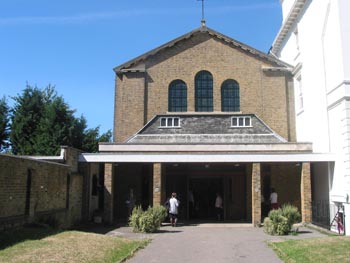
Notre Dame de Rouen. The façade of the Gothic Church in France. Photographer: Hippo1947. Licence: SHUTTERSTOCK.

11 February, 2014

The Venerable Bede (673 A.D.-735 A.D.). Saint. Confessor. Doctor Of The Church. (Part Seven).


Text and Illustrations from Wikipedia - the free encyclopaedia,
unless otherwise stated.


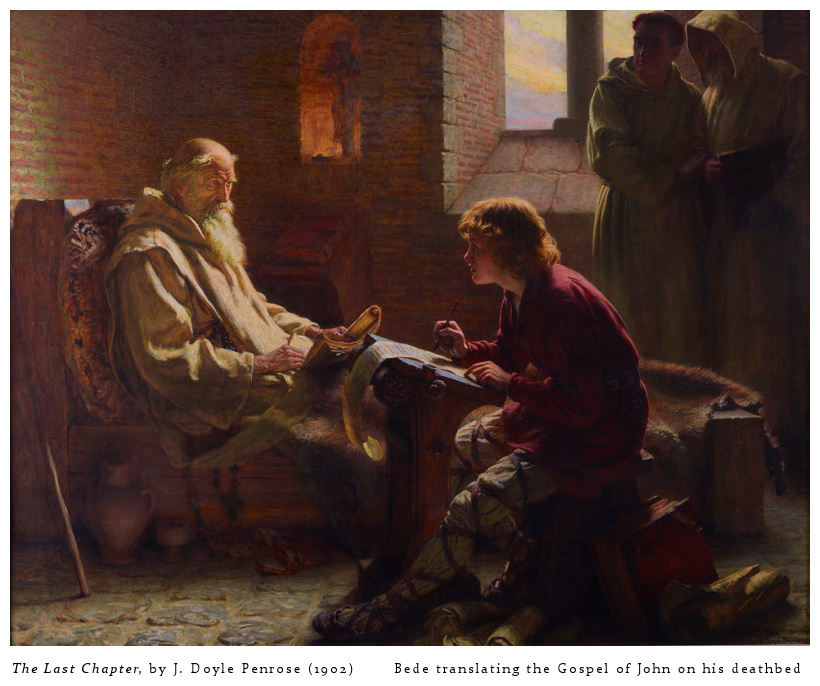
Bede, translating the Gospel
of Saint John on his deathbed.
Date: 1902.
Author: James Doyle Penrose.
(Wikimedia Commons)


As Chapter 66 of Bede's "On the Reckoning of Time", in 725 A.D., Bede wrote the Greater Chronicle (chronica maiora), which sometimes circulated as a separate work. For recent events, the Chronicle, like his Ecclesiastical History, relied upon Gildas, upon a version of the Liber pontificalis, current at least to the Papacy of Pope Sergius I (687 A.D. – 701 A.D.), and other sources. For earlier events, he drew on Eusebius's Chronikoi Kanones. The dating of events in the Chronicle is inconsistent with his other works, using the era of creation, the anno mundi.


File:St Pauls Monastery Jarrow.jpg

The Ruins of Saint Paul's Monastery.
Once the home of The Venerable Bede.
Photo: 12 November 2005.
Source: From geograph.org.uk.
Author: Mark Smiles.
(Wikimedia Commons)

The Monastery of Saint Paul, in Jarrow, part of the twin foundation Monkwearmouth-Jarrow Priory, was once the home of the Venerable Bede, whose most notable works include The Ecclesiastical History of the English People and the translation of the Gospel of John into Old English
At the time of its foundation, it was reputed to have been the only Centre of Learning in Europe, North of Rome. In 794 A.D., Jarrow became the second target in England of the Vikings, who had plundered Lindisfarne in 793 A.D. The Monastery was later dissolved by King Henry VIII. The ruins of the Monastery are now associated with, and partly built into, the present-day Church of Saint Paul, which stands on the site. One wall of the Church contains the oldest Stained-Glass Window in the world, dating from about 600 A.D. Just beside the Monastery, is "Bede's World", a working museum, dedicated to the life and times of Bede. Bede's World also incorporates Jarrow Hall, a Grade II Listed Building and a significant local landmark.


His other historical works included Lives of the Abbots of Wearmouth and Jarrow, as well as Verse and Prose Lives of Saint Cuthbert of Lindisfarne, an adaptation of Paulinus of Nola's Life of Saint Felix, and a translation of the Greek Passion of Saint Anastasius. He also created a listing of Saints, the Martyrology.

In his own time, Bede was as well known for his Biblical commentaries and exegetical, as well as other theological, works. The majority of his writings were of this type, and covered the Old Testament and the New Testament. Most survived the Middle Ages, but a few were lost. It was for his theological writings that he earned the title of Doctor Anglorum, and why he was made a Saint.

Bede synthesised and transmitted the learning from his predecessors, as well as made careful, judicious innovation in knowledge (such as recalculating the age of the Earth – for which he was censured before surviving the Heresy accusations and eventually having his views championed by Archbishop Ussher, in the 16th-Century – see below), that had theological implications.


File:Jarrow.jpg

English: Ruins of Saint Paul's Monastery, Jarrow, England.
Once the home of The Venerable Bede.
Nederland: Ruïne van het nl:klooster te nl:Jarrow
met de nog bestaande kerk op de achtergrond.
Date: 2004-12-15 (original upload date).
Source: Originally from nl.wikipedia; description page is/was here.
Author: Original uploader was Xaphire at nl.wikipedia.
Permission: Licensed under the GFDL by the Author.
(Wikimedia Commons)


In order to do this, he learned Greek, and attempted to learn Hebrew. He spent time reading and re-reading both the Old and the New Testaments. He mentions that he studied from a text of Jerome's Vulgate, which itself was from the Hebrew text. He also studied both the Latin and the Greek Fathers of the Church. In the Monastic Library at Jarrow were a number of books by theologians, including works by BasilCassianJohn ChrysostomIsidore of SevilleOrigenGregory of NazianzusAugustine of HippoJeromePope Gregory IAmbrose of MilanCassiodorus, and Cyprian

He used these, in conjunction with the Biblical texts themselves, to write his Commentaries and other theological works. He had a Latin translation by Evagrius of Athanasius's Life of Antony, and a Copy of Sulpicius Severus' Life of Saint Martin. He also used lesser-known writers, such as FulgentiusJulian of EclanumTyconius, and Prosperius. Bede was the first to refer to Jerome, Augustine, Pope Gregory and Ambrose as the four Latin Fathers of the Church. It is clear from Bede's own comments that he felt his job was to explain to his students and readers the theology and thoughts of the Church Fathers.

Bede also wrote Homilies, works written to explain theology used in worship services. Bede wrote Homilies not only on the major Christian seasons, such as AdventLent, or Easter, but on other subjects, such as anniversaries of significant events.


File:Saint Boniface by Cornelis Bloemaert.jpg

Saint Boniface by Cornelis Bloemaert, circa 1630.
Used Bede's Homilies in his 
missionary efforts on the Continent.
Photo: 26 April 2013.
Author: Cornelis Bloemaert (1603-1684).
(Wikimedia Commons)


Both types of Bede's theological works circulated widely in the Middle Ages. A number of his Biblical Commentaries were incorporated into the Glossa Ordinaria, an 11th-Century collection of Biblical Commentaries. Some of Bede's Homilies were collected by Paul the Deacon, and they were used in that form in the Monastic OfficeSaint Boniface used Bede's Homilies in his missionary efforts on the Continent.

Bede sometimes included in his theological books an acknowledgement of the predecessors on whose works he drew. In two cases, he left instructions that his marginal notes, which gave the details of his sources, should be preserved by the Copyist, and he may have originally added marginal comments about his sources to others of his works. Where he does not specify, it is still possible to identify books to which he must have had access by quotations that he uses.


PART EIGHT FOLLOWS

09 February, 2014

Palestrina. Basilica Di Santa Maria Maggiore. Rome. Tallis Scholars.


File:Piazza Esquilino, Santa Maria Maggiore.JPG

Piazza Esquilino with 
Basilica di Santa Maria Maggiore, 
Rome, Italy.
Photo: March 2006.
Source: Own work.
Author: Sixtus.
Permission: GFDL.
(Wikimedia Commons)


Surge, illuminare1:08 
Missa Papae Marcelli Kyrie 4:19
Missa Papae Marcelli Gloria 8:39
Missa Papae Marcelli Credo 14:32
Missa Papae Marcelli Sanctus 23:46
Missa Papae Marcelli Agnus Dei 30:36
Miserere mei Deus [Allegri] 38:46
Stabat Mater 52:38
Alma Redemptoris Mater 1:02:40
Magnificat 1:06:14
Nunc dimittis 1:14:46

The Palestrina 400 Concert.
The Tallis Scholars.
Available on YouTube at


The Venerable Bede (673 A.D.-735 A.D.). Saint. Confessor. Doctor Of The Church. (Part Six).


Text and Illustrations from Wikipedia - the free encyclopaedia,
unless otherwise stated.


Bede, translating the Gospel
of Saint John on his deathbed.
Date: 1902.
Author: James Doyle Penrose.
(Wikimedia Commons)


He is also parsimonious in his praise for Aldhelm, a West Saxon who had done much to convert the native Britons to the Roman form of Christianity. He lists seven Kings of the Anglo-Saxons, whom he regards as having held imperium, or overlordship; only one King of Wessex, Ceawlin, is listed, and none from Mercia, though elsewhere he acknowledges the secular power several of the Mercians held. Historian Robin Fleming states that he was so hostile to Mercia, because Northumbria had been diminished by Mercian power, that he consulted no Mercian informants and included no stories about its Saints.

Bede relates the story of Augustine's mission from Rome, and tells how the British Clergy refused to assist Augustine in the conversion of the Anglo-Saxons. This, combined with Gildas's negative assessment of the British Church at the time of the Anglo-Saxon invasions, led Bede to a very critical view of the native Church. However, Bede ignores the fact that at the time of Augustine's mission, the history between the two was one of warfare and conquest, which, in the words of Barbara Yorke, would have naturally "curbed any missionary impulses towards the Anglo-Saxons from the British Clergy."


File:Bibliothèque du Grand Séminaire de Strasbourg 31.jpg

English: The Venerable Bede's "De naturis rerum". 
Bibliothèque du Grand Séminaire de Strasbourg, France. 
Conservateur : Louis Schlaefli.
Français: Bède le Vénérable, De naturis rerum (Ms 31/3), page de titre (IXe-Xe s.), 
à la bibliothèque du Grand Séminaire de Strasbourg. 
Conservateur : Louis Schlaefli.
Photo: 18 June 2013.
Source: Own work.
(Wikimedia Commons)


At the time Bede wrote the Historia Ecclesiastica, there were two common ways of referring to dates. One was to use indictions, which were fifteen-year cycles, counting from 312 A.D. There were three different varieties of indiction, each starting on a different day of the year. The other approach was to use regnal years—the reigning Roman Emperor, for example, or the ruler of whichever kingdom was under discussion. This meant that, in discussing conflicts between kingdoms, the date would have to be given in the regnal years of all the kings involved. Bede used both these approaches on occasion, but adopted a third method as his main approach to dating: the anno domini method, invented by Dionysius Exiguus. Although Bede did not invent this method, his adoption of it, and his promulgation of it in De Temporum Ratione, his work on chronology, is the main reason why it is now so widely used.

The Historia Ecclesiastica was copied often in the Middle Ages, and about 160 manuscripts, containing it, survive. About half of those are located on the European Continent, rather than on the British Isles. Most of the 8th- and 9th-Century texts of Bede's Historia come from the Northern parts of the Carolingian Empire. This total does not include manuscripts with only a part of the work, of which another 100 or so survive.

It was printed for the first time between 1474 and 1482, probably at Strasbourg, France. Modern historians have studied the Historia, extensively, and a number of editions have been produced. For many years, Early-Anglo-Saxon history was essentially a retelling of the Historia, but recent scholarship has focused as much on what Bede did not write as what he did. The belief that the Historia was the culmination of Bede's works, the aim of all his scholarship, a belief common among historians in the past, is no longer accepted by most scholars.


File:Bibliothèque du Grand Séminaire de Strasbourg 32.jpg

English: The Venerable Bede's "De naturis rerum". 
Bibliothèque du Grand Séminaire de Strasbourg, France. 
Conservateur : Louis Schlaefli.
Français: Bède le Vénérable, De naturis rerum (Ms 31/3), page de titre (IXe-Xe s.), 
à la bibliothèque du Grand Séminaire de Strasbourg. 
Conservateur : Louis Schlaefli.
Photo: 18 June 2013.
Source: Own work.
(Wikimedia Commons)


Modern historians and editors of Bede have been lavish in their praise of his achievement in the Historia Ecclesiastica. Stenton regarded it as one of the "small class of books which transcend all but the most fundamental conditions of time and place", and regarded its quality as dependent on Bede's "astonishing power of co-ordinating the fragments of information which came to him through tradition, the relation of friends, or documentary evidence ... In an age where little was attempted beyond the registration of fact, he had reached the conception of history." Patrick Wormald described him as "the first and greatest of England's historians".

The Historia Ecclesiastica has given Bede a high reputation, but his concerns were different from those of a modern writer of history. His focus on the history of the organisation of the English Church, and on Heresies and the efforts made to root them out, led him to exclude the Secular history of Kings and Kingdoms, except where a moral lesson could be drawn or where they illuminated events in the Church. 

Besides the Anglo-Saxon Chronicle, the Mediaeval writers, William of MalmesburyHenry of Huntingdon, and Geoffrey of Monmouth, used his works as sources and inspirations. Early-Modern writers, such as Polydore Vergil and Matthew Parker, the Elizabethan Archbishop of Canterbury, also utilised the Historia, and his works were used by both Protestant and Catholic sides in the Wars of Religion.


File:Jacob Leupold Counting fingers table year 1727.jpg

English: Figure published 1727 in ""Theatrum arithmetico geometricum" 
by Jacob Leupold (1674–1727). Representing counting with fingers, 
described by The Venerable Bede.
Suomi: Kuva julkaistu 1727 kirjassa ""Theatrum arithmetico geometricum" teikijä Jacob Leupold (1674–1727). Esittää sormilla laskemista, jota Bede Venerabilis (kuoli 735) kuvaili jo 700 luvulla.
Date: Circa 1727.
Source: John D. Barrow: "Pi in the Sky", 1992, Oxford University Press, figure.
Author: original figure by Jacob Leupold (1674–1727).
(Wikimedia Commons)


Some historians have questioned the reliability of some of Bede's accounts. One historian, Charlotte Behr, thinks that the Historia's account of the arrival of the Germanic invaders in Kent should not be considered to relate what actually happened, but rather relates myths that were current in Kent during Bede's time.

It is likely that Bede's work, because it was so widely copied, discouraged others from writing histories and may even have led to the disappearance of manuscripts containing older historical works.


PART SEVEN FOLLOWS


08 February, 2014

Ave Regina Caelorum.


English: Blessed Virgin Mary with the Christ Child and Saint John the Baptist.
Deutsch: Madonna della Tenda, Szene: Maria mit Christuskind und Johannes dem Täufer.
Français: La Vierge au rideau (Vierge à l'Enfant avec saint Jean-Baptiste.
Artist: Raphael (1483–1520).
Date: 1514.
Current location: Alte Pinakothek, Munich, Germany.
Source/Photographer: The Yorck Project: 10.000 Meisterwerke der Malerei. DVD-ROM, 2002. 
ISBN 3936122202. Distributed by DIRECTMEDIA Publishing GmbH.
Permission: [1].
(Wikimedia Commons)


Ave Regina Caelorum.
Motet from Giovanni Legrenzi,
from Jaroussky's, 'Beata Vergine'.
Philippe Jaroussky, counter-tenor,
Marie-Nicole Lemieux, contralto.
Available on YouTube at


The Venerable Bede (673 A.D.-735 A.D.). Saint. Confessor. Doctor Of The Church. (Part Five).


Text and Illustrations from Wikipedia - the free encyclopaedia,
unless otherwise stated.


Bede, translating the Gospel
of Saint John on his deathbed.
Date: 1902.
Author: James Doyle Penrose.
(Wikimedia Commons)


Bede quoted his sources at length in his narrative, as Eusebius had done. Bede also appears to have taken quotes directly from his correspondents at times. For example, he almost always uses the terms "Australes" and "Occidentales" for the South and West Saxons, respectively, but in a passage, in the first book, he uses "Meridiani" and "Occidui", instead, as perhaps his informant had done. At the end of the work, Bede added a brief autobiographical note; this was an idea taken from Gregory of Tours' earlier "History of the Franks".

Bede's work as a hagiographer, and his detailed attention to dating, were both useful preparations for the task of writing the Historia Ecclesiastica. His interest in "Computus", the science of calculating the date of Easter, was also useful in the account he gives of the controversy between the British and Anglo-Saxon Churches over the correct method of obtaining the Easter date.


Saint Bede's Church (founded 1771),
Appleton, Cheshire,
England.
Photo: 27 March 2007.
Source: From geograph.org.uk.
Author: Sue Adair.
(Wikimedia Commons)


Bede's Latin has been praised for its clarity, but his style in the Historia Ecclesiastica is not simple. He knew rhetoric, and often used figures of speech and rhetorical forms which cannot easily be reproduced in translation, depending, as they often do, on the connotations of the Latin words. However, unlike contemporaries, such as Aldhelm, whose Latin is full of difficulties, Bede's own text is easy to read.

In the words of Charles Plummer, one of the best-known editors of the Historia Ecclesiastica, Bede's Latin is "clear and limpid ... it is very seldom that we have to pause to think of the meaning of a sentence ... Alcuin rightly praises Bede for his unpretending style."

Bede's primary intention, in writing the Historia Ecclesiastica, was to show the growth of the united Church throughout England. The native Britons, whose Christian Church survived the departure of the Romans, earn Bede's ire for refusing to help convert the Saxons; by the end of the Historia, the English, and their Church, are dominant over the Britons. This goal, of showing the movement towards unity, explains Bede's animosity towards the British method of calculating Easter: Much of the Historia is devoted to a history of the dispute, including the final resolution at the Synod of Whitby in 664 A.D. Bede is also concerned to show the unity of the English, despite the disparate kingdoms that still existed when he was writing. He also wants to instruct the reader by spiritual example, and to entertain, and, to the latter end, he adds stories about many of the places and people about which he wrote.


St. Bede's RC Church in Jarrow,
County Durham (now Tyne & Wear),
England.
Photo: 29 March 2007.
Source: From geograph.org.uk.
Author: Vin Mullen.
(Wikimedia Commons)


Bede's extensive use of miracles is disconcerting to the modern reader, who thinks of Bede as a more or less reliable historian, but men of the time accepted miracles as a matter of course. However, Bede, like Gregory the Great, whom Bede quotes on the subject in the Historia, felt that Faith, brought about by miracles, was a stepping stone to a higher, truer Faith, and that, as a result, miracles had their place in a work designed to instruct.

Bede is somewhat reticent about the career of Wilfrid, a contemporary, and one of the most prominent Clerics of his day. This may be because Wilfrid's opulent lifestyle was uncongenial to Bede's Monastic mind; it may also be that the events of Wilfrid's life, divisive and controversial as they were, simply did not fit with Bede's theme of the progression to a unified and harmonious Church.

Bede's account, of the early migrations of the Angles and Saxons to England, omits any mention of a movement of those peoples across the Channel from Britain to Brittany, described by Procopius, who was writing in the 6th-Ccentury. Frank Stenton describes this omission as "a scholar's dislike of the indefinite"; traditional material that could not be dated or used for Bede's didactic purposes had no interest for him.


Saint Bede's Catholic Church,
Clapham Park, London SW12 OLF.


Bede was a Northumbrian, and this tinged his work with a local bias. The sources he had access to gave him less information about the West of England than for other areas. He says relatively little about the achievements of Mercia and Wessex, omitting, for example, any mention of Boniface, a West Saxon missionary to the Continent of some renown, and of whom Bede had almost certainly heard, though Bede does discuss Northumbrian missionaries to the Continent.


PART SIX FOLLOWS


06 February, 2014

The Knights Templar. Chant of The Templars. Salve Regina.


Text from Wikipedia, the free encyclopaedia,
unless otherwise stated.


File:Cross of the Knights Templar.svg


The Poor Fellow-Soldiers of Christ and of the Temple of Solomon (Latin: Pauperes commilitones Christi Templique Salomonici), commonly known as the Knights Templar, the Order of the Temple (French: Ordre du Temple or Templiers) or, simply, as Templars, were among the most wealthy and powerful of the Western Christian military orders. The organisation existed for nearly two centuries during the Middle Ages.

Officially endorsed by the Catholic Church, around 1129, the Order became a favoured Charity throughout Christendom and grew rapidly in membership and power. Templar Knights, in their distinctive white mantles with a red cross, were among the most skilled fighting units of the Crusades.


CHANT OF THE TEMPLARS.
SALVE REGINA.

Available on YouTube


Non-combatant members of the Order managed a large economic infrastructure throughout Christendom, innovating financial techniques that were an early form of banking, and building fortifications across Europe and the Holy Land.

The Templars' existence was tied closely to the Crusades; when the Holy Land was lost, support for the Order faded. Rumours about the Templars' secret initiation ceremony created mistrust and King Philip IV of France, deeply in debt to the Order, took advantage of the situation.

In 1307, many of the Order's members in France were arrested, tortured into giving false confessions, and then burned at the stake. Under pressure from King Philip, Pope Clement V disbanded the Order in 1312. The abrupt disappearance of a major part of the European infrastructure gave rise to speculation and legends, which have kept the "Templar" name alive into the modern day.


The Venerable Bede (673 A.D.-735 A.D.). Saint. Confessor. Doctor Of The Church. (Part Four).


Text and Illustrations from Wikipedia - the free encyclopaedia,
unless otherwise stated.


Bede, translating the Gospel
of Saint John on his deathbed.
Date: 1902.
Author: James Doyle Penrose.
(Wikimedia Commons)


The fifth book brings the story up to Bede's day, and includes an account of missionary work in Frisia, and of the conflict with the British Church over the correct dating of Easter. Bede wrote a Preface for the work, in which he dedicates it to Ceolwulf, King of Northumbria. The Preface mentions that Ceolwulf received an earlier draft of the book; presumably, Ceolwulf knew enough Latin to understand it, and he may even have been able to read it. The Preface makes it clear that Ceolwulf had requested the earlier copy, and Bede had asked for Ceolwulf's approval; this correspondence with the King indicates that Bede's Monastery had excellent connections among the Northumbrian nobility.

The Monastery at Wearmouth - Jarrow had an excellent Library. Both Benedict Biscop and Ceolfrith had acquired books from the Continent, and in Bede's day the Monastery was a renowned centre of learning. It has been estimated that there were about 200 books in the Monastic Library.


File:LASTCRYPT.png

The Altar in the Crypt of Lastingham Church, Yorkshire,
probably the site of the Early-Anglo-Saxon Monastery.
Bede wrote to Lastingham Monastery 
to enquire about Cedd and his brother, Chad.
This File: 14 June 2007.
User: Sjwells53.
(Wikipedia)

Lastingham is a village and Civil Parish, which lies in the Ryedale district of North YorkshireEngland. It is on the Southern fringe of the North York Moors. It was home to the early Missionaries to the AnglesSaint Cedd and his brother, Saint Chad
At the 2001 Census, the Parish had a population of ninety-six.
Not much is known of this Monastery, though all who spoke of it spoke well. Perhaps the best indication of its standards is that, in 687 A.D., one of its graduates, Trumbert, transferred to Wearmouth-Jarrow Monastery and became Scriptural Tutor to a youthful Bede.


For the period prior to Augustine's arrival in 597 A.D., Bede drew on earlier writers, including Solinus. He had access to two works of Eusebius: the Historia Ecclesiastica, and also the Chronicon, though he had neither in the original Greek; instead, he had a Latin translation of the Historia, by Rufinus, and Saint Jerome's translation of the Chronicon. He also knew Orosius's Adversus Paganus, and Gregory of ToursHistoria Francorum, both Christian histories, as well as the work of Eutropius, a pagan historian. 

He used Constantius's "Life of Germanus" as a source for Germanus's visits to Britain. Bede's account of the invasion of the Anglo-Saxons is drawn largely from Gildas's De Excidio et Conquestu BritanniaeBede would also have been familiar with more recent accounts such as Eddius Stephanus's "Life of Wilfrid", and anonymous Lives of Gregory the Great and Cuthbert. He also drew on Josephus's "Antiquities", and the works of Cassiodorus, and there was a copy of the Liber Pontificalis in Bede's Monastery. 

Bede quotes from several classical authors, including CiceroPlautus, and Terence, but he may have had access to their work via a Latin Grammar, rather than directly. However, it is clear he was familiar with the works of Virgil and with Pliny the Elder's "Natural History", and his Monastery also owned copies of the works of Dionysius Exiguus. He probably drew his account of Saint Alban from a Life of that Saint, which has not survived. He acknowledges two other Lives of Saints, directly; one is a Life of Fursa, and the other of Saint Æthelburh; The latter no longer survives. He also had access to a Life of Ceolfrith. Some of Bede's material came from oral traditions, including a description of the physical appearance of Paulinus of York, who had died nearly 90 years before Bede's Historia Ecclesiastica was written.


File:St. Bede Catholic Church, La Canada.JPG

Saint Bede Catholic Church,
La Canada, California, America.
Photo: April 2008.
Source: Self-made.
Transferred from en.wikipedia.
Author: Cbl62 (talk).
(Wikimedia Commons)


Bede also had correspondents, who supplied him with material. Albinus, the Abbot of the Monastery in Canterbury, provided much information about the Church in Kent, and with the assistance of Nothhelm, at that time a Priest, in London, obtained copies of Gregory the Great's correspondence from Rome relating to Augustine's mission. Almost all of Bede's information, regarding Augustine, is taken from these Letters. Bede acknowledged his correspondents in the Preface to the Historia Ecclesiastica; he was in contact with Daniel, the Bishop of Winchester, for information about the history of the Church in Wessex, and also wrote to the Monastery at Lastingham for information about Cedd and Chad. Bede also mentions an Abbot Esi, as a source for the affairs of the East Anglian Church, and Bishop Cynibert, for information about Lindsey.

The historian, Walter Goffart, argues that Bede based the structure of the Historia on three works, using them as the framework around which the three main sections of the work were structured. For the early part of the work, up until the the Gregorian mission, Goffart feels that Bede used Gildas's De excidio. The second section, detailing the Gregorian mission of Augustine of Canterbury, was framed on the anonymous "Life of Gregory the Great", written at Whitby. The last section, detailing events after the Gregorian mission, Goffart feels were modelled on Stephen of Ripon's "Life of Wilfrid".

Most of Bede's informants, for information after Augustine's mission, came from the Eastern part of Britain, leaving significant gaps in the knowledge of the Western areas, which were those areas likely to have a native Briton presence.


File:Appin St Bedes Church.jpg

Saint Bede's Roman Catholic Church,
Appin, New South Wales, Australia.
Photo: 14 June 2010.
Source: Own work.
Author: Bluedawe.
(Wikimedia Commons)


Bede's stylistic models included some of the same authors from whom he drew the material for the earlier parts of his Historia ecclesiastica gentis Anglorum. His introduction imitates the work of Orosius, and his title is an echo of Eusebius's Historia Ecclesiastica. Bede also followed Eusebius in taking the Acts of the Apostles as the model for the overall work: Where Eusebius used the Acts as the theme for his description of the development of the Church, Bede made it the model for his history of the Anglo-Saxon Church.


PART FIVE FOLLOWS


05 February, 2014

The Blessing Of The Candles On The Feast Of The Purification Of Mary. Abbot Guéranger, O.S.B. "The Liturgical Year".


This Article was initiated by reading the excellent Blog, TRANSALPINE REDEMPTORISTS

The Text is taken from The Liturgical Year by Abbot Guéranger, O.S.B.,
unless otherwise stated.


File:Brooklyn Museum - The Presentation of Jesus in the Temple (La présentation de Jésus au Temple) - James Tissot - overall.jpg

English: The Presentation of Jesus in the Temple.
Français: La présentation de Jésus au Temple.
Artist: James Tissot (1836–1902).
Date: Between 1886 and 1894.
Current location: Brooklyn Museum,
New York, United States of America.
Credit line: Purchased by public subscription.
Source/Photographer: Online Collection of Brooklyn Museum;
Photo: Brooklyn Museum, 2006, 00.159.27_PS1.jpg.
(Wikimedia Commons)


"We Must Hold As A Principle Of Our Spiritual Life, 
That The Mysteries Brought Before Us, Feast After Feast, 
Are Intended To Work In Us The Destruction Of The Old, 
And The Creation Of The New Man." 
Dom Guéranger — The Liturgical Year.


THE BLESSING OF THE CANDLES.


The blessing before the Mass: “that as these candles, by their visible light, dispel the darkness of the night, so our hearts burning with invisible fire, and enlightened by the grace of the Holy Ghost, may be delivered from all blindness of sin; that the eye of our soul being purified, we may discern those things that are pleasing to thee, and beneficial to our souls.”
Illustration and Caption from TRANSALPINE REDEMPTORISTS


After Terce, follows The Blessing of the Candles, which is one of the three principal Blessings observed by the Church during the year; the other two are those of the Ashes and of the Palms. The signification of this ceremony bears so essential a connection with the Mystery of Our Lady's Purification, that, if Septuagesima, Sexagesima, or Quinquagesima Sunday fall on 2 February, the Feast is deferred to 3 February; but the Blessing of the Candles, and the Procession which follows it, always takes place on this precise day.

In order to give uniformity to the three great Blessings of the year, the Church prescribes, for that of the Candles, the same colour for the Vestments of the Sacred Ministers as is used in the two other Blessings, of the Ashes and of the Palms — namely, Purple.

Thus, this Solemn function, which is inseparable from the day on which Our Lady's Purification took place, may be gone through every year on 2 February, without changing the colour prescribed for the three Sundays just mentioned.


File:3 rote Kerzen.JPG

English: Three red candles at Christmas-Tide.
Deutsch: Drei brennende rote Kerzen in der Weihnachtszeit
Photo: 25 December 2010.
Source: Own work.
Author: 4028mdk09.
(Wikimedia Commons)


It is exceedingly difficult to say what was the origin of this ceremony. Baronius, Thomassin, and others, are of the opinion that it was instituted towards the close of the 5th-Century, by Pope Saint Gelasius, in order to give a Christian meaning to certain vestiges still retained by the Romans of the old Lupercalia.

Saint Gelasius certainly did abolish the last vestiges of the feast of the Lupercalia, which, in earlier times, the pagans used to celebrate in the month of February. Pope Innocent III, in one of his Sermons for the Feast of the Purification, attributes the institution of this ceremony of Candlemas to the wisdom of the Roman Pontiffs, who turned, into the present religious rite, the remnants of an ancient pagan custom, which had not quite died out among the Christians.

The old pagans, he says, used to carry lighted torches in memory of those which the fable gives to Ceres, when she went to the top of Mount Etna in search of her daughter, Proserpine. But, against this, we have to object that, on the pagan Calendar of the Romans, there is no mention of any feast in honour of Ceres for the month of February.


File:3 rote Kerzen.JPG


We, therefore, prefer adopting the opinion of Dom Hugh Menard, Rocca, Henschenius, and Pope Benedict XIV: That an ancient feast, which was kept in February, and was called the Amburbalia, during which the pagans used to go through the City with lighted torches in their hands, gave occasion to the Sovereign Pontiffs to substitute, in its place, a Christian ceremony, which they attached to the Feast of that Sacred Mystery, in which Jesus, the Light of the World, was presented in the Temple by His Virgin-Mother.

The Mystery of today's ceremony has frequently been explained by Liturgists, dating from the 7th-Century. According to Saint Ivo of Chartres [in his Second Sermon on the Purification], the was, which is formed from the juice of the flowers, by the bee, always considered as the emblem of virginity, signifies the virginal flesh of the Divine Infant, who diminished not, either by His Conception or His Birth, the spotless purity of his Blessed Mother.

The same Holy Bishop would have us see, in the flame of our Candle, a symbol of Jesus, Who came to enlighten our darkness. Saint Anselm [Commentary on Saint Luke], Archbishop of Canterbury, speaking on the same Mystery, bids us consider the three things in the Blest Candle: The wax; the wick; and the flame. The was, he says, which is the production of the virginal bee, is the Flesh of Our Lord; the wick, which is within, is His Soul; the flame, which burns on the top, is His Divinity.


File:3 rote Kerzen.JPG


Formerly, the Faithful looked upon it as an honour to be permitted to bring their wax tapers to the Church, on this Feast of the Purification, that they might be Blessed, together with those which were to be borne in the Procession by the Priests and Sacred Ministers; and the same custom is still observed in some Congregations. It would be well if Pastors were to encourage this practice, retaining it where it exists, or establishing it where it is not known.

[Editor: The following paragraph, written by Abbot Guéranger in the Late-19th-Century, can readily be applied to today's situation, whereby many Catholic practices, rites and traditions are under attack from several quarters. The saliency of these attacks warrants the following paragraph to be italicised, in order to draw Readers' attention to the veracity of its contents.]

There has been such a systematic effort to destroy, or at least to impoverish, the exterior rites and practices of religion, that we find, throughout the world, thousands of Christians who have been insensibly made strangers to those admirable sentiments of Faith, which the Church alone, in her Liturgy, can give to the Body of the Faithful.


File:3 rote Kerzen.JPG


Thus, we shall be telling many what they have never heard before, when we inform them that the Church Blesses the Candles, not only to be carried in the Procession, which forms part of the ceremony on 2 February, but also for the use of the Faithful, inasmuch as they draw, upon such as use them with respect, whether on sea or on land, as the Church says in the Prayer, special Blessings from Heaven.

These Blest Candles ought also to be lit near the bed of the dying Christian, as a symbol of the immortality merited for us by Christ, and of the protection of Our Blessed Lady.

As soon as all is prepared, the Priest goes up to the Altar, and thus begins the Blessing of the Candles. The Prayers having been said, the Celebrant sprinkles the Candles with Holy Water, saying the Asperges in secret, and then incenses them; after which, he distributes them to both Clergy and Laity [in receiving the Candle, the Faithful should kiss first the Candle and then the Priest's hand].


File:3 rote Kerzen.JPG


During the distribution, the Church, filled with emotion at the sight of these Sacred Symbols, which remind her of Jesus, shares in the joyous transports of the aged Simeon, who, whilst holding the Child in his arms, confessed Him to be The Light of the Gentiles. She chants his sweet Canticle, separating each verse by an Antiphon, which is formed out of the last words of Simeon.

Antiphon.

Lumen ad revelationem gentium,
et gloriam plebis tuae Israel.

A Light to the revelation of the Gentiles,
and the glory of Thy people Israel.

Canticle of Simeon.

Nunc dimittis servum tuum, Domine: *
secundum verbum tuum in pace . . .


File:3 rote Kerzen.JPG


THE PROCESSION.


Filled with Holy Joy, radiant with the mystic light, excited, like the venerable Simeon, by the impulse of the Holy Spirit, the Church goes forth to meet her Emmanuel. It is this meeting which the Greek Church calls the Hypapante, under which name she also designates the Feast on 2 February. The Church would imitate that wondrous Procession, which was formed in the Temple of Jerusalem on the day of Mary's Purification. Let us listen to Saint Bernard of Clairvaux.

"On this day, the Virgin-Mother brings the Lord of the Temple into the Temple of the Lord; Saint Joseph presents to the Lord a Son, Who is not his own, but the Beloved Son of that Lord, Himself, and in Whom He is well pleased; Simeon, the Just Man, confesses Him for Whom he had been so long waiting; Anna, too, the widow, confesses Him.

"The Procession of this Solemnity was first made by these four, which afterwards was to be made, to the joy of the whole Earth, in every place and by every nation. Let us not be surprised at its then being so little; for He they carried was little ! Besides, all who were in it were just, and Saints, and perfect — there was not a single sinner." [First Sermon On The Purification.]


File:3 rote Kerzen.JPG


And yet let us join the Holy Procession. Let us go to meet Jesus, the Spouse of our Souls, as did the Wise Virgins, carrying in our hands lamps burning with the flame of Charity. Let us remember the command given us by Our Lord: "Let your loins be girt, and lamps burning in your hands: And you yourselves like to men who wait for their Lord [Saint Luke xii 35, 36]. Guided by Faith, and enlightened by Charity, we shall meet and know Him, and He will give Himself to us.

The Holy Church opens her Chants in this Procession with the following Antiphon, which is found, word for word, in the Greek Liturgy of this same Feast.

Antiphon.

Adorna thalamum tuum, Sion, 
et suscipe Regem Christum . . .

Adorn thy bride-chamber, O Sion,
and receive Christ, thy King . . .

After the Procession, the Celebrant and his Ministers put off their Purple Vestments, and vest in White for the Mass of the Purification. But if it be any of the three Sundays, Septuagesima, Sexagesima, or Quinquagesima, the Mass of the Feast is Deferred till the morrow, as has already been explained.


File:3 rote Kerzen.JPG


THE MASS.


In the Introit, the Church sings the glory of Jerusalem's Temple, that was this day visited by Emmanuel. Great is the Lord in the City of David, great is He on His mount of Sion. Simeon, the representative of the whole human race, receives into his arms Him that is the Mercy sent us by God.

In the Collect, the Church Prays that her children may be presented, as Jesus was, to the Eternal Father; but, in order that they may meet with a favourable reception, she asks Him to give them purity of heart.

All the Mysteries of the Man-God have for their object the purifying of our hearts. He sends his Angel, that is, His Precursor, before His Face, that he may prepare His way; and we have heard this Holy Prophet crying out to us, in the wilderness: Be humbled, O ye hills ! and ye valleys, be ye filled up ! At length, He that is the Angel of the Testament comes in person to seal the alliance with us.


File:3 rote Kerzen.JPG


He comes to His Temple, and this temple is our heart.  But He is like a refining fire, that takes away the dross of metals. He wishes to renew us, by purifying us; that thus we may be worthy to be offered to Him, and with Him, by a perfect sacrifice. We must, therefore, take care, and not be satisfied with admiring these sublime Mysteries.

WE MUST HOLD AS A PRINCIPLE OF OUR SPIRITUAL LIFE, THAT THE MYSTERIES BROUGHT BEFORE US, FEAST AFTER FEAST, ARE INTENDED TO WORK IN US THE DESTRUCTION OF THE OLD, AND THE CREATION OF THE NEW MAN.

We have been spending Christmas; we ought to have been born together with Jesus; this new Birth is now at its fortieth day. On 2 February, we must be offered by Mary, who is also our Mother, to the Divine Majesty, as Jesus was. The moment is come for our offering, for it is the hour of the Great Sacrifice; let us redouble the fervour of our preparation.


File:3 rote Kerzen.JPG


Saint Agatha. Died 251 A.D. Virgin And Martyr. Feast Day 5 February.


Text and Illustrations from Wikipedia - the free encyclopaedia,
unless otherwise stated.


File:Alessandro Turchi - Saint Agatha Attended by Saint Peter and an Angel in Prison - Walters 37552.jpg

Saint Agatha.
Attended in Prison by Saint Peter and an Angel.
Artist: Alessandro Turchi (1578–1649).
Medium: Oil on Slate.
According to an early Christian legend, when a 3rd-Century Roman official of Sicily desired the Christian woman, Agatha, and she refused to yield to his advances, he had her tortured, and even ordered her breasts cut off. At night in prison, she was visited by a vision of Saint Peter and an Angel, and her breasts were miraculously restored. The gray stone of the prison wall was created by letting the slate show through, and it forms a background for the night scene, illuminated by a torch. As opposed to canvas and wood, slate gave a painting almost unlimited durability 
and the same kind of permanence as sculpture.
Date: Between, circa, 1640 and 1645 (Baroque).
Current location: Walters Art Museum, Baltimore,
Maryland, United States of America.
Credit line: Acquired by Henry Walters, before 1909.
Source/Photographer: Walters Art Museum.
(Wikimedia Commons)


File:Bischofstetten Pfarrkirche innen.jpg

English: The Parish Church of Saint Agatha of Sicily,
Bischofstetten, Austria.
Deutsch: Pfarrkirche Bischofstetten, Österreich.
Photo: 8 February 2012.
Source: Own work.
Author: BSonne.
(Wikimedia Commons)


Saint Agatha of Sicily is a Christian Saint. Feast Day 5 February. Agatha was born at Catania, Sicily, and Martyred circa 251 A.D. She is one of seven women, who, along with the Blessed Virgin Mary, are commemorated by name in the Canon of the Mass.

She is the Patron Saint of: Catania, Sicily; Molise, Italy; MaltaSan Marino; and Zamarramala, a municipality of the Province of Segovia, Spain. She is also the Patron Saint of breast cancer patients, Martyrs, wet nurses, bell-founders, bakers, fire, earthquakes, and eruptions of Mount Etna.

Agatha is buried at the Abbey Church of Saint Agatha (Badia di Sant'Agata), Catania. She is listed in the Late-6th-Century Martyrologium Hieronymianum, associated with Jerome, and the Synaxarion, the Calendar of the Church of Carthage, circa 530 A.D.


File:Giovanni Battista Tiepolo 095.jpg

English: The Martyrdom of Saint Agatha.
Italiano: Martirio di Sant'Agata.
Artist: Giovanni Battista Tiepolo.
This File: 17 April 2006.
User: Crux. This image was 
copied from wikipedia:de.
(Wikimedia Commons)


Agatha also appears in one of the carmina of Venantius Fortunatus. Two early Churches were dedicated to her in Rome, notably the Church of Sant'Agata dei Goti, in via Mazzarino, a Titular Church with Apse mosaics of circa 460 A.D., and traces of a fresco cycle, over-painted by Gismondo Cerrini, in 1630. In the 6th-Century, the Church was adapted to Arian Christianity, hence its name, "Saint Agatha of Goths" (Sant'Agata dei Goti), and later reconsecrated by Pope Gregory the Great, who confirmed her traditional Sainthood. 

Agatha is also depicted in the mosaics of Sant' Apollinare Nuovo, Ravenna, where she appears, richly dressed, in the procession of female Martyrs along the North Wall. Her image forms an initial "I" in the Sacramentary of Gellone, from the end of the 8th-Century.


File:2893 - Catania - Giov. Batt. Vaccarini - Chiesa della Badia di S. Agata (1767) - Foto Giovanni Dall'Orto, 4-July-2008.jpg

Italiano: Giovanni Battista Vaccarini (1702-1768), 
English: Giovanni Battista Vaccarini (1702-1768), 
the Abbey Church of Saint Agatha, Catania, Sicily, Italy.
Photo: 4 July 2008.
Source: Own work.
(Wikimedia Commons)


One of the most-highly-venerated Virgin Martyrs of Christian antiquity, Agatha was put to death during the persecution of Decius (250 A.D. - 253 A.D.) in Catania, Sicily, for her steadfast profession of Faith.

Her written legend comprises "straightforward accounts of interrogation, torture, resistance, and triumph, which constitute some of the earliest hagiographic literature", and are reflected in later recensions, the earliest surviving one being an illustrated Late-10th-Century passiobound into a composite volume, in the Bibliothèque nationale de France, originating, probably, in Autun, Burgundy; in its margin illustrations, Magdalena Carrasco detected Carolingian or Late Antique iconographic traditions.

According to Jacobus de Voragine, Legenda Aurea, of circa 1288, having dedicated her virginity to God, fifteen-year-old Agatha, from a rich and noble family, rejected the amorous advances of the low-born Roman Prefect, Quintianus, who then persecuted her for her Christian Faith. He sent Agatha to Aphrodisia, the keeper of a brothel.


File:Church of St Agatha, Rabat.JPG

English: Church of Saint Agatha, Rabat, Malta.
Italiano: Chiesa di Sant'Agata, Rabat, Malta.
Photo: 31 August 2009.
Source: Own work.
Author: Cruccone.
(Wikimedia Commons)


The Madam, finding her intractable, Quintianus sends for her, argues, threatens, and finally has her put in prison. Among the tortures she underwent was the cutting off of her breasts. After further dramatic confrontations with Quintianus, represented in a sequence of dialogues in her passio that document her fortitude and steadfast devotion. Saint Agatha was then sentenced to be burned at the stake, but an earthquake saved her from that fate; instead, she was sent to prison where Saint Peter the Apostle appeared to her and healed her wounds. Saint Agatha died in prison, according to the Legenda Aurea, in "the year of our Lord two hundred and fifty-three, in the time of Decius, the Emperor of Rome."

Osbern Bokenham, A Legend of Holy Women, written in the 1440s, offers some further detail.


File:Mdina St Agatha chapel inside.JPG

English: Internal view of Saint Agatha's Chapel, Mdina, Malta.
Italiano: Interno della cappella di Sant'Agata, Mdina, Malta.
Photo: 31 August 2009.
Source: Own work.
Author: Cruccone.
(Wikimedia Commons)


File:St agatha yorkshire.JPG

Saint Agatha's Church, 
Yorkshire, England. 
The Church is next to Easby Abbey.
Photo: 15 June 2008.
Source: Own work by uploader.
Author: Greenjettaguy.
(Wikimedia Commons)


The following Text is from The Saint Andrew Daily Missal.

Saint Agatha. 
Virgin and Martyr.
Feast Day 5 February.

Double.
Red Vestments.

Saint Agatha, Virgin and Martyr (Collect), was born in Sicily of noble parentage, but she estimated that, for her, the highest nobility would be to belong to Jesus, whom she took as her Spouse (Gospel).

Endowed with remarkable beauty, she had to resist the solicitations of the Roman Governor, Quintianus, who, unable to attain his end by persuasion, had recourse to violence. Her breast was torn by his order, but was healed on the following night, by the Apostle, Saint Peter, who appeared to her in prison (Communion).

Then the body of the Saint was rolled on pieces of broken pottery and on burning coals, and when she was brought back to her cell, she expired while praying.

This happened at Catana (Catania), Sicily, in 251 A.D., during the Persecution of the Emperor, Decius. God Almighty, by granting the victory of Martyrdom to a feeble woman (Collect), wished to show that He alone is our Redeemer, for it is with this "end in view that He chooses what is weak, in the world, to confound with their nothingness those who trust in their own strength" (Epistle).


File:Hausleiten - Pfarrkirche, innen.JPG

English: Interior of the Church of Saint Agatha, Hausleiten, Austria.
Deutsch: Innenansicht der katholischen Pfarrkirche hl. Agatha
in der niederösterreichischen Gemeinde Hausleiten.
Photo: 29 September 2011.
Source: Own work.
Author: Bwag.
(Wikimedia Commons)


On several occasions, the virginal veil, which covered the tomb of Saint Agatha, held up the torrents of burning lava rushing down from Mount Etna and threatening to ruin the town. God thus honoured the resistance that her very pure Soul had shown to all the assaults of passion.

Her name is mentioned in the Canon of the Mass (Second List). Her Feast was already celebrated at Rome in the 6th-Century. The Church of Saint Agatha, in Rome, was made a Stational Church by Pope Pius XI, in 1934 (Third Tuesday in Lent).

Let us invoke Saint Agatha to preserve our homes from fire and to extinguish, through the spirit of penitence, the impure flames that consume our bodies and our Souls.


Related Posts Plugin for WordPress, Blogger...