Text and Illustrations from Wikipedia - the free encyclopaedia,
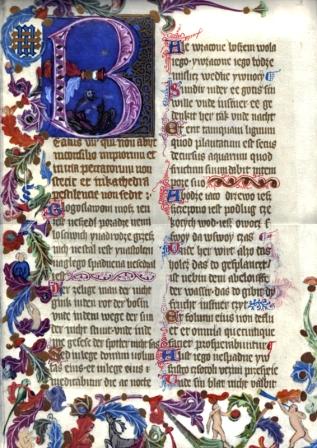
unless otherwise stated. The word "Psalms" is derived from the Greek, Ψαλμοί (Psalmoi), perhaps originally meaning "music of the lyre" or "songs sung to a harp," and, later, any piece of music. From "psallein", "play upon a stringed instrument", and, then, to "make music in any fashion". Psalm 2 is the second Psalm of the Bible. It tells us that people can either defy God and perish, or submit to Him and be Blessed.
Psalm 2 does not identify its author with a superscription, but Acts 4:24-26 in the New Testament clearly attributes it to David.
Thomas Tallis.
English composer (1505 - 1585).
Engraving by Niccolò Haym, after a portrait by Gerard van der Gucht.
The following Text, and the Text in the Headline, are taken from "The Book of Psalms (Liber Psalmorum)" (Douay-Rheims) (2008), published by Baronius Press.
PSALM 2. Quare fremuerunt. The vain efforts of persecutors against Christ and His Church. Quare fremuerunt gentes, et populi meditati sunt inania ? Astiterunt reges terrae, et principes convenerunt in unum adversus Dominum, et adversus christum ejus. Dirumpanus vincula eorum, et projiciamus a nobis jugum ipsorum. Qui habitat in caelis irridebit eos, et Dominus subsannabit eos. Tunc loquetor ad eos in ira sua, et in furore suo conturbabit eos. Ego autem constitutus sum rex ab eo super Sion, montem sanctum ejus, praedicans preaeceptum ejus. Dominus dixit ad me: Filius meus es tu; ego hodie genui te. Postula a me, et dabo tibi gentes haereditatem tuam, et possessionem tuam terminos terrae. Reges eos in virga ferrea, et tamquam vas figuli confringes eos. Et nunc, reges, intelligite; erudimini, qui judicatis terram. Servite Domino in timore, et exsultate ei cum tremore. Apprehendite disciplinam, nequando irascatur Dominus, et pereatis de via justa. Cum exarserit in brevi ira ejus, beati omnes qui confidunt in eo.
Why have the Gentiles raged, and the people devised vain things ?
The kings of the Earth stood up, and the princes met together,
against the Lord, and against His Christ.
Let us break their bonds asunder; and let us cast away
their yoke from us.
He that dwelleth in Heaven shall laugh at them: And
the Lord shall deride them.
Then shall He speak to them in His anger, and
trouble them in His rage.
But I am appointed king by Him over Sion His holy mountain,
preaching His commandment.
The Lord hath said to me: Thou art My Son, this day
have I begotten thee.
Ask of Me, and I will give thee the Gentiles for thy inheritance,
and the utmost parts of the Earth for thy possession.
Thou shalt rule them with a rod of iron, and shalt break them
in pieces like a potter's vessel.
And now, O ye kings, understand: Receive instruction, you
that judge the Earth.
Serve ye the Lord with fear: And rejoice unto Him with trembling.
Embrace discipline, lest at any time the Lord be angry,
and you perish from the just way.
When His wrath shall be kindled in a short time, blessed
are all they that trust in Him.
Psalm 3 is attributed to David, in particular, when he fled from Absalom, his son. David, deserted by his subjects, derided by Shimei, pursued for his crown and life by his ungracious son, turns to his God, makes his supplications, and confesses his Faith. The story of Absalom is found in 2 Samuel, Chapters 13-18.
Canticum David cum fugeret a facie Abessalon filii sui Domine quare multiplicati sunt hostes mei multi consurgunt adversus me multi dicunt animae meae non est salus huic in Deo semper tu autem Domine clipeus circa me gloria mea et exaltans caput meum voce mea ad Dominum clamabo et exaudiet me de monte sancto suo semper ego dormivi et soporatus sum evigilavi quia Dominus sustentavit me non timebo milia populi quae circumdederunt me surge Domine salvum me fac Deus meus quia percussisti omnium inimicorum meorum maxillam dentes impiorum confregisti Domini est salus super populum tuum benedictio tua semper.
A Psalm of David, when he fled from Absalom, his son
Lord, how are they increased that trouble me! many are they that rise up against me. Many there be which say of my soul, There is no help for him in God. Selah. But thou, O LORD, art a shield for me; my glory, and the lifter up of mine head. I cried unto the LORD with my voice, and he heard me out of his holy hill. Selah. I laid me down and slept; I awaked; for the LORD sustained me. I will not be afraid of ten thousands of people, that have set themselves against me round about. Arise, O LORD; save me, O my God: for thou hast smitten all mine enemies upon the cheek bone; thou hast broken the teeth of the ungodly. Salvation belongeth unto the LORD: thy blessing is upon thy people. Selah.
Frontispiece to the King James' Bible, 1611, shows the Twelve Apostles at the top. Moses and Aaron flank the central text. In the four corners sit Matthew, Mark, Luke, and John, authors of the four Gospels, with their symbolic animals. At the top, over the Holy Spirit in a form of a dove, is the Tetragrammaton "יהוה" ("YHWH").
The title page text reads:
THE HOLY BIBLE,
Conteyning the Old Teſtament,
AND THE NEW:
Newly Tranſlated out of the Originall tongues: & with the former Tranſlations diligently compared and reuiſed, by his Maiesties speciall Comandement.
Appointed to be read in Churches.
Imprinted at London by Robert Barker, Printer to the Kings moſt Excellent Maiestie.
ANNO DOM. 1611. At the bottom is "C. Boel ſecit in Richmont."
In Matthew Henry’s Concise Commentary, verse 1-3 represents David complaining to God of his enemies, and confiding in God. Verses 4-8 represents his triumphs over his fears, and giving God the glory, while taking to himself the comfort.
In Adam Clark's Commentary, verses 1-2 represents David's complaint, in great distress, of the number of his enemies, and the reproaches they cast on him, as one forsaken of God. Verse 3 represents as confidence, notwithstanding, that God will be his protector. Verse 4-5 mention David's prayers and supplications, and how God heard him. Verses 6-7 deride the impotent malice of his adversaries, and foretell their destruction. The final verse ascribes salvation to God.
Verse 1: Lord, how are they increased that trouble me? The hearts of all Israel went after Absalom (2 Samuel xv. 13), and David was astonished to find such a sudden and general revolt. Not only the common people, but his counsellors also, and many of his chief captains.
Verse 2: No help for him in God: one of many reproaches of his enemies. Shimei said: "Come out, come out, thou bloody man, and thou man of Belial: The LORD hath returned upon thee all the blood of the house of Saul, in whose stead thou hast reigned; and the LORD hath delivered the kingdom into the hand of Absalom thy son: and, behold, thou art taken in thy mischief, because thou art a bloody man." (2 Samuel xvi. 7-8) Such reproaches deeply affected David's heart, and he mentions them with that note which so frequently occurs in the Psalms, and occurs in Psalm 3 for the first time, 'selah', a word the Septuagint translate by diayalma diapsalma, "a pause in the Psalm." It either comes from ls sal, to raise or elevate, and may denote a particular elevation in the voices of the performers, which is very observable in the Jewish singing to the present day. It may come from hls salah, to strew or spread out, intimating that the subject to which the word is attached should be spread out, meditated on, and attentively considered by the reader.
Verse 3. Thou, O Lord art a shield: As a shield covers and defends the body from the strokes of an adversary, so wilt thou cover and defend me from them that rise up against me.The lifter up of mine head: Thou wilt restore me to the state from which my enemies have cast me down, as he speaks prophetically. He was satisfied that the deliverance would take place, hence his confidence in prayer; so that we find him, with comparative unconcern, laying himself down in his bed, expecting the sure protection of the Almighty.
Verse 4. I cried unto the Lord with my voice: Exposed to much danger, David had need of fervour. He heard me: Notwithstanding my enemies said, and my friends feared, that there was no help for me in my God. yet he heard me out of his holy hill. Selah: God never forsakes those who trust in him. He never shuts out the prayer of the distressed.
Verse 5. I laid me down and slept: He who knows that he has God for his Protector may go quietly and confidently to his bed, not fearing the violence of the fire, the edge of the sword, the designs of wicked men, nor the influence of malevolent spirits. I awaked: Though humanly speaking there was reason to fear I should have been murdered in my bed, as my most confidential servants had been corrupted by my rebellious son. yet God, my shield, protected me: I both slept and awaked; and my life is still whole in me.
Verse 6. I will not be afraid of ten thousands: Strength and numbers are nothing against the omnipotence of God. He who has made God his refuge certainly has no cause to fear.
Verse 7. Arise, O Lord: Though he knew that God had undertaken his defense, yet he knew that his continued protection depended on his continual prayer and faith. God never ceases to help as long as we pray. Thou hast smitten: That is, Thou wilt smite. David speaks in full confidence of God's interference; and knows as surely that he shall have the victory, as if he had it already. Breaking the jaws and the teeth are expressions which imply, confounding and destroying an adversary; treating him with extreme contempt; using him like a dog, etc.
Verse 8. Salvation belongeth unto the Lord: It is God alone who saves. He is the fountain whence help and salvation come; and to him alone the praise of all saved souls is due. His blessing is upon his people. Those who are saved from the power and the guilt of sin are his people. His mercy saved them; and it is by his blessing being continually upon them, that they continue to be saved. David adds his selah here also: 1. Salvation comes from God. 2. Salvation is continued by God.
Psalm 3 has been scored in music by many artists, including "Thou Art A Shield For Me", by Byron Cage, "Christian Karaoke Praise Song Psalm 3 worship", by Andrew Bain.
In the Eastern Orthodox Church, Psalm 3 is the first Psalm, of "The Six Psalms", which are read as part of every Orthros(Matins) Service. During the reading of the Six Psalms, movement and noise are strongly discouraged, as it is regarded as one of the most holy moments of the Orthros Service.
[This first Paragraph from Wikipedia, the free encyclopaedia.] The word "Psalms" is derived from the Greek, Ψαλμοί (Psalmoi), perhaps originally meaning "music of the lyre" or "songs sung to a harp," and, later, any piece of music. From "psallein" "play upon a stringed instrument" and, then, to "make music in any fashion".
The following Latin text is taken from the "Liber Psalmorum cum Canticis Breviarii Romani" (1945). The following English text is taken from "The Psalms and New Testament" (Douay-Rheims) (2007), published by Baronius Press. PSALM 1.
"BEATUS VIR".
The happiness of the Just and
the evil state of the wicked.
Beatus vir, qui non sequitur
consilium impiorum,
Et viam peccatorum non ingreditur,
et in conventu protervorum non sedet;
Sed in lege Domini voluptas eius est,
et de lege eius meditatur die ac nocte.
Et est tamquam arbor
plantata iuxta rivos aquarum,
Quae fructum praebet tempore suo,
cuiusque folia non marcescunt,
et quaecumque facit, prospere procedunt.
Non sic impii, non sic;
sed tamquam palea, quam dissipat ventus,
Ideo non consistent impii in iudicio,
neque peccatores in concilio iustorum,
Quoniam Dominus curat viam iustorum,
et via impiorum peribit.
Blessed is the man who hath not walked in the counsel of the ungodly,
nor stood in the way of sinners, nor sat in the chair of pestilence:
But his will is in the Law of the Lord,
and on His Law he shall mediate day and night.
And he shall be like a tree,
which is planted near the running waters,
which shall bring forth its fruit, in due season.
And his leaf shall not fall off:
And all whatsoever he shall do shall prosper.
Not so the wicked, no so:
But like the dust, which the wind driveth from the face of the Earth.
Therefore the wicked shall not rise again in judgment:
Please note: Zephyrinus will be Posting every day during Lent on the Lenten Stational Church for that day. It is humbly offered as an aid to every Reader's Lenten Journey of introspection, Penance, and Prayer.
Lenten Station Days were days of Fasting in the early Christian Church. The practice of keeping "Stations" died out during the Avignon papacy, but was revived by Pope Leo XIII and Pope John XXIII.
Pope Gregory the Great, 590 A.D. - 604 A.D., designated certain Churches in Rome as "stationes" and recommended that, on the more solemn festivals, they should be made Stations (stationes fieri) until the Hour of Sext, and at these same Churches on the appointed days (statis dicbus) the Faithful should assist at The Daily Office.
Today, they are Days associated with Processions to particular Churches in which the Faithful may gain certain Indulgences.
From as early as the 3rd-Century, the Church of Rome observed the Season of Lent by journeying each day, while singing the Litanies of the Saints, to a "Station Church" or one of the ancient and prominent Churches of Rome.
Basilica of Santa Maria Maggiore (Saint Mary Major). One of the Lenten Stations.
Photo: Taken by Jack Curran, December 2005. Original upload date: 7 January 2006.
Here the Bishop of Rome, the Holy Father, would lead the people in Prayer as they honoured the Holy Martyrs of Rome. The Holy Relics of the Saints are exposed on this day and the Holy Mass is celebrated. It is a Pilgrimage of Faith, a symbol of unity, and an incentive for us all to adhere more fully to the Gospel.
In the 6th-Century, Pope Saint Gregory I ("The Great"), 590 A.D. - 604 A.D., designated it as a Lenten Practice. Unfortunately, the custom ceased during the Avignon Papacy in 1305, but interest was revived by Pope Saint Leo XIII at the turn of the 20th-Century. Blessed Pope John XXIII fully restored the custom in 1959 and it continues to this day. As our Holy Father, Pope Benedict XVI, reminds us:
“These rites retain their value, despite the passing of centuries, because they recall how important it also is in our day to accept Jesus’ words without compromises: “If any man would come after me, let him deny himself and take up his Cross, daily, and follow me” (Lk 9:23) (Benedict XVI, Ash Wednesday Homily, 1 March 2006).
English: Basilica of Saint Paul Without The Walls, Rome, Italy. One of the Lenten Stations.
German: Rom, Sankt Paul vor den Mauern, San Paolo fuori le mura
Italiano: Statua di San Paolo di fronte alla facciata della
The following is the list of the Station Churches, as it was compiled in the time of Pope Saint Gregory I (6th-Century):
Patriarchal Basilicas:
S. Giovanni in Laterano, S. Pietro, S. Maria Maggiore, S. Paolo Fuori le Mura, S. Lorenzo Fuori le Mura;
Cardinalitial Titles:
S. Sisto; SS. Giovanni e Paolo, SS. Quattro Coronati, S. Clemente, S. Marcellino e Pietro, S. Pietro in Vincoli, S. Silvestro ai Monti, S. Prassede, S. Pudenziana, S. Eusebio, S. Vitale, S. Susanna, S. Ciriacos, S. Marcello, S. Lorenzo in Lucina, S. Lorenzo in Damaso, S. Marco, S. Anastasia, S. Nereo e Achilleo, S. Balbina, S. Sabina, S. Prisca, S. Maria in Trastevere, S. Cecilia, S. Crisogono;
Diaconates (those which had been Stations before they were Diaconates):
S. Nicolo in Carcere, SS. Cosma e Damiano, S. Maria in Via Lata, S. Maria in Porticu, S. Maria in Domnica.
Basilica of The Twelve Holy Apostles, Rome, Italy. One of the Lenten Stations.
The number of Stations is eighty-six, and, that of the Churches being less, some of them have the Station several times in the year. S. Sabina, the Station established by Pope Urban VIII for Ash Wednesday, is the most important of all because it was long customary for the Popes to repair thither on that day to distribute the Ashes to the people.
Persons desirous of gaining the Station Indulgences, first repair to a Church in the vicinity of the Station, in imitation of the ancient Collect, or gathering of the Clergy and the people, preparatory to the Procession.
In this Church, Prayers are recited from the Station Manual, consisting of invocations to the Blessed Virgin and the Martyrs. Then begins the journey to the Station, accompanied by the recitation of the Miserere, five Paters, the Ave and Gloria, and the steps of the Passion of Christ.
On arrival at the Station Church, the Litany of the Saints is said with versicles and Prayers, ending with the "De Profundis". The Pope grants dispensations to all who are unable to go in person to the Stations, such as Cloistered Religious, prisoners, the sick, etc., who are free to visit their own Church and say the Prayers prescribed.
Cardinals and their attendants and Prelates of the Papal Court may gain the Station Indulgence by reciting certain Prayers in their Oratory. These Prayers are printed annually and distributed to the Cardinals and Prelates, who assist at the first Sistine Chapel of Lent.
BURNICRON in Etudes, CIV (Paris, 1905), 205-24.
H. LECLERCQ.
Basilica of Saint John Lateran, Rome, Italy. One of the Lenten Stations.
Text is taken from The Saint Andrew Daily Missal. Illustrations, unless stated otherwise, are taken from The Saint Andrew Daily Missal at UNA VOCE OF ORANGE COUNTY
Quinquagesima Sunday. Station at Saint Peter's Basilica, Rome. Semi-Double. Privilege of the Second Class. Violet Vestments.
Jesus said to him: "Receive thy sight, thy faith hath made thee whole".
In the same way that the first three Prophecies of Holy Saturday, with their accompanying Prayers, are concerned with Adam, Noah and Abraham, so, during the Septuagesima Season, our attention is called in Missal and Breviary to these same Patriarchs, known respectively by the Church as the father of the human race, the father of future generations and the father of those who believe.
Adam, Noah and Abraham were types of Christ in the Paschal Mystery, a fact which we have already shown to be true in the case of the first two, in our notes on Septuagesima Sunday and Sexagesima Sunday. That it is true of Abraham, also, we shall see today.
In the Ambrosian Liturgy, Passion Sunday was called "Abraham's Sunday" and the "Response of Abraham" was read in the Office for that day; in the Roman Liturgy, also, he is still the subject of the Gospel for Passion Sunday.
Esto mihi in Deum protectorem, et in locum refugii,
ut salvum me facias: quoniam firmamentum meum,
et refugium meum es tu: et propter nomen
tuum dux mihi eris,
et enutries me.
Ps. In te, Domine, speravi, non confundar in aeternum:
in iustitia tua libera me, et eripe me.
V. Gloria Patri.
"Abraham, your father", says Our Lord, "rejoiced that he might see My day, he saw it and was glad
. . . Amen, Amen, I say to you, before Abraham was made, I am". God had indeed promised Abraham that the Messias should descend from him, and he was overwhelmed with great joy, when, by Faith, he contemplated beforehand the day of the Redeemer's coming.
Again, when this was fulfilled, he still contemplated it with a fresh joy in Limbo, where he was waiting, with the Just Men of the Old Law, for Jesus to come and deliver them after His Passion. When the three weeks of the Septuagesima Season were added to Lent, Quinquagesima became the Sunday on which the Liturgy is devoted to Abraham, so that, in the Lessons and Responses for today, the whole history of the Patriarch is described.
With the desire of forming a people, who should be specially His own in the midst of the idolatrous nations of the world (Gradual and Tract), Almighty God chose Abraham as its Head and gave him his name, which means father of many nations. "And He took him from Ur, in Chaldee, and kept him from harm in all his wanderings" [Prayers taken from the Rituale Romanum, for the Recommendation of a Soul, and before a journey].
A man is not saved by being a son of Abraham, according to the flesh, but by being Abraham's son by means of a Faith like his. So Saint Paul writes: "In Christ Jesus, neither circumcision (to be a Jew) availeth anything, nor uncircumcision (to be a Gentile), but a new creature". "Walk in love, as Christ also hath loved us, and hath delivered Himself for us, an oblation and a sacrifice to God for an odour of sweetness".
If the custom of allowing ourselves a little relaxation of spirit, before undertaking the Lenten Penance which binds us all, is of Liturgical origin, let us not forget that the Church condemns all excess. To atone, therefore, for those sins that are committed, let us make a Solemn Adoration of the Blessed Sacrament, besides saying this Prayer of Reconciliation known as the Forty Hours' Prayer, which was instituted, either, by Saint Anthony-Mary Zaccaria († 1539), or by the Capuchin Father, Joseph Piantanida da Fermo (about 1636), a Prayer richly Indulgenced by Pope Clement XIII (1765).
The Forty Hours' Devotion originated from the Forty Hours that Jesus passed in the tomb. Exposition of the Blessed Sacrament was included but at a later date, and regulated by Pope Clement XI, in 1705.
Every Parish Priest celebrates Mass for the people of his Parish.
The Seminarians of the European Seminary of the Priestly Fraternity of Saint Peter (FSSP), in Wigratzbad, Bavaria, visited one of the most glorious Abbatial Churches in the world, in Ottobeuren, Bavaria, Germany, for the Feast of the Chair of Saint Peter.
Josquin des Prez (or Josquin Lebloitte dit Desprez; 1450/1455 – 1521), often referred to simply as Josquin, was a Netherlands composer of the Renaissance. He is also known as Josquin Desprez and Latinised as Josquinus Pratensis, alternatively Jodocus Pratensis. He himself spelled his name "Josquin des Prez" in an acrostic in his motet Illibata Dei virgo nutrix. He was the most famous European composer between Guillaume Dufay and Palestrina, and is usually considered to be the central figure of the Franco-Flemish School. Josquin is widely considered by music scholars to be the first Master of the High Renaissance style of polyphonic vocal music
Sexagesima Sunday. Station at Saint Paul-without-the-Walls. Semi-Double. Privilege of the Second Class. Violet Vestments.
The Seed is the Word of God.
As on Septuagesima Sunday, and on those which follow until Passion Sunday, the Church teaches us "to celebrate the Paschal Sacrament" by "the Scriptures of both Testaments" (Prayer of Holy Saturday after the Seventh Prophecy).
Through the whole of this week, the Divine Office is full of the thought of Noah. God, seeing man's wickedness was great upon the Earth, said: "I will destroy man, whom I have created"; and He told Noah: "I will establish my Covenant with thee and thou shalt enter into the Ark."
For forty days and forty nights rain fell on the Earth, while the Ark floated on the waters which rose above the mountain tops and covered them; and in this whirlpool all men were carried away "like stubble" (Gradual); only Noah and his companions in the Ark remaining alive.
Then, God remembered them, and, at length, the rain ceased. After some time, Noah opened the window of the Ark and set free a dove, which returned with a fresh olive leaf, and Noah understood that the waters no longer covered the Earth.
And God told him: "Go out of the Ark, thou and thy wife, thy sons and the wives of thy sons, with thee" (Communion). And the rainbow appeared as a sign of reconciliation between God and men.
That Noah's story is related to the Paschal Mystery is shown by the fact that the Church reads it on Holy Saturday [Second Prophecy); and this is how she, herself, applies it, in the Liturgy, to Our Lord and His Church. "The just wrath of the Creator drowned the guilty world in the vengeful waters of the Flood, only Noah being saved in the Ark.
But then the admirable power of love laved (washed) the world in blood" [Hymns for the Feast of the Precious Blood]. It was the wood of the Ark, which saved the human race, and it is that of the Cross, which, in its turn, saves the world.
"Thou, alone," says the Church, speaking of the Cross, "hast been found worthy to be, for this shipwrecked world, the Ark which brings safely into port" [Hymn at Lauds in Passiontide]. "The open door in the side of the Ark, by which those enter who are to escape from the Flood, and who represent the Church, are, as is explained in the Liturgy, a type of the Mystery of Redemption; for, on the Cross, Our Lord had His Sacred Side open and, from this gate of life, went forth the Sacraments, giving true life to Souls. Indeed, the Blood and Water, which flow from thence, are symbols of the Eucharist and of Holy Baptism" [Lessons from Saint Chrysostom and Saint Augustine, Matins of the Feast of The Precious Blood].
"O God, Who by water didst wash away the crimes of the guilty world, and by the overflowing of the deluge didst give a figure of regeneration, that one and the same element might, in a Mystery, be the end of vice and the origin of virtue: Look, O Lord, on the face of Thy Church and multiply in her Thy regenerations, opening the fonts of Baptism all over the world for the renovation of the Gentiles" [Blessing of the Baptismal Font on Holy Saturday].
"In the days of Noah," says Saint Peter, "eight Souls were saved by water, whereunto Baptism, being of the like form, now saveth you also."
On Maundy Thursday, when the Bishop Blesses the Holy Oil from the olive tree, which is to be used for the Sacraments, he says: "When of old, the crimes of the world were atoned for by the waters of the Flood, a dove, foreshadowing the gift to come, announced by an olive branch, the return of peace to the Earth.
And this indeed is made clear by its effects in latter times: When the waters of Baptism, having washed away all guilt of sin, the unction of the oil makes us joyous and serene." The Blood of Christ is the blood of the New Covenant, which Almighty God has made with man, through His Son. "Thou," cries the Church, "Who, by an olive branch, didst command the dove to proclaim peace to the world."
Commovisti, Domine, terram . . .
The Tract for Sexagesima Sunday.
Gregorian Chant notation from the Liber Usualis (1961).
Peace is often mentioned in the Mass, which is the memorial of the Passion: "Pax Domini sit semper vobiscum." And we shall find the Collect for Easter Friday, speaking of the Paschal Sacrament, as the Seal of Reconciliation between God and man.
Above all, however, in his divinely-appointed mission as father of all succeeding generations, Noah is a figure of Christ [Sixth Lesson of Septuagesima Sunday]; he was truly the second father of the human race and he remains the type of life continually renewed. We are told in the Liturgy that the olive branch, by means of its foliage, is a symbol of the prosperous fertility bestowed by Almighty God upon Noah when he came forth from the Ark, and the Ark, itself, is called by Saint Ambrose, in today's Office, the "seminarium," or nursery, that is, the place containing the seed of life which is to fill the world.
Now, Christ, much more than Noah, was the second Adam, peopling the world with a race of believing Souls, faithful to God. On Holy Saturday, in the Prayer following the Second Prophecy, which is concerned with Noah, the Church humbly asks Almighty God to "peacefully effect," by His eternal decree, "the work of human salvation," and to "let the whole world experience and see that, what was fallen, is raised up; what was old, is made new," and that "all things are re-established, through Him from Whom they received their first being, Our Lord Jesus Christ".
It was through the Word that God made the world in the beginning (Last Gospel), and it is by the preaching of His Gospel that Our Lord came to bring men to a new birth. "Being born again," says Saint Peter, "not of corruptible seed, but incorruptible, by the Word of God, Who liveth and reigneth for ever . . . And this is the Word, which, by the Gospel, hath been preached unto you".
From this, we can see why today's Gospel is taken from the Parable of the Sower, for "the seed is the word of God". If, in Noah's days, men perished, Saint Paul tells us, it was because of their unbelief, while, at the same time, it was by Faith that Noah "framed the Ark . . . by the which he condemned the world, and was instituted heir of the justice which is by Faith".
In the same way, those who believe in Our Lord's words will be saved.
According to Saint Augustine's exposition, "as there were three floors in the Ark, so there are three different spiritual harvests". In today's Epistle, Saint Paul recounts all that he did and suffered in the course of preaching the Faith to the Gentiles and, indeed, he, the Apostle to the Gentiles, was the outstanding preacher of the world.
He is the "minister of Christ", that is, the one whom God had chosen to unfold to all nations the good news of the Incarnate Word. "Who will grant me", cries Saint John Chrysostom, "to walk around Saint Paul's body, to embrace his tomb, to behold the dust of that body which filled up what was lacking in Christ's sufferings, which bore the marks of his wounds, which everywhere spread abroad, like good seed, the preaching of the Gospel ? [In the Office for the Octave of Saint Peter and Saint Paul].
The Roman Church has fulfilled this desire, in the case of her own children, by making a Station on this day to the Basilica of Saint Paul-without-the-Walls. "Through the Church's Neophytes", we read in the Liturgy, "the Earth is renewed, and thus renewed, she brings forth fruit as it were from the dead ! [Easter Monday at Matins].


![Douay-Rheims & Clementina Vulgata [side-by-side] - Hardcover (Black Leather)](https://lh3.googleusercontent.com/blogger_img_proxy/AEn0k_v_TjQWBK39cNrVv2RZ-fz3glMKFweXKFMkE9GveLc4QinQnatvAJKOTIcG-BNmZd9j4flQZdTPiuK79rNOXPIhLslJvZNLXKGuAez-zW53MPqi=s0-d)