Notre Dame de Rouen. The façade of the Gothic Church in France. Photographer: Hippo1947. Licence: SHUTTERSTOCK.

19 April, 2014

Lenten Station At The Papal Arch-Basilica Of Saint John Lateran. Holy Saturday.


Roman Text is taken from The Saint Andrew Daily Missal.

Italic Text, Illustrations and Captions, are taken from Wikipedia - the free encyclopaedia,
unless otherwise stated.


Indulgence of 30 Years and 30 Quarantines.
Double of the First-Class.

Violet Vestments
      and White Vestments.


English: Papal Arch-Basilica of Saint John Lateran.
Latin: Archibasilica Sanctissimi Salvatoris 
et Sanctorum Iohannes Baptistae et Evangelistae in Laterano 
Omnium urbis et orbis ecclesiarum mater et caput.

English: Basilica of Saint John Lateran, Cathedral of the Bishop of Rome, Italy.
Italiano: Basilica di San Giovanni in Laterano, Roma.
Polski: Bazylika św. Jana na Lateranie (znana jako Bazylika Laterańska), 
katedra biskupa Rzymu, Włochy.
Photo: September 2005.
Source: Own work.
Author: Stefan Bauer, http://www.ferras.at.
(Wikimedia Commons)


The Station is at Saint John Lateran, the Mother Church of the Christian world, and it is here that the Church celebrated the First Mass of Easter and that, formerly, she received into her bosom the many Catechumens, who were Baptised on this day. First dedicated to our Blessed Saviour, this Basilica was subsequently Consecrated to Saint John the Baptist, with the Baptistry attached.

In former times, the Church held no special Service on this morning. Apart from any gathering for the Lenten Station, a Meeting was held in the course of the afternoon for the Seventh, and last, Scrutiny, which almost immediately preceded the Baptism. [It was at this gathering that the Rite of Exorcism took place, and the Rite of Ephpheta, which recalls the miracles worked by Jesus when He cured the deaf and dumb, and the Renunciation of Satan, pronounced by the Catechumen after being anointed with the Oil of Catechumens. He then recited the Symbol, a proceeding known as "the Rendering of the Symbol". We discover these Rites, again, in the present ceremonies of Baptism, following those that took place at the Third Scrutiny.]

At night, was held the Watch, or Solemn Vigil of Easter, towards the end of which, before daybreak, the Catechumens plunged in the water of the Baptistry and were, so to speak, buried with Jesus; and, at the very hour at which Christ rose triumphantly from the Sepulchre, they were born to the Life of Grace.

Later, the Great Ceremonies were Anticipated, being held first in the evening, and, subsequently, in the morning of Holy Saturday. They reveal a sudden change from sorrow to joy, and disclose certain anomalies which this notice helps to explain.


File:Lateran-north.jpg

English: The Lateran Palace (on the left) beside the Basilica of Saint John Lateran.
Deutsch: Das Bild zeigt den Lateranspalast und das Seitenportal der Lateransbasilika 
von der Piazza S. Giovanni in Laterano aus.
Italiano: Facciata laterale della Basilica di San Giovanni in Laterano (Roma)
con a sinistra il Palazzo Laterano.
Photo: September 2004.
Source: Own work.
Author: Maus-Trauden.
(Wikimedia Commons)


THE BLESSING OF THE NEW FIRE.

The Church, blessing, as she does, all elements of which she makes use for Divine Worship, made a practice of blessing, every evening, the new fire that was to provide the light for the Office of Vespers. The Liturgy of Holy Saturday maintains this custom. She also blesses the five grains of incense, which are to be fixed in the Paschal Candle, the offering of which to God will thenceforward be accepted as a sweet savour.

At a convenient hour, the Altars are covered with Linen Cloths, but the Candles are not lighted until the beginning of Mass. Meanwhile, fire is struck from a flint outside the Church and the coals are kindled. At the end of None, the Priest, vested in Amice, Alb, Girdle, and Stole, to which he adds, if possible, a Violet Cope, accompanied by his Ministers, with Processional Cross, Holy Water and Incense, goes outside the Church Door, and blesses the new fire.

THE BLESSING OF THE PASCHAL CANDLE.

The Celebrant goes up to the Epistle side of the Altar, and the Deacon, giving the Reed to an Acolyte, takes the Book and asks a blessing of the Priest.

The Deacon then goes to the Lectern, puts down the Book and incenses it. At his right-hand, stand the Sub-Deacon, with the Cross, and the Thurifer; at his left, the two Acolytes, one holding the Reed and the other the vessel containing the five blessed grains of incense, to be set in the Paschal Candle.


File:Latran intérieur.jpg

The Cloisters
of the Basilica of Saint John Lateran,
Rome, Italy.
Photo: May 2005.
Source: Own work.
Author: Briséis.
(Wikimedia Commons)


All rise and stand, as at the Gospel, and the Deacon sings the Exsultet, in which the Church expounds the beautiful symbolic meaning of the Paschal Candle. He sings of the night of happy memory, which witnessed the escape of the Children of Israel from Egypt, conducted by a Pillar of Fire illumined with the splendour of Christ. When the Exsultet has been sung, the Deacon fixes the five blessed grains of incense in the Paschal Candle, in the form of a Cross.

THE PROPHECIES.

After the Blessing of the Paschal Candle, the Deacon lays aside his White Dalmatic and puts on a Violet Stole and Violet Maniple. He then goes to the Celebrant, who, after laying aside his Cope, puts on a Violet Maniple and Violet Chasuble. The Prophecies are then chanted, by the Cantors, without any introduction, while the Priest, standing on the Epistle side of the Altar, reads them in a low voice.

The Reading of the Twelve Prophecies served the object, formerly, of a final initiation of the Catechumens.


File:Roma-san giovanni cloister.jpg

English: Cloisters of the Basilica of Saint John Lateran, Rome.
Italiano: Chiostro della Basilica di San Giovanni in Laterano, Roma, Italy.
Photo: October 2005.
Source: Flickr.
Author: Ern.
Reviewer: Mac9.
(Wikimedia Commons)


THE BLESSING OF THE FONT.

In earlier times, the Clergy, at this point, went to the Baptistry of the Lateran, where the Sovereign Pontiff blessed, by virtue of the Cross, the water that was to be used for the Baptism. The Paschal Candle, which he dipped three times into it, recalled to mind the incident of the Baptism of Jesus in the Jordan, whereby He sanctified the water and imparted to it the power of regeneration.

The Catechumens were then questioned, for the last time, on the Creed, were Baptised and then Confirmed, and the white garments, in which they were then clothed, became the mystical robe which entitled them to sit at the Holy Table and make their First Communion.

At the end of the Reading of the Prophecies, if there is a Baptismal Font in the Church, the Priest, who is about to bless it, puts on a Violet Cope and, preceded by the Processional Cross, the Candelabra and the lighted Blessed Candle, goes to the Font with his Ministers and the Clergy, while the Tract is sung.

THE LITANY OF THE SAINTS.

As the Priest and his Ministers return to the Altar, after the Blessing of the Font, two Cantors begin to sing the Litany of the Saints.

At the Invocation, Peccatores, te rogamus, audi nos, the Priest and his Ministers go into the Sacristy, where they vest in White Vestments for the Solemn Celebration of Mass. Meanwhile, the Candles are lighted on the Altar.


English: Basilica of Saint John Lateran, Rome.
With its length of 400 feet, this Basilica ranks fifteenth among the largest Churches in the world.
Français: Basilique Saint-Jean-de-Latran, Vatican, située à Rome, Latium, Italie. Avec sa longueur de 121,84 mètres, cette Basilique se classe au 15è rang parmi les plus grandes églises au monde.
Photo: September 2010.
Source: Own work.
Author: Tango7174.
(Wikimedia Commons)


MASS AND VESPERS.

During the singing of the Litany, the Neophytes re-entered the Church, and the Mass was begun, which inaugurated the Solemn Services of Easter (Secret). This celebrates the glory of the Risen Christ (Gospel), and that of the Souls who, through Baptism, have entered on a new life, a pledge of their future resurrection (Epistle, Collect, Hanc igutur). Hence, the joyful Alleluia that is sung, the pealing of the Organ and the ringing of the Bells.

The Vespers, which follow the Communion, remind us of the Holy Women, who were the first to realise the great Mystery of the Resurrection.

Let us show our gratitude to God for the Sacraments of Baptism, Confirmation, and the Holy Eucharist, which have made it possible for us to pass with Jesus from the Death of Sin to the Life of Grace.


File:Roma-san giovanni03.jpg

The Pope's Seat,
Basilica di San Giovanni in Laterano,
Roma, Italy.
Photo: October 2005.
Source: Flickr.
Author: Ern.
Reviewer: Mac9.
(Wikimedia Commons)


At the end of the Litany, the Cantors sing the Solemn Kyrie eleison, Christe eleison, Kyrie eleison, each invocation being repeated thrice. Meanwhile, the Priest, attended by his Ministers, all in White Vestments, goes to the Altar, recites the Judica me, adding the Gloria Patri, and makes the Confession in the usual way. Then, ascending the steps, he kisses the Altar, incenses it and, as soon as the Choir have finished the Kyrie eleison, he intones the Gloria in Excelsis Deo; the Organ is played and the Bells are rung.

During the Mass, the Agnus Dei is omitted and, instead of a Communion Antiphon, the Choir sings Vespers.

During Vespers, the Chapter, Hymn and Verse are omitted.

During the Magnificat, the Altar is incensed, as at Solemn Vespers.


File:Basilica st Giovani in Laterano 2011 10.jpg

English: Saint James-the-Less.
By Angelo de' Rossi
Nave of the Basilica of Saint John Lateran,
Rome, Italy.
Česky: Socha Sv. Jana Menšího z dílny Angela de' Rossiho z 
Photo: April 2011.
Source: Own work.
Author: Karelj.
(Wikimedia Commons)


At the Dismissal, at the end of Mass, the Deacon, turning towards the people, says: "Ite Missa est, alleluia, alleluia". This double alleluia is added to the Ite Missa est until Easter Saturday, inclusive.

The Mass ends, as usual, with the "Placeat", the Blessing, and the Last Gospel.

PASCHALTIDE.

Paschaltide, extending from Easter Sunday to Saturday after Pentecost, commemorates the Three Glorious Mysteries of the Resurrection of Our Lord (celebrated during forty days), of His Ascension (during ten days) and of the Descent of The Holy Ghost (during the Octave of Pentecost).

Therefore, the Doctrinal, Historical and Liturgical Notes for Paschaltide, in the Saint Andrew Daily Missal, will be given in Three Parts, respectively, before each one of the Feast of Easter, the Feast of Ascension Day and the Feast of Pentecost.


18 April, 2014

Ave Maria. Olga Szyrowa (Soprano). 2004. Pasja / The Passion Of The Christ. How Not To Love You, Maria (Diana Navarro - "Mare Mine" In Latin And Spanish).


Illustration from


Ave Maria.
Olga Szyrowa (Soprano).
Pasja / The Passion of the Christ.
2004.
Available on YouTube at
http://youtu.be/Gq5yf0DA8p8

Ave Maria - Olga Szyrowa (Sopran) (M.Lorenc) ścieżka dźwiękowa z film - Prowokator Fragmenty z filmu Mela Gibsona - Pasja / Passion of the Christ, The (2004).

Ave Maria performed by the Russian opera singer, Olga Szyrowa.

The soundtrack comes from the Polish movie, Prowokator (1995).

Composer of all songs for the movie is Michał Lorenc.


How not to love you, Maria

(Diana Navarro - "Mare mine" in Latin and Spanish).
Available on YouTube at

Good Friday. Stabat Mater.


Stabat Mater
(The Mother Stood)
is the Sequence for the Mass of 15 September,
the Mass of the Seven Sorrows of The Blessed Virgin Mary.
It recounts The Blessed Virgin Mary's heartbreak on Good Friday,
when standing at the foot of the Cross,
whilst her Son, Jesus Christ, hung on that infamous gibbet.


Stabat Mater.
Pergolesi.
Kathleen Ferrier (1946).
Available on YouTube at
http://youtu.be/lQlDaHLP15U.


Stabat Mater dolorosa,
Juxta crucem lacrimosa,
Dum pendebat Filius.

At the Cross, her Station keeping,
Stood the mournful Mother weeping,
Close to Jesus to the last.

Cujus animam gementem,
Contristatam et dolentem,
Pertransivit gladius.

Through her heart, His sorrow sharing,
All His bitter anguish bearing,
Now at length the sword had passed.

O quam tristis et afflicta,
Fuit illa benedicta,
Mater Unigeniti !

Oh, how sad and sore distress'd,
Was that Mother, highly blest
Of the sole-begotten One !

Quae maerebat, et dolebat,
Pia Mater dum videbat
Nati poenas inclyti.

Christ above in torment hangs;
She beneath beholds the pangs
Of her dying glorious Son.


Quis est homo, qui non fleret,
Matrem Christi si videret
In tanto supplicio ?

Is there one who would not weep
Whelm'd in miseries so deep
Christ's dear Mother to behold ?

Quis non posset contristari,
Christi Matrem contemplari
Dolentem cum Filio ?

Can the human heart refrain
From partaking in her pain,
In that Mother's pain untold ?

Pro peccatis suae gentis
Vidit Jesum in tormentis
Et flagellis subditum.

Bruis'd, derided, curs'd, defil'd,
She beheld her tender child:
All with bloody scourges rent.

Vidit suum dulcem natum
Moriendo desolatum,
Dum emisit spiritum.

For the sins of His own nation,
Saw Him hang in desolation,
'Til His spirit forth He sent.


Eia Mater, fons amoris,
Me sentire vim doloris
Fac, ut tecum lugeam.

O thou Mother, fount of love !
Touch my spirit from above;
Make my heart with thine accord.

Fac ut ardeat cor meum
In amando Christum Deum,
Ut sibi complaceam.

Make me feel as thou hast felt;
Make my soul to glow and melt
With the love of Christ Our Lord.

Sancta Mater, istud agas,
Crucifixi fige plagas
Cordi meo valide.

Holy Mother ! Pierce me through;
In my heart each wound renew
Of my Saviour crucified.

Tui nati vulnerati,
Tam dignati pro me pati,
Poenas mecum divide.

Let me share with thee His pain,
Who for all my sins was slain,
Who for me in torments died.


Fac me tecum pie flere,
Crucifixo condolere,
Donec ego vixero.

Let me mingle tears with thee,
Mourning Him who mourn'd for me,
All the days that I may live.

Juxta crucem tecum stare,
Et me tibi sociare
In planctu desidero.

By the Cross with thee to stay,
There with thee to weep and pray,
Is all I ask of thee to give.

Virgo virginum praeclara,
Mihi jam non sis amara:
Fac me tecum plangere.

Virgin of all virgins best,
Listen to my fond request:
Let me share thy grief divine.

Fac ut portem Christi mortem,
Passionis fac consortem,
Et plagas recolere.

Let me, to my latest breath,
In my body bear the death
Of that dying Son of thine.


Fac me plagis vulnerati
Fac me cruce inebriari,
Et cruore Filii.

Wounded with his every wound,
Steep my soul 'til it hath swoon'd
In His very blood away.

Flammis ne urar succensus,
Per te, Virgo, sim defensus,
In die judicii.

Be to me, O Virgin, nigh,
Lest in flames I burn and die,
In His awful Judgment Day.

Christe, cum sit hinc exire,
Da per Matrem me venire
Ad palmam victoriae.

Christ, when Thou shalt call me hence,
Be Thy Mother my defence,
Be Thy Cross my victory.

Quando corpus morietur,
Fac ut animae donetur
Paradisi gloria.

Amen. Alleluia.

While my body here decays,
May my Soul Thy goodness praise,
Safe in Paradise with Thee.

Amen. Alleluia.

Good Friday. Church Of The Nativity Of Mary, Hoechberg, Germany.


File:Höchberg, Pfarrkirche Mariä Geburt 009.JPG

(Church of the Nativity of Mary)
Hochberg, Bavaria,
Germany.
Photo: 15 September 2012.
Source: Own work.
Author: Mattana.
(Wikimedia Commons)


File:Mariae Geburt.jpg

Deutsch: Pfarrkirche Mariae Geburt in Hoechberg.
English: Parish Church of The Nativity of Mary,
Hoechberg, Germany.
Photo: 18 July 2007.
Source: Own work.
Author: Paul Kordwig post.eingang.
(Wikimedia Commons)

The Parish Church of the Nativity of Mary is a Catholic Pilgrimage Church,
in Hochberg ( Lower Franconia, Bavaria, Germany).
The present appearance of the Church
occurred during the last renovation and expansion projects in 1909.
The conspicuous neo-Gothic Church overlooks the village of Altortes, Hochberg.


File:Mariae Geburt innen.jpg

Deutsch: Blick in den Innenraum der Pfarrkirche
Mariä Geburt (Hoechberg).
English: Interior of the Parish Church of
The Nativity of Mary,
Hoechberg, Germany.
Photo: 2 July 2009.
Source: Own work.
Author: Paul Kordwig (post.eingang).
The original uploader was Post.eingang at German Wikipedia.
(Wikimedia Commons)


File:Hoechberg mariae geburt.JPG

English: Church of The Nativity of Mary,
Hoechberg, Germany.
Deutsch: Blick auf die Pfarrkirche Mariä Geburt
in Höchberg.
Photo: 26 December 2008.
Source: Own work.
Author: Post.eingang.
(Wikimedia Commons)


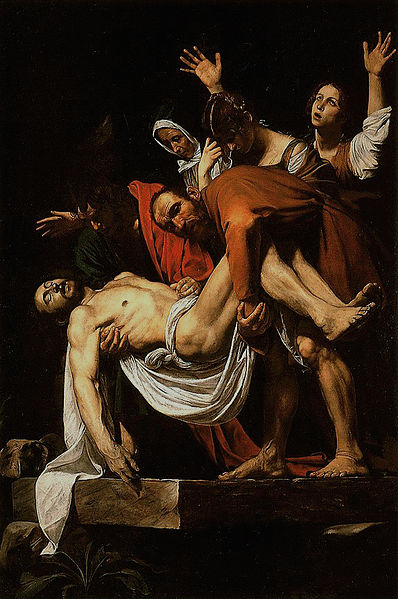
The Entombment Of Christ. Good Friday. Caravaggio.


English: The Entombment of Christ, (1602–1603).
Italiano: La Deposizione di Cristo.
Artist: Caravaggio.
Current location: Pinacoteca Vaticana, Rome.
Photo: May 2010.
Source: Own work.
Author: Lafit86.
(Wikimedia Commons)


Lenten Station At The Basilica Of The Holy Cross In Jerusalem. Good Friday.


Roman Text is taken from The Saint Andrew Daily Missal.

Italic Text, Illustrations and Captions, are taken from Wikipedia - the free encyclopaedia,
unless otherwise stated.


Indulgence of 30 Years and 30 Quarantines.
Double of the First-Class.

Black Vestments.


English: Basilica of The Holy Cross in Jerusalem.
Italian: Basilica di Santa Croce in Gerusalemme.
Latin: Basilica Sanctae Crucis in Hierusalem.

Santa Croce in Gerusalemme (Rome). 
One of the masterpieces of the "barochetto romano" by 
Pietro Passalacqua and Domenico Gregorini, from 1743.
Photo: February 2006.
Author: Anthony M. from Rome, Italy.
(Wikimedia Commons)


The Lenten Station is at the Basilica, which, in Rome, represents Jerusalem, whose name it bears. It is Consecrated to Our Redeemer's Passion and contains earth from Calvary, some important fragments of the True Cross, and one of the Nails used in the Crucifixion of Our Lord.

On this day, the anniversary of Our Saviour's death, the Church gives her Temples an appearance of desolation, and clothes her Ministers in the garb of mourning.

THE MASS OF THE CATECHUMENS.

The first part of today's Liturgy recalls the gatherings that took place in the Synagogues on the Sabbath Day. The first Christian communities, composed as they were of convert Jews, took these assemblies as their model, at the same time subjecting them to necessary modifications, especially by early associating them with the Liturgy of the Eucharistic Sacrifice.


File:Santa Croce in Gerusalemme nave painting.jpg

Santa Croce in Gerusalemme,
Rome, Italy.
Painting by Corrado Giaquinto, from 1744. 
"The Virgin presents Saint Helena and Emperor Constantine to the Trinity".
Photo: February 2006.
Author: Anthony M. from Rome, Italy.
(Wikimedia Commons)


It is in the Mass of the Catechumens that these are told that the mercies of God are soon to descend on the Christian people, just as chastisement will fall on the faithless nations, Ephraim and Juda; for, at the very moment when the multitude of the Children of Israel will be offering the Paschal Lamb (Second Lesson), the Jews will be putting to death the Lamb of God on the Cross. This death is described for us in the story of Our Lord's Passion according to Saint John.

None having been said in Choir, the Celebrant and the Sacred Ministers, in Black Vestments and without Lights or Incense, come before the Altar, where they prostrate themselves and Pray for some moments.

Meanwhile, the Acolytes spread a single Altar-Cloth upon the Altar. The Celebrant and the Ministers, having finished Praying, go up the steps to the Altar, which the Celebrant kisses, as usual, in the middle, afterwards going to the Epistle side. After this, a Reader, in the place where the Epistle is read, begins the First Lesson in the Tone of the Prophesies.


Portrait of Pope Urban VIII.
Artist: Gian Lorenzo Bernini (1598–1680).
Date: Circa 1625.
Current Location: Galleria Nazionale d'Arte Antica, Rome.
Note: Housed in the Salon of Pietro da Cortona of the Palazzo Barberini.
Source/Photographer: Villas et palais de Rome de Carlo Cresti et Claudio
Rendina, photographies de Massimo Listri, traduction de l'italien par
Jean-Philippe Follet. Paris : Mengès, novembre 1998, p. 308.
ISBN 9782856204092 / Oxxo.
(Wikimedia Commons)

Pope Urban VIII (Papacy 1623 - 1644)
A large piece of The Cross was taken from 
Santa Croce in Gerusalemme, Rome,
to Saint Peter's Basilicaon the instructions of
Pope Urban VIII, in 1629.


THE PASSION OF OUR LORD ACCORDING TO SAINT JOHN.

The drama of The Passion is universal and, in one sense, will end only with the world itself, for all men, by their sins, have taken a share in the death of Christ. Jesus was bound to triumph through those very atoning sufferings, by which He became the Victim of every passion which shall agitate the human race until the end of the world.

For He has atoned for the pride of those who share the hatred of truth, which turned the Jews into murderers: the avarice of those who are possessed by the demon of greed, which drove Judas to sell his master; the lust of all who indulge in sensual delights, like Herod, who mocked Jesus and sent Him back to Pilate; the cruelty of those who love to cause suffering, like the soldiers who struck Our Lord and insulted Him; and the cowardice of all who leave the path of duty, like the Apostles, who forsook Him, to whom they owed everything.

Our Lord's Passion is the whole of humanity, hurling itself upon its Divine Healer, and yet cured by Him; yet, also, it is the anointed of God, the King of Martyrs, who, in face of all the generations who persecute Him, and before the whole world, offers to His Father a supreme token of submission, that of Blood, itself.

Christ on the Cross ! What a model of death to all our sins, of resistance to every temptation, of warfare against all evil-doers, and of the testimony which we, in our turn, ought to render to God, even, if necessary, at the cost of our very life.


English: Coat-of-Arms of Pope Urban VIII.
Français: Armoiries du pape Urbain VIII : d'azur à trois abeilles d'or posées 2 et 1.
Date: August 2008.
Source: Own work.
Author: Odejea.
(Wikimedia Commons)


THE  SOLEMN  PRAYERS.

In the second part of today's Liturgy, we have a relic of Prayers which were also a feature of the primitive gatherings previously mentioned. Of these Prayers, the only trace existing in the Roman Mass is the Oremus, said before the Offertory.

These Liturgical Prayers show us that the effects of Our Lord's death extend to all necessities of the Church and of the human race. They even foresee the conversion of the deicide race, who will one day recognise that Jesus is the Messias.


Imaginary portrait of Pope Gregory I
(After Carlo Saraceni (1579–1620))
or Workshop of Carlo Saraceni (1579–1620).
Date: Circa 1610.
Current Location: Galleria Nazionale d'Arte Antica, Rome.
Source/Photographer: Galleria Nazionale d'Arte Antica, Rome; 
(Uploaded using CommonsHelper or PushForCommons)
This Image: July 2007.
User: Helix84.
(Wikimedia Commons)

Pope Gregory I (Papacy 590 A.D. - 604 A.D.).
Ordered the construction of the Basilica's Museum.


THE  ADORATION  OF  THE  CROSS.

This ceremony owes its origin to a custom which prevailed at Jerusalem in the 4th-Century, of venerating, on this day, the wood of the True Cross. Meanwhile, the Improperia, or tender reproaches of Christ to His people, to whom He had done nothing but good, were sung in Greek, which language was still partly in use in the Mass of every day.

When the Prayers are finished, the Celebrant takes off the Chasuble and he unveils the Cross, singing the words: "Ecce Lignum Crucis" - Behold the wood of the Cross. Thence begins the Adoration of the Cross by the Celebrant, Ministers and the people, during which the Choir sing "The Reproaches".

THE MASS OF THE PRE-SANCTIFIED.

Good Friday, being the anniversary of Our Lord's death, there stands out before the whole world, the blood-stained throne of the Cross from which the God-Man reigns. The Church does not celebrate the Holy Mass, which is the memorial of that of the Cross; she contents herself with consuming the Sacred Species, previously Consecrated; which, in the Greek Rite, is the daily practice during Lent, except on Saturdays and Sundays. From this, comes the name "Mass of the Pre-Sanctified", since the Offerings are Sanctified (Consecrated), previously.

VESPERS FOR GOOD FRIDAY.

There follows Vespers, which are the same as for Vespers on Maundy Thursday.


17 April, 2014

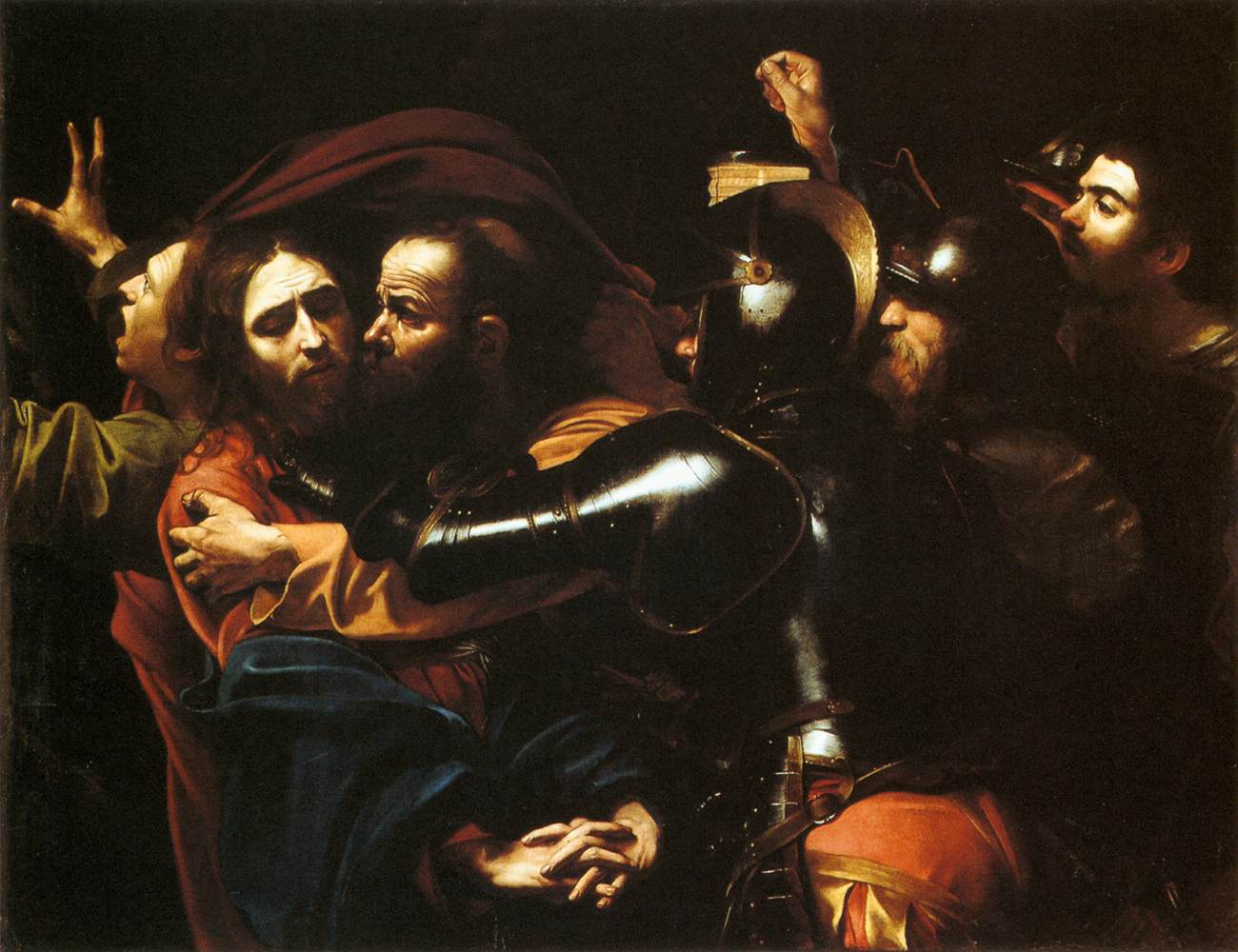
The Taking Of Christ. Maundy Thursday. Caravaggio.


File:Caravaggio - Taking of Christ - Dublin.jpg

English: The Taking of Christ.
Deutsch: Die Festnahme Christi.
Artist: Caravaggio (1573 - 1610).
Date: Circa 1598.
Current location: National Gallery of Ireland,
Dublin, Ireland.
Notes: English: Also known as "The Judas Kiss".
Notes: Deutsch: Auch bekannt als „Der Judaskuss“. Es existieren mehrere zeitgenössische Kopien des Werkes, unter Anderen die in Odessa befindliche und zwischenzeitlich gestohlene Version File:Caravaggio - Taking of Christ - Odessa.jpg.
Source/Photographer: Web Gallery of Art: Image Info about artwork.
(Wikimedia Commons)

The Taking of Christ, National Gallery of Ireland, Dublin. Caravaggio's application of the chiaroscuro technique shows through on the faces and armour, notwithstanding the lack of a visible shaft of light. The figure on the extreme right is a self-portrait.


The Denial Of Saint Peter. Maundy Thursday. Caravaggio.


File:The Denial of Saint Peter-Caravaggio (1610).jpg

English: The Denial of Saint Peter.
Polski: Zaparcie się św. Piotra.
Artist: Caravaggio (1573–1610).
Date: Circa 1610.
Current location: Metropolitan Museum of Art
New York City, U.S.A.
Source/Photographer: Scan.
Photo: May 2011.
User: Masur.
(Wikimedia Commons)


Lenten Station At The Papal Arch-Basilica Of Saint John Lateran. Maundy Thursday.


Roman Text is taken from The Saint Andrew Daily Missal.

Italic Text, Illustrations and Captions, are taken from Wikipedia - the free encyclopaedia,
unless otherwise stated.


Plenary Indulgence.
Double of the First-Class.

White Vestments at Mass.


File:San Giovanni Laterano Rom.jpg

English: Papal Arch-Basilica of Saint John Lateran.
Latin: Archibasilica Sanctissimi Salvatoris 
et Sanctorum Iohannes Baptistae et Evangelistae in Laterano
Omnium urbis et orbis ecclesiarum mater et caput.

English: Basilica of Saint John Lateran, Cathedral of the Bishop of Rome, Italy.
Italiano: Basilica di San Giovanni in Laterano, Roma.
Polski: Bazylika św. Jana na Lateranie (znana jako Bazylika Laterańska), 
katedra biskupa Rzymu, Włochy.
Photo: September 2005.
Source: Own work.
Author: Stefan Bauer, http://www.ferras.at.
(Wikimedia Commons)


The Lenten Station was formerly held at Saint John Lateran, which was originally called the Basilica of Saint Saviour.

The Liturgy of Maundy Thursday is full of memories of the Redemption. It formerly provided for the celebration of three Masses: The first Mass for the reconciliation of public penitents; The second Mass for the Consecration of the Holy Oils; The third Mass for a special Commemoration of the institution of the Holy Eucharist at the Last Supper. This last Mass is the only one that has been preserved, and, at it, the Bishop, attended by twelve Priests, seven Deacons and seven Sub-Deacons, blesses the Holy Oils in his Cathedral Church.


File:Basilica di San Giovanni in Laterano - Interior 7.jpg

Side-Chapel in the Basilica of Saint John Lateran.
San Giovanni in Laterano is the Cathedral Church of Rome.
Photo: October 2008.
Source: Own work.
Author: Maros M r a z (Maros).
(Wikimedia Commons)


The Reconciliation of Public Penitents.

The Church, endowed with the power of laying down the conditions necessary for the validity of the Sacrament of Penance, required in the first centuries that, after open Confession of sins of public notoriety, described by the Fathers of the Church as Capital Sins, the Absolution should be preceded by the complete fulfilling of the satisfaction or Penance.

Hence, the Rite of the Reconciliation of Penitents, who, on Maundy Thursday, received the Sacramental Absolution of the sins for which they had done Public Penance during Lent. To this may be traced the Easter Confession following the Forty Days' Penance.

In the beginning of the 4th-Century, Private Penance came more largely into vogue, and this led gradually to the reversal of the practice aforesaid to that now in general use, the Absolution being given immediately after the Confession, and being followed by the performance of the Penance imposed.


File:St John Lateran ceiling.jpg

The Coffered Ceiling of the
Basilica of Saint John Lateran,
Rome, Italy.
Photo: March 2010.
Source: Own work.
Author: Grenouille vert.
(Wikimedia Commons)


Sinners, who had undergone a course of Penance, were granted on this day “the abundant remission of their sins”, “which were washed away in the Blood of Jesus”. Dying with Christ, they were “cleansed of all their sins, and, clad in the nuptial robe, they were admitted once more to the banquet of the Most Holy Supper”.

The Blessing of the Holy Oils.

This Blessing took place with a view to the Baptism and Confirmation of the Catechumens during Easter night. The Bishop exorcised the Oil, praying God “to instil into it the power of the Holy Ghost”, so that “the Divine Gifts might descend on those who were about to be anointed”.

Before the Prayer "Per quem haec omnia", there used to be a Form of Blessing of the good things of the Earth, with mention of their different kinds (fruits, milk, honey, oil, etc), of which we still find examples in the Leonine Sacramentary. Of this Form, there remains nothing in the Canon of the Mass, except the conclusion, which, on Holy Thursday, retains its natural meaning, since it immediately follows the Blessing of the Holy Oils.


Side-Chapel in the Basilica of Saint John Lateran.
Photo: 2005-07-06.
Source: Flickr.com.
Original Photo: [1].
(Wikimedia Commons)


The Oil of the Sick, which is the matter of the Sacrament of Extreme Unction, is the first to be Blessed, before the Pater. Formerly, this used also to be Blessed on other days.

The Holy Chrism, which is the matter of the Sacrament of Confirmation, is the noblest of the Holy Oils, and the Blessing of it takes place with greater pomp, after the Clergy have Communicated. It is used for the Consecration of Bishops, in the Rite of Baptism, in the Consecration of Churches, Altars and Chalices, and in the Baptism or Blessing of Bells.


File:Chor Apsis San Giovanni Laterano Rom.jpg

English: Choir and Apse in the Basilica of Saint John Lateran, Rome.
Deutsch: Chorraum und Apsis von San Giovanni in Laterano, Rom.
Photo: September 2005.
Source: Own work.
Author: Stefan Bauer, http://www.ferras.at
(Wikimedia Commons)


The third Holy Oil, which is Blessed immediately after, is that of the Catechumens. It is used to anoint the breast, and between the shoulders, of the person to be Baptised, for the Blessing of Baptismal Fonts on Holy Saturday and on the Vigil of Pentecost, at the Ordination of Priests, at the Consecration of Altars, and for the Coronation of Kings and Queens.

“Oil”, says Saint Augustine, “signifies something great.” Through the ages, and in many a land, it has always played a mystical and religious part. Soothing and restoring by its very nature, it symbolises the healing wrought by the Holy Ghost (Extreme Unction); a source of light, it denotes the Graces of the Holy Ghost, which enlighten the heart; flowing and penetrating, it represents the infusion of the Holy Spirit into Souls (Baptism, Confirmation); softening in its effects, it shows forth the action of the Holy Ghost, who bends our rebellious wills and arms us against the enemies of our salvation.

The Holy Ghost is especially represented by the Olive Oil, according to the Blessings of Oil and of Palms, because the dove, a symbol of the Holy Ghost, carried an olive branch in her beak; because the Holy Ghost came down upon Christ, the Anointed One; and because the olive branches, cast by the Jews in Our Lord’s path, foreshadowed the outpouring of the Holy Spirit, which was to be given to the Apostles at Pentecost. The balm, which is added to the oil to make the sacred Chrism, signifies, by its sweet perfume, the good odour of all Christian virtues. Also, it preserves from corruption - another respect in which it is a symbol of Supernatural Grace that protects us from the contagion of sin (Catechism of the Council of Trent).


English: Basilica of Saint John Lateran,
Rome, Italy. With its length of 400 feet, this Basilica
ranks fifteenth among the largest Churches in the world.
Français: Basilique Saint-Jean-de-Latran, Vatican, située à Rome, Latium, Italie. Avec sa longueur de 121,84 mètres, cette Basilique se classe au 15è rang parmi les plus grandes églises au monde.
Photo: September 2010.
Source: Own work.
Author: Tango7174.
(Wikimedia Commons)


Mass for Maundy Thursday.

The Church, which commemorates throughout the year in the Holy Eucharist all the mysteries of Our Lord’s life, today lays special stress on the institution of that Sacrament and of the Priesthood. This Mass carries out more than any other the command of Christ to His Priests to renew the Last Supper, during which He instituted His immortal presence among us at the very moment His death was being plotted. The Church, setting aside her mourning today, celebrates the Holy Sacrifice with joy. The Crucifix is covered with a White Veil, her Ministers are vested in White, and the Bells are rung at the Gloria in Excelsis. They are not rung again until Holy Saturday.

Saint Paul tells us, in the Epistle, that the Mass is a “memorial of the death of Christ”. The Sacrifice of the Altar is necessary if we are to partake in the Victim of Calvary and share in His merits. And the Eucharist, which derives all its virtue from the Sacrifice of the Cross, makes it universal as regards time and space in a sense unknown so far. To love the Blessed Sacrament is “to glory in the Cross of Our Lord Jesus Christ” (Introit).


File:Roma Grab Leo XIII BW.JPG

English: The Tomb of Pope Leo XIII
in the Basilica of Saint John Lateran.
Deutsch: Grab Leo XIII.
Photo: May 2007.
Source: Own work.
Author: Berthold Werner.
(Wikimedia Commons)


Christ takes on Himself to perform the ablutions prescribed by the Jews during the supper (Gospel), to show forth the purity and charity that God requires of those who desire to Communicate, for, as in the case of Judas (Collect), “whosoever eats this Bread unworthily is guilty of the Body and of the Blood of the Lord” (Epistle).

After the Mass, the Altar is stripped, in order to show that the Holy Sacrifice is interrupted and will not be offered again to God until Holy Saturday. The Priest, therefore, has Consecrated two Hosts, for, on Good Friday, the Church refrains from renewing on the Altar the Sacrifice of Calvary.

On this Holy Thursday, when the Epistle and Gospel describe for us the details of the institution of the Priesthood and the Eucharistic Sacrifice, let us receive from the Priest’s hands that Holy Victim who offers Himself upon the Altar, and, in this holy manner, fulfil our Easter duty.


File:Sgio1.JPG

The Late-Baroque façade of the Basilica of Saint John Lateran
was completed by Alessandro Galilei in 1735,
after winning a competition for the design. 
Photo: February 2007.
Source: Own work.
Author: Howardhudson.
(Wikimedia Commons)


The Ite Missa Est is said and the Blessing given, followed by the Gospel of Saint John, at the beginning of which the Priest does not make the sign of the Cross on the Altar, but only on himself.

Immediately after Mass, the Celebrant incenses the Chalice containing the Reserved Host, which is carried in Procession to the Altar of Repose prepared for its reception within the Church. During the Procession, the Hymn Pange Lingua, from the Vespers of Corpus Christi, is sung.

On reaching the Altar of Repose, the Chalice, with the Reserved Host, is placed on it, and, after being incensed, it is placed in the Tabernacle.

Vespers are then said in The Choir.


14th-Century Gothic Baldacchino
in the Basilica of Saint John Lateran,
Rome, Italy.
Photo: March 2013.
Source: Own work.
Author: Wiki ktulu.
(Wikimedia Commons)


Vespers for Maundy Thursday.

The Pater Noster and Ave Maria, having been recited secretly, the Vespers are at once begun with the first Antiphon (Psalm CXV. 13. "Calicem salutaris accipiam, et nomen Domini invocabo". "I will take the Chalice of Salvation, and I will call upon the name of the Lord".

The Stripping of the Altars.

At the conclusion of Vespers, the Priest, assisted by his Ministers, proceeds to Strip the Altars, whilst reciting the Antiphon Diviserunt and Psalm XXI (Deus Meus).

"The Divine Saviour applied this Psalm to Himself by beginning it with a loud cry on the Cross, in order to teach us to continue it in the same sense" (Bossuet).


File:Rooma 2006 047.jpg

The Cloisters
at the Basilica di San Giovanni in Laterano.
Photo: May 2006.
Source: Own work.
Author: Joonas Lyytinen Joonasl
(Wikimedia Commons)


The Washing of the Feet.

After the Stripping of the Altars, the Clergy, at a convenient hour, meet to perform the Ceremony known as the Mandatum. The Prelate, or Priest, puts on, over the Amice and Alb, a Violet Stole and Cope. Then, the Deacon, in White Vestments (as is also the Sub-Deacon) sings the Gospel "Ante diem festum Paschae" in the usual way.

The officiating Priest then removes his Cope, girds himself with a Cloth, and, assisted by his Ministers, begins the washing of the feet of thirteen Clerics or thirteen poor people chosen for the ceremony.

It is obvious that the number was originally twelve, in remembrance of the Twelve Apostles. According to a tradition, the alteration was made by Saint Gregory the Great. This holy Pope, when washing the feet of twelve poor men, noticed one more, of a very beautiful countenance. When he tried to know who he was, after the Ceremony, the mysterious poor man had disappeared. Saint Gregory believed it was an Angel, or Our Lord, Himself. The official Liturgical Book, known as the "Ceremonial of the Bishops", prescribes the number as thirteen.

The officiating Priest kneels before each one of them, washes, wipes, and kisses the foot presented, using the Cloth tendered by the Deacon.

Meanwhile, Antiphons are sung.


File:Roma380te.jpg

English: Cloisters of the Basilica of Saint John Lateran,
Cathedral of the Bishop of Rome.
Español: El Claustro de la Basílica de San Juan de Letrán,
catedral del Obispo de Roma, Italia.
Português: Claustro da Basílica de São João de Latrão,
catedral do Bispo de Roma, Itália.
Photo: 2005.
Source: Own work.
Author: Quinok.
(Wikimedia Commons)


Indulgences for Maundy Thursday.

Pope Pius VII granted a Plenary Indulgence to all who, on Maundy Thursday, perform some pious exercise (Reading, Meditation, Divine Office) for one hour in commemoration of the institution of the Holy Eucharist, provided that, being truly contrite, they go to Confession and Holy Communion on that day or on any day of the week, following.

He also granted a Plenary Indulgence to all who pay a visit to the Blessed Sacrament at Altars of Repose on Maundy Thursday and Good Friday, and Pray there for the intention of the Sovereign Pontiff, provided they have been to Confession and that they go to Holy Communion on Maundy Thursday or on Easter Sunday.


16 April, 2014

Birthday Of The Pope Emeritus.


This Article is taken from ONCE I WAS A CLEVER BOY


Happy Birthday
to the
Pope Emeritus.


Today is the 87th Birthday of the Pope Emeritus, and an opportunity to express good wishes
to Pope Benedict in his Retirement, and to put on record my appreciation of his
great and long service to the Church, as a theologian, pastor, administrator,
as well as Pope, and for the rich legacy he has given the Faithful
by example and by the written and spoken word.


Image; blogs.telegraph.co.uk


May he continue to enjoy his Retirement
and know the love and regard of those
he has served so faithfully.


Related Posts Plugin for WordPress, Blogger...