Notre Dame de Rouen. The façade of the Gothic Church in France. Photographer: Hippo1947. Licence: SHUTTERSTOCK.

13 May, 2014

Chester Cathedral. Part Six.


Text and Illustrations from Wikipedia - the free encyclopaedia,
unless otherwise stated.


Chester Cathedral.
Cathedral Church of Christ and The Blessed Virgin Mary,
Chester, England.
The Cathedral, seen from the South-East, looking towards the Choir, right, with the Lady Chapel projecting, extreme right, and the South Transept, left. The Lady Chapel is in the Early-English
(or Lancet) Gothic Style, marked by the simple windows. The Choir is in the Late-Geometric Decorated Gothic Style. The South Transept has Flowing Decorated Windows in the Aisle,
and Perpendicular Gothic Windows in the Clerestory. The friable Red Sandstone building
was heavily restored in the 19th-Century.
Photo: May 2012.
Source: Family Album.
Author: Stephen Hamilton.
(Wikimedia Commons)


In 1910, William Hill and Son, of London, extensively rebuilt and re-voiced the Organ, replacing the Cavaillé-Coll reeds with new pipes of their own. The Choir Division of the Organ was enlarged and moved behind the Choir Stalls on the South Side. The instrument was again overhauled by Rushworth and Dreaper, of Liverpool, in 1969, when a new mechanism and some new pipework, made to a design by the organist, Roger Fisher, was installed. Since 1991, the Organ has been in the care of David Wells, of Liverpool.


English: Chester Cathedral's Nave
and North Aisle.
Deutsch: Chester, England.
Kathedrale: Mittelschiff (14./15.Jhdt.)
mit nördlichem Seitenschiff.
Photo: 13 July 2011.
Source: Wikimedia Commons.
Author: Wolfgang Sauber.
(Wikimedia Commons)


Chester suffered badly at the hands of the Parliamentary troops during the English Civil War. As a consequence, its Stained-Glass dates mainly from the 19th- and 20th-Centuries, and has representative examples of the significant trends in Stained-Glass design from the 1850s, onwards. Of the earlier, Victorian firms, William Wailes is the best represented, in the South Aisle (1862), as well as Hardman and Co., and Michael Connor.

Glass, from the High-Victorian period, is well represented by two leading London firms, Clayton and Bell and Heaton, Butler and Bayne. The Aesthetic Style is represented by Charles Eamer Kempe. Early-20th-Century windows include several commemorating those who died in World War I.

There are also several notable modern windows, the most recent being the Refectory Window of 2001 by Ros Grimshaw, which depicts The Creation. The Eight-Light Perpendicular Window, of the West End, contains Mid-20th-Century glass, representing The Holy Family and Saints, by W. T. Carter Shapland.

Three modern windows in the South Aisle, designed and made by Alan Younger, were installed to replace windows damaged in the Second World War. They were donated by the 6th Duke of Westminster to celebrate the 900th anniversary of the Cathedral, and contain the dates 1092 and 1992 to reflect the theme of "continuity and change".


English: Chester Cathedral's Nave.
Deutsch: Chester, England.
Kathedrale: Mittelschiff (14./15.Jhdt).
Photo: 13 July 2011.
Source: Wikimedia Commons.
Author: Wolfgang Sauber.
(Wikimedia Commons)


The West End of the Nave is dominated by an Eight-Light Window in the Perpendicular Gothic Style, which almost fills the upper part of the West Wall. It contains Stained-Glass designed by W. T. Carter Shapland, dating from 1961, and depicts The Holy Family in the middle Two Lights, flanked by the Northern Saints, Werburgh, Oswald, Aidan, Chad and Wilfrid, and Queen Ethelfleda.

The stone Nave Pulpit was designed by the restorer, R. C. Hussey, and the Lectern, dated 1876, is by Skidmore. The mosaic floor of the Tower Bay was designed by Dean Howson and executed by Burke and Co. The same firm installed the mosaics which decorate the wall of the North Aisle, depicting the Patriarchs and Prophets, Abraham, Moses, David and Elijah. They were designed by J. R. Clayton, of Clayton and Bell, and date from 1883 to 1886.

Monuments in the Nave include those to Roger Barnston, dated 1838, by John Blayney, to Bishop Stratford, dated 1708, to Bishop Hall, who died in 1668, to Edmund Entwistle, dated 1712, to John and Thomas Wainwright, who died, respectively, in 1686 and 1720, to Robert Bickerstaff, who died in 1841, by Blayney, to Dean Smith, who died in 1787, by Thomas Banks, and to Sir William Mainwaring, dated 1671.

The most famous feature of the Choir is the set of Choir Stalls, dating from about 1380, and described, above. The Lectern, in the form of a wooden eagle, symbol of Saint John the Evangelist, dates from the first half of the 17th-Century. The Candlesticks also date from the 17th-Century and are by Censore of Bologna, Italy, who died in 1662.


English: Chester Cathedral's Rood Screen.
Deutsch: Chester, England.
Kathedrale: Lettner.
Photo: 13 July 2011.
Source: Wikimedia Commons.
Author: Wolfgang Sauber.
(Wikimedia Commons)


With these exceptions, most of the decoration and the fittings of the Choir date from the 19th-Century and are in keeping with the Gothic Revival promoted by the Oxford Movement and by Augustus Welby Pugin. The restored Vault of the Choir is typical of the period, having been designed by Scott and decorated and gilded by Clayton and Bell.

The Choir is entered through a Screen designed by George Gilbert Scott, with Gates made by Skidmore. The Rood was designed by Scott, and was made by F. Stuflesser. The Bishop’s Throne, or “Cathedra”, was designed by Scott to complement the Choir Stalls. It was constructed by Farmer and Brindley, in 1876. The Reredos and the floor mosaic date from 1876, and were designed by J. R. Clayton. The East Window has Tracery of an elegant Decorated Gothic design, which is filled with Stained-Glass of 1884, by Heaton, Butler and Bayne.

The 13th-Century Lady Chapel contains the stone Shrine of Saint Werburgh, which dates from the 14th-Century, and which used to contain her Relics. The Shrine, of similar red sandstone as the Cathedral, has a base pierced with deep Niches. The upper part takes the form of a miniature Chapel containing Statuettes. During the Dissolution of the Monasteries, it was dismantled. Some of the parts were found during the 1873 Restoration of the Cathedral and the Shrine was re-assembled in 1888 by Blomfield.

A carving of Saint Werburgh, by Joseph Pyrz, was added in 1993. Also in the Chapel, are a Sedilia and a Piscina. The Stained-Glass, of 1859, is by William Wailes. The Chapel contains a Monument to Archdeacon Francis Wrangham, made by Hardman and Co., and dating from 1846.


Early-16th-Century Double Piscina
in the South Wall of the O'Donellan Side Chapel,
Kilconnell Friary,
County Galway, Ireland.
Photo: 16 September 2009.
Source:Own work.
(Wikimedia Commons)


The North Choir Aisle has a stone Screen, by R. C. Hussey, and an iron Gate, dated 1558, that came from Guadalajara. At the East End of the Aisle, is the Chapel of Saint Werburgh, which has a Vault of Two Bays, and an East Window, depicting the Nativity, by Michael O'Connor, dated 1857. Other Stained-Glass Windows in the North Aisle are by William Wailes, by Heaton, Butler and Bayne, and by Clayton and Bell.

The Chapel contains a Piscina, dating from the 14th-Century, and Monuments to Bishop Graham, dated 1867, and to William Bispham, who died in 1685. Other Monuments in the North Aisle include a Tablet to Bishop Jacobson, dated 1887, by Boehm, to a design by Blomfield.

The small Norman Transept has Clerestory Windows, containing Stained-Glass by William Wailes, installed in 1853. The Sacristy, of 1200, has an East Window, depicting Saint Anselm, and designed by A. K. Nicholson. In the North Transept, is a free-standing Tomb-Chest Monument to Bishop Pearson, who died in 1686, designed by Arthur Blomfield and carved by Nicholas Earp, with a recumbent effigy by Matthew Noble.

Other Monuments in the Transept include one to Samuel Peploe, dating from about 1784, by Joseph Nollekens. The Wall Monuments include Cenotaphs to Members of the Cheshire (Earl of Chester's) Yeomanry, killed in the Boer War, and in the First and Second World Wars. At the corner of the Transept with the North Aisle, is a 17th-Century Tree of Jesse, carved in whale ivory. A Niche contains a rare example of a "cobweb picture", painted on the web of a caterpillar. Originating in the Austrian Tyrol, it depicts Mary and the Christ-Child, and is based on a painting by Lucas Cranach the Elder.


Photo: 30 September 2012.
Author: Pieter Brueghel the Elder (1526 – 1569.
(Wikimedia Commons)


Grisaille (French: gris) ('grey') is a term for a painting executed entirely in monochrome or near-monochrome, usually in shades of grey. It is particularly used in large decorative schemes in imitation of sculpture. Many grisailles, in fact, include a slightly wider colour range. Paintings executed in brown are sometimes referred to by the more specific term brunaille, and paintings executed in green are sometimes called verdaille.

The Chapter House has Stained-Glass in its East Window, by Heaton, Butler and Bayne, and Grisaille Windows in the North and South Walls, dated 1882–1883, by Blomfield. It contains an oak Cope Cupboard, from the Late-13th-Century. The front of the Chapter House was rebuilt to a design by Hussey.

The South Aisle was shortened in 1870 by Scott, and given an Apsidal East End, becoming the Chapel of Saint Erasmus. The Stained-Glass in the Apse Window is dated 1872 and is by Clayton and Bell. Below this, is a mosaic designed by J. R. Clayton and made by Salviati, and a fresco painting by Clayton and Bell, dated 1874.

Elsewhere, the Stained-Glass in the Aisle is by Wailes, and by Hardman & Co., to a design by Pugin. The Aisle contains the tomb of Ranulf Higdon, a Monk at Saint Werburgh's Abbey in the 12th-Century, who wrote a major work of history, entitled Polychronicon; a Monument to Thomas Brassey (a Civil Engineering contractor who died in 1870), designed by Blomfield and made by Wagmuller; a Monument to Bishop Peploe, who died in 1752, and three painted Monuments by a member of the Randle Holme family.


English: Chester Cathedral Lectern.
Deutsch: Chester, England. Kathedrale: Lesepult.
Photo: 13 July 2011.
Source: Wikimedia Commons.
Author: Wolfgang Sauber.
(Wikimedia Commons)


The South Transept, formerly the Parish Church of Saint Oswald, contains a Piscina and a Sedilia in the South Wall. On the East Wall, are four Chapels, each with a Reredos, two of which were designed by Giles Gilbert Scott, one by Kempe and the other by his successor, W. E. Tower. The South Window is dated 1887 and was made by Heaton, Butler and Bayne to a design by R. C. Hussey.

Other Stained-Glass in the Transept is by Clayton and Bell, by C. E. Kempe and by Powell. The Monuments include those to: George Ogden, who died in 1781, by Hayward; Anne Matthews, who died in 1793, by Thomas Banks; John Philips Buchanan, who died at Waterloo in 1815; and the 1st Duke of Westminster, designed by C. J. Blomfield.

On the wall of the South-West Crossing Pier, are Monuments which include a Cenotaph to the casualties in HMS Chester, in the Battle of Jutland in 1916, who included the 16-year-old John Cornwell VC. The West Wall of the South Transept has many Memorials, including Cenotaphs to The Cheshire Regiment, The Royal Air Force and The Free Czech Forces.

The Cloisters were restored in the 20th-Century, and the Stained-Glass Windows contain the images of some 130 Saints. The Cloister Garth contains a modern sculpture, entitled "The Water of Life", by Stephen Broadbent. The Refectory Roof is dated 1939 and was designed by F. H. Crossley. The East Window, with reticulated Tracery, was designed by Giles Gilbert Scott and is dated 1913.


The Bishop's "Cathedra" (Chair),
Chester Cathedral.
Date: 25 March 2008
(original upload date).
(Original Text : 17th March 2008).
Source: Transferred from en.wikipedia.
Author: Original uploader was Joopercoopers
(Original Text : Joopercoopers.
(Wikimedia Commons)


The Stained-Glass in the West Window, depicting The Creation, was designed by Ros Grimshaw and installed in 2001 to celebrate the Millennium. On the Refectory's West Wall, there is a Tapestry depicting Elymas being struck with blindness, which was woven at Mortlake, in the 17th-Century, from a cartoon by Raphael. The Heraldic paintings on the North Wall represent the Arms of the Earls of Chester.

A Library has been present since the time of Saint Werburgh's Abbey, and, following the Dissolution of the Monasteries, it became the Cathedral Library. It continued to grow over the Centuries, but, by the 19th-Century, it had become neglected. Between 1867 and 1885, it was enlarged and, in the 1890s, new book-cases were added. A further reorganisation took place in the 1920s, but, by the 1980s, the contents were contained in five separate sites around the Cathedral. A programme of repair and re-cataloguing of the contents was instituted. During recent years, more work was carried out and the refurbished Library, housed in three rooms, opened in 2007. The Library is available for research and for organised visits by groups.

The Choral tradition at Chester is 900-years-old, dating from the foundation of the Benedictine Monastery. In 1741, Handel heard the first recital of his Messiah at Chester. There are usually eight Choral Services in the Cathedral each week. Chester has a Cathedral Choir of male Lay Clerks, Choral Scholars, and boy and girl Choristers. They rehearse in the Song School, built on the site of the former Monks' Dormitory. In addition to singing at Services, the Choir perform in concerts, tour abroad, and make recordings on CDs. There is no Choir School at Chester, so the Choristers come from local schools. There is also a Mixed Choir of adults, the Nave Choir, which sings Compline on Sunday evenings and in other services. This Choir also takes part in concerts, and undertakes tours. Having been founded during the 1860s, it is the longest-running voluntary Cathedral Choir in Britain.

Burials at Chester Cathedral include: George Clarke of Hyde, former Colonial Governor of New York, America, between 1736 to 1743; Frederick Phillips, a wealthy landowner from New York, America, who was loyal to the British Colonial Government and who was forced to quit his estates.


THIS COMPLETES THE ARTICLE ON CHESTER CATHEDRAL.


09 May, 2014

The Apparition Of Saint Michael The Archangel: “Who Is Like God ?”


This Article is taken from NOBILITY AND ANALOGOUS TRADITIONAL ELITES
and complements the Post, yesterday, on Saint Michael the Archangel's Feast Day.


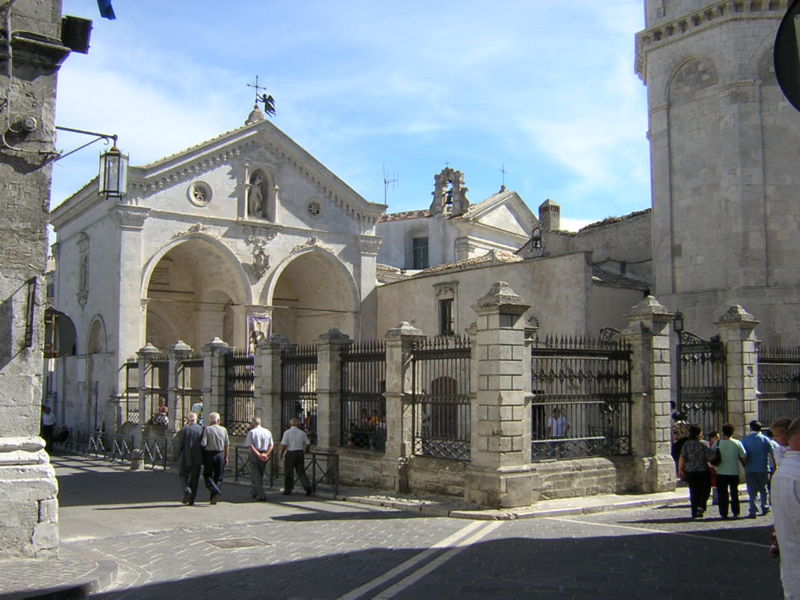
The Sanctuary of Monte Sant’Angelo sul Gargano,
Italy, sometimes called, simply, Monte Gargano.


Well known is the Apparition of Saint Michael the Archangel, as related in the Roman Breviary, 8 May, at his renowned Sanctuary on Monte Gargano, Italy, where his original glory as Patron in war was restored to him.

To his intercession, the Lombards of Sipontum (Manfredonia) attributed their victory over the Greek Neapolitans, 8 May, 663 A.D.


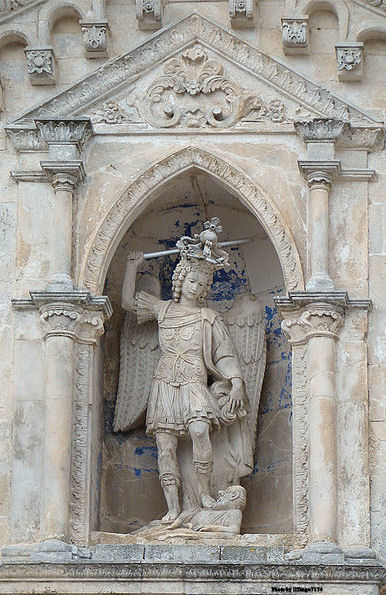
Statue of Saint Michael
overlooking the main entrance at the Sanctuary of Saint Michael the Archangel,
Monte Sant’Angelo, Apulia, Italy.


In commemoration of this victory, the church of Sipontum instituted a special Feast in honour of the Archangel, on 8 May, which has spread over the entire Latin Church and is now called (since the time of Pope Saint Pius V) “Apparitio S. Michaelis”, although it originally did not commemorate the Apparition, but the victory.

(cfr. Catholic Encyclopedia)

Saint Michael the Archangel: “Who is like God ?”

In Hebraic, mîkâ’êl, means “Who is like God ?”


The Scriptures refer to the Archangel Saint Michael in four different passages: two of them, in Daniel’s prophesy (chap. 10, 13 and 21; and chap. 12, 1); one in Saint Jude Thaddeus (single chapter, vers. 9) and, finally, in the Revelation (chap. 12, 7-12).

In the Book of Daniel, the Saint Archangel appears as the “prince and protector of Israel”, who opposes the “prince”, or heavenly protector of the Persians.

According to Saint Jerome and other commentators, the Angel protector of Persia desired that some of the Jews would remain there to expand the knowledge of God; however, Saint Michael desired and asked the Lord that all Jews return to Palestine, to allow the Temple of the Lord to be completed in less time. The spiritual fight between the two Angels lasted twenty one days.

Saint Jude, in his Epistle, alludes to a dispute between Saint Michael and the demon over Moses’ body: the glorious Archangel – by God’s disposition – wanted Moses’ sepulcher to remain hidden; the demon, however, tried to make it known, with the objective of giving to the Jews an occasion to fall into idolatry, through the influence of the neighboring pagan peoples.


In Revelation, Saint John presents Saint Michael as commander-in-chief of the good Angels in a great fight in Heaven, against the rebel Angels, led by Satan, the dragon:
“Now war arose in heaven, Michael and his Angels fighting against the dragon; and the dragon and his Angels fought, but they were defeated and there was no longer any place for them in heaven. And the great dragon was thrown down, that ancient serpent, who is called the Devil and Satan, the deceiver of the whole world — he was thrown down to the earth, and his Angels were thrown down with him” (Revelation 12, 7-12).


The Church did not define anything in particular about Saint Michael, but has permitted that the beliefs originated from the Christian traditions about the glorious Archangel have free course in the piety of the faithful and in the writings of the theologians.

The first of these beliefs is that Saint Michael was, in the Old Testament, the defender of the chosen people, Israel – and nowadays, he is the defender of the new chosen people, the Church.

This pious belief is in accordance with what is said in Daniel: “… but Michael, one of the chief princes, came to help me… Michael, your prince” – that is, prince of the Jews (Dan 10, 13 e 21); and again “At that time shall arise Michael, the great prince who has charge of your people”, the people of Israel (Dan 12, 1).


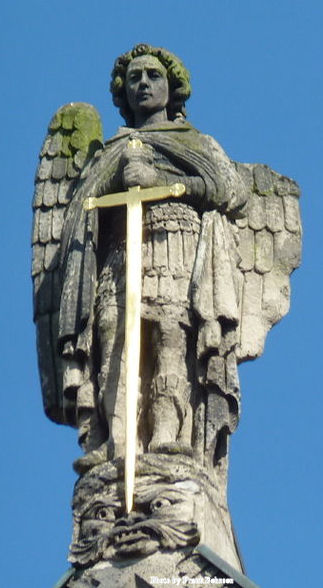
Statue of St. Michael on St. Michaelskirche Church in Siegen, Germany. The left wing of the angel statue was damaged in 1944 by bomb splinters. The damage was as a reminder of the Second World War, left intentionally so, and the rest of the church was restored.


This is a very ancient belief, being also confirmed by the Shepherd of Hermas, a celebrated Christian book of the II Century, in which one can read: “The great and honorable Michael is the one who has the power over this people” (the Christians).

Additionally, this is also believed by theologians and the Church, who corroborate it in several different ways.

The second of these beliefs is that Saint Michael has the power to admit, or not, the souls in Paradise.


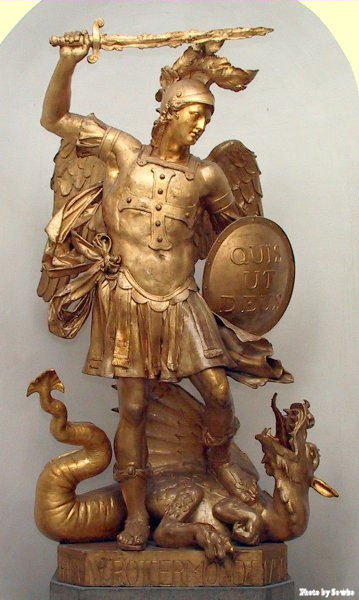
Statue of Archangel St. Michael at the main entrance, University of Bonn, Germany.


In the Divine Office for this holy Archangel, in the old Breviary, Saint Michael was called “Praepositus paradisi”- “Guardian of the Paradise”, to whom God addresses Himself in the following terms: “Constitui te Principem super omnes animas suscipiendas” – “I constituted you the master above all souls to be admitted”. And, in the Mass for the Dead there was the prayer: “Signifer Sanctus Michael representet eas in lucem sanctam” – “O Flag-bearer Saint Michael, lead them to the holy light”.

The third of these beliefs, or, rather, the third opinion, is that Saint Michael occupies the first place in the angelic hierarchy.

About this opinion, there are divergences amongst the theologians, but, this opinion has the support of several Greek Fathers of the Church and seems to be corroborated by the Latin Liturgy, which refers to the glorious Archangel as the“Princeps militiae coelestis quem honorificant coelorum cives” – “Prince of the celestial hosts, honored by all inhabitants of Heaven” and by the Greek liturgy, which calls him “Archistrátegos“, that is, “Mighty General”, or “Generalissimo”.


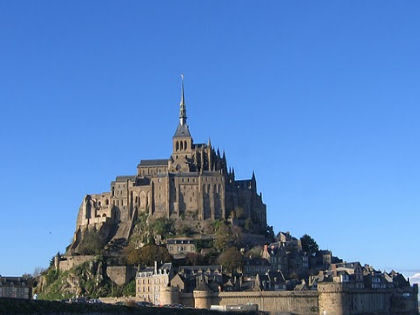
Mont St. Michel,
Normandy, France.


The great commentator of the Sacred Scriptures, Fr. Cornelius a Lapide, a Jesuit from the 16th-Century, writes:

“Many consider that Michael, due to his dignity and nature, and to his grace and glory, is the absolute first and the Prince of all Angels. And this is proved, first, by the book of Revelation (12, 7), where it is said that Michael fought against Lucifer and his Angels, resisting his arrogance with a cry full of humility: ‘Who is like God?’ Therefore, in the same way as Lucifer is the chief of the demons, Michael is the chief of the Angels, being the first among the Seraphim. Second, because the Church calls him Prince of the Heavenly Hosts, who is placed at the gates of Paradise. And it is in his name that we celebrate the Feast of All Angels. Third, because Michael is today exalted as the protector of the Church, as in olden days he was exalted as the protector of the Synagogue. Finally, four, because it is probable that Saint Michael is the Prince of all Angels and the first amongst the Seraphim, because Saint Basil says in his Homily De Angelis: ‘To you, O Michael, general of the Celestial Spirits, who, by his honor and dignity, is placed in front of all other Heavenly Spirits, to you I supplicate . . .”

The same thing is repeated by numerous other authors, Saint Robert Bellarmine included.

In the Middle Ages, Saint Michael was the special Patron of the Orders of Chivalry which defended Christendom against the Muslim danger.


08 May, 2014

The Apparition Of Saint Michael The Archangel. Feast Day 8 May.


Roman Text is taken from The Saint Andrew Daily Missal.
Italic Text is taken from Wikipedia - the free encyclopaedia.

The Apparition of Saint Michael the Archangel.
Feast Day 8 May.

Greater-Double.
White Vestments.

File:Guido Reni 031.jpg

Saint Michael the Archangel.
Artist: Guido Reni (1575–1642).
Date: Circa 1636.
Current location: Church of Santa Maria della Concezione,
Rome, Italy.
Source/Photographer: The Yorck Project: 10.000 Meisterwerke der Malerei.
DVD-ROM, 2002. ISBN 3936122202. Distributed by
DIRECTMEDIA Publishing GmbH.
Permission: [1].
(Wikimedia Commons)

The Easter Feasts are those of Angelical Spirits, for the Resurrection "gives joy also to the Angels," says Saint Gregory, "because, in opening Heaven to us, again, it makes up for the losses which their ranks had sustained."

The Feast of the Apparition of Saint Michael, the chief of the celestial hosts, shows forth, in this Paschaltide, all the grandeur of the Saviour's triumph.

Saint Michael, himself, comes to defend us in battle (Alleluia). He came down from Heaven (Ibid) and appeared in Italy, towards 525 A,D,, under the Pontificate of Pope Gelasius I, in Apulia, on the summit of Monte Gargano, near the Adriatic and the ancient Sipontum.

He requested that a Sanctuary should be erected to him, where God should be worshipped, in memory of himself and all the Angels, and this place became celebrated on account of numerous Miracles.

Mass: Benedícite Dóminum.


File:Jacopo vignali, san michele arcangelo libera le anime del purgatorio.jpg


English: Archangel Michael
saving Souls from Purgatory.
By Jacopo Vignali
17th-Century.
Italiano: Jacopo vignali.
San michele arcangelo libera le anime del purgatorio.
Source: Giovanni Piccirillo (a cura di).
La chiesa dei Santi Michele e Gaetano,
Becocci Editore, Firenze 2006.
Author: sailko.
(Wikimedia Commons)


Saint Michael the Archangel is referred to in the Old Testament and has been part of Christian teachings since the earliest times. Throughout the centuries, specific Roman Catholic traditions and views on Saint Michael have taken shape, as recently as the 19th- and 20th-Centuries.

A specific "Prayer to Saint Michael" was promoted by Pope Leo XIII in 1886 and, as recently as 1994, was reinforced by Pope John Paul II, who encouraged the Catholic Faithful to continue to Pray it, saying: "I ask everyone not to forget it and to recite it to obtain help in the battle against forces of darkness."

Saint Michael has specific roles, within Roman Catholic teachings, that range from acting as the chief opponent of Satan to saving Souls at the hour of death. Roman Catholic literature and traditions continue to point to Saint Michael in contexts as varied as the protection of the Catholic Church to the Consecration of Russia by Popes Pius XII and John Paul II.


PRAYER TO SAINT MICHAEL THE ARCHANGEL
added by Pope Leo XIII, in 1886, to the Leonine Prayers,
at the foot of the Altar, after Low Mass.


File:PapaleoXIII.jpg


Pope Leo XIII,
in 1880.
Source: 1880 book on Pope Leo XIII.
Author: Karl Benzinger.
(Wikimedia Commons)


Holy Michael Archangel,
defend us in the day of battle;
be our safeguard against the wickedness
      and snares of the devil.
May God rebuke him,
we humbly Pray,
and do thou,
Prince of the Heavenly host,
by the power of God,
thrust down to Hell,
Satan and all wicked spirits,
who wander through the world
      for the ruin of Souls.


The Prayer to Saint Michael is an invocation, used mainly by Catholics, addressed to Michael the archangel.

Pope Leo XIII added it, in 1886, to the Leonine Prayers, which he had directed to be said after Low Mass, two years earlier. Pope John Paul II referred to the Saint Michael Prayer in his Regina Coeli address of 24 April 1994 as follows:

"May prayer strengthen us for the spiritual battle that the Letter to the Ephesians speaks of: 'Be strong in the Lord and in the strength of his might' (Ephesians 6:10). The Book of Revelation refers to this same battle, recalling before our eyes the image of Saint Michael the Archangel (cf. Revelation 12:7). Pope Leo XIII certainly had this picture in mind when, at the end of the last century, he brought in, throughout the Church, a special Prayer to Saint Michael: 'Saint Michael the Archangel, defend us in battle. Be our protection against the wickedness and snares of the devil...' Although this Prayer is no longer recited at the end of Mass, I ask everyone not to forget it and to recite it to obtain help in the battle against the forces of darkness and against the spirit of this world."


Missa Solemnis (Solemn High Mass) For Easter Sunday, 1940. Our Lady Of Sorrows Basilica, Chicago. Narration By, Then, Monsignor Fulton J. Sheen.


File:Our Lady of Sorrows 080202 feedback.jpg


and National Shrine, Chicago, Illinois,

United States of America.
Date: 2 February 2008 (edited April 2008).
Author: Original by User:JeremyA.
Edited version by User:Capital photographer.
Permission: The required attribution is:
© 2008, Jeremy Atherton.
(Wikipedia)


A Traditional Catholic Latin Mass, filmed on Easter Sunday in 1940, at Our Lady of Sorrows Church in Chicago. The film presents the Ceremonies of the Missa Solemnis, or Solemn High Mass, in full detail, with narration by, then, Mgr. Fulton J. Sheen.
Celebrated by Rev. J. R. Keane, of the Order of Servites (hence the White Habits and Cowls), the Ceremonies are accompanied by a full Polyphonic Choir, Orchestra, and fifty Gregorian Chanters.
Available on YouTube at


St Andrew Daily Missal (Traditional Mass)

The Saint Andrew Daily Missal.
Image: CENACLE CATHOLIC BOOKS


Chester Cathedral. Part Five.


Text and Illustrations from Wikipedia - the free encyclopaedia,
unless otherwise stated.


Chester Cathedral.
Cathedral Church of Christ and The Blessed Virgin Mary,
Chester, England.
The Cathedral, seen from the South-East, looking towards the Choir, right, with the Lady Chapel projecting, extreme right, and the South Transept, left. The Lady Chapel is in the Early-English (or Lancet) Gothic Style, marked by the simple windows. The Choir is in the Late-Geometric Decorated Gothic Style. The South Transept has Flowing Decorated Windows in the Aisle, and Perpendicular Gothic Windows in the Clerestory. The friable Red Sandstone building was heavily
restored in the 19th-Century.
Photo: May 2012.
Source: Family Album.
Author: Stephen Hamilton.
(Wikimedia Commons)


Scott's restorations were not without their critics and caused much debate in architectural circles. Scott claimed to have archaeological evidence for his work, but the Liverpool architect, Samuel Huggins, argued, in an 1868 address to the Liverpool Architectural Society, that the alterations were less like restoration and more like rebuilding.

One of the larger changes was to shorten the South Aisle and restyle it as an Apse. The changes also proposed the addition of a Spire above the existing Tower, but this proposal was later rejected. Samuel Huggins's further Paper, of 1871, entitled "On so-called restorations of our Cathedral and Abbey Churches", compelled the Dean to attempt to answer the criticism. The debate contributed to the establishment of the Society for the Protection of Ancient Buildings.

Later in the century, from 1882, Arthur Blomfield and his son, Charles, made further additions and modifications, including restoring and re-instating the Shrine of Saint Werburgh. More work was carried out in the 20th-Century by Giles Gilbert Scott, between 1891 and 1913, and by F. H. Crossley, in 1939.


There is a Garden-in-Remembrance, 
of The Cheshire Regiment, 
at Chester Cathedral.
English: A German trench, occupied by British soldiers, near the Albert-Bapaume Road, at
Ovillers-la-Boisselle, France, July 1916. The Battle of the Somme.
The men are from A-Company, 11th Battalion, The Cheshire Regiment.
Français: Tranchée britannique près de la route Albert-Bapaume à Ovillers-la-Boisselle,
en juillet 1916 durant la bataille de la Somme.
an der Straße zwischen Albert und Bapaume.
Magyar: Brit lövészárok az Albert–Bapaume út közelében Ovillers-la-Boisselle-ben,
1916 júliusában, a Somme-i csata alatt.
Italiano: Trincea britannica a Ovillers-la-Boisselle sulla strada tra Albert e Bapaume,
luglio 1916 durante la Battaglia della Somme.
Source: This is photograph Q 3990 from the collection of
The Imperial War Museums (collection no. 1900-13).
Author: John Warwick Brooke.
(Wikimedia Commons)


Towards the end of 1963, the Cathedral Bells, which were housed in the Central Tower, were in need of an overhaul, and ringing was suspended. In 1965, the Dean asked George Pace, architect to York Minster, to prepare specifications for a new Bell Frame and for electrification of the Clock and tolling mechanism.

Due to structural difficulties and the cost of replacing the Bells in the Central Tower, it was advised that consideration should be given to building a Detached Bell-and-Clock Tower in the South-East corner of the Churchyard. It was decided to proceed with that plan, and, in 1969, an announcement was made that the first Detached Cathedral Bell Tower was to be erected since the building of the Campanile at Chichester Cathedral in the 15th-Century.

In February 1969, nine of the ten Bells in the Central Tower were removed, to be re-cast by John Taylor & Co as a Ring of twelve Bells with a Flat Sixth. The new Bells were cast in 1973. Work on the new Bell-Tower began in February 1973. Two old Bells, dating from 1606 and 1626, were left in the Tower. On 26 February 1975, the Bells were rung, for the first time, to celebrate the wedding of a member of the Grosvenor family.


English: 17th-Century 
Chancellor's Seat,
the Consistory Court, 
Chester Cathedral.
Deutsch: Chester, England.
Kathedrale: Konsistorium.
Sitz des Kanzlers.
Photo: 13 July 2011.
Source: Own work.
Author: Wolfgang Sauber.
(Wikimedia Commons)


The official opening, on 25 June 1975, was performed by the Duke of Gloucester. The Belfry is known as the Dean Addleshaw Tower, after the Dean of the Cathedral responsible for its construction. The Tower is built in concrete, faced with sandstone at its base. It is the first Detached Bell Tower to be built for a Cathedral in this country since the Reformation. Between the Bell Tower and the South Transept is a Garden-in-Remembrance of the Cheshire Regiment (originally the 22nd Regiment of Foot).

The treasures of Chester Cathedral are its rare Fittings, specifically its Choir Stalls and the 17th-Century furnishing of the Bishop’s Consistory Court in the South Tower, which is a unique survival.


"Crockets", applied to the Finials,
at Sint-Petrus-en-Pauluskerk,
Photo: 15 June 2005.
Source: Own work.
Author: JoJan.
(Wikimedia Commons)


A Crocket is a hook-shaped decorative element common in Gothic architecture.
It is in the form of a stylised carving of curled leaves, buds or flowers, which is used at regular intervals to decorate the sloping edges of spires, finials, pinnacles, and wimpergs.
When used to decorate the Capitals of Columns, these are called Crocket Capitals.
This element is also used as an ornament, on furniture and metalwork, in the Gothic Style.
The name derives from the diminutive of the French "croc", meaning "hook", due to the resemblance of Crockets to a Bishop's Crosier.


Misericord and Choir Stall,
Chester Cathedral
England.
Date: 17 March 2008 (original upload date). (Original Text :16 March 2008).
Source: Transferred from en.wikipedia. (Original Text : Self-made).
Author; Original uploader was Joopercoopers at en.wikipedia. (Original text : Joopercoopers.
(Wikimedia Commons)


The Choir Stalls date from about 1380. They have high, spiky, closely set, Canopies, with Crocketed Arches and Spirelets. The Stall Ends have Poppyheads, and are rich with figurative carving. The Stalls include forty-eight Misericords, all but five of which are original, depicting a variety of subjects, some humorous and some grotesque. Pevsner states that they are "one of the finest sets in the country", while Alec Clifton-Taylor calls them “exquisite” and says, of the Misericords, that, “for delicacy and grace, they surpass even those at Lincoln and Beverley”.


Poppyhead,
carved as a stylised fleur-de-lys,
in Saint Peter's Church, Neatishead,
Norfolk, England.
Photo: 31 May 2007.
Source: From geograph.org.uk.
Author: John Salmon.
(Wikimedia Commons)

"Poppyhead" is a form of carving of the end of a Bench or a Choir StallIts name is unrelated to the poppy flower. It is derived, by way of Old French, from the Latin word "puppis", which means the poop, or the figurehead, of a ship. In its simplest, and its most usual form, it has the appearance of a stylised fleur-de-lys. In some cases, it consists of a much more intricate carving; for example,
in Holy Trinity Church, Blythburgh, Suffolk, England, some of the Poppyheads
represent the Seven Deadly Sins.


In 1844, an Organ, by Gray and Davison, of London, was installed in the Cathedral, replacing an instrument with parts dating back to 1626. The Organ was rebuilt and enlarged by Whiteley Bros of Chester, in 1876, to include harmonic flutes and reeds by Cavaillé-Coll. It was later moved to its present position at the front of the North Transept.


PART SIX FOLLOWS


07 May, 2014

Saint Stanislaus. Bishop And Martyr. Patron Saint Of Poland. Feast Day 7 May.


Roman Text is taken from The Saint Andrew Daily Missal.

Italic Text is taken from Wikipedia - the free encyclopaedia,
unless otherwise stated.

Saint Stanislaus.
Bishop and Martyr.
Feast Day 7 May.

Double.
Red Vestments.

File:Stanisław Samostrzelnik, Św Stanisław.jpg


Saint Stanislaus of Szczepanów.

Artist: Stanisław Samostrzelnik (1485–1541).
Date: 1530 - 1535.
Current location: National Library of Poland.
Source/Photographer: Polona.pl.
(Wikimedia Commons)


File:Flag of Poland (with coat of arms).svg

English: State flag of Poland with Coat of Arms, symbolic version. Based on Image:Flag of Poland.svg and Image:Herb Polski.svg. Note: the Coat of Arms used here is not the official, accurate version. The official one is still not available in vector format.
Polski: Flaga Polski z godłem, wersja symboliczna. Oparta na Image:Flag of Poland.svg i Image:Herb Polski.svg. Uwaga: godło użyte w tej grafice nie jest oficjalne. Oficjalna wersja godła nie jest jeszcze dostępna w formacie wektorowym, stąd zamieszczono poniżej dodatkową wersję tej grafiki w formacie PNG, w której użyto poprawnego wizerunku godła.
Date: 26 June 2007.
Source: Own work.
Author: Aotearoa, Wanted.
(Wikimedia Commons)


Saint Stanislaus, born in Poland, was made Bishop of Cracow in 1072. He became an object of hatred to King Boleslas II, whom he reproached for his tyranny and dissolute life.

One day, whilst the Saint was saying Mass, the King rushed at him and slew him (Collect). This was in 1079. Saint Stanislaus is the Patron Saint of Poland.

Mass: Protexisti.


File:Stanisław Samostrzelnik, Św Stanisław.jpg


Stanislaus of Szczepanów, or Stanisław Szczepanowski, (July 26, 1030 – April 11, 1079) was a Bishop of Kraków, known chiefly for having been Martyred by the Polish king, Bolesław II the Bold. Stanislaus is venerated in the Roman Catholic Church as Saint Stanislaus the Martyr (as distinct from Stanislaus Kostka).


According to tradition, Stanisław was born at Szczepanów, a village in Lesser Poland, the only son of the noble and pious Wielisław and Bogna. He was educated at a Cathedral school in Gniezno (then the capital of Poland) and later, according to different sources, in Paris or Liège. On his return to Poland, Stanisław was ordained a Priest by Lambert II Suła, Bishop of Kraków.

After the Bishop's death (1072), Stanisław was elected his successor, but accepted the Office only at the explicit command of Pope Alexander II. Stanisław was one of the earliest native Polish Bishops. He also became a Ducal Advisor and had some influence on Polish politics.

Stanisław's major accomplishments included bringing Papal Legates to Poland, and re-establishment of a Metropolitan See in Gniezno. The latter was a pre-condition for Duke Bolesław's coronation as King, which took place in 1076. Stanisław then encouraged King Bolesław to establish Benedictine Monasteries to aid in the Christianisation of Poland.


Related Posts Plugin for WordPress, Blogger...