Notre Dame de Rouen. The façade of the Gothic Church in France. Photographer: Hippo1947. Licence: SHUTTERSTOCK.

03 October, 2014

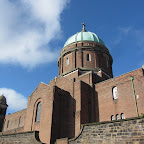
The Dome Of Home. The Church Of Saints Peter And Paul And Saint Philomena, New Brighton, England.


An excellent Video about the revitalisation of The Dome of Home can be found


2013-04-26

Image: DOME OF HOME


Image: DOME OF HOME


Catholic Church of Ss. Peter, Paul and St.Philomena
Institute Christ the King Sovereign Priest
7 Atherton Street
Wallasey
New Brighton CH45 9LT
England.


The Holy Guardian Angels. Feast Day 2 October (Part Two).


Italic Text is taken from The Saint Andrew Daily Missal.

Non-Italic Text is taken from The Liturgical Year by Abbot Guéranger, O.S.B.
(Translated from the French by Dom Laurence Shepherd, O.S.B.)
Time After Pentecost, Book V, Fourth Edition, Volume 14. from

Illustrations taken from Wikipedia - the free encyclopaedia,
unless otherwise stated.

The Holy Guardian Angels.
Feast Day 2 October.

Greater-Double.

White Vestments.


English: Saint Gemma Galgani,
(The Flower of Lucca),
reported interaction with her Guardian Angel.
Français: Détail d'une photo de Gemma Galgani.
Date: 1901.
Source: Photo d'Enrico Giannini prise en 1901,
et conservée à "la casa Giannini" des Sorelle
missionarie di santa Gemma à Lucques.
Author: Philippe Plet. Reproduction à partir du cliché original,
colorisation et recadrage.
(Wikimedia Commons)


Although the Solemnity of 29 September celebrates the praises of all The Nine Glorious Choirs, yet the piety of the Faithful, in the latter ages, desired to have a special day Consecrated to The Guardian Angels. Several Churches having taken the initiative, and kept the Feast under various Rites and on different days, Pope Paul V (1608) authorised its Celebration ad libitum. Pope Clement X (1670) established it by Precept as a Feast of Double Rite on 2 October [it has been a Greater-Double since 1883], the first free day after Michaelmas, on which it thus remains in some way dependent.

It is of Faith, on the testimony of the Scriptures and unanimous Tradition, that God commits to His Angels the guardianship of men, who are called to contemplate Him, together with these Blessed Spirits, in their common fatherland.

Catholic Theology teaches that this protection is extended to every member of the human race, without any distinction of Just and Sinners, Infidels and Baptised. To ward off dangers; to uphold man in his struggle against the demons; to awaken in him Holy Thoughts; to prevent him from sinning, and even, at times, to chastise him; to Pray for him, and present his Prayers to God. Such is the Office of The Guardian Angel.

So special is his mission, that one Angel does not undertake the guardianship of several persons simultaneously; so diligent is his care, that he follows his Ward from the first day to the last of his mortal existence, receiving the Soul as it quits this life, and bearing it from the Feet of the Sovereign Judge to the place it has merited in Heaven, or to its temporary sojourn in the place of expiation and purification.


English: Guardian Angel, German postcard, 1900.
Deutsch: Schutzengel, deutsche Postkarte um 1900.
Polski: Anioł Stróż, niemiecka pocztówka ok. 1900.
Author: Unknown, similar to works by Fridolin Leiber.
(Wikimedia Commons)

It is from the lowest of The Nine Choirs, the nearest to ourselves, that The Guardian Angels are, for the most part, selected. God reserves to The Seraphim, Cherubim, and Thrones, the honour of forming His Own Immediate Court.

The Dominations, from the steps of His Throne, preside over the government of the Universe; The Virtues watch over the course of Nature's laws, the preservation of species, and the movements of the heavens.

The Powers hold the Spirits of Wickedness in subjection. The human race, in its entirety, as also its great Social Bodies, the Nations and the Churches, are confided to The Principalities; while The Archangels, who preside over smaller communities, seem also to have the Office of transmitting to the Angels the Commands of God, together with the love and light which come down, even to us, from the first and highest hierarchy.


English: Guardian Angel.

Deutsch: Schutzengel.

Author: Bernhard Plockhorst (1825–1907).

(Wikimedia Commons)

O, the Depths of the Wisdom of God ! Thus, then, the admirable distribution of Offices, among the Choirs of Heavenly Spirits, terminates in the function committed to the lowest rank, the guardianship of man, for whom the Universe subsists.

Such is the teaching of the School [Suarez. De Angelis, lib. vi. cap. xviii. 5.]; and The Apostle, in like manner, says: "Are they not all ministering Spirits, sent to minister for them, who shall receive the inheritance of Salvation ? " [Heb. i. 14.]


PART THREE FOLLOWS


02 October, 2014

The Holy Guardian Angels. Feast Day 2 October (Part One).


Italic Text is taken from The Saint Andrew Daily Missal.

Non-Italic Text is taken from The Liturgical Year by Abbot Guéranger, O.S.B.
(Translated from the French by Dom Laurence Shepherd, O.S.B.)
Time After Pentecost, Book V, Fourth Edition, Volume 14. from
ST. BONAVENTURE PUBLICATIONS

Illustrations taken from Wikipedia - the free encyclopaedia,
unless otherwise stated.

The Holy Guardian Angels.
Feast Day 2 October.

Greater-Double.

White Vestments.


English: Archangel Michael reaching to save Souls in Purgatory,
by Jacopo Vignali, 17th-Century.
Italiano: Jacopo Vignali, San Michele Arcangelo libera le anime
del Purgatorio, (17th-Century).
Source: Giovanni Piccirillo (a cura di), 
La Chiesa dei Santi Michele e Gaetano, Becocci Editore, Firenze, 2006.
Author: sailko.
(Wikimedia Commons)

This Feast, Solemnised by the Spaniards in the 16th-Century, was extended to the whole Church by Pope Paul V in 1608.

Pope Clement X, in 1670, appointed it to be kept on the first free day after the Feast of Saint Michael, namely 2 October. 

The Angels, already in Glory, have for their mission to adore The Divinity (Introit, Offertory, Communion). Wherefore, in the Preface, the Church makes us ask God to permit our voices to join with theirs in praising God. ["I have seen the Seraphim," says Isaias, "they stood near the Sublime Throne, where Jehovah was seated: Their faces veiled, they cried out to one another: Holy, holy, holy, is the Lord God of Hosts, the whole Earth is full of His glory." (Isaias vi, 1-3.)]


But, as their name indicates, the Angels are also Messengers of Divine Commands (Offertory). The holy Fathers teach that they preside over all created things, and Saint Paul declares "that their mission is to serve the future heirs of Salvation".


Guardian Angel,
by Pietro da Cortona (1656).
Galleria Nazionale d'Arte Antica, Rome.
Source/Photographer: Web Gallery of Art
(Wikimedia Commons).


This is why they are called Guardian Angels (Collect). It is generally thought that Kingdoms, Provinces, Families, Dioceses, Churches, Religious Communities, each have their protecting Angel. 

[In some Countries, they celebrate the Feast of the Angel of the nation. Saint Francis de Sales says that the Bishop, as such, has another Guardian Angel. Ezechiel says that the Angel of the Temple of Jerusalem had a writing case hanging down from his girdle (Ezech. 11). These Angels of the Churches, adds Saint Basil, write down our irreverences.]


English: Statue of a Guardian Angel
in the Parish Church of Saint Oswald,
Oberdrauburg, Austria.
Deutsch: Pfarrkirche St Oswald,
Oberdrauburg, Osterreiche: Schutzengel.
Photo: July 2008.
Author: JJ55.
(Wikimedia Commons).


That there is one Guardian Angel for each Just Man, there can be no doubt, and the Church applies to the Souls, that are under the New Law, what is written about the people under the Old Law: "I shall send My Angel to march before you, to guard you on the way and to bring you into the land which I have prepared for you" (Epistle). [Saint Bernard of Clairvaux: Sixth Lesson at Matins.]

Our Guardian Angel has, for his mission, to protect us and defend us, in order that, under his protection, safe from the snares of the enemies of our Souls and from all adversities, we may reach the promised land of eternal life (Collect, Secret, Postcommunion).

This faithful companion deserves our gratitude, and the Veneration, due to one who already enjoys The Beatific Vision (Gospel).

It is to encourage us, to the habitual practice of this Devotion, that the Church instituted The Feast of The Guardian Angels.


PART TWO FOLLOWS


Your Guardian Angel. Feast Day 2 October.


Have you said "Thank You" to your Guardian Angel, lately ?


English: Guardian Angel, German postcard 1900.
Deutsch: Schutzengel, deutsche Postkarte um 1900.
Polski: Anioł Stróż, niemiecka pocztówka ok. 1900.
Date: 1900.
Source: German postcard 1900.
Author: Unknown, similar to works by Fridolin Leiber.
(Wikimedia Commons)


"Dear Angel, Ever At My Side".
Words by Fr. F. W. Faber
("The Mass
Is The Most Beautiful Thing
This Side of Heaven").
Available on YouTube at


Weekly Traditional Latin Masses In Kent. Maidstone, Ashford, Tenterden, Headcorn.


The current hiatus at Blackfen, Kent, England, where the new Parish Priest has banned the Celebration of Traditional Latin Masses, on the grounds that "they are DIVISIVE", encourages Zephyrinus to publicise the Traditional Latin Masses which
ARE CELEBRATED in Kent on a REGULAR WEEKLY BASIS ON SUNDAYS.

In addition, Traditional Latin Masses are Celebrated during the Week,
on Feast Days and Holy Days of Obligation.

There is a vibrant and happy group who attend these Masses and meet, after Mass,
for a lovely Lunch in various hostelries and locations.

Do come and join them. You will all be most welcome.

Besides Glorifying God in an edifying, Holy and Traditional manner,
you will see the wonderful Kent countryside changing throughout the Seasons,
which, in itself, Glorifies God.


MAIDSTONE, KENT.

CHURCH OF SAINT FRANCIS.


Photo: © Copyright Chris Whippet
and licensed for reuse under this

Traditional Latin Masses are Celebrated at the
Church of Saint Francis,
126, Week Street, Maidstone, Kent ME14 1RH,
(next to Maidstone East Railway Station)
at 1200 hrs,
on the FIRST SUNDAY OF EVERY MONTH.


ASHFORD, KENT.

CHURCH OF SAINT SIMON  STOCK.


Photo: WIKIMAPIA

  Traditional Latin Masses are Celebrated at the
Church of Saint Simon Stock,
Brookfield Road, Ashford, Kent TN23 4EU,
at 1200 hrs,
on the SECOND SUNDAY OF EVERY MONTH.


TENTERDEN, KENT.

CHURCH OF SAINT ANDREW.


Traditional Latin Masses are Celebrated at the
Church of Saint Andrew,
47, Ashford Road, Tenterden, Kent TN30 6LL,
at 1200 hrs,
on the THIRD SUNDAY OF EVERY MONTH.


HEADCORN, KENT.

CHURCH OF SAINT THOMAS OF CANTERBURY.


Photo © Copyright David Anstiss
and licensed for reuse

Traditional Latin Masses are Celebrated at the
Church of Saint Thomas of Canterbury,
Becket Court, 15, Station Road, Headcorn, Kent TN27 9SB,
(next to Headcorn Railway Station)
at 1200 hrs,
on the FOURTH SUNDAY OF EVERY MONTH.


WHEN THERE IS A FIFTH SUNDAY IN THE MONTH,
THE TRADITIONAL LATIN MASS IS CELEBRATED AT

ASHFORD, KENT.

CHURCH OF SAINT SIMON  STOCK.


Photo: WIKIMAPIA

  Traditional Latin Masses are Celebrated at the
Church of Saint Simon Stock,
Brookfield Road, Ashford, Kent TN23 4EU,
at 1200 hrs,
on the FIFTH SUNDAY OF EVERY MONTH.


01 October, 2014

October. Month Of The Holy Rosary. "Adiutricem". Encyclical On The Holy Rosary, By Blessed Pope Leo XIII, 5 September 1895.


The Text of this Article can be found on CATHOLICISM PURE AND SIMPLE


Our Lady of The Rosary.
Image: MOUNT CARMEL


Excerpts from


In Mary, God has given us the most zealous guardian of Christian unity. There are, of course, more ways than one to win her protection by Prayer, but, as for Us, We think that the best and most effective way to her favour lies in The Rosary. 

We have elsewhere brought it to the attention of the devout Christian, and not least among the advantages of The Rosary is the ready and easy means it puts in his hands to nurture his Faith, and to keep him from ignorance of his Religion and the danger of error.

The very origin of The Rosary makes that plain. When such Faith is exercised by vocally repeating The Our Father and Hail Mary of the Rosary Prayers, or, better still, in the contemplation of The Mysteries, it is evident how close we are brought to Mary.


For, every time we devoutly say The Rosary in supplication before her, we are once more brought face to face with the marvel of our Salvation; We watch the Mysteries of our Redemption as though they were unfolding before our eyes; and, as one follows another, Mary stands revealed at once as God’s Mother and our Mother.

The sublimity of that double dignity, the fruits of her twofold ministry, appear in vivid light when, in devout Meditation, we think of Mary’s share in The Joyful, The Sorrowful, The Glorious Mysteries, of her Son. The heart is inflamed by these Reflections with a feeling of grateful love toward her and, esteeming everything beneath her as so much worthless chaff, strives with manful purpose to prove worthy of such a Mother and the gifts she bestows. 

Meditation on the Mysteries of The Rosary, often repeated in the Spirit of Faith, cannot help but please her and move her, the fondest of Mothers, to show mercy to her children.


For that reason, We say that The Rosary is by far the best Prayer by which to plead before her the cause of our separated brethren. To grant a favourable hearing belongs properly to her Office of Spiritual Mother. 

For Mary has not brought forth, nor could she, those who are of Christ except in the One Same Faith and in the One Same Love; for: “Can Christ be divided ?” All must live the Life of Christ in an organic unity, in order to “bring forth fruit to God” in the One Same Body. 

Every one of the multitudes, therefore, whom the mischief of calamitous events has stolen away from that unity, must be born again to Christ, of that same Mother whom God has endowed with a never-failing fertility to bring forth a Holy People.


And this Mary, for her part, longs to do. Adorned by us with garlands of her favourite Prayer, she will obtain, by her entreaties, help in abundance from the Spirit that quickeneth. God grant that they refuse not to comply with the burning desire of their merciful Mother, but, on the contrary, give ear, like men of goodwill, with a proper regard for their eternal salvation, to the voice, gently persuasive, which calls to them: “My little children, of whom I am in labour again, until Christ be formed in you.”

May the peoples of the East and West, and all the others, wherever they may be, profit by the suppliant voice of Catholics united in Prayer, and by our voice, which will cry to our last breath: Show thyself a Mother.


Blessed Pope Leo XIII.
Photogram of the 1896 film "Sua Santitá Papa Leone XIII",
the first time a Pope appeared on film.
This image was copied from wikipedia:de.
The original description was: Papst_Leo_XIII. um ca. 1898.
Public Domain. Library of Congress
http://hdl.loc.gov/loc.pnp/cph.3a00543.
(Wikimedia Commons)


The following Text is taken from Wikipedia - the free encyclopaedia,

Pope Leo XIII (2 March 1810 – 20 July 1903), born Vincenzo Gioacchino Raffaele Luigi Pecci, to an Italian Comital family, reigned from 20 February 1878 to his death in 1903. He was the oldest Pope (reigning until the age of ninety-three), and had the third longest Pontificate, behind that of Pope Pius IX (his immediate predecessor) and Pope Saint John Paul II. He is the most recent Pontiff, to date, to take the Pontifical name of "Leo" upon being elected to the Pontificate.

He is well known for his intellectualism, the development of social teachings with his famous Papal Encyclical "Rerum Novarum", and his attempts to define the position of the Catholic Church with regard to modern thinking.

He influenced Roman Catholic Mariology and promoted both The Rosary and The Scapular. He issued a record eleven Encyclicals on The Rosary, earning the moniker "The Rosary Pope", approved two new Marian Scapulars, and was the first Pope to fully embrace the concept of Mary as Mediatrix. He was the first Pope to never have held any control over The Papal States, after they were dissolved by 1870.

Blessed Pope Leo XIII died on 20 July 1903, at the age of ninety-three, and was briefly buried in Saint Peter's Basilica, before his remains were later Transferred to the Basilica of Saint John Lateran.


St Andrew Daily Missal (Traditional Mass)

Available (in U.K.) from

Available (in U.S.A.) from


Our Lady Of The Clergy, Pray For Us. Notre Dame Du Clergé, Priez Pour Nous.


Illustration: FR. Z's BLOG


30 September, 2014

The Alhambra. A Pearl. Set In Emeralds.


Text and Illustrations from Wikimedia - the free encyclopaedia,
unless otherwise stated.


The Alhambra,
Granada, Spain.
Photo: August 2006.
Source: Flickr.
Author: bernjan.
(Wikimedia Commons)


English: Evening panorama of The Alhambra from Mirador de San Nicolas.
Español: Panorámica de la Alhambra al atardecer desde el
Mirador de San Nicolás, Granada, España.
Photo: 6 August 2014.
Source: Own work.
Author: Slaunger.
(Wikimedia Commons)


The Alhambra (Spanish: [aˈlambɾa]; Arabic: الْحَمْرَاء‎, [ʔælħæmˈɾˠɑːʔ], Al-Ḥamrā', literally. "The Red One"), the complete form of which was "Calat Alhambra", is a Palace and Fortress complex located in Granada, Andalusia, Spain.

It was originally constructed as a small Fortress in 889 A.D., and then largely ignored until its ruins were renovated and rebuilt in the Mid-11th-Century, by the Moorish Emir, Mohammed ben Al-Ahmar, of the Emirate of Granada, who built its current Palace and walls. It was converted into a Royal Palace in 1333 by Yusuf I, Sultan of Granada.


The Ceiling,
Photo: 10 March 2012.
Source: Own work.
Author: Liam987.
(Wikimedia Commons)


The Alhambra's Islamic Palaces, as we know them today, were built for the last Muslim Emirs in Spain and the Court of the Nasrid dynasty. After the Reconquista by the Reyes Católicos ("Catholic Monarchs"), in 1492, some portions were used by Christian rulers.

The Palace of Charles V, built by Charles V, Holy Roman Emperor, in 1527, was inserted in The Alhambra, within the Nasrid fortifications. After being allowed to fall into disrepair for Centuries, the buildings being occupied by squatters, The Alhambra was rediscovered in the 19th-Century by European scholars and travellers, with restorations commencing. It is now one of Spain's major tourist attractions, exhibiting the Country's most significant and well-known Islamic architecture, together with 16th-Century, and later, Christian building and garden interventions. The Alhambra is a UNESCO World Heritage Site and the inspiration for many songs and stories.

Moorish poets described it as "a Pearl, set in Emeralds," an allusion to the colour of its buildings and the woods around them. The Palace complex was designed with the mountainous site in mind and many forms of technology were considered. The Park (Alameda de la Alhambra), which is overgrown with wildflowers and grass in the Spring, was planted by the Moors, with Roses, Oranges, and Myrtles; its most characteristic feature, however, is the dense wood of English Elms, brought by the Duke of Wellington in 1812. The Park has a multitude of Nightingales and is usually filled with the sound of running water from several fountains and cascades. These are supplied through a conduit 8 km (5.0 miles) long, which is connected with the River Darro at the Monastery of Jesus del Valle, above Granada.


English: Arabesques around one of the windows in The Alhambra.
Español: Mirador de Lindaraja, dentro del palacio de los Leones, Alhambra de Granada.
Photo: 23 February 2006.
Source: Own work.
Author: Javier Carro.
(Wikimedia Commons)


Despite long neglect, wilful vandalism, and some ill-judged restoration, The Alhambra endures, as an atypical example of Muslim art, in its final European stages, relatively uninfluenced by the direct Byzantine influences found in the Mezquita of Córdoba. The majority of the Palace buildings are quadrangular in Plan, with all the rooms opening on to a Central Court, and the whole reached its present size simply by the gradual addition of new quadrangles, designed on the same principle, though varying in dimensions, and connected with each other by smaller rooms and passages.

The Alhambra was extended by the different Muslim rulers, who lived in the complex. However, each new section that was added followed the consistent theme of "Paradise on Earth". Column Arcades, Fountains with running water, and reflecting pools, were used to add to the aesthetic and functional complexity. In every case, the Exterior was left plain and austere. Sun and wind were freely admitted. Blue, Red, and a Golden Yellow, all somewhat faded through lapse of time and exposure, are the colours chiefly employed.


The Alhambra,
Granada, Spain.
Available on YouTube at


The decoration consists, as a rule, of Arabic inscriptions that are manipulated into sacred geometrical patterns wrought into Arabesques. Painted tiles are largely used as Panelling for the walls. The Palace complex is designed in the Mudéjar Style, which is characteristic of Western elements, reinterpreted into Islamic Forms, and widely popular during the Reconquista, the reconquest of the Iberian Peninsula from the Muslims by the Christian Kingdoms.

The Alhambra did not have a Master Plan for the total site design, so its overall layout is not orthogonal, nor organised. As a result of the site's many construction phases over time, from the original 9th-Century Citadel, through to the 14th-Century Muslim Palaces, to the 16th-Century Palace of Charles V, some buildings are in odd positionings to each other.

The Terrace or Plateau, where The Alhambra sits, measures about 740 metres (2,430 ft) in length by 205 metres (670 ft) at its greatest width. It extends from West-North-West to East-South-East and covers an area of about 142,000 square metres (1,530,000 sq ft). The Alhambra's most Westerly feature is the Alcazaba(Citadel), a strongly-fortified position. The rest of the Plateau comprises a number of Moorish Palaces, enclosed by a Fortified Wall, with thirteen Towers, some defensive and some providing vistas for the inhabitants.


One detail of the Arabesques (see, above).
Fine architectural detail at The Alhambra Palace,
Granada, Spain.
This File: 29 January 2007.
User: Serg!o.
Source: Flickr
(Author: Yves Remedios)
(Wikimedia Commons)


The decorations within the Palaces typified the remains of Moorish dominion within Spain and ushered in the last great period of Andalucian art in Granada. With little of the Byzantine influence of contemporary Abassid architecture, artists endlessly reproduced the same forms and trends, creating a new style that developed over the course of the Nasrid Dynasty.

The Nasrids used freely all the stylistic elements that had been created and developed during eight centuries of Muslim rule in the Peninsula, including the Calliphal Horseshoe Arch, the Almohad Sebka (a grid of rhombuses), the Almoravid Palm, and unique combinations of them, as well as innovations such as Stilted Arches and Muqarnas (Stalactite Ceiling Decorations). The isolation from the rest of Islam, plus the commercial and political relationship with the Christian Kingdoms, also influenced building styles.

Columns and Muqarnas appear in several Chambers, and the Interiors of numerous Palaces are decorated with Arabesques and Calligraphy. The Arabesques of the Interior are ascribed to, among other Sultans, Yusuf I, Mohammed V, and Ismail I, Sultan of Granada.


Detail of the script
on the wall of the Mexuar Hall:
"God is the only Victor.".
Photo: 8 November 2009.
Source: Own work.
(Wikimedia Commons)


After the Christian conquest of the City in 1492, the conquerors began to alter The Alhambra. The open work was filled up with whitewash, the painting and gilding effaced, and the furniture soiled, torn, or removed. Charles I (1516–1556) rebuilt portions, in the Renaissance Style of the period, and destroyed the greater part of the Winter Palace to make room for a Renaissance-Style structure which was never completed. Philip V (1700–1746) Italianised the rooms and completed his Palace in the middle of what had been the Moorish building; he had partitions constructed which blocked up whole apartments.

Over subsequent Centuries, the Moorish art was further damaged, and, in 1812, some of the Towers were destroyed by the French, under Count Sebastiani. In 1821, an earthquake caused further damage. Restoration work was undertaken in 1828 by the architect José Contreras, endowed in 1830 by Ferdinand VII. After the death of Contreras in 1847, it was continued with fair success by his son, Rafael (+ 1890) and his grandson.

Completed towards the end of Muslim rule of Spain by Yusuf I (1333–1353) and Muhammed V, Sultan of Granada (1353–1391), The Alhambra is a reflection of the culture of the last Centuries of the Moorish rule of Al Andalus, reduced to the Nasrid Emirate of Granada. It is a place where artists and intellectuals had taken refuge as the Reconquista by Spanish Christians won victories over Al Andalus.


English: A room of The Alhambra Palace
and a view of the Court of the Lions.
Deutsch: Innenhof der Alhambra.
Artist: Adolf Seel (1829–1907).
Date: 1892.
Current location: Unknown.
This File: 22 March 2006.
(Wikimedia Commons)


The Alhambra integrates natural site qualities with constructed structures and gardens, and is a testament to Moorish culture in Spain and the skills of Muslim, Jewish, and Christian artisans, craftsmen, and builders of their era. The literal translation of Alhambra, "the red (female)," reflects the colour of the red clay of the surroundings of which the Fort is made. The buildings of The Alhambra were originally whitewashed; however, the buildings, as seen today, are reddish. Another possible origin of the name is the tribal designation of the Nasrid Dynasty, known as the Banu al-Ahmar (Arabic: Sons of the Red (male)), a sub-tribe of the Qahtanite Banu Khazraj tribe. One of the early Nasrid ancestors was nicknamed Yusuf Al Ahmar (Yusuf the Red) and, hence, the (Nasrid) fraction of the Banu Khazraj took up the name of Banu al-Ahmar.

The first reference to the Qal‘at al-Ḥamra was during the battles between the Arabs and the Muladies (people of mixed Arab and European descent) during the rule of the ‘Abdullah ibn Muhammad (888 A.D. – 912 A.D.). In one particularly fierce and bloody skirmish, the Muladies soundly defeated the Arabs, who were then forced to take shelter in a primitive Red Castle, located in the Province of Elvira, presently located in Granada.

According to surviving documents from the era, the Red Castle was quite small, and its walls were not capable of deterring an army intent on conquering. The Castle was then largely ignored until the 11th-Century, when its ruins were renovated and rebuilt by Samuel ibn Naghrela, Vizier to the Emir Badis ben Habus of the Zirid Dynasty of Al Andalus, in an attempt to preserve the small Jewish settlement, also located on the natural Plateau, Sabikah Hill.


English: The Court of the Lions;
a unique example of Muslim art.
The Alhambra Palace.
Español: Patio de los leones.
Photo: 2 October 2003.
Source: Flickr.
Author: comakut.
(Wikimedia Commons)


Ibn Nasr, the Founder of the Nasrid Dynasty, was forced to flee to Jaén to avoid persecution by King Ferdinand III of Castile and the Reconquista supporters working to end Spain's Moorish rule. After retreating to Granada, Ibn-Nasr took up residence at the Palace of Badis ben Habus in The Alhambra. A few months later, he embarked on the construction of a new Alhambra fit for the residence of a Sultan. According to an Arab Manuscript, since published as the Anónimo de Granada y Copenhague, This year, 1238, Abdallah ibn al-Ahmar climbed to the place called "The Alhambra", inspected it, laid out the foundations of a Castle, and left someone in charge of its construction.

The design included Plans for six Palaces, five of which were grouped in the North-East quadrant, forming a Royal Quarter, two Circuit Towers, and numerous Bath-Houses. During the Reign of the Nasrid Dynasty, The Alhambra was transformed into a Palatine City, complete with an irrigation system composed of Acequias for the gardens of the Generalife located outside the Fortress. Previously, the old Alhambra structure had been dependent upon rainwater collected from a cistern, and from what could be brought up from the Albaicín. The creation of the Sultan's Canal solidified the identity of The Alhambra as a Palace-City, rather than a defensive and ascetic structure.


Canopy, with stonework.
The Alhambra Palace.
Date: 5 July 2008 (original Upload Date).
Source: Transferred from en.wikipedia;
Transferred to Commons by User:Arch2all
using CommonsHelper.
Author: Tim Bray.
(Wikimedia Commons)


The Muslim Ruler, Muhammad XII of Granada, surrendered the Emirate of Granada in 1492, without The Alhambra being attacked when the forces of the Reyes Católicos, King Ferdinand II of Aragon and Queen Isabella I of Castile, took the surrounding territory with a force of overwhelming numbers.

The Alhambra resembles many Mediaeval Christian strongholds in its three-fold arrangement as a Castle, a Palace and a Residential Annex for subordinates. The Alcazaba or Citadel, its oldest part, is built on the isolated and precipitous Foreland, which terminates the Plateau on the North-West. All that remains are its massive Outer Walls, Towers and Ramparts.

On its Watch-Tower, the 25 m (85 ft) high Torre de la Vela, the Flag of Ferdinand and Isabella was first raised as a symbol of the Spanish conquest of Granada on 2 January 1492 [Editor: GRANADAINFO.COM states that, nowadays, four Flags are flown from the Tower: The Blue European Flag; the Green and White Andalucian Flag; the Red and Yellow Spanish Flag; and the Red and Green Granada Flag.]


English: Flag of the Autonomous Community of Andalusia (Spain).
One of four Flags flown, nowadays, from the Torre de la Vela, The Alhambra.
Español: Bandera de la Comunidad Autónoma de Andalucía (España). Según la descripción:
La composición de tres franjas horizontales (verde, blanca y verde) que forman la bandera fue aprobada por la Asamblea de Ronda en 1918. Sus colores evocan tonalidades del paisaje andaluz,
al tiempo que simbolizan los valores de la pureza y la esperanza en el futuro. En ambas caras
y en situación centrada se reproduce elEscudo Oficial de Andalucía que tiene una altura
de dos quintas partes de la anchura de la bandera. El color verde se denomina
"Verde Omeya Bandera de Andalucía.
Sources/Fuentes: Símbolos de Andalucía & Descripción símbolos de Andalucía.
Date: 21 February 2009.
Source: Own work.
Author: Miguillen.
(Wikimedia Commons)


Detail of Palacios Nazaries,
The Alhambra, Granada, Spain.
Photo: 20 May 2010.
Source: Own work.
(Wikimedia Commons)


A Turret, containing a large Bell, was added in the 18th-century, and restored, after being damaged by lightning, in 1881. Beyond the Alcazaba, is the Palace of the Moorish Rulers,

Access from the City to the Alhambra Park is afforded by the Puerta de las Granadas (Gate of Pomegranates), a Triumphal Arch dating from the 15th-Century. A steep ascent leads past the Pillar of Charles V, a Fountain erected in 1554, to the main entrance of the Alhambra. This is the Puerta de la Justicia (Gate of Judgment), a massive horseshoe Archway, surmounted by a Square Tower and used by the Moors as an informal Court of Justice.

The Alhambra tiles are remarkable, in that they contain nearly all, if not all, the seventeen mathematically possible Wallpaper Groups. This is a unique accomplishment in World Architecture. M. C. Escher's visit in 1922, and study of the Moorish use of symmetry in the Alhambra tiles, inspired his subsequent work on Regular Divisions of the Plane.

In Astronomy, there is a Main Belt Asteroid named Alhambra.


Available (in U.K.) from

Available (in U.S.A.) from


Related Posts Plugin for WordPress, Blogger...