Notre Dame de Rouen. The façade of the Gothic Church in France. Photographer: Hippo1947. Licence: SHUTTERSTOCK.

11 December, 2014

Vézelay Abbey. Basilique Sainte-Marie-Madeleine De Vézelay.


English: The Nave,
Basilica of Saint Mary Magdalene, Vézelay, France.
Français: Le 23 juin 1976 à 14h27 dans la nef de la basilique Sainte-Marie-Madeleine de Vézelay, le Père Hugues Delautre o.f.m. a donné rendez-vous au soleil, à cet instant précis en culmination par rapport à la terre, pour qu'il lui manifeste le secret de l'édifice. Photographie de François Walch.
Photo: 23 June 1976.
Source: Own work.
(Wikimedia Commons)


"Abide With Me"
and
"Bless The Lord, O My Soul".
The entrance Hymns at
The Pilgrimage of The Scouts to
Vézelay, France, in 2014.
Available on YouTube at


Basilica of Sainte-Marie-Madeleine
Vézelay, France.
Photo: 13 April 2010.
Source: Own work.
Author: PMRMaeyaert.
(Wikimedia Commons)


Vézelay Abbey (French: Abbaye Sainte-Marie-Madeleine de Vézelay) was a Benedictine and Cluniac Monastery in Vézelay, in the Yonne Department in Northern Burgundy, France. The Benedictine Abbey Church, now the Basilica of Sainte-Marie-Madeleine (Saint Mary Magdalene), with its complicated programme of imagery in sculpted Capitals and Portals, is one of the outstanding masterpieces of Burgundian Romanesque art and architecture. Sacked by the Huguenots, in 1569, the building suffered neglect in the 17th- and 18th-Centuries and some further damage during the period of The French Revolution.

The Church at Vézelay was added to the UNESCO List of World Heritage Sites in 1979.

The Benedictine Abbey of Vézelay was Founded, as many Abbeys were, on land that had been a Late-Roman villa, of Vercellus (Vercelle becoming Vézelay). The villa had passed into the hands of the Carolingians and devolved to a Carolingian Count, Girart, of Roussillon. The two Convents, that he Founded there, were looted and dispersed by Moorish raiding parties in the 8th-Century, and a hilltop Convent was burnt by Norman raiders.

In the 9th-Century, the Abbey was re-Founded under the guidance of Badilo, who became an affiliate of the reformed Benedictine Order of Cluny. Vézelay also stood at the beginning of one of the four major routes, through France, for Pilgrims going to Santiago de Compostela, in Galicia, in the North-Western corner of Spain.


Polski: Bazylika św.
English: Vézelay Abbey.
Photo: 25 May 2013.
Source: Own work.
Author: Delta 51.
(Wikimedia Commons)


About 1050, the Monks of Vézelay began to claim to hold the Relics of Mary Magdalene, brought, they related, from The Holy Land, either by their 9th-Century Founder-Saint, Badilo, or by Envoys despatched by him. A little later, a Monk of Vézelay declared that he had detected in a Crypt at St-Maximin, in Provence, France, carved on an empty sarcophagus, a representation of the Unction at Bethany, when Jesus' Head was anointed by Mary of Bethany, assumed in The Middle Ages to be Mary Magdalene.


Vézelay Church.
Available on YouTube at


The Monks of Vézelay pronounced it to be Mary Magdalene's tomb, from which her Relics had been Translated to their Abbey. Freed captives then brought their chains, as Votive Objects, to the Abbey, and it was the newly-elected Abbot Geoffroy, in 1037, who had the ironwork melted down and re-forged as wrought iron railings surrounding the Magdalen's Altar.

Thus, the erection of one of the finest examples of Romanesque architecture, which followed, was made possible by Pilgrims to the declared Relics and these tactile examples demonstrating the efficacy of Prayers. Mary Magdalene is the prototype of the Penitent, and Vézelay has remained an important place of Pilgrimage for the Catholic Faithful, though the actual Relics were torched by Huguenots in the 16th-Century.


English: The Central Tympanum of the Narthex of Vézelay Abbey (carved 1125-1130).
Français: Le tympan central du narthex (sculpté vers 1125-1130),détail: au centre, le Christ en gloire transmet l'Esprit Saint aux apôtres; compartiment du haut, les Byzantins; compartiment du bas, les Arméniens; les médaillons de haut en bas:le Scorpion, un paysan tue un porc, le Sagittaire; sur le linteau, les peuples inconnus: de droite à gauche, les Panotti (aux grandes oreilles), les Pygmées, les Macrobii des Indes (peuple de géants). Basilique Sainte-Marie-Madeleine de Vézelay.
Photo: 9 July 2008.
Source: Own work.
Author: Vassil.
(Wikimedia Commons)


To accommodate the influx of Pilgrims, a new Abbey Church was begun, Dedicated on 21 April 1104, the expense incurred in building it resulted in an increased tax burden in the Abbey's land holdings. As a result, the Peasants revolted and killed the Abbot.The crush of Pilgrims was so great that an extended Narthex (an enclosed Porch) was built, inaugurated by Pope Innocent II, in 1132, to help accommodate the Pilgrim throng.

Saint Bernard of Clairvaux Preached there, in favour of a Second Crusade, at Easter, 1146, in front of King Louis VII of France and King Richard I of England. King Philip II of France visited and spent three months at the Abbey, in 1190, before leaving for The Third Crusade. Thomas Becket, in exile, chose Vézelay Abbey for his Whitsunday Sermon, in 1166, announcing the Excommunication of the main supporters of his English King, Henry II, and threatening the King with Excommunication, too.

The Nave, which had once burned down with great loss of life, burned down again, in 1165. It was then rebuilt in its present form.

Vézelay was self-confident. Its litigious Monastic Community was prepared to defend its liberties and privileges against all-comers: The Bishops of Autun, who challenged its claims to exemption; the Counts of Nevers, who claimed jurisdiction in their Court and rights of hospitality at Vézelay; the Abbey of Cluny, which had reformed its Rule and sought to maintain control of the Abbot within its hierarchy; the Townsmen of Vézelay, who demanded a modicum of communal Self-Government.


English: The Tympanum,
Basilica of Saint Mary Magdalene, Vézelay.
Français: Le tympan central du narthex (1140-1150),
ouvert pour la sortie de la messe.
Basilique Sainte-Marie-Madeleine de Vézelay.
Photo: 15 July 2008.
Source: Own work.
Author: Vassil
(Wikimedia Commons)


The start of the decline of Vézelay coincided with the well-publicised discovery, in 1279, of the alleged body of Mary Magdalene, at Saint-Maximin-La-Sainte-Baume, in Provence, given Regal Patronage by Charles II, the Angevin King of Sicily. When Charles erected a Dominican Convent at La Sainte-Baume, the Shrine was marvellously found intact, even with an explanatory inscription stating why the Relics had been hidden. The local Dominican Monks soon compiled an account of Miracles that these Relics had wrought. This discovery seriously undermined Vézelay's position as the main Shrine of Magdalen in Europe.

After the French Revolution, Vézelay stood in danger of collapse. In 1834, the newly-appointed French Inspector of Historical Monuments, Prosper Mérimée (more familiar as the author of Carmen), warned that it was about to collapse, and, on his recommendation, the young architect Eugène Viollet-le-Duc was appointed to supervise a massive and successful restoration, undertaken in several stages between 1840 and 1861, during which his team replaced a great deal of the weathered and vandalised sculpture. The Flying Buttresses, that support the Nave, are his.


English: The North Aisle of the 12th-Century Nave
of Vézelay Abbey, France,
and its Vaults, supported by impressive Arches.
Français: Le bas-côté Nord de la nef, 2ème moitié du 12ème siècle et ses voûtes d'arête soutenues par d'impressionnants arcs doubleaux, Basilique Sainte-Marie-Madeleine de Vézelay, France.
Photo: 15 July 2008.
Source: Own work.
Author: Vassil
(Wikimedia Commons)


The Tympanum of the Central Portal of the Basilica Sainte-Marie-Madeleine de Vézelay is different from its counterparts across Europe. From the beginning, its Tympanum was specifically designed to function as a Spiritual Defense of The Crusades and to portray a Christian allegory to The Crusaders' mission. When compared to contemporary Churches, such as St. Lazare d'Autun and St. Pierre de Moissac, the distinctiveness of Vézelay becomes apparent.

The art historian George Zarnecki wrote: "To most people, the term Romanesque Sculpture brings to mind a large Church Portal, dominated by a Tympanum carved with an Apocalyptic vision, usually The Last Judgment." This is true in most cases, but Vézelay is definitely an exception. Unlike its contemporaries, which tend to depict The Second Coming of Christ, the subject of Vézelay's Tympanum is The Pentecostal Mission of the Apostles. Its Tympanum reflects its unique importance in the development of The Crusades.

Thirty years before the Vézelay Tympanum was carved, Pope Urban II planned on announcing his call for a Crusade at La Madeleine, Vézelay. In 1095, Pope Urban II altered his plans and preached for The First Crusade at The Council of Clermont, but Vézelay remained a central figure in the history of The Crusades. The Tympanum was completed in 1130. Fifteen years after its completion, Saint Bernard of Clairvaux chose Vézelay as the place from which he would call for a Second Crusade. Vézelay was even the Staging Point for The Third Crusade. It is there that King Richard the Lionheart, of England, and King Philip Augustus, of France, met and joined their armies for a combined Western Invasion of The Holy Land. It is appropriate, therefore, that Vézelay's Portal reflect its place in the history of The Crusades.


Vézelay Abbey (now known as Basilique Sainte-Marie-Madeleine) was a Benedictine and Cluniac Monastery, in Vézelay, in the Yonne Département, Burgundy, France. The Benedictine Abbey Church of Sainte-Marie-Madeleine (or Basilica of Saint Mary Magdalene), with its complicated programme of imagery in sculpted Capitals and Portals, is one of the outstanding masterpieces of Burgundian Romanesque art and architecture, though much of its exterior sculpture was defaced during The French Revolution. The Church was added to the UNESCO List of World Heritage Sites in 1979.
Photo: 1 August 2008.
Source: Basilica of Saint Magdalene in Vézelay
Uploaded by russavia
Author: Michal Osmenda from Brussels, Belgium.
(Wikimedia Commons)


The Sanctuary,
Vézelay Abbey.
Photo: 1 August 2008.
Source: Basilica of Saint Magdalene,
Vézelay, France.
Uploaded by russavia
Author: Michal Osmenda from Brussels, Belgium.
(Wikimedia Commons)


The Lintel of the Vézelay Portal portrays the "ungodly" people of the world. It is a depiction of the first Pentecostal Mission to spread the Word of God to all the people of the world. The figures in the Tympanum, who have not received the Word of God, are depicted as not fully human. Some are shown with pig snouts, others are mis-shapen, and several are depicted as dwarves. One pygmy, in particular, is depicted as mounting a horse with the assistance of a ladder. On the far right, there is a man with elephantine ears, while, in the centre, we see a man covered in feathers. The architects and artisans depicted the unbelievers as physically grotesque in order to provide a visual image of what they saw as the non-believers' moral turpitude.

Vézelay's political motivation becomes all the more apparent, when compared with contemporary Portal designs from other Churches around France. The Vézelay Lintel is distinct, but some comparisons can be made between it and other Romanesque Portal sculptures of the time. Vézelay's Lintel is comparable to the Saint Lazare Lintel, in Autun, in that both show humans who have sinned.

While the Vézelay Lintel is devoted to the depiction of "heathens," the Autun Lintel shows the Damned Souls on Judgement Day. The similarity between both Lintels is due in large part to the fact that the same Master Artisan, Master Gislebertus, was the primary architect on both sites.


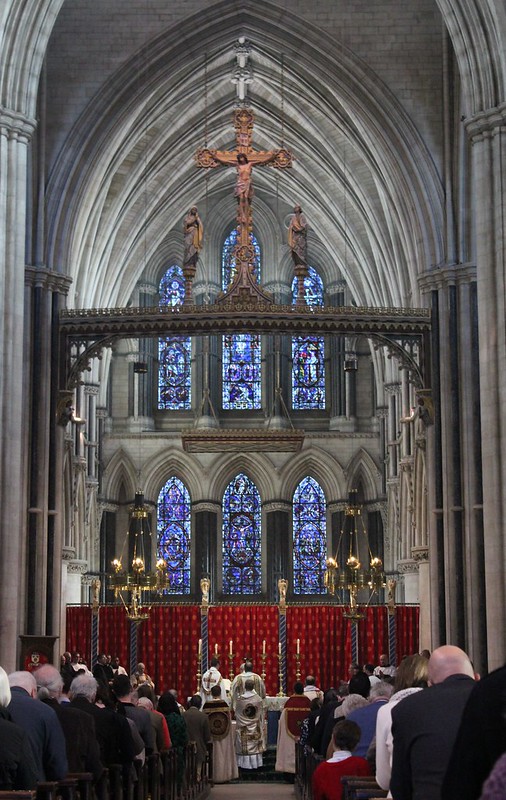
Interior of the Basilica of
Sainte-Marie-Madeleine de Vézelay.
Photo: 13 April 2010.
Source: Own work.
Author: PMRMaeyaert.
(Wikimedia Commons)


Gislebertus . . . began his career at Cluny Abbey, then worked on the original West Facade at Vézelay, and, circa 1120, moved to Autun. In addition, the two Tympana are similar, in that they follow the tradition of placing the exaggerated Christ in the centre of the image. Here is where the similarity stops, however. Autun is more traditional and typical of the Romanesque Portal carvings. It depicts The Second Coming, which is a popular and typical depiction in Romanesque art. Frightful images of demons abound. The goals of the two different Tympana are reflected in their design; Autun is designed to frighten people back to Church, while Vézelay is designed as a political statement to support The Crusades.


The Ambulatory,
Basilique Sainte-Marie-Madeleine de Vézelay.
Photo: 13 April 2010.
Source: Own work.
Author: PMRMaeyaert.
(Wikimedia Commons)


The Lower Four Compartments of the Vézelay Tympanum show the nations that had already received the Gospels. They include the Byzantines, Armenians, and Ethiopians. The inclusion of the Byzantines is particularly important because it was the Byzantines who initially requested a Crusade to The Holy Land. The Byzantines had lost Jerusalem to the Seljuk Turks through warfare, and they were eager to seek Western military support to reclaim that territory.

While the Lower Four Compartments of the Tympanum represent the Christian nations, the Upper Four Compartments are a representation of the Second Mission of The Apostles. According to the Bible, "many wonders and signs were done by The Apostles." These wonders included the healing of the sick and the casting out of demons and devils. These acts are represented in the Upper Four Compartments of the Vézelay Tympanum.

"Special Pleader".


" Special Pleader".

Date: 1893.
Source/Photographer: 
Web screenshot.
This File: 14 November 2013.
User: Rsberzerker.
(Wikimedia Commons)

Pontifical Solemn High Mass From The Throne. Norwich Catholic Cathedral Of Saint John The Baptist. Feast Of All Saints, 1 November 2014.


Pontifical Solemn High Mass From The Throne.
Norwich Catholic Cathedral Of Saint John The Baptist.
Feast Of All Saints, 1 November 2014.
Illustration: THE CHAIRMAN'S BLOG


The following Text is from THE CHAIRMAN'S BLOG

On Saturday, 1 November 2014, All Saints' Day, Bishop Alan Hopes of East Anglia celebrated Mass in The Extraordinary Form in his Cathedral in Norwich, 'from The Throne'.

Various Bishops have celebrated The Traditional Mass in various places, but this is the first celebration by a Bishop in his own Cathedral 'from The Throne', that is, in The Most Solemn Form.


The Nave,
Norwich Catholic Cathedral.
Photo: 29 July 2014.
Source: Own work.
Attribution: "Photo by DAVID ILIFF.
License: CC-BY-SA 3.0"
Author: Diliff.
(Wikimedia Commons)


Bishop Hopes is used to Celebrating the Extraordinary Form Mass; as an Auxiliary Bishop in Westminster, he did this at least annually for The Latin Mass Society for a number of years.

We had been asking for Traditional Masses in Norwich Cathedral [Editor: Norwich's Catholic Cathedral is Saint John the Baptist.] for some time, notably for a Requiem Mass for a couple who were Parishioners and had left money for this purpose. We were therefore delighted when Bishop Hopes told us, after his Appointment to East Anglia, that he would break the ice by celebrating an Extraordinary Form Mass there, himself.


Norwich Catholic Cathedral
of Saint John the Baptist.
Photo: 25 June 2009.
Source: This file was derived from:
Author: O
riginal: Nigel Chadwick;
Derivative work: Rabanus Flavus.
(Wikimedia Commons)

10 December, 2014

Solemn High Mass (Usus Antiquior). 1100 A.M, Christmas Day. Saint Mary's, Chislehurst, Kent.


Solemn High Mass
(Usus Antiquior).
1100 hrs.
Christmas Day.
Saint Mary's,
Chislehurst,
Kent.


Illustration: EASYFUNDRAISING.ORG.UK

28 Crown Lane,
Chislehurst,
Kent BR7 5PL.
Tel: 020 8467 3215.
Fax: 020 8325 9627.
Email: office@stmarysrc.org


The Rorate Mass. The Votive Mass Of Our Lady In Advent.


An excellent account of a Rorate Mass can be found at RORATE CAELI


Altar, with Violet Cloth and Antependium, for the Season of Advent,
prepared for the Celebration of a "Rorate Mass",
in which the Rorate Caeli is sung.
Photo: 3 September 2011.
Source: Own work.
(Wikimedia Commons)


The following Text is from Wikipedia - the free encyclopaedia.

The Rorate Mass got its proper name from the first word of the Introit (Entrance antiphon): "Rorate caeli désuper et nubes pluant justum". "Shower, O heavens, from above, and let the skies rain down righteousness". We know Gaudete Sunday and Laetare Sunday, which also got their names from the Introit. Before the Liturgical changes post-Vatican II, this Mass was celebrated very early in the morning on all Saturdays. In some areas, it was celebrated on several, or even all, weekdays during Advent (The Votive Mass of Our Lady in Advent).

The Rorate Mass is a Votive Mass in honour of The Blessed Mother for the Season of Advent. It has a long tradition in The Catholic Church, especially in German-speaking countries. The Masses have to begin in the morning, when it is still dark, due to winter-time, and are said by candlelight.

A Little Levity To Lighten Your Day.


09 December, 2014

"Suspense".


"Suspense".
Date: 1894.
This File: 29 December 2009.
Author: Repro from Artbook.
(Wikimedia Commons)

"Good Night".


"Good Night".
Artist: Arthur John Elsley
(1860 – 1952).
Illustration:

"All Of Paradise Is Close To The Altar When I Celebrate Mass. The Angels Attend My Mass In Legions. The Virgin Assists Me."


Padre Pio.
Illustration: THE RAD TRAD

"All of Paradise is close to the Altar when I celebrate Mass.
The Angels attend my Mass in Legions. The Virgin assists me."


08 December, 2014

The Dogma Of The Immaculate Conception Of The Blessed Virgin Mary. Promulgated By Blessed Pope Pius IX, In The Papal Bull "Ineffabilis Deus", On 8 December 1854.


Zephyrinus commends to all Readers the Article in UMBLEPIE
on The Dogma of The Immaculate Conception,
and the promulgation of "Ineffabilis Deus".


The Immaculate Conception.
Artist: Peter Paul Rubens (1577–1640).
Date: 1628.
Français: Œuvre appartenant au musée du Prado de Madrid photographiée lors de l’exposition temporaire « Rubens et son Temps » au musée duLouvre-Lens.
English: Work belonging to the Madrid Prado Museum photographed during the exhibition « Rubens et son Temps » (Rubens and His Times) at the Museum of Louvre-Lens.
Deutsch: Arbeiten gehören in der " Rubens et son Temps " (Ausstellung Rubens und seine Zeit) im Museum von Louvre-Lens fotografiert.
Español: Trabaja perteneciente a fotografiado durante la exposición de " Rubens et son Temps " (Rubens y su época) en el Museo de Louvre-Lens.
Current location: Prado Museum, Madrid, Spain.
Source/Photographer: User:Jean-Pol GRANDMONT (2013).
(Wikimedia Commons)


Pope Pius IX.
Source: Originally from hu.wikipedia; description page is/was here.
Author: Original uploader was User:Czinitz at hu.wikipedia
(Wikimedia Commons)

Souvenir From 8 December 1854. Open To Me Your Immaculate Heart, O Mary. I Have Chosen It As Home.


Text and Illustration from HOLY CARD HEAVEN
unless otherwise stated.


THE MOST HIGH HAS SANCTIFIED HIS TABERNACLE.

LE TRES HAUT A SANCTIFIE SON TABERNACLE.

~ Psalm 45.


She is a garden enclosed and a sealed fountain.

C'est ici, le Jardin fermé et la fontaine scellée.

~ Song of Songs.


Open to me your Immaculate Heart, O Mary.
I have chosen it as home.

Ouvrez-moi votre Coeur Immaculé, O Marie.
Je l'ai choisi pour demeure.


English: Stained-Glass Window, from 1887, showing The Immaculate Conception.
South Chapel, Church of Campagne, Dordogne, France.
Français: Vitrail de 1887 représentant l'Immaculée Conception, chapelle sud de l'église de Campagne, Dordogne, France.Photo: 28 September 2014.
Source: Own work.
Author: Père Igor.
(Wikimedia Commons)


The following Text is from Wikipedia - the free encyclopaedia.

During the Reign of Pope Gregory XVI, 1831-1846, the Bishops in various countries began to press for a definition as Dogma of the Teaching of Mary's Immaculate Conception.

In 1839, Mariano Spada (1796 - 1872), Professor of Theology at The Roman College of Saint Thomas, published Esame Critico sulla dottrina dell’ Angelico Dottore S. Tommaso di Aquino circa il Peccato originale, relativamente alla Beatissima Vergine Maria [A critical examination of the Doctrine of Saint Thomas Aquinas, The Angelic Doctor, regarding Original Sin, with respect to The Most Blessed Virgin Mary], in which Aquinas is interpreted, not as treating the question of The Immaculate Conception, later formulated in The Papal Bull Ineffabilis Deus, but, rather, The Sanctification of The Foetus within Mary's womb. Spada furnished an interpretation, whereby Pope Pius IX was relieved of the problem of seeming to foster a Doctrine not in agreement with the Aquinas' Teaching. Pope Pius IX would later appoint Spada as Master of The Sacred Palace in 1867.

Pope Pius IX, at the beginning of his Pontificate, and again after 1851, appointed Commissions to investigate the whole subject, and he was advised that the Doctrine was one which could be Defined and that the time for a Definition was opportune.


English: Detail of Stained-Glass Window, showing Mary Immaculate,
Church of Saint Thomas, Excideuil, Dordogne, France.
Français: Détail d'un vitrail représentant sainte Marie,
église Saint-Thomas, Excideuil, Dordogne, France.
Photo: 2 March 2010.
Source: Own work.
Author: Père Igor.
(Wikimedia Commons)


It was not until 1854 that Pope Pius IX, with the support of the overwhelming majority of Roman Catholic Bishops, whom he had consulted between 1851–1853, promulgated The Papal Bull Ineffabilis Deus (Latin for "Ineffable God"), which defined ex cathedra the Dogma of The Immaculate Conception:
We declare, pronounce and define that the Doctrine which holds that The Blessed Virgin Mary, at the first instant of her conception, by a singular privilege and Grace of The Omnipotent God, in virtue of the Merits of Jesus Christ, The Saviour of Mankind, was preserved Immaculate from all stain of Original Sin, has been revealed by God, and therefore should firmly and constantly be believed by all The Faithful.
—Pope Pius IX, Ineffabilis Deus, 8 December 1854.


Proclamation of The Dogma of The Immaculate Conception,
by Pope Pius IX, on 8 December 1854. Stained-Glass Window, Church of Bécherel, France.
Also depicted is Godefroy Brossay-Saint-Marc, Archbishop of Rennes.
Photo: 8 August 2011.
Source: Own work.
Author: GO69.
(Wikimedia Commons)


Godefroy Brossay-Saint-Marc, first Archbishop of Rennes (see illustration, above),
made a Cardinal (Titulus Santa Maria della Vittoria) in the Consistory
of 17 September 1875, received the Galero of Pope Pius IX.
Detail of Stained-Glass Window in the Church of
Saint Peter and Saint Paul, Pire-sur-Seiche, France.
Photo: 8 August 2011.
Source: Own work.
Author: GO69.
(Wikimedia Commons)


The Dogma was defined in accordance with the conditions of Papal Infallibility, which would be defined in 1870 by The First Vatican Council.

The Papal definition of the Dogma declares, with absolute certainty and authority, that Mary possessed Sanctifying Grace from the first instant of her existence, and was free from the lack of Grace, caused by the Original Sin, at the beginning of human history. Mary's Salvation was won by her Son, Jesus Christ, through His Passion, Death, and Resurrection, and was not due to her own merits.

The Immaculate Conception Of The Blessed Virgin Mary. Feast Day 8 December.


Text from The Saint Andrew Daily Missal,
unless otherwise stated.

Illustrations, unless otherwise stated, are from UNA VOCE OF ORANGE COUNTY
who reproduce them with the kind permission of ST. BONAVENTURE PRESS


Image: SHUTTERSTOCK


The Immaculate Conception of The Blessed Virgin Mary.
Feast Day 8 December.

Double of the First-Class
      with an Octave.

White Vestments.


The Immaculate Conception.


Having decided, from all Eternity, to make Mary Mother of the Incarnate Word (Epistle), God willed that she should crush the head of the serpent from the moment of her Conception.

He covered her "with a Mantle of Holiness" (Introit) and, "preserving her Soul from all stain, He made her a worthy dwelling place for His Son" (Collect).

The Feast of the "Conception" of the Virgin was; from the 8th-Century, celebrated in the East on 9 December; from the 9th-Century in Ireland on 3 May; and, in the 11th-Century in England, on 8 December.

The Benedictines, with Saint Anselm, and the Franciscans, with Duns Scotus (1308), favoured the Feast of the "Immaculate Conception," which, in 1128, was kept in Anglo-Saxon Monasteries.


In the 15th-Century, Pope Sixtus IV, a Franciscan, erected at the Vatican the Sixtine (Sistine) Chapel in honour of The Conception of The Virgin. And, on 8 December 1854, Pope Pius IX officially proclaimed this great Dogma, making himself the mouthpiece of all the Christian tradition summed up in the words of the Angel: "Hail Mary, full of Grace, the Lord is with thee, Blessed art thou among women" (Gospel). "Thou art all beautiful, O Mary, and the original stain is not in thee" says in truth the Alleluia Verse.

Like the Dawn, which announces the day, Mary precedes the Sun of Justice, which will soon illumine the world of Souls. Bringing to us her Son, it is she who first appears in the Liturgical Cycle.

Let us ask God "to heal us and to deliver us from all our sins" (Secret, Postcommunion) in order that, by the Graces which specially belong to The Feast of The "Immaculate", we may become more worthy of receiving Jesus in our hearts when He comes into them on 25 December.

Every Parish Priest celebrates Mass for the people of his Parish.


St Andrew Daily Missal (Traditional Mass)

Available (in U.K.) from

Available (in U.S.A.) from


Fröhliche Unbefleckte Empfängnis. Happy Feast Of The Immaculate Conception.


The Immaculate Conception.
Artist: Anonymous.
Date: 17th-Century.
Current location: Museo Carmen Thyssen, Malaga, Spain.
Source: http://www.carmenthyssenmalaga.org/
Author: Anonymous.
(Wikimedia Commons)

The Immaculate Conception Of The Blessed Virgin Mary. Feast Day 8 December.


The Immaculate Conception of The Blessed Virgin Mary.
Feast Day 8 December.


Double of the First-Class
with an Octave.


White Vestments.


THE IMMACULATE CONCEPTION

WHAT A WONDERFUL FEAST
FOR THE MOTHER OF GOD,


Illustration from HOLY CARD HEAVEN

07 December, 2014

Verbum Supernum. Benediction Hymn By Saint Thomas Aquinas (1225 - 1274).


Text and Illustrations from Wikipedia - the free encyclopaedia,
unless otherwise stated.


Monstrance.
Photo: 2004-10-18 (original upload date).
Source: Own work (zelf gemaakt).
Originally from nl.wikipedia; description page is/was here.
Author: Original uploader was Broederhugo at nl.wikipedia.
(Wikimedia Commons)


Verbum Supernum
by Saint Thomas Aquinas.
Available on YouTube at


Verbum Supernum Prodiens is a Catholic Hymn in long metre by Saint Thomas Aquinas. It was written for The Hour of Lauds in The Divine Office of Corpus Christi. It is about the institution of The Eucharist by Christ at The Last Supper, and His Passion and Death.

The last two verses form a Hymn on their own, as well, O Salutaris Hostia, which is sung at The Adoration of The Blessed Sacrament.

There is also another, unrelated, Latin Nativity Hymn of the same name, which is the Office Hymn at Mattins for The Second Sunday in Advent.

Verbum supernum prodiens,
Nec Patris linquens dexteram,
Ad opus suum exiens,
Venit ad vitæ vesperam.

In mortem a discipulo
Suis tradendus æmulis,
Prius in vitæ ferculo
Se tradidit discipulis.

Quibus sub bina specie
Carnem dedit et sanguinem;
Ut duplicis substantiæ
Totum cibaret hominem.


Se nascens dedit socium,
Convescens in edulium,
Se moriens in pretium,
Se regnans dat in præmium.

O salutaris hostia,
Quæ cæli pandis ostium,
Bella premunt hostilia;
Da robur, fer auxilium.

Uni trinoque Domino
Sit sempiterna gloria:
Qui vitam sine termino
Nobis donet in patria.

Amen.


English Translation.

The Word descending from above,
without leaving The Right-Hand of His Father,
and going forth to do His work,
reached the evening of His life.

When about to be given over
to His enemies, by one of His disciples,
to suffer death, He first gave Himself
to His disciples as the bread of life.

Under a twofold appearance,
He gave them His flesh and His blood;
that He might thus wholly feed us,
made up of a twofold substance.


By His Birth, He gave Himself as our companion;
At The Last Supper, He gave Himself as our food;
Dying on The Cross, He gave Himself as our ransom;
Reigning in Heaven, He gives Himself as our reward

O Salutary Host,
Who expandest the door of the sky,
Hostile wars press.
Give strength; bear aid.

To The Lord, One in Three,
May there be Sempiternal Glory;
May He grant us life without end
In The Native Land.

Amen.

Second Sunday Of Advent.


Text from The Saint Andrew Daily Missal,
unless otherwise stated.

Illustrations, unless otherwise stated, from UNA VOCE OF ORANGE COUNTY
(from The Saint Andrew Daily Missal, 1952 Edition), who reproduce them 
with the kind permission of ST. BONAVENTURE PRESS

Second Sunday of Advent.
Station at The Church of The Holy Cross in Jerusalem.

Indulgence of 10 years and 10 Quarantines.
Privileged Sunday of the Second-Class.

Semi-Double.

Violet Vestments.

John sent two of his Disciples to Christ.


The Blessed Virgin Mary, Saint Gabriel the Archangel,
The Prophet Isaias, Saint John the Baptist.

The whole of today's Liturgy is filled with the thought of Isaias (whose name means "The Lord Saves"), since he is, beyond all others, the Prophet who proclaims The Coming of Christ The Redeemer.

He foretold, seven Centuries before, that "a Virgin" should "conceive and bear" a son, "Emmanuel" (Isaias VII, 14), and that God would send His "Angel"; that is John the Baptist, who should "prepare His way before Him" (Gospel), and The Messias should come clothed with the Power of God, Himself [First and Second Antiphons of Vespers] to free all nations from the bondage of Satan.

"The Ox," says Isaias, meaning the Gentiles, "knoweth his owner, and the Ass, his Master's Crib, but Israel hath not known Me and My people have not understood" (Isaias I, 3). "The Root of Jesse," [the Jews say that by this "Root" is meant the Kingly Power of The Messias. It is Our Lord's Sceptre, meaning His Cross, for as David declares: "It is from the Tree that God will Rule the Nations."] he goes on, "shall rise up to rule the Nations (Epistle), and the deaf and the blind, plunged in darkness, that is the heathen, shall hear the words of release and shall see (Gospel).


English: Basilica of The Holy Cross in Jerusalem, Rome, Italy.
Italiano: Basilica di Santa Croce in Gerusalemme, Roma, Italy.
Latin: Basilica Sanctae Crucis in Hierusalem, Roma, Italy.
One of the masterpieces of the "barochetto romano",
by Pietro Passalacqua and Domenico Gregorini, from 1743.
Photo: 18 February 2006.
Author:: Anthony M. from Rome, Italy.
(Wikimedia Commons)


Then shall the true Jerusalem, that is The Church, "tremble with joy" (Communion), for all the Nations, sanctified by Christ, shall flow unto it (Gradual).

"The Messias," as Isaias explains, "will establish Salvation in Sion and Glory in Jerusalem," "Sion shall be strong, for The Lord shall be its wall and its bulwark," that is, its powerful Protector [Second Antiphon of Vespers].

The Station takes place at Rome in The Church of The Holy Cross in Jerusalem, which was built by Saint Helena to receive the Relic of The Holy Cross.

Every Parish Priest Celebrates Mass for the people of his Parish.

Related Posts Plugin for WordPress, Blogger...