Notre Dame de Rouen. The façade of the Gothic Church in France. Photographer: Hippo1947. Licence: SHUTTERSTOCK.

18 January, 2015

Saint Peter's Chair At Rome. Feast Day, Today, 18 January.


Text from The Saint Andrew's Daily Missal,
unless otherwise stated.

Saint Peter's Chair at Rome.
Feast Day 18 January.

Greater-Double.
White Vestments.


File:Chair of Saint Peter.jpg

Chair of Saint Peter,
in Saint Peter's Basilica,
The Vatican.
Year: 1647-1653.
Photo: 3 May 2008.
Source: Own work.
Author: Sergey Smirnov.
(Wikimedia Commons)

The manifestation of the Divinity of Jesus, which characterises the Season after Epiphany, demands of us the recognition of His Kingship over our Souls.

Christ is the Head of the Church. But as He is to re-ascend some day to Heaven, He communicates His Divine Power to man, for, after the Incarnation, it is to human intermediaries that God wills normally to establish His dealings with us.

The man whom Jesus constitutes "Prince" of Souls (Introit), and "on whom He builds His Church" (Gospel), is Saint Peter. As Vicar of Christ, he will sit in the Chair once occupied by Jesus and will hold in his hands The Keys as symbols of supreme authority (Collect, Gospel).


Gian Lorenzo Bernini's 
"Cathedra Petri" (or Chair of Saint Peter).
Gilded bronze, gold, wood, stained glass, 1647-1653.
(Apse of Saint Peter's Basilica, Vatican, Rome).
Available on YouTube at


We read in the Epistle, the beginning of the First Letter of Saint Peter. All the Letters of the Apostle bear the mark of his Primacy. Rome is to be the Capital of the Kingdom of Heaven on Earth. It is to Rome that Peter will come, it is on Rome's Blessed soil that he will shed his blood, he will be Bishop of Rome.

Wherefore, we must see in this Feast, a Liturgical testimony to the Primacy of honour and jurisdiction attached to The Chair of Rome. This material Chair is still preserved in the Apse of the Basilica of Saint Peter.

Saint Paul, during his sojourn at Corinth, in the year 58 A.D., wrote an Epistle to the Romans. Towards the year 62 A.D., he was led to Rome a captive and remained there two years. Imprisoned again in the year 67 A.D., he was put to death, like Saint Peter, in the henceforth Eternal City. Wherefore, the Liturgy associates, in a Second Collect, the glorious name of the Apostle with that of the first Bishop of Rome.

Let us, today, Pray for the Pope, successor of Saint Peter, that he may freely exercise the Divine Powers communicated to him by Jesus, Son of God.

Mass: Státuit ei Dóminus.
Commemorations: Saint Paul and Saint Prisca.


File:Vatican-StPierre-Intérieur1.jpg

English: Interior of the Basilica of Saint Peter's, Vatican.
Français: Vatican, Basilique St Pierre, Intérieur.
The Chair of Saint Peter can be seen
directly through the Baldachin,
in the middle of the photo.
Source: Own work.
(Wikimedia Commons)


Saint Peter's Basilica, Vatican City, Italy.
Saint Peter's Chair is in Saint Peter's Basilica.
Available on YouTube at


The following Text is from Wikipedia - the free encyclopaedia.

The Chair of Saint Peter (Latin: Cathedra Petri) is a Relic, conserved in Saint Peter's Basilica, enclosed in a sculpted gilt bronze casing, that was designed by Gian Lorenzo Bernini, and executed between 1647 and 1653. 

The name derives from the Latin Cathedra, meaning "Chair", or, Throne, which is used to denote the Chair or Seat of a Bishop. The Cathedra, in Saint Peter's Basilica, was once used by the Popes. Inside the Chair, is a wooden Throne, which, according to Tradition, was used by Saint Peter. It was, however, actually a gift from Charles the Bald to Pope John VIII in 875 A.D.

17 January, 2015

The Cathedral And Primatial Basilica Of The Blessed Virgin Mary Assumed Into Heaven, And Saint Adalbert. Esztergom, Hungary.


Text and Illustrations from Wikipedia - the free encyclopaedia,
unless otherwise stated.


The Cathedral and Primatial Basilica of
The Blessed Virgin Mary Assumed Into Heaven, and Saint Adalbert.
Esztergom Basilica, Hungary.
Photo: 13 August 2011.
Source: http://www.flickr.com/photos/ramoncutanda/6100881117/ 
Author: Ramón Cutanda López.
(Wikimedia Commons)


Coat-of-Arms of Hungary.
BlazonPer pale, the first barry of eight Gules and Argent, the second Gules, on a mount Vert a crown Or, issuant therefrom a double cross Argent. In crest the Holy Crown of Hungary.”
Date: 1 January 2009.
Author: Thommy.
(Wikimedia Commons)


The Primatial Basilica of The Blessed Virgin Mary Assumed Into Heaven and Saint Adalbert (Hungarian: Nagyboldogasszony és Szent Adalbert prímási főszékesegyház), also known as The Esztergom Basilica (Hungarian: Esztergomi bazilika), is an Ecclesiastic Basilica in Esztergom, Hungary, the Mother Church of The Archdiocese of Esztergom-Budapest, and the Seat of The Catholic Church in Hungary. It is dedicated to Saint Mary of The Assumption, and Saint Adalbert.


Magyar: Az esztergomi bazilika oltárképe, melyet Michelangelo Grigoletti festett. A világ legnagyobb, egy vászonra festett olajképe.
English: The Altarpiece of Esztergom Basilica was painted by Michelangelo Grigoletti. It is the biggest Altarpiece in the world, which was painted only onto a single canvas.
Photo: 9 September 2009.
Source: Own work.
Author: Ivanhoe.
(Wikimedia Commons)


It is the biggest building in Hungary and the eighteenth biggest Church in the world. Its inner area is 5,600 m². It is 118 m long and 49 m wide. It has a reverberation time of more than 9 seconds. Its Dome, forming a Semi-Sphere, is situated in the middle, and it has twelve windows. It is 71.5 m high inside, with a diameter of 33.5 metres, and is 100 m high from outside, counted from the Crypt.

The Altarpiece (13.5 × 6.6 metres, depicting The Assumption of The Blessed Virgin Mary, by Girolamo Michelangelo Grigoletti) is the largest painting in the world painted on a single piece of canvas.


Magyar: Az Esztergomi Bazilika éjjel.
English: The Esztergom Cathedral at night.
Photo: 21 February 2006.
Source: 
Author: Villy.
(Wikimedia Commons)


The Basilica is also known for the Bakócz Chapel (named after Tamás Bakócz), built by Italian Masters between 1506–1507, out of Red Marble of Süttő, its walls adorned with Tuscan Renaissance motifs. It is the most precious remaining example of Renaissance Art in Hungary.

The huge Crypt, built in Old Egyptian Style in 1831, is today the resting place of Late Archbishops, among others, József Mindszenty, famous for his opposition to both Nazi and Communist rule.


English: Interier of Esztergom Basilica, Esztergom, Hungary.
Čeština: Interiér Baziliky v Ostřihomi, Maďarsko.
Photo: April 2009.
Source: Own work.
Author: Karelj.
(Wikimedia Commons)


The building of the present Church took place on the Foundations of several earlier Churches. The first was built by Stephen I of Hungary, between 1001–1010 (as the original Saint Adalbert Church), the first Cathedral in Hungary, which was burned down at the end of the 12th-Century. It was rebuilt, and even survived the Mongol invasion of Hungary. However, in 1304, Wenceslaus III, a probable candidate for the Hungarian Throne, sacked the Castle and the Church. It was repaired in the following years.


Esztergom Basilica.
View from the Danube River.
Photo: 15 June 2011.
Source: Own work.
(Wikimedia Commons)


The Archbishops, of the 14th- and 15th-Centuries, made the Church more ornate and added a huge Library, the second most significant one in the Country. It was ruined again, under Turkish rule, in 1543. In 1820, the Archdiocese was restored and Archbishop Sándor Rudnay decided to restore Esztergom's status as Mother Church of the Country. The Church maintains the Relics of the Catholic Martyr and Saint, Marko Krizin.

The architect was Pál Kühnel and the lead contractor was János Packh. The Foundation-Stone was laid and work began in 1822. The Bakócz Chapel was carefully disassembled (into about 1,600 pieces) and was moved twenty metres away from its original location and attached to the new Basilica.


Coronation Chasuble.
Hungarian embroidery from the second half of the 17th-Century.
Photo: 18 February 2013.
Current location: Főszékesegyházi kincstár, Esztergom, Hungary.
Source: Own work, scanned by Szilas from A magyar Szent Korona by Tóth Endre,
Szelényi Károly, Kossuth 2000, Budapest.
Author: Szilas.
(Wikimedia Commons)


In 1838, Packh was murdered, so József Hild was placed in charge of construction. He completed it in Classic Style. Under the next Archbishop, János Scitovszky, the Upper Church was completed and Dedicated on 31 August 1856. The 1856 Consecration Ceremonies featured the premiere of the Missa Solennis zur Einweihung der Basilika in Gran (Grand Mass), composed and conducted by Franz Liszt, and featuring the Organist Alexander Winterberger. The final completion of the Cathedral took place twelve years later, in 1869.


Magyar: Az esztergomi bazilika orgonája.
English: The Organ of the Basilica in Esztergom, Hungary.

Photo: 9 September 2009.
Source: Own work.
Author: Ivanhoe.
(Wikimedia Commons)


The renovation and enlargement of the Organ started in the 1980s, after extensive preparations, and it is currently in progress. It is supervised by István Baróti, the Basilica's Organist and Choirmaster since 1975. As of 2008, the project is still not fully funded. The Organ has five manuals and by 2006 had 85 stops working out of the planned 146. The Organ contains the largest Organ Pipes in Hungary, 10 m, about 35 feet (11 m) long. When complete, it will be the third largest Organ in Europe, surpassing all Organs in Hungary in both volume and variety of stops.

At the time of the construction, in 1856, the Organ was the largest in Hungary with forty-nine stops, 3,530 Pipes and 3 manuals. The present Organ preserves several stops from the instrument that Liszt played.

For the Organ's detailed specifications, see its article in the Hungarian Wikipedia.

16 January, 2015

The Rosary. Rev. Fr. Hugh Thwaites SJ.


"The Virgin With Angels".
Artist: William-Adolphe Bouguereau (1825–1905).
Current location: Petit Palais, Paris, France.
Source/Photographer: Art Renewal Centerdescription
Copied from the English Wikipedia to Commons.
(Wikimedia Commons)


The Rosary,
by Rev. Fr. Hugh Thwaites SJ.
Available on YouTube at

Murillo: The Two Trinities.


"The Two Trinities".
Date: 1675-1682.
Current location: National Gallery, London, England.
Source/Photographer: 
The Yorck Project: 10.000 Meisterwerke der Malerei. DVD-ROM, 2002.
ISBN 3936122202. Distributed by DIRECTMEDIA Publishing GmbH.
(Wikimedia Commons)


FR Z's BLOG mentioned this wonderful painting by Murillo in his Article
"LONDON DAY 4: prints and pain", which can be viewed HERE

Beat The Rush. Help Blind Veterans UK’s Centenary Year By Buying Your Christmas 2015 Cards And Gifts Nice And Early.


This Article can be read in full at BLIND VETERANS UK


Illustration: BLIND VETERANS UK


Christmas Cards - From just £2 per pack
Choose from a wide range of attractive Christmas Cards reduced to just £2 for a pack of 10.
We also have our ever popular Bumper Pack of 25 assorted cards for just £2.50.
SHOP NOW

Blind Veterans UK - 100 Years of Service Life beyond sight loss
St Dunstan's since 1915


To order call 0300 111 0440, or shop online at

shop.blindveterans.org.uk


Illustration: BLIND VETERANS UK


BLIND VETERANS UK, formerly St Dunstan's, is a large national charity in the United Kingdom, providing free support and services to vision impaired ex-Armed Forces and National Service personnel in the UK.

Blind Veterans UK is a registered charity in England and Scotland and operates throughout the United Kingdom. It has its head office in London and centres in Brighton, Sheffield and in Llandudno, Wales.

15 January, 2015

Thoughts On The Ordinary Form Of Mass. By Fr. Hugh Thwaites, S.J.


This Article is taken from CATHOLICISM PURE AND SIMPLE


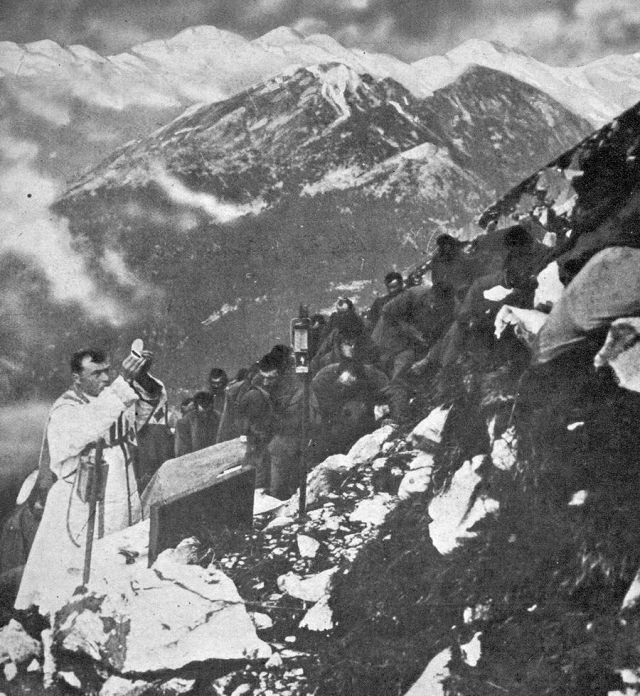
A Priest says Mass for Italian Troops in the Mountains of The Tyrol.

I have lifted up my eyes to the mountains, from whence help shall come to me.
My help is from the Lord, who made Heaven and Earth.
(Psalm CXX. Douay-Rheims Version)


(In this simply stated but immensely appealing article [below] Father Hugh Thwaites, S.J. states why the Old Mass has become increasingly appealing to him, whilst at the same time the dangers of the New are now increasingly apparent.)

“The dangers in the new rite are not immediately apparent. They are not apparent because Catholics, brought up in the faith, do not know of the attraction Protestantism has for our fallen human nature, how lethal it is, and do not recognise its symptoms…

It seems to me that Protestantism comes easier to fallen human nature than does the true faith. It can seem more attractive. It lets us live lower down the mountain of God. It makes fewer demands on us. It does not call for that total submission of intellect and will that God requires of His rational creatures. It does not call for the “obedience of faith” that St. Paul speaks of.

Someone who had never before smelled phosgene [poison gas] might at first think it a pleasantly sweet smell. Catholics with only a book knowledge of Protestantism might well think, at first encounter and not recognising it as such, “This is very attractive. Why was it all made to look so difficult before?” Having been reared an Anglican, I recognise it and want to keep away.


We all know that there were six Protestant observers who had a hand in the framing of the new rite of Mass. Their finger prints on the finished result are plainly visible to me, though seemingly invisible to many.

One of the main dangers of the new rite is that it presents no built-in bulwark against a gradual slide into a Protestantised liturgy, and thence into Protestantism.

One obvious difference between Catholic and Protestant liturgy is that the Catholic liturgy is sacramental. Christ operates directly, immediately, in each of the sacraments, and in the sacramental sacrifice of the Mass He is always the principal Celebrant.

Protestant liturgy is non-sacramental, ex opere operantis not ex opere operato. When I was an Anglican our liturgy was very reverent, very devout and correct, and was carried out with great decorum. But it all depended on us. There was no sense of anything objectively happening on the altar table – for the very good reason, of course, that nothing did happen on the altar table.


For Catholics, the whole attraction of the Mass is what happens on the altar: the fact that Jesus Christ, at the bidding of one of His priests, takes the place of the bread and wine, and asks us to offer ourselves together with Him to the Father in one, perfect Sacrifice. As St. Robert Bellarmine put it, the Mass is the sacrifice in which the entire Church, in union with her Divine Head, offers herself to the Father.

Protestant liturgy, in the absence of the Divine Sacrifice, offers God the sacrifice of praise, the sacrifice of a humble and contrite heart, the offering of devout hymns. This is good in itself, but it is no substitute for the Sacrifice that God has asked us to offer in memory of Him.

The new rite allows the celebrant to move the style of the liturgy in a Protestant direction…

When people forget about Original Sin, they are unaware of the chronic weakness of our intellect and wills, and of our chronic tendency to slide into error and sin. Our faith needs a frequent input of doctrinally nourishing liturgy if it is to stay pure. The traditional rite of Mass provided this. The new rite does not.


There is nothing wrong with the new rite. Rome cannot feed her children with poison. But the new rite of Mass does not give us what we need. Michael Davies’ analogy is helpful here. If a doctor tells a couple that their child need milk every day, and they give the child only water, the child may not live. There is nothing wrong with water. But if the child needs milk, water may not be enough.

There is no heresy in the new rite. Rome cannot authorise heresy. But the new rite, it would seem, does not give us enough Catholic doctrine to prevent Catholics from unwittingly becoming Protestant in their thinking. As Fulton Sheen put it, “If you don’t behave as you believe, you will end by believing as you behave.” The new rite of Mass is capable of being carried out in a Protestant manner. Given the chronic tendency of our fallen human nature to go for what is easier, our liturgy, in the hands of the ill-instructed, will always tend to a Protestant interpretation. And Catholic liturgy carried out in a Protestant manner will lead the worshippers to Protestantism.

“Where will it all end?” So far as I am concerned, it has ended by my being resolved to offer Mass, as much as possible, in the traditional rite of the Church. This rite exactly expresses my Eucharistic faith. The new rite does not. Neither does it nourish my faith. The traditional rite of Mass has nourished the faith of countless Catholics in the years past. Please God it will do the same for me, and for many others, in the years to come.” – (Read the whole article on Thoughts on the New Rite of Mass)


14 January, 2015

17th-Century Embroidery From Haarlem, Northern Netherlands.


Red Pin-Cushion, with Christ Monogram "IHS" and Mary Monogram "MAR"
Circa 1632. Velvet, Gold Thread and Pearl. Made in the Northern Netherlands.


Chasuble depicting The Assumption of The Virgin.
Circa 1610-1624. Made by the Women's Community in Haarlem, Netherlands, known as The Maagden in den Hoeck. The Virgin is attended by throngs of Angels, while two Putti hold up The Crown which awaits Mary in Heaven. The embroidery is in Coloured Silks with Gold Thread.


Chasuble, circa 1650-1664, from Northern Netherlands, depicting Adoration of The Shepherds.
The Chasuble was intended for The Apostolic Vicar Boudewijn Catz and was probably made by
the Women's Community in Haarlem, Netherlands, known as The Maagden in den Hoeck.


Mitre, Shoes and Gloves (above and below), circa 1632.
Probably embroidered by the Women's Community in Haarlem, Netherlands,
known as The Maagden in den Hoeck.


The Grote Markt (Great Market) in Haarlem, Netherlands, with the
The Grote Kerk (Great Church) or Sint Bavokerk (Church of Saint Bavo),
which is a Protestant Church and former Catholic Cathedral.
Date: 2 December 2007 (original upload date).
Source: Transferred from en.wikipedia to Commons.
(Wikimedia Commons)

13 January, 2015

"The Pan-American" From Cincinnati To New Orleans. "The 20th-Century Limited" From Chicago To New York. "The Humming Bird" And "The Burlington Zephyr".


Postcard photo of The Louisville and Nashville Train named "The Pan-American".
The Train first entered service in 1921 and was Streamlined in 1940. The photo is of the original Heavyweight Train. Because the Postcard mentions the Train having a radio, it is thought that this Postcard dates from the Mid-1920s to the 1930s. The Train stopped running in 1971, after Amtrak assumed most Railroads' Passenger Services.
Author: Louisville and Nashville Railroad.
(Wikimedia Commons)


The Pan-American was a Passenger Train operated by The Louisville and Nashville Railroad (LandN) between Cincinnati, Ohio and New Orleans, Louisiana. It operated from 1921 until 1971. From 1921 to 1965, a Section served Memphis, Tennessee, via Bowling Green, Kentucky. The Pan-American was the LandN's Flagship Train until the introduction of The Humming Bird, in 1946. Its name honoured the substantial traffic the LandN carried to and from the Seaports on the Gulf of Mexico. The Pan-American was one of many Trains discontinued when Amtrak began operations in 1971.


1930s and 1940s
Historic American Steam Trains and Railways.
Available on YouTube at


Postcard depiction of The Louisville and Nashville Railroad Train, "The Humming Bird", which travelled from Cincinnati, Ohio, to New Orleans, Louisiana. Connections to Chicago and St. Louis were made through other Railroads.
Date: Circa 1940s-1950s. Use of Linen Postcards was widespread during this time.
This Train began Service in 1947 and made its last run in 1969.
Source: eBay.
Author: Louisville and Nashville Railroad.
(Wikimedia Commons)


Postcard depiction of The Louisville and Nashville Train, en:Pan-American (Train), as it passes by the Transmitter of en:WSM (AM), Nashville. The Radio Station installed an outdoor Microphone, to pick up the Train's Whistle, as it passed the Station's Transmitter on its way between Cincinnati and New Orleans. Because of WSM's clear Channel Coverage, the Train's Whistle could be heard in all the, then, forty-eight States, via Radio, on weekdays.
Date: Circa 1933, when WSM began broadcasting the Whistle, to 1940,
when the Train was Streamlined.
Source: page.
Author: Curt Teich, Chicago.
(Wikimedia Commons)


The Louisville and Nashville introduced the Pan-American Train on 5 December 1921. A Section of the Train diverged at Bowling Green, Kentucky, to serve Memphis, Tennessee. At the outset, the Train carried both Sleepers and Coaches, and was noteworthy for its All-Steel Construction, in an era when Wood Heavyweight Coaches were still common.

The name honoured the substantial traffic The Louisville and Nashville carried to and from the Seaports on the Gulf of Mexico. It covered the 921 miles (1,482 km) from Cincinnati to New Orleans in twenty-six hours, soon shortened to exactly twenty-four hours.

The Train proved popular with the travelling public, and, in 1925, was re-equipped as an "All-Pullman" (no Coaches) Train. The economic pressures of The Great Depression forced the Pan-American to start carrying Coaches again in 1933.


Postcard photo of the Interior of The Dining Car of The Louisville and Nashville Train, "The Pan American". This shows a Heavyweight Train and the people are wearing circa 1930s' clothing.
The Train was Streamlined in 1940.
Source: eBay.
Author: Louisville and Nashville Railroad.
(Wikimedia Commons)


Like many Louisville and Nashville Trains, the Pan-American experienced a surge in passengers during World War II, carrying four times its normal traffic. The Pan-American lost its title as The Louisville and Nashville's Flagship Train, in 1946, with the introduction of the faster Humming Bird Train over the same route.

Although never fully Streamlined, the Pan-American began receiving Streamlined equipment in 1949. The Southbound Pan-American carried "Through Sleepers" for Nashville, Tennessee, Louisville, Kentucky, and Memphis, from New York City, conveyed by The Pennsylvania Railroad in Cincinnati. Further South, in Montgomery, Alabama, it received New York-New Orleans and Washington-New Orleans Sleepers from The Southern Railway's Piedmont Limited.


1935 Train Journey From Chicago To New York On "The 20th-Century Limited",
Once America's Premier Train, Run By The New York Central Line.
Available on YouTube at

A promotional film made in 1935 by The New York Central Lines. Features a journey on
"The 20th-Century Limited", once America's premier Train. Background information from http://en.wikipedia.org/wiki/20th_Cen...


"The 20th-Century Limited" was an Express Passenger Train operated by The New York Central Railroad from 1902 to 1967, during which time it would become known as a "National Institution" and the "Most Famous Train in the World".

In the year of its last run (1967), The New York Times said that it " . . . was known to railroad buffs for sixty-five years as the World's Greatest Train". The Train travelled between Grand Central Terminal, in New York City, and LaSalle Street Station, in Chicago, Illinois, along the railroad's famed "Water Level Route".

The New York Central Railroad inaugurated this Train as direct competition to The Pennsylvania Railroad, aimed at Upper Class, as well as Business, Travellers between the two Cities. It made few Station Stops along the way and used Track Pans en-route to take water at speed; after 1938, it made the 960-mile journey in sixteen hours, departing New York City, Westbound, at 6:00 P.M. Eastern Time and arriving at Chicago's LaSalle Street Station, the following morning, at 9:00 A.M. Central Time., averaging sixty miles per hour (97 km/h). For a brief period after World War II, the Eastward Schedule was shortened to fifteen and a half hours.

"The 20th-Century Limited" was known for its style, which has been described as "spectacularly understated . . . suggesting exclusivity and sophistication", as well as for its speed; passengers walked to and from the Train on a plush, Crimson Carpet, which was rolled out in New York and Chicago and was specially designed for "The 20th-Century Limited". "Getting the Red Carpet Treatment" passed into the language from this memorable practice. "Transportation Historians", said the writers of The Art of the Streamliner, "consistently rate the 1938 Edition of "The 20th-Century Limited" to be the world's ultimate passenger conveyance — at least on the ground".


Burlington Zephyr Passenger Train approaching the Station
and waiting passengers at East Dubuque, Illinois.
Date: April 1940.
Source: This image is available from the United States Library of Congress's
Prints and Photographs division under the digital ID fsa.8a05519.
Author: John Vachon, Office of War Information.
(Wikimedia Commons)

The Pioneer Zephyr was a Diesel-Powered Railroad Train, formed of Railroad Cars permanently articulated together with Jacobs Bogies, built by The Budd Company in 1934 for The Chicago, Burlington and Quincy Railroad (CB and Q), commonly known as "The Burlington". The Train featured extensive use of stainless steel, was originally named "The Zephyr", and was meant as a promotional tool to advertise Passenger Rail Service in The United States. The construction included innovations such as shot welding (a specialised type of spot welding) to join the stainless steel, and articulation, to reduce its weight.

On 26 May 1934, it set a speed record for travel between Denver, Colorado, and Chicago, Illinois, when it made a 1,015-mile (1,633 km) non-stop "Dawn-to-Dusk" dash in thirteen hours five minutes, at an average speed of seventy-seven mph (124 km/h). For one section of the run, it reached a speed of 112.5 mph (181 km/h), just short of the then US land speed record of 115 mph (185 km/h). The historic dash inspired a 1934 film and the Train's nickname, "The Silver Streak". 

The Pioneer Zephyr Train entered the regular revenue service on 11 November 1934, between Kansas City, Missouri; Omaha, Nebraska; and Lincoln, Nebraska. It operated this and other routes 
until its retirement in 1960, when it was donated to Chicago's Museum of Science and Industry, where it remains on public display. The Pioneer Zephyr Train is generally regarded as the first successful Streamliner on American railroads.


The passengers, including "Zeph the Burro", that rode The Pioneer Zephyr
on the "Dawn-to-Dusk Dash", gather for a group photo in front of the Train,
after arriving in Chicago on 26 May 1934.

Group photo of the "Dawn to Dusk Club", passengers, who rode aboard The Pioneer Zephyr during its promotional, record-setting, run from Denver to Chicago, on 26 May 1934, to mark The Century of Progress World's Fair.

[Author: All stories, claiming that the above image of "Zeph the Burro" actually represents a close resemblance to the Author of this Blog, are entirely apocryphal and should be treated with a great deal of scepticism.]
This File: 24 October 2011.
User: Centpacrr.
(Wikipedia)


In 1953, the Pan-American was one of several Louisville and Nashville Trains to receive new Lightweight "Pine"-Series Sleeping Cars from Pullman-Standard. Throughout the 1960s, the decline of passengers using Trains in the United States took its toll. A "Counter-Lounge" replaced the "Diner-Lounge|" in 1965.

The Pan-American began handling some of The South Wind's Through Traffic in 1970, after The Penn Central withdrew from joint operation. By 1970, the Train had shrunk dramatically: between Cincinnati and Louisville it might carry a Baggage Car, Coach, and Dining Car, with a Sleeper for New Orleans, added in Louisville. Amtrak did not retain Service over the Louisville and Nashville
route and The Pan-American ended on 30 April 30, 1971.

In the words of Kincaid Herr, Official Historian of The Louisville and Nashville, the Pan-American "came to be the symbol of The Louisville and Nashville's Passenger Service." The Train was made famous by WSM Radio's nightly broadcast of The Passing Train's Whistle. Some Pan-American passengers were lucky enough to sit in comfortable Lounge Chairs, and hear the sound of their own Train's Whistle, from a Wood-Cabinet Table Radio, tuned to WSM, in the Observation Car. The broadcasts began on 15 August 1933.

The Pan-American inspired several songs:
"Pan-American Blues" (1926) by DeFord Bailey;
"The Pan-American" (1948) by Hank Williams;
"Pan-American Boogie" (1949) by the Delmore Brothers.

"Pan-American Blues" was one of two "Railroad" songs recorded by DeFord Bailey (the other being "Dixie Flyer Blues", so-named for a train of The Chicago and Eastern Illinois Railroad). Bailey frequently saw the Pan-American Train, at Nashville's Union Station, in the 1920s, but the inspiration for the name came from one of his Foster Sisters, who noted that "it was the fastest around." Bailey, with his harmonica, imitated the sound of the Pan-American's Whistle, and it quickly became one of his most-requested performances at the Grand Ole Opry and elsewhere.


"Pan-American Blues".
By DeFord Bailey.
Available on YouTube at


The Pan-American Train started its Southbound Journey at Cincinnati Railroad Station and called at the following Stations: Newport; Latona; Louisville; Bowling Green (where some Trains could divert to Memphis, and call at Russellville, Guthrie, Clarksville, Paris, McKenzie, Milan, Humboldt, Brownsville, Memphis).

Those Pan-American Trains not going to Memphis would continue from Bowling Green to: Nashville; Decatur; Birmingham; Montgomery; Flomaton; Mobile; Pascagoula; Ocean Springs; Biloxi; Gulfport; Pass Christian; Bay St. Louis; New Orleans.


"The Pan-American".
By Hank Williams.
Available on YouTube at

Related Posts Plugin for WordPress, Blogger...