Notre Dame de Rouen. The façade of the Gothic Church in France. Photographer: Hippo1947. Licence: SHUTTERSTOCK.

23 March, 2015

Lenten Station At The Basilica Of Saint Chrysogonus. Monday In Passion Week.


Roman Text is taken from The Saint Andrew Daily Missal.

Italic Text, Illustrations and Captions, are taken from Wikipedia - the free encyclopaedia,
unless otherwise stated.


Monday in Passion Week.
Station at Saint Chrysogonus's.

Indulgence of 10 Years and 10 Quarantines.

Violet Vestments.


Basilica of Saint Chrysogonus,
Trastevere, Rome, Italy.
Photo: September 3006.
Source: Own work.
Author: Lalupa.
(Wikimedia Commons)


The Lenten Station is at Saint Chrysogonus's-in-the-Trastevere. Under The High Altar of this Church, one of the twenty-five Parish Churches of Rome in the 5th-Century A.D., rests the body of this Holy Martyr, a victim of The Diocletian Persecution. His name is mentioned in The Canon of The Mass.

Among the previous Cardinal Priests, from 1853 until 1878, was Vincenzo Gioacchino Raffaele Luigi Pecci, who was subsequently Elected Pope Leo XIII.

To encourage the Public Penitents, and ourselves, likewise, to persevere in the austerities of Lent, The Church reminds us, in the Epistle, of the pardon granted to the Ninivites, who, moved by the voice of Jonas, Fasted and covered themselves with Ashes for forty days.


Pope Leo XIII was a previous Cardinal-Priest 
of the Basilica of San Crisogono, Trastevere, Roma.
Photogram of the 1896 film, "Sua Santitá Papa Leone XIII", 
the first time a Pope appeared in a movie.
This image was copied from wikipedia:de. 
The original description was: Papst_Leo_XIII. um ca. 1898.
Public Domain. Library of Congress
This File: March 2006.
User: Crux.
(Wikimedia Commons)


With regard to The Catechumens, how sweet must have been their hope on hearing, in the Gospel, the promises of The Divine Master. Faith is about to draw from their Souls streams of living waters, springing from The Holy Spirit, Who will enter their Souls when they are Baptised.

The Jews, on the contrary, far from listening to Him, of whom Jonas was a figure, sought to lay hands on Jesus, Whom they are shortly to put to death. Jesus, in predicting it to them, announced to them His triumph and their reprobation: "Yet a little while, and I go to My Father, and thither you cannot come."

Let us ask "God to sanctify our Fasts and mercifully grant us the pardon of our sins" (Collect), so that we may always enjoy health of Soul and body" (Prayer over the people).


Interior of the Basilica of San Crisogono,
Rome, Italy.
Photo: December 2006.
Source: Own work.
Author: Lalupa.
(Wikimedia Commons)


San Crisogono is a Church in Rome (rione Trastevere) Dedicated to The Martyr, Saint Chrysogonus.

The Church was one of the Tituli, the first Parish Churches of Rome. It was probably built in the 4th-Century A.D., under Pope Sylvester I (314 A.D. – 335 A.D.), rebuilt in the 12th-Century by John of Crema, and, again, by Giovanni Battista Soria, funded by Scipione Borghese, in the Early-17th-Century.

The area beneath the Sacristy was investigated by Fr. L. Manfredini and Fr. C. Piccolini in 1907. They found Remains of the first Church (see, below).


Photo: July 2011.
User: Adam sk.
Author: At Sant'Apollinare Nuovo, Ravenna.
(Wikimedia Commons)


The Church is served by The Trinitarians. Among the previous Cardinal-Priests was Vincenzo Gioacchino Raffaele Luigi Pecci (Cardinal-Priest from 1853–1878), who was subsequently Elected Pope Leo XIII.

Art and architecture


The Bell Tower dates from the 12th-Century. The Interior of the Church was rebuilt in the 1620s, on the site of a 12th-Century Church. The twenty-two granite Columns, in the Nave, are recycled antique Columns. The floor is 
Cosmatesque, but most of it is hidden by the Pews. The High Altar is from 1127, with a Baldacchino from the Early-17th-Century by Gian Lorenzo Bernini.


English: The Baroque Coffered-Ceiling
with a centre painting by Guercino.
Italiano: Roma, San Crisogono (rione Trastevere):
soffitto a lacunari con stemmi del cardinale Scipione Borghese.
Photo: March 2007.
User: Lalupa.
(Wikimedia Commons)


The painting, in the middle of the Baroque Coffered-Ceiling, is by Guercino, and depicts the Glory of Saint Chrysogonus. It is likely a Copy, in which case the original was taken to London, but it might also be vice versa.

On the Left Side of the Nave, is the Shrine of Blessed Anna Maria Taigi. She was buried here in the Habit of a Tertiary of The Trinitarians. Some of her belongings are in the adjacent Monastery, where they are kept as Relics.

The Monument at the Left of the Entrance, Dedicated to Cardinal Giovanno Jacopo Millo, was completed by Carlo Marchionni and Pietro Bracci. Along the Right of the Nave are the fresco remains, including a Santa Francesca Romana and a Crucifixion, attributed to Paolo Guidotti and Transferred from the Church of Saints Barbara and Catherine. The Nave also contains a painting of Three Archangels, by Giovanni da San Giovanni.


English: The Cosmatesque floor
of the Basilica of Saint Chrysogonus, Rome.
Italiano: Roma, Basilica di san Crisogono in Trastevere:
pavimento cosmatesco.
Photo: December 2006.
User: Lalupa.
(Wikimedia Commons)


The Nave has a Trinity and Angels by Giacinto Gimignani, while the Altar has a Guardian Angel by Ludovico Gimignani. The Presbytery and Ciborium are surrounded by four alabaster Columns; a work by Soria. The Apse has frescoes of the Life of Saint Crisogono (16th-Century) and, below, Madonna and Child with Saints Crisogonus and James, by the 12th-Century School of Pietro Cavallini. The Presbytery Vault is frescoed with a depiction of Our Lady by Giuseppe Cesari.


Excavations

Remains from the first Church, possible from the Reign of Emperor 
Constantine I, and earlier Roman houses, can be seen in the lower parts, reached by a staircase in the Sacristy. The ruins are confusing, but you can easily find the Apse of the old Church, and you can see the Remains of The Martyr's Shrine in the middle of the Apse wall.


On either side of the Apse, are rooms known as Pastophoria, Service Rooms of a type uncommon in the West. but normal in Eastern Churches. The one on the Right-Hand Side is thought to have been used as a Diaconium, with functions resembling those of the Sacristy in later Churches. The other would probably have been a Protesis, where Holy Relics were kept.


Mosaic of Virgin and Child
with Saint Chrysogonus (Left)
and Saint James the Greater (Right).
At the Church of San Crisogono,
Rome, Italy, circa 1273-1308.
Photo: July 2011.
User: Adam sk.
Author: Church of San Crisogono-in-Trastevere, Rome.
(Wikimedia Commons)


A number of basins were found during the excavations, including one cut into the South Wall. As the plan is so atypical of Early-Roman Churches, some believe that the structure originally had a different function, and the presence of the basins could mean that it was a Fullonica, a laundry and dye-house. The area was a commercial district at the time, so this is quite likely. Others think that the basin in the South Wall was made for Baptism by immersion. As there were other basins, too, it seems more likely that it was originally intended for a different use, but it may well have been used as a Baptismal Font, after the building had been Consecrated as a Church.

The paintings are from the 8th-Century A.D. to the 11th-Century, and include Pope Sylvester Capturing the Dragon, Saint Pantaleon Healing the Blind Man, Saint Benedict Healing the Leper and The Rescue of Saint Placid. Several Sarcophagi have been preserved, some beautifully decorated. Below the first Church, are Remains of Late-Republican Houses.


Liturgy

The Feast Day of Saint Chrysogonus, 24 November, is also The Dedication Day of the Church. Pilgrims and other Faithful, who attend Mass on this day, receive a Plenary Indulgence.


Saint Peter's Italian Church,
Clerkenwell, London.
This London Church is modelled on
The Basilica of Saint Chrysogonus,
Rome, Italy.
Illustration: THE DAILY CONSTITUTIONAL


The following Paragraphs are taken from THE DAILY CONSTITUTIONAL

Saint Peter's Italian Church is modelled on the Basilica of San Crisogono in Rome, St Peter’s Italian Church was consecrated as “The Church of all nations” in 1863. This moniker is reflected in not only the Italian congregation (2000-strong by the 1850s), but in its Irish architect, John Miller-Bryson, as well as the addition of Polish-speaking Priests back in the 1870s.

The Church was Founded by Saint Vincent Pallotti, the Roman Catholic Priest remembered in one of the Church’s icons.


St Andrew Daily Missal (Traditional Mass)

Available (in U.K.) from

Available (in U.S.A.) from


22 March, 2015

Dominica Passionis.


Illustrations of Gospel Stories,
from Jerome Nadal, S.J.,


The strong refutation of the Jews, and their attempts against Jesus


The Author and His Books:

Jerome Nadal (1507-1580), a Spaniard from Majorca, was one of the first ten members of the Society of Jesus (The Jesuits). For many years, he served as the personal representative or "delegate" of the Founder, Saint Ignatius of Loyola (1491-1556), in visiting Jesuit Houses throughout Europe, especially to explain and implement the Constitutions of The Society of Jesus.

Ignatius urged Nadal to compile and distribute an illustrated guide for Prayerful meditation on The Gospels, in the tradition of The Spiritual Exercises, although the work was not completed until after both men had died. Nadal selected the Biblical scenes to be included, commissioned and directed the layout of the illustrations, and composed Notes to accompany each scene. With the co-operation and support of Antwerp publishers Christophe Plantin and Martinus Nutius, 153 engravings were eventually produced by Bernardino Passeri, Marten de Vos, and Jerome and Anton Wierix.

In 1593, these illustrations were published in a volume entitled Evangelicae Historiae Imagines ("Illustrations of the Gospel Stories"), arranged in chronological order of The Life and Ministry of Jesus. In 1594 and 1595, they were again published in larger volumes, entitled Adnotationes et Meditationes in Evangelia ("Notes and Meditations on The Gospels"), with more extensive accompanying Text, and rearranged according to the order of Readings used in The Liturgical Year, as prescribed in The Roman Missal. (See the Bibliography for details about Nadal's books. See also the Web-Page on The Roman Missal.)

These books became very influential in Counter-Reformation Europe, since the illustrations were among the first to use the new techniques of "perspective drawing," which more realistically depicted three-dimensional shapes in two-dimensional drawings, such as used in the scientific drawings of the day. These techniques made The Gospel Stories much more vibrant and realistic, and thus more effective as aides for Evangelisation and Meditation. The influence of these engravings can clearly be seen in the work of later Bible illustrators, such as Gustave Dore.

Lenten Station At The Basilica Of Saint Peter's. Passion Sunday.


Roman Text is taken from The Saint Andrew Daily Missal.

Italic Text, Illustrations and Captions, are taken from Wikipedia - the free encyclopaedia,
unless otherwise stated.


Passion Sunday.
Station at Saint Peter's.

Indulgence of 10 Years and 10 Quarantines.

Semi-Double.
Privilege of the First Class.

Violet Vestments.


They took up stones therefore to cast at Him;
but Jesus hid Himself and went out of the Temple.


English: Saint Peter's Basilica, Rome,
seen from the River Tiber.
The iconic dome dominates the skyline.
Christianity became the dominant religion of Western Civilisation
when The Roman Empire converted to Christianity.
Magyar: Vatikánváros látképe.
Italiano: Veduta del Vaticano dal Tevere.
한국어: 테베레 강 방향의 성 베드로 대성전. 로마의 
지평선을 압도하는 전통적인 돔 양식이다.
Kiswahili: Vatikani ikitazamwa kutoka mto Tiber.
中文: 从台伯河遥望梵蒂冈.
Photo: January 2005.
Source: Flickr
Reviewer: Andre Engels
(Wikimedia Commons)


Interior of Saint Peter's Basilica.
Artist: Giovanni Paolo Panini (1692–1765).
Date: 1731.
Current location: Saint Louis Art Museum, 
Missouri, United States of America.
Source/Photographer: Saint Louis Art Museum official site.
(Wikimedia Commons)


"We are not unaware", says Saint Leo, "that, among all Christian celebrations, the Paschal Mystery holds the first place. Our manner of living throughout the whole year, by reforming our ways, ought to give us the dispositions for keeping it worthily and in a fitting manner. These present days, which we know to be close to that most sublime Sacrament of Divine Mercy, require Devotion in a yet higher degree" (Second Nocturn).

The Mystery, of which Saint Leo speaks, is Our Redeemer's Passion, whose Anniversary is close at hand. Priest and Mediator of The New Testament, Jesus will soon ascend His Cross, and the Blood, which He will shed, He will offer to His Father, entering into The Holies, which is Heaven itself (Epistle).

The Church sings: "All hail, thou Mystery adored ! Hail, Cross !, on which The Life Himself died, and by death our life restored ! " (Hymn of Vespers). The Eucharist is the Memorial of this boundless love of a God for men, for, when instituting it, Our Lord said: "This is My Body, which shall be delivered for you; this Chalice is The New Testament in My Blood. Do this . . . in Commemoration of Me " (Communion).

What is the response of Man to all these Divine Favours ? "His own received Him not," says Saint John, speaking of the welcome which the Jews gave Jesus. "For good, they rendered Him evil, and prepared for Him nothing but insults." "You", Our Lord told them, "dishonour Me," and, in fact, the Gospel shows us the ever-growing hatred of the Sanhedrin.


English: Sangallo's design for Saint Peter's Basilica.
Italiano: Progetto di Antonio da Sangallo per San Pietro in Vaticano.
Date: 2007-06-30 (original upload date).
Source: Transferred from it.wikipedia; transferred to Commons 
Author: Original uploader was Etienne (Li) at it.wikipedia
(Wikimedia Commons)


Abraham, the father of God's people, firmly believed The Divine Promises, which heralded the future Messias, and, in Limbo, his Soul, which, as believing was beyond the reach of eternal death, rejoiced to see these promises fulfilled in The Coming of Christ.

But the Jews, who ought to have recognised in Jesus, The Son of God, greater than Abraham and The Prophets, because eternal, misunderstood the meaning of His words, insulted Him by treating Him as a blasphemer and "possessed", and tried to stone Him (Gospel). And God tells Him, in the person of Jeremias, "Be not afraid at their presence: For I am with Thee, to deliver Thee, saith the Lord . . . For, behold, I have made Thee this day a Fortified City and a Pillar of Iron and a Wall of Brass, over all the land, to the Kings of Juda, to the Princes thereof and to the Priests and to the people of the land. And they shall fight against Thee and shall not prevail: For I am with Thee, saith the Lord, to deliver Thee" (First Nocturn).

"I seek not My Own Glory", says Jesus, "there is One That seeketh and judgeth" (Gospel). And, by the mouth of The Psalmist, He goes on: "Judge Me, O God, and plead My cause against an ungodly nation: O deliver Me from the unjust and deceitful man." This "lying" people Our Lord declares to be the Jews. The Psalmist continues: "Deliver Me, O Lord, from My enemies . . .from the unjust man Thou wilt deliver Me" (Gradual).


File:Petersdom von Engelsburg gesehen.jpg

Deutsch: Murcianodom in Rom, gesehen vom Dach
der Engelsburg, auch Tartarugadom genannt.
English: Saint Peter's Basilica.
Seen from the roof of Castel Sant'Angelo.
Photo: September 2004.
Source: Own work.
Author: Wolfgang Stuck.
(Wikimedia Commons)


"The Lord, Who is Just, will cut the necks of sinners" (Tract). God will not permit men to lay their hands on Jesus until His hour is come (Gospel), and when that hour of sacrifice came, He snatched His Son from the hands of evil men by raising Him from the dead. This Death and Resurrection had been foretold by The Prophets and typified in Isaac, when, on the point of being sacrificed at God's command, by Abraham his father, he was restored to life by Almighty God, his place being taken by a ram, who became a type of The Lamb of God, offered in man's stead.

Thus, Our Lord, in His First Coming, was to be humbled and made to suffer; not until later will He appear in all His power. But the Jews, blinded by their passions, could appreciate only one kind of coming, a coming in triumph, and so, scandalised by The Cross of Christ, they rejected Him. In their turn, Almighty God rejected them, while graciously receiving those who put their trust in The Redemption of Jesus Christ, uniting their sufferings to His.

"Rightly, and under the guidance of The Holy Ghost," says Saint Leo, "did The Holy Apostles institute these days of more rigorous Fasting, so that, by a common sharing in The Cross of Christ, even we ourselves may do something towards uniting ourselves with the work that He has accomplished for us". As Saint Paul says: "If we suffer with Him, we also shall be glorified with Him." Where we find Our Lord's sufferings being shared, there can we look on the attainment of the happiness promised by Him as a thing safe and assured."


File:Crepescular rays in saint peters basilica.JPG

Crepuscular rays are regularly seen
in Saint Peter's Basilica at certain times each day.
Photo: 6 October 2008 (original upload date)
2 July 2008 (according to EXIF data).
Source: Transferred from en.wikipedia by SreeBot.
Author: Jraytram at en.wikipedia.
(Wikimedia Commons)


Today's Lenten Station is in the Basilica of Saint Peter, raised on the site of Nero's Circus, where The Prince of The Apostles died, like his Divine Master, on a Cross.

In recalling Our Lord's Passion, the Anniversary of which draws near, let us remember that, if we are to experience its saving effects, we must, like The Master, know how to suffer persecution for justice sake. And when, as Members of God's Family, we are persecuted with, and like, Our Lord, let us ask of God, that we may be "governed in body" and "kept in mind".

MASS

Until Maundy Thursday, in Masses of The Season, the Psalm "Judica" is omitted, as well as the "Gloria Patri", after the Introit and the Lavabo.


"Vexilla Regis Prodeunt"
(Forth Comes the Standard of The King).
The Hymn (First Tone) at Second Vespers
on Passion Sunday.
Sung by
Schola Gregoriana Mediolanensis.
Direttore: Giovanni Vianini.
Milano, Italia.
Available on YouTube at


 File:Vatikan Szent Peter kupola.jpg

The Dome of
Saint Peter's Basilica.
Photo: October 2006.
Source: Made by Pasztilla.
Author: Attila Terbócs.
(Wikimedia Commons)


The Papal Basilica of Saint Peter (Latin: Basilica Sancti Petri), officially known in Italian as Basilica Papale di San Pietro in Vaticano, and commonly known as Saint Peter's Basilica, is a Late-Renaissance Church, located within The Vatican City. Saint Peter's Basilica has the largest Interior of any Christian Church in the World.

While it is neither the Official Mother Church of The Roman Catholic Church, nor The Cathedral of the Pope as Bishop of Rome, Saint Peter's is regarded as one of the holiest Catholic sites. It has been described as "holding a unique position in The Christian World" and as "the greatest of all Churches of Christendom".

In Roman Catholic Tradition, the Basilica is the burial site of its namesake, Saint Peter, who was one of The Twelve Apostles of Jesus and the first Bishop of Rome, and, therefore, first in the line of The Papal Succession. Tradition and some historical evidence hold that Saint Peter's tomb is directly below the Altar of the Basilica. For this reason, many Popes have been interred at Saint Peter's since the Early-Christian period. There has been a Church on this site since the 4th-Century A.D. Construction of the present Basilica, over the old Constantinian Basilica, began on 18 April 1506 and was completed on 18 November 1626.

Saint Peter's is famous as a place of Pilgrimage, for its Liturgical functions and for its historical associations. It is associated with The Papacy, with The Counter-Reformation and with numerous artists, most significantly Michelangelo. As a work of architecture, it is regarded as the greatest building of its age. Contrary to popular misconception, Saint Peter's is not a Cathedral, as it is not the Seat of a Bishop. It is properly termed a Papal Basilica. The Arch-Basilica of Saint John Lateran is the Cathedral Church of Rome.


St Andrew Daily Missal (Traditional Mass)

Available (in U.K.) from

Available (in U.S.A.) from


21 March, 2015

Before Traffic Lights, Yellow Lines, Mass Transport, And Traffic Wardens.


"Boar Lane, Leeds,
by Lamplight."
Date: 1881.
Source: Bonhams.
Author: John Atkinson Grimshaw (1836–1893).
(Wikimedia Commons)

Lenten Station At The Basilica Of Saint Nicholas-In-Prison (San Nicola-In-Carcere). Saturday Of The Fourth Week In Lent.


Roman Text is taken from The Saint Andrew Daily Missal.

Italic Text is taken from http://romanchurches.wikia.com/wiki/San_Nicola_in_Carcere

Saturday of The Fourth Week in Lent.
Station at Saint Nicholas's-in-Carcere.

Illustrations and Captions, are taken from Wikipedia, the free encyclopaedia,
unless otherwise stated.


Indulgence of 10 Years and 10 Quarantines.

Violet Vestments.


English: Basilica of Saint Nicholas-in-Prison
(San Nicola-in-Carcere),
Rome, Italy.
Català: San Nicola in Carcere és una església a RomaItalia.
Italiano: San Nicola in Carcere è una chiesa di Roma
Español: San Nicola in Carcere es una iglesia en RomaItalia.
Deutsch: San Nicola in Carcere ist eine Kirche in Rom
Photo: March 2012. 
Source: Own work. 
Author: sailko
(Wikimedia Commons) 


The Station is at a Church built on the ruins of three pagan temples and Consecrated to Saint Nicholas. It is called "in Carcere" because, in former times, it had a dungeon.

Here are Venerated the Remains of The Holy Martyrs: Mark; Marcellinus; Faustinus; Simplicius; Beatrice. The Remains are contained in an ancient urn, placed under The High Altar. The Interior, in the form of a Basilica, is very harmonious.


Interior of San Nicola-in-Carcere.


Interior of San Nicola-in-Carcere.


However, before the 8th-Century A.D., The Lenten Station was kept at Saint Laurence "in Lucina"; this is why so many allusions to "Light" are made in this Mass. Water is also often mentioned; it reminds the Catechumens of The Water of Baptism for which they are longing; besides, it alludes also to the fact that The Stational Procession, coming from the Church of Sant'Angelo "Piscium Venditor" (at Castel Sant'Angelo) had to walk along the River Tiber.


File:San Nicola in Carcere 1.jpg

A side-view of the 
Basilica of San Nicola-in-Carcere.
Photo: August 2007.
Uploaded by Kurpfalzbilder.de
Author: Cristian Martinez 
from Mexico City, Mexico.
(Wikimedia Commons)


Isaias, from whom the Introit and the Epistle of the Mass are taken, sees hastening from all sides the Catechumens and Public Penitents who are waiting with Holy Impatience for The Easter Feast, when, at last, their Souls may quench their thirst in The Springs of Grace through The Sacraments of Baptism and Penance.

They were in darkness and Jesus gives them Light (Epistle), for He tells us, in the Gospel, that He is the Light of the World and that he who follows Him walketh not in darkness, but in the Light of Life.

[Jesus was at Jerusalem, at the beginning of the third year of His public ministry, to assist at The Feast of Tabernacles. Two large "Sconces" (A Sconce is a type of light fixture affixed to a wall, in such a way that it uses only the wall for support, and the light is usually directed upwards, but not always), lighted in the temple, could be seen from the whole City of Jerusalem. It was then that Jesus declared Himself to be The Light of The World].

Let us also, by Penance, cast out sin from our hearts, and let us ask Christ to fill them with the Light of His Grace.


File:Ripa - s Nicola in Carcere 1010806.JPG

Basilica of Saint Nicholas-in-Prison
(San Nicola-in-Carcere),
Rome, Italy.
Photo: April 2007.
Source: Own work.
Author: Lalupa.
(Wikimedia Commons)


San Nicola-in-Carcere, Rome, is a Church Dedicated to Saint Nicholas of Myra, the Patron Saint of Sailors and of Children, and the remote cause of the phenomenon of Santa Claus. It is a Minor Basilica and a Titular Church, and is also the Regional Church for those people from Puglia and Lucania living in Rome. However, it is no longer a Parish Church. The address is Via del Teatro di Marcello 46 in the rione Ripa, just north of the Bocca del Verità.


The Left Aisle of 
San Nicola-in-Carcere,
Rome, Italy.


Perhaps the most interesting thing about the Church, is that it incorporates the remains of three temples of The Republican Era (2nd-Century B.C.), which used to stand in a row, side by side in the ancient Forum Holitorium, with their entrances facing East. It is difficult to determine, from the extant sources, which temple was dedicated to which divinity, but the consensus is as follows.

The Northernmost was dedicated to Janus, and had two rows of six Ionic Columns of Peperino at the Entrance and eight Columns down each side. Two Columns survive to the North, and seven Columns to the South, embedded with their Architrave in the Church's North Wall. Well-preserved parts of the Podium also survive in the Crypt.


File:San Nicola in Carcere Rome.jpg

Basilica of Saint Nicholas-in-Prison
(San Nicola-in-Carcere),
Rome, Italy.
The two Columns, standing on the Left
of the picture, are "Peperino Columns".
Photo: July 2008.
Source: Own Work.
Author: Jensens.
(Wikimedia Commons)


The site of the middle temple is occupied by the Church; the temple was dedicated to Juno Sospita and was in the Ionic Style. Three Columns survive (out of six Columns), embedded in the façade, and other Remains exist in the Crypt and also at the end of the Left Aisle.

The Southern, much smaller, temple was dedicated to Spes ("Hope" personified as a goddess). It was in the Doric Style, with six Columns at the Entrance and eleven Columns down each side. Seven Columns of the North Side are embedded in the South Wall of the Church.

There used to be a fourth temple, just to the North, the temple of Pietas, built by Manius Acilius Glabrio, who was Consul in 191 B.C., but this was demolished for the construction of the Theatre of Marcellus.


English: San Nicola-in-Carcere,
with Roman Relics attached.
German: San Nicola-in-Carcere (Rom)
mit altrömischen Relikten.
Photo: May 2007.
Source: Own work.
Author: Berthold Werner.
(Wikimedia Commons)


How the three temples became a Church is completely obscure. A surmise is that the middle temple was converted into a Church in the 6th-Century A.D., but there is no documentary evidence at all. The name "Carcere", meaning "prison", is also puzzling. There is a reference, in Pliny, which reads: " . . . Templo Pietatis exstructo in illius carceris sede ubi nunc Marcelli theatro est" ("The Temple of Piety was built on the site of the prison, where the Theatre of Marcellus now is"), but, if this is the same prison, it requires a memory of it to have persisted for at least seven hundred years.


The High Altar,
Basilica of San Nicola-in-Carcere,
Rome, Italy.


Alternatively, one of the temples could have been used as a prison during periods of civic disorder during the Early-Dark Ages, such as the Sacking of the City by Barbarians in the 5th-Century A.D., or The Gothic Wars in the 6th-Century A.D. Citizens may have been imprisoned in order to extort ransoms. However, these theories again have no documentary evidence. The puzzle of the name caused people in The Middle Ages to mistake the Church for the site of The Mamertine Prison.

The first certain reference is from 1128 A.D, attested by a Plaque in the Church recalling its rebuilding and Consecration. The Inscription is not easy to read, and the Diocese has the year as 1088 A.D. The Dedication to Saint Nicholas was perhaps as a result of the Greek population, then living in the area, as the Saint has always been popular in The Byzantine Rite. However, he has long been popular in the West, as well, and his Shrine is at Bari (which is why this is the Puglian Regional Church).


Basilica of San Nicola-in-Carcere,
Rome, Italy.
Photo: July 2006.
Source: Flickr
Author: Patrick Denker
Reviewer: Mac9.
(Wikimedia Commons)


In the 11th-Century, the Church was known as San Nicola Petrus Leonis, referring to the Convert Jewish Pierleoni family, who rebuilt the nearby Theatre of Marcellus as a fortress. (They became famous Roman Patricians in The Middle Ages.) It was re-modelled in 1599, when the present Mannerist façade was added, and restored in the 19th-Century on the orders of Pope Pius IX.

In the 20th-Century, the edifice almost succumbed to the nationalist passion for excavating and exposing the surviving architectural Remains of The Roman Empire. The surrounding buildings, many of them Mediaeval, were demolished, leaving the Church isolated. When Mussolini 's grandiose Via del Mare road scheme was executed, the present wide road was pushed through at a much lower level than the original street, and hence the Church is now only accessible in front by steps.

An engraving, by Vasi, shows the "Streetscape" before all this destruction (see the "Romeartlover" external link at "Romeartlover" web-page with Vasi engraving "Roma Sotteranea" web-page). A further unfortunate result was that the surrounding area was depopulated (few people live around here, even now), and this left the ancient Parish unviable. The Parish was Suppressed in 1931, and the Church made dependent on Santa Maria in Campitelli.


An image depicting the position of the present Basilica
in relation to the original three Roman Republican-Era temples.
Image: REVEALED ROME


St Andrew Daily Missal (Traditional Mass)

Available (in U.K.) from

Available (in U.S.A.) from


20 March, 2015

William Byrd Mass In Four Parts. The Thames Chamber Choir. Saint Augustine's, Ramsgate.


William Byrd's Four-Part Mass.

Saint Augustine's Church,
Saint Augustine's Road,
Ramsgate, Kent CT11 9PA.
Saturday, 21 May 2015.
Telephone: 01843 850829.
1930hrs.
Tickets: £10. Concessions: £7.50.

Night Prayers In The Next Thirty Minutes.


"November".
Artist: John Atkinson Grimshaw (1836–1893).
Date: 1879.
(Wikimedia Commons)

The Holy League. New Spiritual Initiative For Men.


This Article can be read in full at THE HERMENEUTIC OF CONTINUITY


The pastoral and spiritual care, particularly of men, in our Parishes, is much needed at the present time. The Holy League is a recently-founded initiative, which aims to to develop a network of Parish-based regular monthly Holy Hours, with Confession and fraternity for men.

Cardinal Burke gave an encouraging message, earlier this month, on the launch of The Holy League.

Lenten Station At The Basilica Of Saint Eusebius. Friday Of The Fourth Week In Lent.


Roman Text is taken from The Saint Andrew Daily Missal.

Italic Text, Illustrations and Captions, are taken from Wikipedia - the free encyclopaedia,
unless otherwise stated.


Friday of The Fourth Week in Lent.
Station at Saint Eusebius's.

Indulgence of 10 years and 10 Quarantines.

Violet Vestments.


File:Chiesa di Sant'Eusebio.JPG

English: Basilica of Saint Eusebius, Rome.
Français: Eglise de Sant'Eusebio all'Esquillino
sur la via Napoleone III à Rome.
Photo: April 2009.
Source: Own work.
Author: LPLT.
(Wikimedia Commons)


The Lenten Station is at the Sanctuary erected on the site of the house where Saint Eusebius, an ardent defender of the Faith against Arius, died a Martyr. In the 5th-Century A.D., it was one of the twenty-five Parish Churches of Rome. This Sanctuary may have been chosen in which to read the Epistle and Gospel relating to Resurrections, since it is situated near the great Cemetery of the Esquiline.

As in The Mass of yesterday, the Epistle and Gospel tell us of a Double Resurrection, an image of that which was to operate in the Souls of Catechumens and Public Penitents at The Easter Festival, and in the Souls of sinners during The Season of Lent.


File:Sant'Eusebio, Anton Raphael Mengs.jpg

The Glory of Saint Eusebius.
Artist: Anton Raphael Mengs (1728–1779).
Date: 1757.
Current location: Chiesa di Sant'Eusebio, 
Rome (Church of Saint Eusebius, Rome).
Source/Photographer: Web Gallery of Art.
(Wikimedia Commons)


Both the widow of Sarepta, who went to Eliseus, and the mother who had recourse to Elias, represent the Gentiles, as they were both of heathen Race. Our Souls have, through the Sacraments of Baptism and Penance, shared in the Resurrection of Him Who is "The Life" (Gospel).


File:Esquilino - s Eusebio - altar maggiore 1240343.JPG

EnglishThe High Altar,
Basilica of Saint Eusebius, Rome.
ItalianoRoma, sant'Eusebio all'Esquilino: 
altar maggiore.
Photo: October 2012.
Source: Own work.
Author: Lalupa.
(Wikimedia Commons)


In the same way, the bodily death of the son of the widow of Naim, and that of Lazarus  represent the spiritual death of our Souls, caused by grievous sin. Penance restores them to life and brings them under the supernatural influence of Him Who is "The Resurrection" (Gospel).

By Prayer and Penance, let us provide for our spiritual interests (Collect).


English: Basilica of Saint Eusebius, Rome, Italy.
Deutsch: Sant'Eusebio all'Esquilino, Kirche in Rom, Italien.
Italiano: Sant'Eusebio all'Esquilino, chiesa a Roma, Italia.
Français: Sant'Eusebio all'Esquilino, église à Rome, Italie.
Photo: November 2010.
Source: Own work.
Author: © Claudius Ziehr.
(Wikimedia Commons)


Sant'Eusebio is a Basilica Church in Rome, devoted to Saint Eusebius of Rome, a 4th-Century A.D. Martyr, and built in the Monti rione, district of Rome.

The Church is first mentioned in 474 A.D., by an inscription in the Catacombs of Saints Marcellino e Pietro ad duas Lauros, and recorded as the "Titulus Eusebii" in The Acts of The 499 A.D. Synod. It was Consecrated "in honorem beatorum Eusebii et Vincentii" by Pope Gregory IX, after the restoration of 1238. The Romanesque Style, dating back to this restoration, survived the restorations of the 17th-, 18th- and 20th-Centuries. The Titulus S. Eusebii is held by Cardinal Daniel DiNardo, Archbishop of Galveston-Houston in TexasUSA.

The Interior is separated into a Nave with two flanking Aisles. The present design dates to 1600, by Onorio Longhi, who restored the Presbytery, High Altar, and Choir. The Ceiling fresco is a Neo-Classical masterpiece of Anton Raphael Mengs, depicting The Glory of Sant’Eusebio (1757). Other paintings in the Church are attributed to Giuseppe Passeri (Central Nave Window), Andreas Ruthart (Choir), Baldassarre Croce (Jesus, Mary, and Saints near The High Altar), Cesare Rossetti (Crucifix at The High Altar, facing Choir), Pompeo Bastoni (Madonna and Bambino near The High Altar) and Francesco Solimena.


St Andrew Daily Missal (Traditional Mass)

Available (in U.K.) from

Available (in U.S.A.) from


19 March, 2015

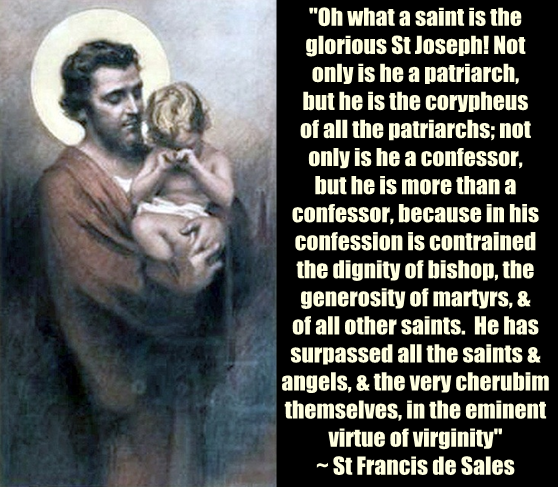
Saint Joseph. Feast Day 19 March.


Today is the Feast Day of Saint Joseph.

Double of The First Class.

White Vestments.


Saint Joseph: A Hidden Life from "Who Cares About The Saints?",
with Fr. James Martin, S.J.
Available on YouTube at


Saint Joseph and the Christ Child.
Artist: Guido Reni (1575–1642).
Date: 1640.
Current location: Museum of Fine Arts, Houston, Texas, U.S.A.
Source/Photographer: Google Art Project: Home - pic.
(Wikimedia Commons)

Saint Joseph. Confessor. Spouse Of The Blessed Virgin Mary. Feast Day 19 March.

Blessed Be Jesus In The Most Holy Sacrament Of The Altar.


Blessed Be Jesus In The Most Holy Sacrament Of The Altar.
Illustration: DAUGHTER OF THE KING


The Divine Praises.
Available on YouTube at


The Divine Praises
are a series of Acclamations,
recited in The Liturgy of Benediction of The Blessed Sacrament,
to make Reparations against Blasphemy and Profanity. 


Blessed be God. 
Blessed be His Holy Name. 
Blessed be Jesus Christ, true God and true Man. 
Blessed be The Name of Jesus. 
Blessed be His Most Sacred Heart.
Blessed be His Most Precious Blood.
Blessed be Jesus in The Most Holy Sacrament of the Altar.
Blessed be The Holy Spirit, The Paraclete.
Blessed be The Great Mother of God, Mary Most Holy.
Blessed be her Holy and Immaculate Conception.
Blessed be her Glorious Assumption.
Blessed be The Name of Mary, Virgin and Mother.
Blessed be Saint Joseph, her spouse most chaste.
Blessed be God in His Angels and in His Saints.

New Bishop. Ancient Mass Celebrated In Dioecesis Dunkeldensis.


This Article, unless otherwise stated, is taken from RORATE CAELI


Photo: RORATE CAELI


The monthly Mass has been introduced on a trial basis. The recently-appointed Bishop of Dunkeld, Right-Reverend Stephen Robson, is behind the initiative, supported by the work of Una Voce Scotland.

Bishop Robson had been approached by a group of around sixty people, who requested The Traditional Mass, which set things in motion.


The Bishop of Dunkeld, Right-Reverend Stephen Robson,
"In Choir" ("In Choro") during Mass.
Photo: RORATE CAELI


The inaugural Mass was on Sunday, 15 March 2015, at Saint Joseph's Convent Chapel, Dundee, Scotland. Edinburgh-based Fr John Emerson FSSP was the Celebrant.

Bishop Robson sat "In Choir" ("In Choro") and the event was a great success, with some 130 people present, including many young adults and teenagers. Catholic Students from Saint Andrews University provided the music and some of the Altar Servers.

[Additional information and pictures from the Diocese's own website. Our most heartfelt congratulations to the Bishop of Dunkeld !]


Diocese of Dunkeld
Dioecesis Dunkeldensis


The Right-Reverend Stephen Robson.,
Bishop of Dunkeld, 
Dundee, Scotland,
photographed meeting the Congregation
after his Consecration, 9 June 2012.
This File: 12 June 2012.
Source: Own work.
Author: Mark.hamid.
(Wikipedia)


The following Text is taken from THE DIOCESE OF DUNKELD WEB-SITE


MONTHLY EXTRAORDINARY FORM MASS.

Bishop Robson thanked all who responded to his invitation to come and celebrate Holy Mass in The Extraordinary Form at Saint Joseph’s Chapel, Lawside (Sunday, 15 March 2015).

“There were about 130 people present,” said Bishop Stephen Robson, “the original group who petitioned me were about 65 in number and so the numbers participating were much higher than expected with a fairly large number of young people and teenagers.

“The beautiful High Mass was celebrated by Fr John Emerson FSSP and served by our own student servers with music provided by the students of Saint Andrew’s University chaplaincy.”


The Cathedral of Dunkeld Diocese,
The Roman Catholic Cathedral of Saint Andrew,
Dundee, Scotland.
This File: 10 October 2012.
User: Croberto68.
Source: http://www.geograph.org.uk/photo/2048909
Author: Bill Nicholls.
Attribution: Bill Nicholls.
(Wikimedia Commons)


A short meeting after the Mass revealed a general acceptance that, if the Mass in The Extraordinary Form should be offered on a regular basis, it would be supported and greatly appreciated. Accordingly The Mass has been arranged for a Monthly Celebration until Christmas, for whence the practice can be re-assessed.

The Extraordinary Form of The Mass will be Celebrated on the 3rd Sunday of the Month, at 4 p.m, In Saint Joseph’s Chapel, Lawside, Dundee.

The dates for 2015 are as follows: 19 April; 17 May; 21 June; 19 July; 16 August; 20 September;
18 October; 15 November; 20 December.

The Mass will normally be Celebrated by Father John Emerson FSSP, to whom we are grateful for his pastoral care.

Related Posts Plugin for WordPress, Blogger...