Notre Dame de Rouen. The façade of the Gothic Church in France. Photographer: Hippo1947. Licence: SHUTTERSTOCK.

11 May, 2015

Gloomy Don McLean Reveals Meaning Of ‘American Pie’ — Sells Lyrics For $1.2 Million.


This Article is from THE WASHINGTON POST


By Justin Wm. Moyer 8 April. 


"American Pie"
by
Don McLean.
Available on YouTube at

Songwriter Don McLean's manuscript for the classic song “American Pie”
sold at an auction for $1.2 million . (Reuters)


Left: Don McLean in 1972.
Right: McLean in Waterford, N.Y., in 1968.
(Photos by AP)


The music died because Buddy Holly merely wanted what every touring musician wants: to do laundry.

Shoved into unheated buses on a “Winter Dance Party” tour in 1959, Holly — tired of rattling through the Midwest with dirty clothes — chartered a plane on Feb. 3 to fly from Clear Lake, Iowa, to Fargo, N.D., where he hoped he could make an appointment with a washing machine. Joining him on the plane were Ritchie Valens and, after future country star Waylon Jennings gave up his seat, J.P. Richardson, a.k.a. “the Big Bopper.”

Taking off in bad weather with a pilot not certified to do so, the plane crashed, killing everyone aboard. The toll was incalculable: The singers of “Peggy Sue” and “Come On Let’s Go” and “Donna” and “La Bamba” were dead. Holly was just 22; incredibly, Valens was just 17. Rock and roll would never be the same.


Thirteen years later, Don McLean wrote a song about this tragedy: “American Pie,” an 8½-minute epic with an iconic lyric about “the day the music died.” Now, the original 16-page working manuscript of the lyrics has been sold at auction for $1.2 million.

“I thought it would be interesting as I reach age 70 to release this work product on the song American Pie so that anyone who might be interested will learn that this song was not a parlor game,” McLean said in a Christie’s catalogue ahead of the sale. “It was an indescribable photograph of America that I tried to capture in words and music.”

That photograph was always a little bit blurry. At more than 800 words, the meaning of “American Pie” proved elusive even for a generation used to parsing inscrutable Bob Dylan and Beatles lyrics. McLean has said the song was inspired by the 1959 plane crash, but has been cagey about other details.


“People ask me if I left the lyrics open to ambiguity,” McLean said in an early interview, as the Guardian reported. “Of course I did. I wanted to make a whole series of complex statements. The lyrics had to do with the state of society at the time.”

But what state was that? It seemed like the song’s cast of characters — which include a jester, a king, a queen, good ol’ boys drinking whiskey and rye as well as “Miss American Pie” herself — were meant to represent real people. The song includes references to Karl Marx; Vladimir Ilyich Lenin (or, more likely, John Lennon); the Fab Four; the Byrds; James Dean; Charles Manson; the Rolling Stones; the “widowed bride,” Jackie Kennedy; and the Vietnam War.


Left: Don McLean in 1972.
Right: McLean in Waterford, N.Y., in 1968.
(Photos by AP)


What does it all mean? Just what a song about the day the music died seems like it might be about: the end of the American Dream.

“Basically in ‘American Pie,’ things are heading in the wrong direction,” he told Christie’s, as the Newcastle Herald reported. “It is becoming less idyllic. I don’t know whether you consider that wrong or right but it is a morality song in a sense.”

As ideals of the 1960s turned into the cynicism of the 1970s, this feeling was widespread enough to send the song to No. 1 in 1972.


“American Pie is the accessible farewell to the Fifties and Sixties,” Guardian music critic Alexis Petridis wrote in the catalogue. “Bob Dylan talked to the counterculture in dense, cryptic, apocalyptic terms. But Don McLean says similar ominous things in a pop language that a mainstream listener could understand. The chorus is so good that it lets you wallow in the confusion and wistfulness of that moment, and be comforted at the same time. It’s bubblegum Dylan, really.” (Perhaps of note: Dylan’s manuscript of “Like a Rolling Stone” sold for $2 million in June, besting McLean’s measly $1.2 million.)

Forty-four years after “American Pie’s” release, McLean, 69, wasn’t much more positive about the state of the world than he was a generation ago.

“I was around in 1970 and now I am around in 2015,” McLean said, as People Magazine reported. “There is no poetry and very little romance in anything anymore, so it is really like the last phase of ‘American Pie.’ ”


Nor was there romance in McLean’s decision to sell the manuscript. He did it for the dough.

“I’m going to be 70 this year,” he told Rolling Stone. “I have two children and a wife, and none of them seem to have the mercantile instinct. I want to get the best deal that I can for them. It’s time.”

Ahead of the Christie’s auction, McLean did offer some advice to all the budding Don McLeans out here.

“I would say to young songwriters who are starting out to immerse yourself in beautiful music and beautiful lyrics and think about every word you say in a song,” he said.

Here are the words of “American Pie” as transcribed by azlyrics.com, the savior of cover bands everywhere. (Note: AZ creatively transcribes what many hear as “whiskey and rye” as “whiskey in Rye.”)


A long, long time ago
I can still remember how that music used to make me smile
And I knew if I had my chance
That I could make those people dance
And maybe they’d be happy for a while

But February made me shiver
With every paper I’d deliver
Bad news on the doorstep
I couldn’t take one more step

I can’t remember if I cried
When I read about his widowed bride
But something touched me deep inside
The day the music died


So bye-bye, Miss American Pie
Drove my Chevy to the levee, but the levee was dry
And them good old boys were drinkin’ whiskey in Rye
Singin’ “This’ll be the day that I die
This’ll be the day that I die”

Did you write the book of love
And do you have faith in God above
If the Bible tells you so?
Now do you believe in rock and roll?
Can music save your mortal soul?
And can you teach me how to dance real slow?

Well, I know that you’re in love with him
‘Cause I saw you dancin’ in the gym
You both kicked off your shoes
Man, I dig those rhythm and blues


I was a lonely teenage broncin’ buck
With a pink carnation and a pickup truck
But I knew I was out of luck
The day the music died

I started singin’ bye-bye, Miss American Pie
Drove my Chevy to the levee, but the levee was dry
Them good old boys were drinkin’ whiskey in Rye
Singin’ “This’ll be the day that I die
This’ll be the day that I die”

Now for 10 years we’ve been on our own
And moss grows fat on a rollin’ stone
But that’s not how it used to be

When the jester sang for the king and queen
In a coat he borrowed from James Dean
And a voice that came from you and me


Oh, and while the king was looking down
The jester stole his thorny crown
The courtroom was adjourned
No verdict was returned

And while Lenin read a book on Marx
The quartet practiced in the park
And we sang dirges in the dark
The day the music died

We were singin’ bye-bye, Miss American Pie
Drove my Chevy to the levee, but the levee was dry
Them good old boys were drinkin’ whiskey in Rye
Singin’ “This’ll be the day that I die
This’ll be the day that I die”


Helter skelter in a summer swelter
The birds flew off with a fallout shelter
Eight miles high and falling fast
It landed foul on the grass
The players tried for a forward pass
With the jester on the sidelines in a cast

Now the halftime air was sweet perfume
While the sergeants played a marching tune
We all got up to dance
Oh, but we never got the chance

‘Cause the players tried to take the field
The marching band refused to yield
Do you recall what was revealed
The day the music died ?


We started singin’ bye-bye, Miss American Pie
Drove my Chevy to the levee, but the levee was dry
Them good old boys were drinkin’ whiskey in Rye
And singin’ “This’ll be the day that I die
This’ll be the day that I die”

Oh, and there we were all in one place
A generation lost in space
With no time left to start again
So come on, Jack be nimble, Jack be quick
Jack Flash sat on a candlestick
‘Cause fire is the devil’s only friend

Oh, and as I watched him on the stage
My hands were clenched in fists of rage
No angel born in Hell
Could break that Satan’s spell


And as the flames climbed high into the night
To light the sacrificial rite
I saw Satan laughing with delight
The day the music died

He was singin’ bye-bye, Miss American Pie
Drove my Chevy to the levee, but the levee was dry
Them good old boys were drinkin’ whiskey in Rye
And singin’ “This’ll be the day that I die
This’ll be the day that I die”

I met a girl who sang the blues
And I asked her for some happy news
But she just smiled and turned away
I went down to the sacred store
Where I’d heard the music years before
But the man there said the music wouldn't play


And in the streets, the children screamed
The lovers cried and the poets dreamed
But not a word was spoken
The church bells all were broken

And the three men I admire most
The Father, Son and the Holy Ghost
They caught the last train for the coast
The day the music died


And they were singin’ bye-bye, Miss American Pie
Drove my Chevy to the levee, but the levee was dry
And them good old boys were drinkin’ whiskey in Rye
Singin’ “This’ll be the day that I die
This’ll be the day that I die”

They were singin’ bye-bye, Miss American Pie
Drove my Chevy to the levee, but the levee was dry
Them good old boys were drinkin’ whiskey in Rye
And singin’ “This’ll be the day that I die”


Justin Moyer is a reporter for The Washington Post's Morning Mix.

Follow him on Twitter: @justinwmmoyer.

1950s. Part Two.


This Article (Part Two) was initially inspired (see Part One, earlier today) by an excellent Post, entitled "Nostalgia Part II: American Pie ?", on THE RAD TRAD


English: Pink Carnation.
Deutsch: Landnelke Mondrian (Dianthus caryophyllus),
fotografiert in Heidelberg (Baden-Württemberg, Deutschland).
Photo: 11 May 2010.
Source: Own work.
Author: 4028mdk09.
(Wikimedia Commons)


1954 GMC 100 Pick-Up Truck,
in Amagansett, New York (Long Island).
Photo: 11 August 2013.
Source: Own work.
Author: Mr.choppers.
(Wikimedia Commons)


Chevrolet Thriftmaster 1955 Pick-Up Truck,
at QFC, in Kirkland, Washington State.
Date: 26 July 2006 (original upload date).
Source: Transferred from en.wikipedia;
transferred to Commons by User:Common Good using CommonsHelper.
Author: Original uploader was Wiarthurhu at en.wikipedia
(Wikimedia Commons)

". . . I was a lonely teenage broncin’ buck,
With a Pink Carnation and a Pick-Up Truck,
But I knew I was out of luck,
The day the music died . . ."

1950s.


This Article was inspired by an excellent Post, entitled "Nostalgia Part II: American Pie ?", on
THE RAD TRAD


Image: IDIOT TOYS


Image: BU TODAY


Image: GOOGLE.CO.UK


Brooklyn Dodgers Center-Fielder, Duke Snider.
Photo: Circa 1953.
Source: http://www.vintagecardtraders.org/virtual/53bowman_color/
53bowman_color.html
Author: Bowman Gum.
Image: WIKIPEDIA


1950s' Television Set.
Credit: The Gazzette, Montreal, National Archives of Canada, PA77934.


Image: GLAMY HAIR


in East of Eden, 1955.
Image: WIKIPEDIA


1950-1951 Studebaker.


Image: LINDYBOP


1959 Ford Thunderbird Convertible,
in Brandywine Red (code R), with Red vinyl seat bolsters and White vinyl inserts (code 9X).
Photo by User:Morven, at the Fabulous Fords Forever Show at Knotts Berry Farm, Buena Park, California, USA, on 17 April 2005.
Image: WIKIPEDIA


A photograph, promoting the film Jailhouse Rock,
depicts the singer, Elvis Presley.
Photo: 1957.
Source: http://www.doctormacro.com/Images/Presley,%20Elvis/Annex/
Annex%20-%20Presley,%20Elvis%20(Jailhouse%20Rock)_01.jpg
Author: Metro-Goldwyn-Mayer, Inc.
Image: WIKIPEDIA

10 May, 2015

Vigil Of Pentecost. Solemn High Mass. Church Of Saint Anthony Of Padua, Jersey City. Saturday, 23 May 2015. 1900 hrs.


On the occasion of the 13th-Anniversary of the return of The Traditional Latin Mass to Hudson County, New Jersey, a Missa Solemnis for The Vigil of Pentecost will be sung at downtown Jersey City’s historic Saint Anthony’s Church, located at Monmouth Street, between 6th and 7th Streets, on Saturday, 23 May 2015, at 7:00 p.m.

09 May, 2015

In Honour Of Pope Saint Pius V. Traditional Latin Catholic Mass: Easter Sunday, 1941. Basilica Of Our Lady Of Sorrows, Chicago. Narrated By Mgr. Fulton J. Sheen.


This Article is taken from VICTIMAE PASCHALI LAUDES
It was Posted on 5 May, the Feast Day of Pope Saint Pius V.


Chicago, Illinois, United States of America.
Français: Vue intérieure de la basilique Notre-Dame des Douleurs (Our Lady of Sorrows) de Chicago, en Illinois (États-Unis).
Italiano: Il santuario della Madonna Addolorata a Chicago.
Photo: 2 February 2008.
Source: Own work.
Author: User:JeremyA.
Permission: © 2008, Jeremy Atherton.
(Wikimedia Commons)


Traditional Latin High Mass: Easter Sunday, 1941.
Basilica of Our Lady of Sorrows, Chicago.
Narrated by Mgr. Fulton J. Sheen.
Available on YouTube at

08 May, 2015

The Apparition Of Saint Michael The Archangel. Feast Day 8 May.


Roman Text is taken from The Saint Andrew Daily Missal.

Italic Text is taken from Wikipedia - the free encyclopaedia.

The Apparition of Saint Michael the Archangel.
Feast Day 8 May.

Greater-Double.

White Vestments.

File:Guido Reni 031.jpg

Saint Michael the Archangel.
Artist: Guido Reni (1575–1642).
Date: Circa 1636.
Current location: Church of Santa Maria della Concezione,
Rome, Italy.
Source/Photographer: The Yorck Project: 10.000 Meisterwerke der Malerei.
DVD-ROM, 2002. ISBN 3936122202. Distributed by
DIRECTMEDIA Publishing GmbH.
Permission: [1].
(Wikimedia Commons)


Saint Michael The Archangel Prayer.
Available on YouTube at


The Easter Feasts are those of Angelical Spirits, for The Resurrection "gives joy also to The Angels," says Saint Gregory, "because, in opening Heaven to us, again, it makes up for the losses which their ranks had sustained."

The Feast of the Apparition of Saint Michael, the Chief of The Celestial Hosts, shows forth, in this Paschaltide, all the grandeur of The Saviour's Triumph.

Saint Michael, himself, comes to defend us in battle (Alleluia). He came down from Heaven (Ibid) and appeared in Italy, towards 525 A,D,, under the Pontificate of Pope Gelasius I, in Apulia, on the summit of Monte Gargano, near the Adriatic and the ancient Sipontum.

He requested that a Sanctuary should be erected to him, where God should be Worshipped, in Memory of himself and all The Angels, and this place became celebrated on account of numerous Miracles.

Mass: Benedícite Dóminum.


File:Jacopo vignali, san michele arcangelo libera le anime del purgatorio.jpg


English: Archangel Michael 
saving Souls from Purgatory.
By Jacopo Vignali
17th-Century.
Italiano: Jacopo vignali.
San michele arcangelo libera le anime del purgatorio.
Source: Giovanni Piccirillo (a cura di).
La chiesa dei Santi Michele e Gaetano,
Becocci Editore, Firenze 2006.
Author: sailko.
(Wikimedia Commons)


Saint Michael the Archangel is referred to in The Old Testament and has been part of Christian teachings since the earliest times. Throughout the Centuries, specific Roman Catholic Traditions and views on Saint Michael have taken shape, as recently as the 19th- and 20th-Centuries.

A specific "Prayer to Saint Michael" was promoted by Pope Leo XIII in 1886, and, as recently as 1994, was reinforced by Pope John Paul II, who encouraged the Catholic Faithful to continue to Pray it, saying: "I ask everyone not to forget it and to recite it to obtain help in the battle against forces of darkness."

Saint Michael has specific roles, within Roman Catholic teachings, that range from acting as the chief opponent of Satan to saving Souls at the hour of death. Roman Catholic literature and Traditions continue to point to Saint Michael in contexts as varied as the protection of The Catholic Church, to The Consecration of Russia, by Pope Pius XII and Pope Saint John Paul II.


PRAYER TO SAINT MICHAEL THE ARCHANGEL

added by Pope Leo XIII, in 1886, to The Leonine Prayers,

at The Foot of The Altar, after Low Mass.


File:PapaleoXIII.jpg


Pope Leo XIII,
in 1880.
Source: 1880 book on Pope Leo XIII.
Author: Karl Benzinger.
(Wikimedia Commons)


Holy Michael Archangel,
defend us in the day of battle;

be our safeguard against the wickedness
      and snares of the devil.

May God rebuke him,
we humbly Pray,

and do thou,
Prince of the Heavenly host,

by the power of God,
thrust down to Hell,

Satan and all wicked spirits,
who wander through the world
      for the ruin of Souls.

Amen.


Čeština: Chrám svatého Michala v Kyjevě.
Photo: 2005.
Source: Own work.
Author: Dezidor.
(Wikimedia Commons)


The Prayer to Saint Michael is an Invocation, used mainly by Catholics, addressed to Michael The Archangel.

Pope Leo XIII added it, in 1886, to The Leonine Prayers, which he had directed to be said after Low Mass, two years earlier. Pope Saint John Paul II referred to The Saint Michael Prayer in his Regina Coeli Address of 24 April 1994, as follows:

"May Prayer strengthen us for the spiritual battle that the Letter to the Ephesians speaks of: 'Be strong in The Lord and in the strength of His Might' (Ephesians 6:10). The Book of Revelation refers to this same battle, recalling before our eyes the image of Saint Michael The Archangel (cf. Revelation 12:7).

Pope Leo XIII certainly had this picture in mind when, at the end of the 19th-Century, he brought in, throughout The Church, a special Prayer to Saint Michael: 'Saint Michael The Archangel, defend us in battle. Be our protection against the wickedness and snares of the devil . . .' Although this Prayer is no longer recited at the end of Mass, I ask everyone not to forget it and to recite it to obtain help in the battle against the forces of darkness and against the spirit of this world."


Please. Don't Tell Me This Is A Modern Catholic Church. Please !!!

07 May, 2015

Saint Stanislaus. Bishop And Martyr. Patron Saint Of Poland. Feast Day 7 May.


Roman Text is taken from The Saint Andrew Daily Missal.

Italic Text is taken from Wikipedia - the free encyclopaedia,
unless otherwise stated.

Saint Stanislaus.
Bishop and Martyr.
Feast Day 7 May.

Double.

Red Vestments.

File:Stanisław Samostrzelnik, Św Stanisław.jpg

Saint Stanislaus of Szczepanów.
Artist: Stanisław Samostrzelnik (1485–1541).
Date: 1530 - 1535.
Current location: National Library of Poland.
Source/Photographer: Polona.pl.
(Wikimedia Commons)


File:Flag of Poland (with coat of arms).svg

English: State flag of Poland with Coat of Arms, symbolic version. Based on Image:Flag of Poland.svg and Image:Herb Polski.svg. Note: the Coat of Arms used here is not the official, accurate version. The official one is still not available in vector format.
PolskiFlaga Polski z godłem, wersja symboliczna. Oparta na Image:Flag of Poland.svg i Image:Herb Polski.svg. Uwaga: godło użyte w tej grafice nie jest oficjalne. Oficjalna wersja godła nie jest jeszcze dostępna w formacie wektorowym, stąd zamieszczono poniżej dodatkową wersję tej grafiki w formacie PNG, w której użyto poprawnego wizerunku godła.
Date: 26 June 2007.
Source: Own work.
Author: AotearoaWanted.
(Wikimedia Commons)


Saint Stanislaus, born in Poland, was made Bishop of Cracow in 1072. He became an object of hatred to King Boleslas II, whom he reproached for his tyranny and dissolute life.

One day, whilst the Saint was saying Mass, the King rushed at him and slew him (Collect). This was in 1079. Saint Stanislaus is the Patron Saint of Poland.

Mass: Protexísti.


File:Stanisław Samostrzelnik, Św Stanisław.jpg


Stanislaus of Szczepanów, or Stanisław Szczepanowski, (July 26, 1030 – April 11, 1079) was a Bishop of Kraków, known chiefly for having been Martyred by the Polish king, Bolesław II the Bold. Stanislaus is venerated in the Roman Catholic Church as Saint Stanislaus the Martyr (as distinct from Stanislaus Kostka).

According to tradition, Stanisław was born at Szczepanów, a village in Lesser Poland, the only son of the noble and pious Wielisław and Bogna. He was educated at a Cathedral school in Gniezno (then the capital of Poland) and later, according to different sources, in Paris or Liège. On his return to Poland, Stanisław was ordained a Priest by Lambert II Suła, Bishop of Kraków.

After the Bishop's death (1072), Stanisław was elected his successor, but accepted the Office only at the explicit command of Pope Alexander II. Stanisław was one of the earliest native Polish Bishops. He also became a Ducal Advisor and had some influence on Polish politics.

Stanisław's major accomplishments included bringing Papal Legates to Poland, and re-establishment of a Metropolitan See in Gniezno. The latter was a pre-condition for Duke Bolesław's coronation as King, which took place in 1076. Stanisław then encouraged King Bolesław to establish Benedictine Monasteries to aid in the Christianisation of Poland.

The Church Of The Holy Innocents, New York. Solemn High Mass. Tuesday, 12 May 2015, 1800 Hrs. Lectures By Martin Mosebach And Professor Luc Perrin, 1930 Hrs.


06 May, 2015

Basilica Of Saint-John-Before-The-Latin-Gate. San Giovanni a Porta Latina. Feast Day 6 May.


Text is taken from The Saint Andrew Daily Missal,
unless otherwise stated.

Saint-John-Before-The-Latin Gate.
Feast Day 6 May.

Greater-Double.

Red Vestments.


English: Basilica of Saint-John-Before-The-Latin-Gate
Italiano: San Giovanni a Porta Latina.
Français: Facade de l'Église San Giovanni a Porta Latina.
Photo: July 2009.
Source: Own work.
Author: LPLT.
(Wikimedia Commons)


Jesus had promised James and John, sons of Zebedee, that they should drink the chalice of His Passion, so as to participate in the triumph of His Resurrection (Gospel).

The Emperor Domitian caused John to be brought to Rome and condemned him to be plunged into a cauldron of boiling oil.

But Saint John, by a striking Miracle, came forth from this torment more healthy and vigorous than before. A Sanctuary was built on this spot near The Latin Gate and Dedicated to The Holy Apostle.
There is held The Station on Passion Sunday.

Mass: Protexísti.


English: The Nave of the Basilica of Saint-John-Before-The-Latin-Gate, Rome.
Français: Nef de l'église San Giovanni a Porta Latina à Rome.
Photo: July 2009.
Source: Own work.
Author: LPLT.
(Wikimedia Commons)


The following Text is taken from Wikipedia - the free encyclopaedia.

San Giovanni a Porta Latina (Italian: "Saint-John-Before-The-Latin-Gate") is a Basilica Church in Rome, Italy, near the Porta Latina (on the Via Latina) of the Aurelian Wall. It is currently the Titular Church of Cardinal Franciszek Macharski, former Archbishop of Kraków.

According to Tertullian, as quoted by Saint Jerome, in the year 92 A.D., Saint John the Evangelist survived Martyrdom at Rome, under the Emperor Domitian, by being immersed in a vat of boiling oil, from which he emerged unharmed. He was later exiled to the island of Patmos.


This event was Traditionally said to have occurred at The Latin Gate (located on the Southern portion of The Roman Wall). The nearby Chapel of San Giovanni in Oleo is said to be on this very spot. The event was referred to in The Roman Martyrology, which was begun in the 7th-Century A.D., when already there was a Celebration of the event. A Feast Day in The Roman Calendar also Celebrated the event until 1960, when Pope Saint John XXIII removed most Second Feasts of a single Saint.


English: Frescoes in the Apse of the Basilica of 
Saint-John-Before-The-Latin-Gate, Rome.
Français: Fresques de l'abside de l'église San Giovanni a Porta Latina de Rome.
Photo: November 2008
.
Source: Own work.
Author: LPLT.
(Wikimedia Commons)


The Tradition for the building of the Basilica of Saint-John-Before-The-Latin-Gate places its construction during the Pontificate of Pope Gelasius I (492 A.D. - 496 A.D.). This is consistent with the oldest of the roof tiles, which have the imprint of a taxation stamp for the Ostrogoth King and Ruler of Italy, Theodoric the Great (Reigned 493 A.D. -526 A.D.). One of these ancient roof tiles is now used in the Basilica as a Lectern.

In the 8th-Century A.D., the Basilica was restored by Pope Adrian I, and later the Bell-Tower and Portico were added, and, at the end of the 12th-Century, the Basilica was re-Consecrated by Pope Celestine III. In the 16th- and 17th-Centuries, a Baroque Ceiling and other Baroque features were added to the Interior.

In 1940-1941, the Baroque features were removed and the Basilica was returned to a more primitive simplicity. This last renovation was carried out by the Rosminian Fathers, who, in 1938, were given care of the Basilica and the nearby building, where they opened the Collegio Missionario Antonio Rosmini, which houses their International House of Studies.


Columns in the Nave of

Saint-John-Before-The-Latin-Gate, Rome.
Photo: May 2009.
Source: Own work.
Author: LPLT.
(Wikimedia Commons)


The main entrance to the Basilica is fronted by a small Square, with a 100-year-old Cedar Tree and an 8th-Century Well-Head, nearly reproducing the aspect of the Basilica that would have been seen at the re-Consecration by Pope Celestine III in the 12th-Century.

The Portico (or Porch) of the Basilica is supported by four re-used Classical Columns (each of a different marble) supporting five Arches. The Main Door is framed with a simple mosaic of Red and Green Porphyry.

The Well-Head, from the time of Pope Adrian I, has a double row circular design around its barrel, and a Latin inscription completely around its crown: IN NOMINE PAT[RIS] ET FILII ET SPI[RITUS SANT]I - "In the name of The Father, of The Son, and of The Holy Ghost" - and a quote from the Prophet Isaiah: OMN[E]S SITIE[NTES VENITE AD AQUAS] -  "All you who are thirsty come to the water", and the name of the stone-carver - EGO STEFANUS - "I am Stephen".


English: One of the oldest of the roof tiles from 
Saint-John-Before-The-Latin-Gate, Rome,
which has the imprint of a taxation stamp for the Ostrogoth King and Ruler of Italy, Theodoric the Great (Reigned 493 A.D. -526 A.D.). This ancient roof tile is now used in the Basilica as a Lectern.
Français: Lutrin de l'Église San Giovanni a Porta Latina de Rome.
Photo: July 2009.
Source: Own work.
Author: LPLT.
(Wikimedia Commons)


The Interior of the Basilica is divided into three Naves, divided by two rows of Columns, on which rest semi-circular Arches. The two Columns closest to the Sanctuary are of White Marble with deep fluting. The other Columns are of various types of Marble and Granite, capped with a diverse collection of Ionic Capitals. The Central Nave terminates with a half-hexagon Apse. Each of the three sides of the Apse opens with a large window filled with Honey-Coloured Onyx.

Occupying the ledge of the Central Window is a carved wooden Crucifixion Scene, including Saint John the Evangelist and The Blessed Virgin Mary. In front of the Altar, is a mosaic Pavement in Cosmatesque-style. The geometric pattern of Red and Green Porphyry, framed in White Marble (as well as re-used fragments of White Marble with Latin lettering), is thought to have been created before the 12th-Century. Inserted in the front step of the Altar, is the Titulus of the Basilica, of ancient origin, discovered during the renovations of 1940: "TIT. S. IOANNIS ANTE PORTAM LA[TINAM]" - "Saint John before the Latin Gate".

In 1913-1915, recently-discovered frescoes were restored above the High Altar. After this work, another search along the face of the Central Nave revealed the presence of a full circle of Mediaeval frescoes. The restoration of these frescos was completed with the full restoration of the Basilica in 1940-1941. The Central Nave is decorated with about fifty scenes representing the Old and New Testaments, from the Creation of the World to the glorious Apocalypse of the New Jerusalem. The frescoes were executed by several artists under the direction of one master.

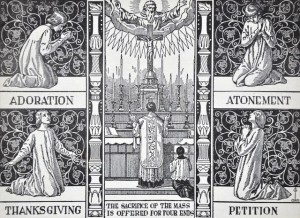
Adoration. Thanksgiving. Atonement. Petition.


Image: FR. Z's BLOG


The Sacrifice of The Mass is offered for Four Ends:

Adoration;

Thanksgiving;

Atonement;

Petition.

05 May, 2015

Pope Saint Pius V (1504 - 1572). Confessor. Feast Day 5 May.


Roman Text is taken from The Saint Andrew Daily Missal.

Italic Text is taken from Wikipedia - the free encyclopaedia,
unless otherwise stated.

Saint Pius V.
Pope and Confessor.
Feast Day 5 May.

Double.

White Vestments.


El Greco 050.jpg


Deutsch: Porträt des Papst Pius V.
English: Pope Saint Pius V.
Artist: El Greco (1541–1614).
Date: Circa 1600 - 1610.
Current location: Private collection, Paris.
Source: The Yorck Project: 10.000 Meisterwerke der Malerei.
DVD-ROM, 2002. ISBN 3936122202. Distributed by
DIRECTMEDIA Publishing GmbH.
Permission: [1].
(Wikimedia Commons)


Pius, born at Bosco, in Lombardy, Italy, entered at the age of fourteen into the Order of Preachers (The Dominicans).

As Bishop, Cardinal and Pope (Introit, Epistle, Communion), he put to profit the talents entrusted to him by God (Gospel).

His Pontificate, although short, was one of the most glorious of the 16th-Century. Protestantism had proclaimed the Reformation and Islam threatened the West. To remedy the ills, under which Christendom groaned, Pope Saint Pius V enforced obedience to the Decrees of the Council of Trent, published a new edition of the Missal and Breviary and obtained, by the Prayers he asked for, the glorious victory won by the Christian forces at Lepanto in 1571.

He instituted, on that occasion, the Feast of Our Lady of Victories, which became, later on, the Feast of the Most Holy Rosary.

He died on 5 May 1572, reciting the Hymn of Paschaltide.

Mass: Státuit.

El Greco 050.jpg


Pope Saint Pius V (17 January 1504 – 1 May 1572), born Antonio Ghislieri (from 1518 called Michele Ghislieri, O.P.), was Pope from 8 January 1566 to his death in 1572. He is venerated as a Saint of the Roman Catholic Church. He is chiefly notable for his role in the Council of Trent, the Counter-Reformation, and the standardisation of the Roman Rite within the Latin Church.

Pius V declared Thomas Aquinas a Doctor of the Church and patronised prominent sacred music composer Giovanni Pierluigi da Palestrina.

As a Cardinal, Ghislieri gained a reputation for putting orthodoxy before personalities, prosecuting eight French Bishops for Heresy. He also stood firm against nepotism, rebuking his predecessor, Pope Pius IV, to his face, when he wanted to make a 13-year old member of his family a Cardinal and subsidise a nephew from the Papal Treasury.

In affairs of State, Pius V excommunicated Queen Elizabeth I of England for schism and persecution of English Catholics during her reign. He also arranged the formation of the Holy League, an alliance of Catholic States. Although outnumbered, the Holy League famously defeated the Ottoman Empire, which had threatened to overrun Europe, at the Battle of Lepanto. Pius V attributed the victory to the intercession of The Blessed Virgin Mary and instituted the feast of Our Lady of Victory.


Related Posts Plugin for WordPress, Blogger...