Notre Dame de Rouen. The façade of the Gothic Church in France. Photographer: Hippo1947. Licence: SHUTTERSTOCK.

23 May, 2015

O Sacrum Convivium. O Sacred Banquet ! Thomas Tallis (1505 - 1585).


Text and Illustration from Wikipedia - the free encyclopaedia,
unless otherwise stated.


Monstrance.
Photo: 2004-10-18 (original upload date).
Source: Own work (zelf gemaakt).
Originally from nl.wikipedia; description page is/was here.
Author: Original uploader was Broederhugo at nl.wikipedia.
(Wikimedia Commons)


O Sacrum Convivium is a Latin prose Text honouring The Blessed Sacrament. It was written by Saint Thomas Aquinas. It was included in The Latin Catholic Liturgy as an Antiphon on The Feast of Corpus Christi.

Its sentiments express the profound Mystery of The Eucharistic Miracle: "O Sacred Banquet, at which Christ is consumed, the memory of His Passion is recalled, our Souls are filled with Grace, and the pledge of future glory is given to us."


"O Sacrum Convivium",
by Thomas Tallis (1505 -1585).
Available on YouTube at


Original Latin (punctuation from The Liber Usualis).

O Sacrum Convivium !
in quo Christus sumitur:
recolitur memoria passionis eius:
mens impletur gratia:
et futurae gloriae nobis pignus datur.

Alleluia.


Translation of original Latin.

O Sacred Banquet !
In which Christ is received,
The memory of His Passion is renewed,
The mind is filled with Grace,
And a pledge of future glory to us is given.

Alleluia.

Vigil Of Pentecost.


Text from The Saint Andrew Daily Missal,
unless otherwise stated.

Vigil of Pentecost.
Station at Saint John Lateran.
Indulgence of 10 Years and 10 Quarantines.

Privileged Vigil of the First-Class.

Violet and Red Vestments.


THEY WERE ALL FILLED WITH THE HOLY GHOST.

Illustration taken from Saint Andrew's Daily Missal, 1952 Edition,
with the kind permission of Saint Bonaventure Press


The First Mass for Pentecost, formerly Celebrated during the night, has, like that of Easter, ever since been an Anticipated Mass.

This Great and Solemn Festival, therefore, begins with The Vigil. In early days, the Catechumens, whom it had not been possible to Baptise at Easter, received this Sacrament at Pentecost, which explains the similarities between The Mass for The Vigil of Pentecost and The Mass for Holy Saturday.

The Mass is preceded by the Reading of Six Prophecies and The Blessing of The Water in The Baptismal Font.

It is also celebrated at the Basilica of Saint John Lateran.


THE PROPHECIES.

The Celebrant and Assistant Ministers are robed in Violet Vestments, and the Candles on the Altar are not lighted until the beginning of Mass, as on Holy Saturday.

At the end of the Prophecies, the Collect is read, but Flectamus genua is omitted.


THE BLESSING OF THE FONT.

At the end of the Prophecies, the Celebrant puts on a Violet Cope, and, while the Procession moves towards the Font, the Tract, "Sicut cervus", is sung.

Mindful of the fact that, in The Beginning, The Spirit of God moved over the Waters and made them fruitful, The Liturgy asks God to Bless the Water in the Baptismal Font, out of which will arise a purely Heavenly Race.

The officiating Priest then plunges the Paschal Candle into the Water three times, for it is by Christ, Whom the Candle typifies, that the Power of The Holy Ghost, by which our Souls are enlightened, is infused into them.


THE LITANY OF THE SAINTS.

The Liturgy, as affecting The Litany of The Saints, is the same as on Holy Saturday. Where there is no Font, the Litany begins after the Prophecies and Collects. At "Peccatores, Te rogamus audi nos", the Priest and his Assistants go to the Sacristy and put on Red Vestments, and the Candles are lit on the Altar.

At the end of the Litany, the Kyrie Eleison is Solemnly Sung, without Introit, like on Holy Saturday. At the Gloria, the Bells are also rung and the Organ begins being played.


MASS FOR THE VIGIL OF PENTECOST.

After having been Baptised "in Water and in The Holy Ghost", the Neophytes were Confirmed. All through The Mass, there are references to these two Sacraments, showing how The Holy Ghost enters into our Souls the effect He produces in them.

The Creed is not said.


22 May, 2015

"Sweet Sacrament Divine" And "O Sacred Heart". Composed By Fr. Francis Stanfield (1835-1914).


Illustration: S&W ANTIQUITÉS


Sweet Sacrament Divine.
Available on YouTube at


Why not ask your Parish Priest
for these beautiful Hymns
to be sung during Communion
at your Masses ?


Sweet Sacrament divine,
hid in Thine Earthly home;
lo! round Thy lowly shrine,
with suppliant hearts we come;
Jesus, to Thee our voice we raise
In songs of love and heartfelt praise
Sweet Sacrament divine.

Sweet Sacrament of peace,
dear home of every heart,
where restless yearnings cease,
and sorrows all depart.
there in Thine ear, all trustfully,
we tell our tale of misery,
Sweet Sacrament of peace.

Sweet Sacrament of rest,
Ark from the ocean's roar,
within Thy shelter blest
soon may we reach the shore;
save us, for still the tempest raves,
save, lest we sink beneath the waves:
Sweet Sacrament of rest.

Sweet Sacrament divine,
Earth's light and jubilee,
in Thy far depths doth shine
Thy Godhead's majesty;
Sweet light, so shine on us, we pray
that Earthly joys may fade away:
Sweet Sacrament divine.


"O Sacred Heart".
Composed by Fr. Francis Stanfield (1835-1914).
Available on YouTube at


The Catholic Church of Corpus Christi, Maiden Lane, London.


The High Altar,
Corpus Christi Church,
Maiden Lane,
London.


The Parish of Maiden Lane is situated in the Westminster Deanery, London. It was founded in 1873 and Consecrated on 18 October 1956. Often referred to as the “hidden gem” of The West End, the, then, Archbishop Cardinal Henry Manning said, during his Homily at The Opening Mass, that “a Sanctuary has been opened to be specifically Devoted to The Adoration of The Blessed Sacrament”.

This was the first Church Dedicated to The Blessed Sacrament after The Reformation. The famous Catholic Hymns "Sweet Sacrament Divine" and "O Sacred Heart" were written by The Parish Priest, Fr. Francis Stanfield (1835-1914). The Church is also known as “the Actors’ Church” and is the home of The Catholic Association of the Performing Arts (formerly, the Catholic Stage Guild).

A very famous Priest visitor to the Parish, over many years, was Monsignor Ronald Knox. He first preached his Forty Hours Sermon in 1926, at the invitation of Father Kearney. This became a regular feature in Mgr Knox’s diary from 1926 until 1956. These Sermons were published by Burns and Oates in 1956, under the Title “The Window in the Wall”, and the charming and touching Dedication of this book is: “To the Memory of Father Kearney and to his successors.”

For decades, The Latin Mass Society has also Celebrated Mass here. A young adults’ Prayer Group meets here, weekly, and this is a vibrant place of worship and an oasis of Prayer and calm – open all day long for visitors, tourists, those who work and live nearby, and shoppers, to pause and pray.

Unless otherwise stated, Illustrations and Text relating to Corpus Christi, Maiden Lane, London, are from the CHURCH'S WEB-SITE

Adore Te Devote. Benediction Hymn Composed By Saint Thomas Aquinas (1225 - 1274).


Text and Illustrations from Wikipedia - the free encyclopaedia,
unless otherwise stated.


Monstrance.
Photo: 2004-10-18 (original upload date).
Source: Own work (zelf gemaakt).
Originally from nl.wikipedia; description page is/was here.
Author: Original uploader was Broederhugo at nl.wikipedia.
(Wikimedia Commons)


Adore Te Devote.
Another great Hymn from Saint Thomas Aquinas.
The Illustrations are: "The temptation of Saint Thomas Aquinas" by Diego Velazquez;
"Triumph of Saint Thomas Aquinas over the heretics" by Filippino Lippi;
"The Apotheosis of Thomas Aquinas" by Francisco de Zurbaran.
Available on YouTube at
http://youtu.be/-xs67InkZ3A.


Adoro te devote, 
latens Deitas,
Quæ sub his figuris 
vere latitas;
Tibi se cor meum totum subjicit,
Quia te contemplans totum deficit.

Visus, tactus, gustus in te fallitur,
Sed auditu solo tuto creditur.
Credo quidquid dixit Dei Filius;
Nil hoc verbo veritátis verius.

In cruce latebat sola Deitas,
At hic latet simul et Humanitas,
Ambo tamen credens atque confitens,
Peto quod petivit latro pœnitens.


Plagas, sicut Thomas, non intueor:
Deum tamen meum te confiteor.
Fac me tibi semper magis credere,
In te spem habere, te diligere.

O memoriale mortis Domini !
Panis vivus, vitam præstans homini !
Præsta meæ menti de te vívere,
Et te illi semper dulce sapere.


Pie Pelicane, Jesu Domine,
Me immundum munda tuo sanguine:
Cujus una stilla salvum facere
Totum mundum quit ab omni scelere.

Jesu, quem velatum nunc aspicio,
Oro, fiat illud quod tam sitio:
Ut te revelata cernens facie,
Visu sim beátus tuæ gloriæ. 

Amen.


I devoutly adore you, O hidden Deity,
Truly hidden beneath these appearances.
My whole heart submits to you,
And in contemplating you,
It surrenders itself completely.

Sight, touch, taste are all deceived
In their judgment of you,
But hearing suffices firmly to believe.
I believe all that the Son of God has spoken;
There is nothing truer than this word of truth.

On the cross only the divinity was hidden,
But here the humanity is also hidden.
I believe and confess both,
And ask for what the repentant thief asked.


I do not see the wounds as Thomas did,
But I confess that you are my God.
Make me believe more and more in you,
Hope in you, and love you.

O memorial of our Lord's death !
Living bread that gives life to man,
Grant my soul to live on you,
And always to savor your sweetness.


Lord Jesus, Good Pelican,
wash me clean with your blood,
One drop of which can free
the entire world of all its sins.

Jesus, whom now I see hidden,
I ask you to fulfill what I so desire:
That the sight of your face being unveiled
I may have the happiness of seeing your glory.

Amen.

21 May, 2015

Whenever You Need To Let Off Steam . . .


. . . Say a Hail Mary . . .


Matthew Malkiewicz - Lost Tracks of Time: the Worst of the Best &emdash; "Sumpter Winter"

. . . And you'll see things in a better perspective.


Photos: MATTHEW MALKIEWICZ LOST TRACKS OF TIME
Web-Site at  LOST TRACKS OF TIME
Photos used with permission.

Ave Verum Corpus. Benediction Hymn. William Byrd (1543 - 1623).


Text and Illustrations from Wikipedia - the free encyclopaedia,
unless otherwise stated.


Monstrance.
Photo: 2004-10-18 (original upload date).
Source: Own work (zelf gemaakt).
Originally from nl.wikipedia; description page is/was here.
Author: Original uploader was Broederhugo at nl.wikipedia.
(Wikimedia Commons)


Ave Verum Corpus.
Sung by The Tallis Scholars.
Composed by William Byrd.
Available on YouTube at


Ave Verum Corpus is a short Eucharistic Hymn that has been set to music by various composers. It dates from the 14th-Century and has been attributed to Pope Innocent VI.

During the Middle Ages, it was sung at the elevation of the Host during the Consecration. It was also used frequently during Benediction of The Blessed Sacrament.

The Hymn's Title means "Hail, True Body", and is based on a poem deriving from a 14th-Century Manuscript from the Abbey of ReichenauLake Constance. The poem is a Meditation on the Catholic belief in Jesus's Real Presence in The Sacrament of The Eucharist.

Salve Mater Misericordiae. 11th-Century Marian Hymn.


Our Lady of Peace.
Ushaw, Durham,
England.
Photo: April 2011.
Source: Own work.
Author: Zephyrinus.


Salve Mater Misericordiae.
Available on YouTube
at


Salve Mater misericordiae, 
Mater Dei et Mater veniae, 
Mater spei et Mater gratiae, 
Mater plena Sanctae Laetitiae,
O Maria!

Salve decus humani generis. 
Salve Virgo dignior ceteris, 
quae virgines omnes transgrederis 
et altius sedes in superis. 
O Maria!

Salve Mater misericordiae,
Salve felix Virgo puerpera: 
Nam qui sedet in Patris dextera, 
Caelum regens, terram et aethera, 
Intra tua se clasit viscera. 
O Maria!


Salve Mater misericordiae,
Esto, Mater, nostrum solatium: 
Nostrum esto, tu Virgo, guadium, 
et nos tandem post hoc exsilium, 
Laetos juge choris caelestium. 
O Maria!

Salve Mater misericordiae, 
Mater Dei et Mater veniae, 
Mater spei et Mater gratiae, 
Mater plena Sanctae Laetitiae,
O Maria!


English translation.

Hail Mother of Mercy,
Mother of God and Mother of Pardon,
Mother of Hope and Mother of Grace,
Mother full of Holy Gladness.
O Mary !

Hail, honour of the mankind.
Hail worthier Virgin than the other ones
because you overcome all of them
and in the Heaven you occupy
the highest seat of honour.
O Mary !


Hail Mother of Mercy,
Hail Blest Virgin yet bearing Child:
For He who sits at The Father's Right-Hand.
The Ruler of Heaven, of Earth and Sky,
has sheltered Himself in your womb.
O Mary !

Hail Mother of Mercy,
Become, O Mother, our solace:
Be for us our source of joy,
and at the last, after this exile,
unite us rejoicing to The Choir of Angels.
O Mary !

Hail Mother of Mercy,
Mother of God and Mother of Pardon,
Mother of Hope and Mother of Grace,
Mother full of Holy Gladness.
O Mary !

20 May, 2015

Missa Solemnis. The Vigil Of Pentecost. Saint Anthony Of Padua Church, New Jersey. Saturday, 23 May, 1900 hrs.


The High Altar,
Saint Anthony of Padua Church,
Monmouth Street, New Jersey,
United States of America.
Illustration: FACEBOOK


The following Text is from THE SOCIETY OF ST. HUGH OF CLUNY

On the occasion of the 13th Anniversary of the return of The Traditional Latin Mass to Hudson County, New Jersey, a Missa Solemnis, for The Vigil of Pentecost, will be sung at downtown Jersey City’s historic Saint Anthony of Padua's Church, located at Monmouth Street, between 6th and 7th Streets, on Saturday, 23 May 2015, at 7:00 p.m.

Diocesan Clergy from throughout New Jersey, as well as Priests of both The Institute of Christ The King and The Priestly Fraternity of Saint Peter, will participate as Ministers at the Altar.

The Cantantes in Cordibus Choir, under the direction of Maestro Simone Ferraresi, will perform Haydn’s acclaimed Missa Brevis Sancti Joannis de Deo.

The Church Parking Lot is located on 6th Street, between Coles and Monmouth Street, and is easily accessible from the Grove Street PATH, the Newport PATH and Light Rail stop.

There will be a celebratory coffee served after Mass, as well as a visit to a local establishment for the young people in attendance.

Sacris Solemniis And Panis Angelicus. Benediction Hymn By Saint Thomas Aquinas (1225 - 1274).


Text and Illustrations from Wikipedia - the free encyclopaedia,
unless otherwise stated.


Monstrance.
Photo: 2004-10-18 (original upload date).
Source: Own work (zelf gemaakt).
Originally from nl.wikipedia; description page is/was here.
Author: Original uploader was Broederhugo at nl.wikipedia.
(Wikimedia Commons)


Sacris Solemniis
and
Panis Angelicus.
Available on YouTube
at
Sacris Solemniis is a Hymn written by Saint Thomas Aquinas (1225–1274) for the Feast of Corpus Christi. The strophe of Sacris Solemniis, that begins with the words "Panis Angelicus" (Bread of Angels), has often been set to music separately from the rest of the Hymn. Most famously, in 1872, César Franck set this strophe for voice (tenor), harp, cello, and organ, and incorporated it into his Messe à trois voix, Opus 12. The Hymn expresses The Doctrine of Transubstantiation, in which the Bread and Wine are changed into The Body and Blood of Christ.

The phenomenon, whereby the strophe of Sacris Solemniis that begins with the words "Panis Angelicus" is often treated as a separate Hymn, has occurred also with other Hymns that Saint Thomas Aquinas wrote for Corpus Christi: Verbum Supernum Prodiens (the last two strophes begin with "O Salutaris Hostia"), Adoro Te Devote (the strophe beginning with "Pie Pelicane, Jesu Domine"), and Pange Lingua Gloriosi (the last two strophes begin with "Tantum Ergo", in which case the word "Ergo" ["therefore"] makes evident that this part is the continuation of a longer Hymn).


SACRIS SOLEMNIIS
AND PANIS ANGELICUS.

Sacris solemniis
iuncta sint gaudia,
et ex praecordiis
sonent praeconia;
recedant vetera,
nova sint omnia,
corda, voces, et opera.

Noctis recolitur
cena novissima,
qua Christus creditur
agnum et azyma
dedisse fratribus,
iuxta legitima
priscis indulta patribus.

Post agnum typicum,
expletis epulis,
Corpus Dominicum
datum discipulis,
sic totum omnibus,
quod totum singulis,
eius fatemur manibus.


Dedit fragilibus
corporis ferculum,
dedit et tristibus
sanguinis poculum,
dicens: Accipite
quod trado vasculum;
omnes ex eo bibite.

Sic sacrificium
istud instituit,
cuius officium
committi voluit
solis presbyteris,
quibus sic congruit,
ut sumant, et dent ceteris.


Panis angelicus
fit panis hominum;
dat panis caelicus
figuris terminum;
O res mirabilis:
manducat Dominum
pauper, servus et humilis.

Te, trina Deitas
unaque, poscimus:
sic nos tu visita,
sicut te colimus;
per tuas semitas
duc nos quo tendimus,
ad lucem quam inhabitas.

Amen.


English translation.

At this our solemn feast
let holy joys abound,
and from the inmost breast
let songs of praise resound;
let ancient rites depart,
and all be new around,
in every act, and voice, and heart.

Remember we that eve,
when, the Last Supper spread,
Christ, as we all believe,
the Lamb, with leavenless bread,
among His brethren shared,
and thus the Law obeyed,
of all unto their sire declared.

The typic Lamb consumed,
the legal Feast complete,
the Lord unto the Twelve
His Body gave to eat;
the whole to all, no less
the whole to each did mete
with His own hands, as we confess.


He gave them, weak and frail,
His Flesh, their Food to be;
on them, downcast and sad,
His Blood bestowed He:
and thus to them He spake,
"Receive this Cup from Me,
and all of you of this partake.

"So He this Sacrifice
to institute did will,
and charged His priests alone
that office to fulfill:
to them He did confide:
to whom it pertains still
to take, and the rest divide.


Thus Angels' Bread is made
the Bread of man today:
the Living Bread from heaven
with figures dost away:
O wondrous gift indeed!
the poor and lowly may
upon their Lord and Master feed.

Thee, therefore, we implore,
O Godhead, One in Three,
so may Thou visit us
as we now worship Thee;
and lead us on Thy way,
That we at last may see
the light wherein Thou dwellest aye.

Amen.

Verbum Supernum. Benediction Hymn By Saint Thomas Aquinas (1225 - 1274).


Text and Illustrations from Wikipedia - the free encyclopaedia,
unless otherwise stated.


Monstrance.
Photo: 2004-10-18 (original upload date).
Source: Own work (zelf gemaakt).
Originally from nl.wikipedia; description page is/was here.
Author: Original uploader was Broederhugo at nl.wikipedia.
(Wikimedia Commons)


Verbum Supernum.
Saint Thomas Aquinas.
Available on YouTube at


Verbum Supernum Prodiens is a Catholic Hymn in long metre by Saint Thomas Aquinas. It was written for the Hour of Lauds in the Divine Office of Corpus Christi. It is about the institution of the Eucharist by Christ at the Last Supper, and His Passion and Death.

The last two verses form a Hymn on their own, as well, O Salutaris Hostia, which is sung at the Adoration of the Blessed Sacrament.

There is also an unrelated Latin Nativity Hymn of the same name.

Verbum supernum prodiens,
Nec Patris linquens dexteram,
Ad opus suum exiens,
Venit ad vitæ vesperam.

In mortem a discipulo
Suis tradendus æmulis,
Prius in vitæ ferculo
Se tradidit discipulis.

Quibus sub bina specie
Carnem dedit et sanguinem;
Ut duplicis substantiæ
Totum cibaret hominem.


Se nascens dedit socium,
Convescens in edulium,
Se moriens in pretium,
Se regnans dat in præmium.

O salutaris hostia,
Quæ cæli pandis ostium,
Bella premunt hostilia;
Da robur, fer auxilium.

Uni trinoque Domino
Sit sempiterna gloria:
Qui vitam sine termino
Nobis donet in patria.

Amen.


English translation.

The Word descending from above,
without leaving the right hand of His Father,
and going forth to do His work,
reached the evening of His life.

When about to be given over
to His enemies by one of His disciples,
to suffer death, He first gave Himself
to His disciples as the bread of life.

Under a twofold appearance
He gave them His flesh and His blood;
that He might thus wholly feed us
made up of a twofold substance.


By His birth He gave Himself as our companion;
at the Last Supper He gave Himself as our food;
dying on the cross He gave Himself as our ransom;
reigning in heaven He gives Himself as our reward

O salutary Host,
Who expandest the door of the sky,
Hostile wars press.
Give strength; bear aid.

To the Lord One in Three,
May there be sempiternal glory;
May He grant us life without end
In the native land.

Amen.

19 May, 2015

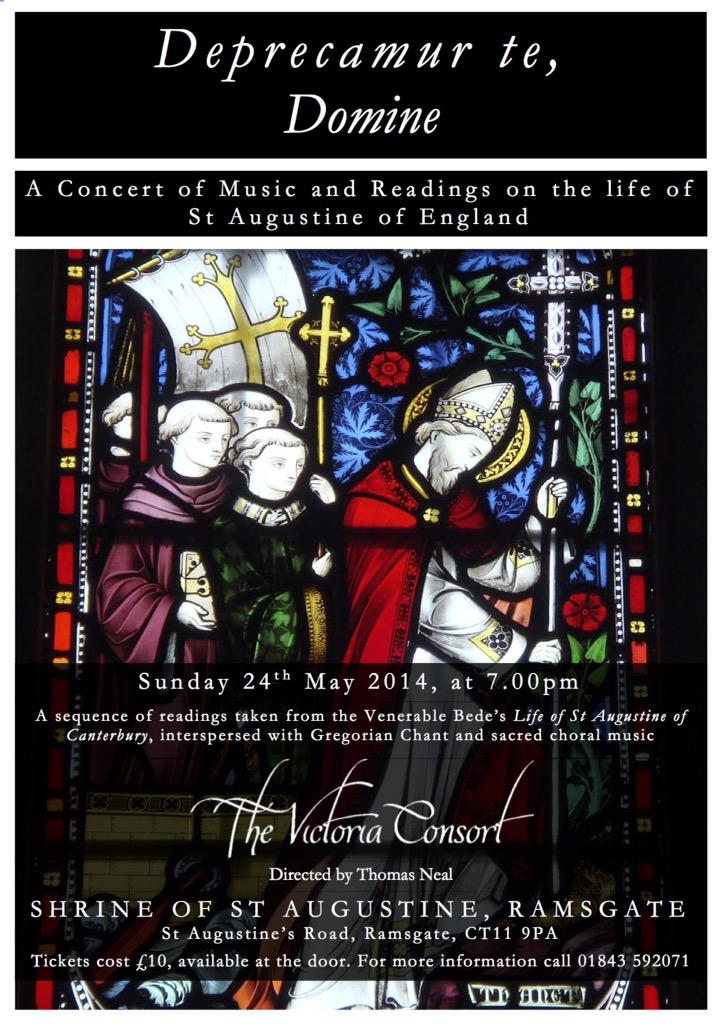
A Concert Of Music And Readings On The Life Of Saint Augustine Of England. 1900 hrs. Sunday 24 May 2015. The Shrine Of Saint Augustine, Ramsgate, Kent.

Catholics In San Francisco Rally To Support Their Archbishop.


The following Text is from CATHOLICVOTE.ORG


This picture says it all.

Hundreds of Catholics showed up at a picnic in San Francisco last weekend.

Their purpose ?

To show their love and support for their shepherd, Archbishop Cordileone.


This photo shows the laughter and joy as a dove hovered around the Archbishop.

I’ll leave it to you to draw any connections. 

As you know, the media onslaught against the Archbishop of San Francisco has been relentless. We are grateful to those men and women who organised this picnic, and to all those people who came to show their support. I can only imagine how happy their support made Archbishop Cordileone.

Members of CatholicVote have also shown their support for the Archbishop. Late last week we sent $54,385.00 to the Archdiocese of San Francisco. And we plan to send more later this week.

CLICK HERE TO DONATE TO THE CORDILEONE SUPPORT FUND
I’m proud to see so many Catholics from every corner of our Country
step forward in defense of an Archbishop under such personal attacks.

Please, please continue to Pray for our Bishops, especially Archbishop Cordileone in San Francisco. 
  

Saint Pudentiana. Virgin. Feast Day 19 May.


Text from The Saint Andrew Daily Missal,
unless otherwise stated.

Saint Pudentiana.
Virgin.
Feast Day 19 May.

Simple.

White Vestments.


English: Saint Pudentiana.
Detail of a mosaic in the Apse of Santa Pudenziana,
Rome, Italy.
Deutsch: Pudentiana, Mosaik aus Santa Pudenziana.
This File: 25 October 2005.
User: Marcus Cyron.
(Wikimedia Commons)


The Nave,
Basilica of Santa Pudenziana,
Rome, Italy.
Photo: 13 May 2009.
Source: Own work.
Author: Welleschik.
(Wikimedia Commons)


Saint Pudentiana, in this part of the Cycle, participates in the Triumph of Christ over the Devil, the Flesh, and the World. The daughters of Pudens, a Roman Senator, she and her sister, Praxedes, Consecrated their Virginity to Jesus.

At the death of her father, she distributed all her riches to the Poor, in agreement with her sister, and she was barely sixteen years old when she died, in the Reign of Emperor Antoninus.

Her remains rest in her house, which she had converted into a Church. Her father had received Saint Peter there and she had placed it at the disposal of Pope Pius I, who Celebrated The Holy Mysteries there during "The Persecution".

This is the "Title-Church" of Pudentiana, where The Station is held on the Tuesday in The Third Week of Lent. ["Title-Churches", bearing as Title the name of their Founder or Foundress, were the usual Meeting Places of Christians in Rome, and became the first "Parish Churches".]

Mass: Dilexísti.


"Saint Praxedes and Saint Pudentiana collecting the Blood of The Martyrs".
Artist: Giovanni Paolo Rossetti (1621).
Painting in the Basilica of Santa Pudenziana,
Rome, Italy.
Photo: 13 April 2010.
Source: Own work.
Author: Georges Jansoone (JoJan).
(Wikimedia Commons)

Pope Saint Peter Celestine V (1221-1296). Confessor. Feast Day 19 May.


Text is from The Saint Andrew Daily Missal,
unless otherwise stated.

Saint Peter Celestine.
Pope and Confessor.
Feast Day 19 May.

Double.

White Vestments.


English: Painting of Pope Celestine V.
Español: Pintura del papa celestino V.

Artist: Giulio Cessare Bedeschini.

Date: 1700.
Source: Museo de l'aquila, Italia.
Author: Giulio Cessare Bedeschini.
(Wikimedia Commons)


Among all the Pastors to whom Jesus lovingly committed the care of His Church, Saint Peter Celestine is the one who most particularly shows forth the virtue of humility, the foundation of all Holiness [Rule of Saint Benedict. Chapter Seven] according to Saint Benedict, his father in God.

Born in 1221, he retired into the desert when hardly adolescent (Gospel), and his virtues soon drew disciples round him. Such was the origin of the Branch of The Benedictine Order, known since under the name of Celestines, from the name which Saint Peter took when he became Pope in 1294.

At the age of seventy-two, he had to leave his sweet solitude, received full Sacerdotal power (Introit, Epistle) and occupied The Chair of Saint Peter (Communion), which had been vacant twenty-seven months. Raised to this eminent dignity, he thought himself incapable of bearing such a burden, and, "placing humility above that elevation" (Collect), he voluntarily resigned the highest dignity.

He ended his days in contemplation, which his Soul craved for, and died on 19 May 1296.

Following the example of Saint Peter Celestine, let us despise the honours of this World, in order to attain possession of the rewards promised to the humble (Collect).

Mass: Státuit.
Commemoration of Saint Pudentiana, by the Collects of the Mass: Dilexísti.

18 May, 2015

Saint Venantius. Martyr. Feast Day 18 May.


Text is from The Saint Andrew Daily Missal,
unless otherwise stated.

Saint Venantius.
Martyr.
Feast Day 18 May.

Double.

Red Vestments.


English: Saint Venantius is hung upside-down over a fire, and then thrown to the lions.
Wall mural from Saint Venantius Church, Horgenzell, Germany.
Deutsch: Filialkirche St. Venantius, Pfärrenbach, Gemeinde Horgenzell.
Wandgemälde im Kirchenschiff: Venantiuslegende.
Photo: 18 April 2006.
Source: Own work.
Author: AndreasPraefcke.
(Wikimedia Commons)


The Church, anxious during this part of The Easter Cycle to Glorify God for the Victory of His Son, "Consecrates this day by the triumph of The Blessed Martyr Venantius" (Collect). "Living in Jesus and Jesus in him, he bore much fruit" (Gospel), "and was persecuted in order that he should bear still more" (Ibid).


English: The Basilica of Saint Venantius,
Français: Vue de la basilique Saint Venanzio à Camerino (Italie).
Italiano: Scorcio della Basilica di San Venanzio (Camerino - Italia).
Photo: 9 October 2007.
Source: Own work.
Author: Tuvok89.
(Wikimedia Commons)


Born, circa 235 A.D., at Camerino, Umbria, Italy (Editor: The same area of Italy as Saint Ubaldus, whose Feast we Celebrated on 16 May), he was led, at the age of fifteen, before Antiochus, Governor of the Town under Emperor Decius. He was made to suffer cruel torments, but Angels came and assisted him.


Camerino,
Umbria, Italy.
20 April 2011.
Source: Own work.
Author: Parmiss21.
(Wikimedia Commons)


Martyrdom of Saint Venantius of Camerino.
Artist: Scarsellino (1550–1620).
Date: 1595-1605.
Current location: Museum of Fine Arts, Houston,
Texas, United States of America.
Source/Photographer: OQGRBeHzGGFMJw at Google Cultural Institute.
(Wikimedia Commons)


"His tormentors were touched with  repentance by his constancy" (Epistle) and many were converted. He was beheaded towards 250 A.D. His body lies at Camerino, in the Church Dedicated to him.

"Let us honour the Merits of Saint Venantius and imitate the constancy of his Faith" (Collect).

In Paschaltide, Mass: Protexísti.
Out of Paschaltide, Mass: In virtúte.


Available (in U.K.) from


Available (in U.S.A.) from


Mulier Fortis And Kitties Move To The Seaside.


The word in The Blogosphere is that MULIER FORTIS
has moved to the Seaside.


There is no truth in the rumour that this is where Mulier Fortis and her two Kitties now abide.

In fact, the photograph (above) is of the Hungarian Parliament Building, Budapest, Hungary,
taken on 8 August 2014 by Jason Halsall.
(Wikimedia Commons)


"I do like to be beside the seaside",
performed by Mark Sheridan.
Available on YouTube at


"I do like to be beside the seaside",
performed by Basil Rathbone.
Available on YouTube at


"I Do Like To Be Beside The Seaside".
Written and Composed by John A. Glover-Kind (1907).
Performed by Basil Rathbone.

Everyone delights to spend their summer holiday
Down beside the side of the silvery sea
I'm no exception to the rule
In fact, if I'd my way
I'd reside by the side of the silvery sea.

But when you're just the common or garden Smith or Jones or Brown
At bus'ness up in town
You've got to settle down.
You save up all the money you can till summer comes around
Then away you go
To a spot you know
Where the cockle shells are found.

Oh! I do like to be beside the seaside
I do like to be beside the sea!
I do like to stroll upon the Prom, Prom, Prom!
Where the brass bands play: "Tiddely-om-pom-pom!"
So just let me be beside the seaside
I'll be beside myself with glee
For there's lots of girls besides,
I should like to be beside
Beside the seaside!
Beside the sea!

Related Posts Plugin for WordPress, Blogger...