Notre Dame de Rouen. The façade of the Gothic Church in France. Photographer: Hippo1947. Licence: SHUTTERSTOCK.

28 May, 2015

The First Church In Ireland, Ever Dedicated To The Sacred Heart Of Jesus, Opens Again In Limerick. For His Greater Glory And Honour.


This Article is taken from REGINA MAGAZINE


The Institute of Christ The King Sovereign Priest.


How The Light Of The Gospel Is Returning To Limerick.

by Donna Sue 


Canon Wulfran Lebocq, Choir-Master of The Institute of Christ The King Sovereign Priest (ICKSP), spoke with Regina Magazine about the ongoing restoration of Sacred Heart Church, one of the most beautiful Churches in Limerick, Ireland, which was falling into ruins when The Institute bought it in 2012.

The Institute of Christ The King Sovereign Priest is a Society of Apostolic Life of Pontifical Right, whose goal is “the honour of God and the Sanctification of Priests in the Service of The Church and Souls.” Its specific aim is to spread The Reign of Our Lord Jesus Christ in all spheres of human life, under the Patronage of The Immaculate Conception, to Whom The Institute is Consecrated.

In 1990, Monsignor Gilles Wach and Father Philippe Mora founded The Institute, in Gabon, on the West Coast of Central Africa, where they still have Missions. Today, the Mother House and International Seminary of The Institute is located in Gricigliano, in The Archdiocese of Florence, Italy.


The Sacred Heart Church,
Limerick, Ireland.
The Restoration Project.
By ACP Productions.
Available on YouTube at


The Jesuit Order began building Sacred Heart Church, in Limerick, in 1865, and completed in 1868. Sacred Heart is the first Church in Ireland to be Dedicated to The Most Sacred Heart of Jesus, and features exquisite Mosaics and Shrines, as well as a large Choir Loft and a superb Organ, installed by Telford Organ Builders of Dublin, in 1924. Although the bulk of his Organ building was in Ireland, Telford was known and respected in England and abroad. He was a close personal friend of the famous French Organ builder, Aristide Cavaillé-Coll.

The mechanism of the Telford Organ was so well constructed that The Institute was able make the Organ playable again, with minor repairs, thanks to the restoration work of Padraig O’Donovan, a young Organ builder from Cork.


Photo: Michael O’Brien.


Q. I understand the Church was purchased in 2012. How did that purchase come about ?

To answer this question fully, I must recount to you the details of this beautiful story written by hand of Divine Providence.

The Institute of Christ The King has had the joy to serve Ireland since early 2006. At the request of certain Faithful, I began coming, monthly, then bi-monthly, to offer The Extraordinary Form of The Mass on The Emerald Isle. The process of acquiring Sacred Heart Church began then, when I first learned that The Jesuits were selling it. You can imagine what the sight of the closure of this magnificent Church would do to a Catholic Priest coming to Ireland for the first time.


If Sacred Heart Church is physically in the heart of Limerick, even more so was it in the very heart of the good people of Limerick. The initial step to the process was Prayer: We began Praying, then our Religious Sisters began Praying, and then even the Members of our Lay Branch, The Society of The Sacred Heart, began Praying. We all confided our Intention to The Sacred Heart of Jesus. Many devout locals, who had attended every Friday devotions to The Sacred Heart, were orphaned by the closure, but continued their devotions privately.

Q. In what condition did you find the complex at that time ?

When the Jesuit Fathers sold the buildings, they sold everything in it. All the furniture and Liturgical items, even the Altar and Tabernacle, the Stations of The Cross, and the Pews. Most distressing was the removal of the Statue of The Sacred Heart, overlooking the main doors of the Church. This feature of the Church façade always had been illuminated at night, and was cherished by the people of Limerick for many decades.


Photo: Michael O’Brien.


In 2006, a developer purchased the Church, planning to turn the property into a swimming pool and spa. Thanks be to God, this project failed because the financial difficulties in Ireland at the time caused the developer to declare bankruptcy.

Several years passed, and the property fell more and more into decrepitude, under the assault of Ireland’s often-unforgiving climate. Divine Providence, though, is not without irony and had special plans for this once-Venerated edifice. Thanks to many local benefactors, and important loans from the United States, as well as Germany, The Institute of Christ The King was able to purchase the property (a rare feat for our relatively new and small Institute). This allowed for the first Church in Ireland ever Dedicated to The Sacred Heart of Jesus to be reopened for His greater Glory and Honour.


Photo: Michael O’Brien.


The Church and the adjoining residence had been totally abandoned since 2006. The condition of the property was appalling. Once a building ceases to be heated, it immediately begins to fall into disrepair. Dampness penetrates every facet of the structure. First, the paint chips, and then the plaster falls. For Sacred Heart Church, the heating system itself became non-functional after six years of neglect and disuse. The roof of the attached residence had major leaks, which affected two stories of the building, and the broken gutters to broken windows. A tree was growing in one of the Confessionals.

How has the renovation progressed ?

Our first step was to replace the Statue of The Sacred Heart above the entrance. We then had the water turned on again and tried to clean up a bit. Next, we repaired the major leaks of the roofs and the gutters, for stopping any further damage was crucial to our restoration plans.


Photo: Michael O’Brien.


As soon as we began offering Holy Mass in the Church, we obtained temporary Pews for the Faithful. We also had to procure everything else necessary for Divine Worship. Before the original Sacristy could be rendered even marginally suitable, it was necessary to use one of the rare dry rooms of the residence as a makeshift Sacristy. Again, both the Church and residence were without a functioning heating system, so, during most of the first year, we attempted to find a solution to this fundamental problem, but to no practical avail.

Finally, by the Fall of 2013, the old radiators in the Church were reconnected with a new temporary boiler, providing much welcomed warmth for the Liturgies and visits to Sacred Heart Church this past Winter. Now, we have also completely restored the Sacristy, fabricated a laundry room in the residence, replaced several copper gutters, and redone the pointing on the brick exterior.


Photo: Michael O’Brien.


Q. Are there any projects that are currently underway ?

Currently, our project is to install two Marble Adoring Angels on each side of The High Altar, as well as a beautiful Marble Pulpit, saved from another closed Church. In the end, we are not here simply to fix windows and boilers, but to integrally restore this Church to its former nobility, beginning with the Liturgy and ending in Contemplation of Our Lord.

Below are photographs of the Church, prior to the purchase by The Institute of Christ The King Sovereign Priest. The Photographs were taken by Michael O’Brien.


Photos by Michael O’Brien.


Q. Would you tell us about the response you have received from the local Irish community ?

The closure of the Church was profoundly discouraging to the local community. It seemed to them that The Light of The Gospel was being overcome by The Darkness of The World.

Today, the Church’s resurrection has become a source of great hope and renewal for the Faith of the local Community, so sorely tried by the increasing antagonism of the Modern Culture and Materialism.

After we had opened daily, we Solemnly Prayed The Rosary before The Blessed Sacrament exposed for the month of October. The people were impressed by the reverence and beauty of the ceremonies, even if the condition of the Church was dilapidated.

Many visitors, who step into the Church for the first time after several years, are moved to tears to see such a young and vibrant Community totally dedicated to the Service of Souls and The Church. For some, it is like a passage to a bygone era from their youth. People often share stories and happy memories with us about their receiving the Sacraments or attending Mass as students, singing in the Choir, or listening to the Organ play. To witness some of this again is a true source of inspiration for them, and their subsequent Charity has been a grand consolation and motivation for us.


Photo: Michael O’Brien.


Q. Have you taken residence at Sacred Heart ?

In the Winter of 2013, we decided to move permanently into the Church residence, despite its condition. On 29 January 2013, The Feast of Saint Francis de Sales, the Community moved into the residence. As the first act in our new home, we sang the Vespers of our Patron and Doctor of Charity. The building was without heat and the conditions rough. It would be more accurate to say we camped in the building for several months before it could be considered habitable. Even today, we still live with very basic bathrooms, the entire living quarters lack heat, and what we call a kitchen, more nearly resembles a campsite, with a sink and propane gas stove.


Photo: Michael O’Brien.


Q. What is daily life like at the Priory ?

We work and Pray, gently and without haste, transforming the residence and Church. Personal sacrifices are necessary in reviving a dead building, and making the Church truly suitable for Divine Worship.

Despite the ever-present cold and damp of the residence and Church, we keep and maintain as much as possible the Order of our daily Community Life. Our days are rooted in The Sacred Liturgy: Lauds, Meditation, Holy Mass, Studies, Sext, work in the Church or residence, Vespers, Adoration, and Devotions to The Sacred Heart on Friday. Likewise, we have Mass, not only here in Limerick, but also in Galway City every Sunday and, occasionally, Masses elsewhere in Ireland – sometimes as far as Belfast.


Photo: Michael O’Brien.


Q. As vocations to The Priesthood and Religious Life are flourishing among those Orders that celebrate The Traditional Form of The Mass, has there been interest amongst The Faithful who may be discerning a Vocation to the Priesthood or Religious Life ? Have you received any Pre-Seminary Candidates ?

We have received possible Vocations that have come to Limerick in discernment. Two of these may go to The United States in September as part of the Pre-Formation Programme for our Seminary. The Institute is Blessed with an Irish Religious Sister who has been with us for four years. She received the Habit from Cardinal Canizares, and now is preparing for her Final Vows.

Considering the much larger spectrum of Irish heritage, the picture is more interesting. The Institute has a number of Canons, Seminarians, Oblates, and Sisters, of Irish ancestry. Ireland, in former times a “model nation” sent out Priests and Missionaries across the World. Now, many Members of the Institute are thrilled to be able to give back to a Country that has given the world so much.

Q. As Choir-Master for The Institute, what can you tell us about the Sacred Music programme at the Irish Apostolate ?

In spite of the many urgent and pressing restoration needs, one of the very first things we did last year was to restore the Organ, considered by experts as one of the finest in Ireland.


Photo: Michael O’Brien.


As the Choir-Master for The Institute, I understand very personally the importance of music in The Liturgy. For many years now, I have had the joy to train our Seminarians and Priests in the subtle art of Gregorian Chant. As much as possible, I have tried to bring this rich treasure to our Liturgy here. We sing The Divine Office together, which is open to the public. This is definitely our most important and efficacious Apostolate. A Gregorian Schola has been established to train anyone interested in the Theory of Chant, especially according to the beautiful Classic method of Solesmes, in which I was trained and that The Institute encourages as much as possible. We also have a Choral Ensemble, Cor Jesu Singers, who specialise in the Polyphony of The Renaissance.


Photo: Michael O’Brien.


A highlight of this was our first Sacred Music Week, held last year; each evening a Concert of various forms of Sacred Music: Chant; Organ; Sacred Polyphony; and Vocal Solo Music. Thus, the treasure, as you say, of the Church’s heritage, is offered to all as a means of reaching God. All our work here is directed to this end; to bring Souls to God by means of The Sacred Liturgy, in all its beauty, consolations, and encouragement, to keep us moving towards our true home in Heaven.

(Editor’s Note: To support the restoration of Sacred Heart Church, go to their website to make a donation or download the “Trifolium Romanum” their monthly Newsletter. You can also follow the Institute in Ireland on Facebook and Twitter!)

Cordoba Cathedral.


Text is from Wikipedia - the free encyclopaedia,
unless otherwise stated.


English: Cordoba Cathedral, Spain.
The Ceiling.
Português: Teto da Catedral de Córdoba.
Photo: 4 February 2013.
Source: Own work.
Author: Jbribeiro1.
Attribution: © José Luiz Bernardes Ribeiro / CC-BY-SA-3.0
(Wikimedia Commons)


English: Cordoba Cathedral, Spain.
The Choir.
Español: Coro de la Mezquita de Córdoba (España).
Photo: 26 November 2012.
Source: Flickr: IMG_5289.
Author: Jan Seifert.
(Wikimedia Commons)


The Cathedral of Córdoba (Spanish: Mezquita–Catedral de Córdoba), known as the Great Mosque of Córdoba (Spanish: Mezquita de Córdoba), whose Ecclesiastical name is The Cathedral of Our Lady of The Assumption (Spanish: Catedral de Nuestra Señora de la Asunción), is the Catholic Cathedral of The Diocese of Córdoba, Dedicated to The Assumption of The Virgin Mary and located in the Spanish region of Andalusia. The structure is regarded as one of the most accomplished monuments of Moorish architecture.

It originally was a Catholic Christian Church built by the Visigoths, When Muslims conquered Spain in 711 A.D., the Church was first divided into Muslim and Christian halves. This sharing of the site lasted until 784 A.D., when the Christian half was purchased by the Caliph 'Abd al-Rahman I, who then proceeded to demolish the entire structure and build the grand mosque of Cordoba on its ground. After the Reconquista, it was converted to a Roman Catholic Church, culminating in the insertion of a Renaissance Cathedral Nave in the 16th-Century.


Cordoba Cathedral, Spain.
The Choir.
Photo: 2 November 2002.
Source: originally posted to Flickr as 2002-10-26 11-15
Author: Allie_Caulfield.
(Wikimedia Commons)


Cordoba Cathedral, Spain.
Interior.
Photo: 17 August 2007.
(Wikimedia Commons)

27 May, 2015

Pope Saint John I (525 A.D. - 526 A.D.) Martyr. Feast Day 27 May.


Text is from The Saint Andrew Daily Missal,
unless otherwise stated.

Saint John I.
Pope and Martyr.
Feast Day 27 May.

Simple.

Red Vestments.


Illustration of Pope Saint John I.
Date: 1911.
Author: Artaud de Montor, Alexis François.
(Wikimedia Commons)


Pope Saint John I (Papacy 525 A.D. - 526 A.D.) governed The Church at the time when the Arian King, Theodoric, ravaged Italy. This King, having artfully enticed the Pope to Ravenna, caused him to be thrown into a dark dungeon, where he died.

His body was buried at Rome in the Basilica of Saint Peter.

Mass: In Paschaltime, Protexísti. Out of Paschaltime, Sacerdótes Dei. Collects: In both cases from Mass: Sacerdótes.


The following Text is from Wikipedia - the free encyclopaedia.

Pope John I (Latin: Ioannes I; 470 A.D. – 18 May 526 A.D.). He was a native of Siena (or the "Castello di Serena"), near Chiusdino, in Italy. He is the first Pope known to have visited Constantinople whilst in Office.

While a Deacon in Rome, he is known to have been a partisan of the Anti-Pope, Laurentius, for, in a Libellus written to Pope Symmachus in 506 A.D., John confessed his error in opposing him, condemned Peter of Altinum and Laurentius, and begged pardon of Symmachus. He would then be the "Deacon John" who signed the "Acta" (Ecclesiastic publication) of The Roman Synod of 499 A.D., and 502 A.D; the fact The Roman Church only had seven Deacons at the time makes identifying him with this person very likely. He may also be the "Deacon John" to whom Boethius, the 6th-Century philosopher, dedicated three of his five religious tractates, or treatises, written between 512 A.D. and 520 A.D.

John was very frail when he was Elected to the Papacy as Pope John I. Despite his protests, Pope John was sent by the Arian King, Theodoric the Great, Ruler of the Ostrogoths, a Kingdom in present-day Italy, to Constantinople, to secure a moderation of a decree against the Arians, issued in 523 A.D., of Emperor Justin, Ruler of the Byzantine, or East Roman, Empire.


King Theodoric threatened that if John should fail in his mission, there would be reprisals against the orthodox, or non-Arian, Catholics in the West. John proceeded to Constantinople with a considerable entourage; his Religious companions included Bishop Ecclesius of Ravenna, Bishop Eusebius of Fanum Fortunae, and Sabinus of Campania. His Secular companions were the Senators Flavius Theodorus, Inportunus, Agapitus, and the Patrician, Agapitus.

Emperor Justin is recorded as receiving John honorably and promised to do everything the embassy asked of him, with the exception of restoring converts from Arianism-to-Catholicism to their original beliefs. Although John was successful in his mission, when he returned to Ravenna, Theodoric's Capital in Italy, Theodoric had John arrested on the suspicion of having conspired with Emperor Justin. John was imprisoned at Ravenna, where he died of neglect and ill treatment. His body was transported to Rome and buried in the Basilica of Saint Peter.

The Liber Pontificalis credits John with making repairs to the cemetery of the Martyrs Nereus and Achilleus, on the Via Ardeatina, that of Saints Felix and Adauctus, and the cemetery of Priscilla.

Pope John I is depicted in art as looking through the bars of a prison or imprisoned with a Deacon and a Sub-Deacon. He is Venerated at Ravenna and in Tuscany.

When It All Gets Too Much, Get Onboard The California Zephyr.


Text is from Wikipedia, the free encyclopaedia,
unless otherwise stated.


Postcard photo of the California Zephyr,
prior to her first 1949 run.
Source: eBay item.
Author: Publisher: Lyman Cox-Photograph: Western Pacific Railroad.
(Wikimedia Commons)


The California Zephyr is a passenger train operated by Amtrak between Chicago, Illinois, and Emeryville, California, via Illinois, Iowa, NebraskaColorado, Utah, Nevada, and California. At 2,438 miles (3,924 km) it is Amtrak's second-longest route. Amtrak claims the route as one of its most scenic, with views of the Upper Colorado River Valley in The Rocky Mountains, and The Sierra Nevada.


Travelling on Amtrak's
California Zephyr.
Part One.
Available on YouTube at


Before Amtrak, the California Zephyr (the CZ, or "Silver Lady") was a passenger train operated by the Chicago, Burlington and Quincy (CB and Q), Denver and Rio Grande Western (D and RGW) and Western Pacific railroads, all of whom dubbed the train "the most talked about train in America" on 19 March 1949, with the first departure the following day.

It was scheduled to pass through the most spectacular scenery on its route in the daylight. The original train ceased operation in 1970, though the D and RGW continued to operate its own passenger service, the Rio Grande Zephyr, between Salt Lake City and Denver, using the original equipment until 1983. Since 1983, the California Zephyr name has been applied to the Amtrak service, which operates daily and is a hybrid of the route of the original Zephyr and its former rival, the City of San Francisco.


Still travelling on Amtrak's
California Zephyr.
Part Two.
Available on YouTube at


During fiscal year 2012, the California Zephyr carried more than 376,000 passengers, an increase of 5.9% on 2011. The train had a total revenue of $47,605,728 in 2012, a 6.4% increase on 2011.

The original California Zephyr operated over the Chicago, Burlington and Quincy Railroad from Chicago to Denver, Colorado, the Denver and Rio Grande Western Railroad between Denver and Salt Lake City, Utah, and the Western Pacific Railroad from Salt Lake City to Oakland, California. Cars owned by different railroads ran together; rail cars cycled in and out for service, repairs, and varying passenger loads with the seasons.

The first train was named in San Francisco by Eleanor Parker, while California Lieutenant Governor Goodwin Knight, Mayor of San Francisco Elmer Robinson, and WP President Harry A. Mitchell looked on. For the inaugural run in 1949, every female on the train was given "silver" and orange orchids flown from Hilo, Hawaii. The rail car hostesses were known as "Zephyrettes."


Tickets, please.
Still onboard The California Zephyr.
Part Three.
Available on YouTube at


In Summer 1954, the schedule for 2,532 miles Chicago to San Francisco was 50 hrs 50 mins. An Eastbound California Zephyr, through Ruby Canyon, saw the train's first birth on 1 March 1955, when Reed Zars was born.

The Zephyr was not immune to falling passenger travel in the 1960s; moreover, it began to lose money even when sold out. The Western Pacific applied to discontinue its portion in 1966 but the Interstate Commerce Commission (ICC) refused after public outcry.


English: Westbound California Zephyr, operated by Amtrak, in front of the Book Cliffs, between Green River and Floy, Utah, USA. The train is hauled by two General Electric P42DC locomotives.
Deutsch: Von Amtrak betriebener nach Westen verkehrender California Zephyr
vor den "Book Cliffs", zwischen Green River und Floy, Utah.
Der Zug wird von zwei General Electric P42DC gezogen.
Français: Le California Zephyr, un train de voyageurs américain de la compagnie Amtrak,
passe devant les Book Cliffs, entre la rivière Green et Floy, en Utah (États-Unis).
le train est tracté par deux locomotives General Electric P42DC.
Photo: 14 June 2010.
Author: Kabelleger / David Gubler (http://www.bahnbilder.ch).
(Wikimedia Commons)


The D and RGW made the same request in 1969 and in 1970 the ICC permitted Western Pacific to end its portion, provided the D and RGW and Burlington provide "some semblance of [service]" between Chicago and Ogden, Utah. The last Westbound California Zephyr to the West Coast left Chicago on 22 March 1970 and arrived in Oakland two days later.

The California Zephyr had operated for 21 years and 2 days. East of Salt Lake City, the train was reduced to a tri-weekly schedule, operating as California Service on the Burlington and as the Rio Grande Zephyr on the Rio Grande. The Rio Grande portion of the train was extended beyond Salt Lake to Ogden, Utah, allowing Nevada and California passengers to connect to the Southern Pacific Railroad's City of San Francisco. This continued until the creation of Amtrak on 1 May 1971,


The California Zephyr.
Part Four.
Available on YouTube at


The brainchild of Velma McPeek, the Burlington's Supervisor of Passenger Train Services, the Zephyrettes were train hostesses who performed a wide variety of roles, from tour guide, to First Aid Responder, to Babysitter. After debuting on The Denver Zephyr in 1936, they served on The California Zephyr from 1949 until it was discontinued in 1970.


A Zephyrette (centre, in blue uniform) at work
on the lower level of a California Zephyr Vista-Dome car in 1967.
Date: March 1967.
Source: eBay.
Author Burlington Route.
(Wikimedia Commons)


Described by former Zephyrette, Julie Ann Lyman, as "the railroad's answer to the air line stewardess", the various duties of the position included welcoming passengers, making announcements, sending telegrams, making dinner reservations, and generally serving as a liaison between the train's passengers and its crew. At any one time, there were ten or eleven Zephyrettes who were actively employed. When Amtrak revived The California Zephyr in 1983, it invited a former Zephyrette, Beulah Bauman, to Christen the train.

A pair of the Western Pacific's Budd Rail Diesel Cars (RDCs), replacements for the Royal Gorge (trains No. 1 and 2), also picked up the name Zephyrette. From 15 September 1950 to 2 October 1960, they were in service between Oakland, California, and Salt Lake City, a distance of 924 miles (1,487 km), which made the route the longest Rail Diesel Car service in the United States.


The California Zephyr.
Part Five.
Available on YouTube at


California Zephyr 60th Anniversary Special, 2009.
Rear car is the Budd #377 "Silver Solarium," built 1948-1949.
Photo: 30 October 2009.
Source: 086xRP.
Author: Drew Jacksich from San Jose, CA, The Republic of California.
(Wikimedia Commons)


The California Zephyr.
Part Six.
Available on YouTube at


Historic California Zephyr dome coach car "Silver Lariat" en route to Oakland, being pulled by
the Coast Starlight. The Budd Company built #4718 "Silver Lariat" in 1948-1949 for the CB and Q
as part of the original California Zephyr.
Date: 12 May 2009 (original upload date).
Source: Transferred from en.wikipedia;
Transferred to Commons by User:Liftarn using CommonsHelper.
Author: Original uploader was Jcesare at en.wikipedia.
(Wikimedia Commons)

Saint Bede The Venerable. Confessor And Doctor. Feast Day 27 May.


Text is from The Saint Andrew Daily Missal,
unless otherwise stated.

Saint Bede The Venerable.
Confessor and Doctor.
Feast Day 27 May.

Double.

White Vestments.


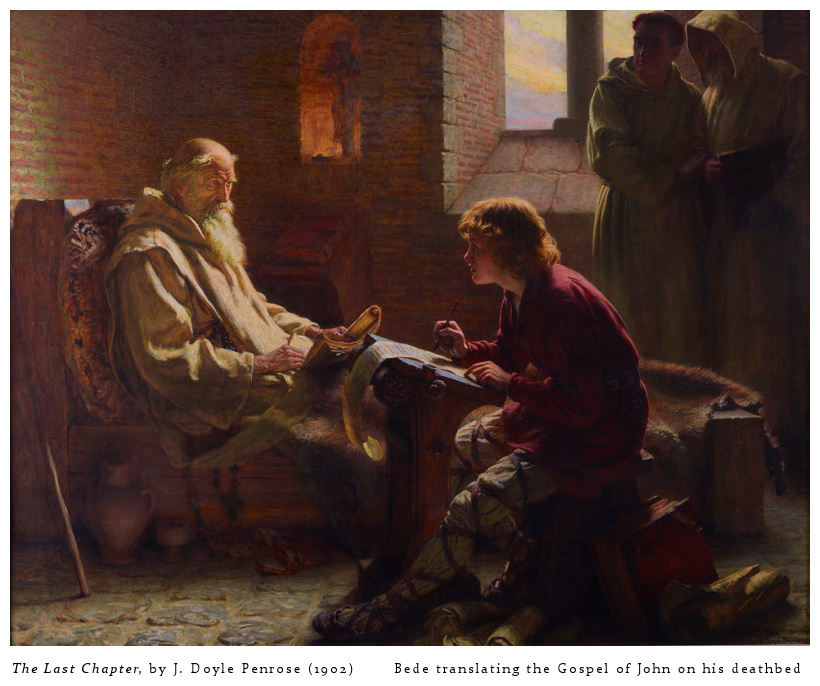
The Venerable Bede, translating The Gospel of John, on his deathbed.
Artist: James Doyle Penrose.
Date: 1902.
(Wikimedia Commons)


Born at Yarrow, in Northumberland, England, Bede was committed, as a child, to Saint Benedict Bishop, Abbot of The Benedictine Monastery at Wearmouth.

The Holy Ghost filled him with Wisdom and Intelligence (Introit), wherefore his writings, penetrated by Holy Doctrine (Epistle), were read aloud in the Churches, even in his lifetime. As it was not permissible to call him "Saint", he was called "The Venerable," a Title he kept after his death.

He was one of the most learned Churchmen in the 8th-Century and his name is found among those of The Doctors of The Church.

Not satisfied with teaching men the Law and the Prophets, he also practised the most beautiful Virtues (Gospel). On the Eve of The Ascension, he received The Last Sacraments, embraced his brethren, lay down on the ground upon his hair cloth, said twice: Glory be to The Father, and to The Son, and to The Holy Ghost, and fell asleep in The Lord on 27 May 735 A.D.

Let us honour Saint Bede, the Holy Doctor, that we may always be enlightened by his Wisdom and helped by his Merits (Collect).

Mass: In médio.
Commemoration of Saint John I. Collects from Mass: Sacerdótes Dei.


Tomb of The Venerable Bede in Durham Cathedral,
Durham, England.
Photo: 4 May 2008.
Author: robert scarth
(Wikimedia Commons)


The following Text is from Wikipedia - the free encyclopaedia.

Bede (Old English: Bǣda or Bēda; 672 A.D. – 26 May 735 A.D.), also referred to as Saint Bede or The Venerable Bede (Latin: Bēda Venerābilis), was an English Monk at the Monastery of Saint Peter at Monkwearmouth and its companion Monastery, Saint Paul's, in modern-day Jarrow (see Monkwearmouth-Jarrow), Northeast England, both of which were located in the Kingdom of Northumbria. He is well known as an author and scholar, and his most famous work, Historia ecclesiastica gentis Anglorum (The Ecclesiastical History of The English People) gained him the Title of "The Father of English History".

In 1899, Bede was made a Doctor of The Church by Pope Leo XIII; he is the only native of Great Britain to achieve this designation (Anselm of Canterbury, also a Doctor of The Church, was originally from Italy). Bede was, moreover, a skilled linguist and translator, and his work made the Latin and Greek writings of the early Church Fathers much more accessible to his fellow Anglo-Saxons, contributing significantly to English Christianity. Bede's Monastery had access to an impressive Library, which included works by Eusebius and Orosius, among many others.


26 May, 2015

Pope Saint Eleutherius (170 A.D.-185 A.D). Martyr. Feast Day 26 May.


Text from The Saint Andrew Daily Missal,
unless otherwise stated.

Saint Eleutherius.
Pope and Martyr.
Feast Day 26 May.

Simple.

Red Vestments.


English: Basilica of Saint Denis, France. Tympanum of the Portal of the North Transept showing the beheading of Saint Denis and of his Companions, Rustique and Eleutherius.
Français: Basilique Saint-Denis (France), tympan du portail du transept nord : la décollation de saint Denis et de ses compagnons Rustique etÉleuthère.
Photo: 1 March 2012.
Source: Own work.
Author: Myrabella.
(Wikimedia Commons)


Saint Eleutherius governed The Church during the period that followed The Persecution of The Emperor Commodus. Faith, at the time, made great progress in the whole World.

After a Pontificate lasting fifteen years, he died in 185 A.D., and was buried on The Vatican Hill near the body of Saint Peter.

Mass: In Paschaltide: Protexísti. Out of Paschaltide: Státuit.
Collects: As mentioned in The Mass of Saint Philip Neri.


English: Stained-Glass Window in the Church of Saint Germain-l'Auxerrois, Paris, France, commemorating Saint Dionysius (top), Saint Rusticus (bottom Left)
and Saint Eleutherius (bottom Right).
Deutsch: Detail eines Bleiglasfensters in der Kirche Saint-Germain-l'Auxerrois in Paris.
Inschrift: "Scs Dionysius", "Scs Rusticus" und "Scs Eleutherius"
Photo: 25 August 2010.
Source: Own work.
Author: GFreihalter.
(Wikimedia Commons)


English: The Church of Saint Eleutherius, Lesdain, Belgium.
Deutsch: Lesdain, Ortsteil der Gemeinde Brunehaut (Belgien, Prov. Hennegau),
Dorfmitte mit St. Eleutheriuskirche (église saint-éleuthère).
Photo: 3 January 2009.
Source: Own work.
(Wikimedia Commons)


English: The 11th-Century Church of Saint Eleutherius,
Esquelmes, Belgium.
Français: Eglise d'Esquelmes.
Photo: 21 July 2009.
Source: Own work.
Author: Laurent Lienart.
(Wikimedia Commons)


English
Saint Dionysius’ Church,
Esslingen am Neckar
Baden-Württemberg, Germany.
Detail from Stained-Glass Window at the South-East side of the Choir. Circa 1300.
The four Saints depicted in the bottom row are (Left to Right):
Saint Rusticus; Saint Dionysius; Saint Eleutherius and Saint Vitalis.
Deutsch: Esslingen – Sankt Dionys – Südost-Fenster im Chorraum (ca. 1300). In der unteren Reihe sind (von links nach rechts) die Heiligen Rusticus, Dionysius, Eleutherius und Vitalis zu sehen, in der oberen Reihe (von links nach rechts) die Heilige Agnes, die Madonna mit dem Kind sowie die Heiligen Katharina und Margareta. Die Bilder des Heiligen Dionysius und Eleutherius sind nicht original erhalten, sie wurden nach dem Zweiten Weltkrieg ergänzt.
Photo: 23 August 2009.
Source: Own work.
Author: Ecelan.
(Wikimedia Commons)

Saint Philip Neri. Confessor. Feast Day 26 May.


Text from The Saint Andrew Daily Missal,
unless otherwise stated.

Saint Philip Neri.
Confessor.
Feast Day 26 May.

Double.

White Vestments.


Painting of Saint Philip Neri.
Artist: Unknown.
This File: 6 March 2006.
User: Mathiasrex.
(Wikimedia Commons)


Saint Philip, born at Florence in the 16th-Century, left everything to serve The Divine Master (Gospel), and Founded The Congregation of The Oratory.

The Holy Ghost had inflamed him with such love for God (Introit, Alleluia, Secret), that the palpitations of his heart bent two of his ribs (Communion).

He would spend whole nights in the contemplation of Heavenly things and The Spirit of Truth "taught him true Wisdom" (Epistle). His conversations with  Jesus filled him with such intense joy that he exclaimed: "Enough, Love, enough ! "

He loved young men: "Amuse yourselves," he said to them, "but do not offend God."

He died in 1595 on The Feast of Corpus Christi.

Like Saint Philip, with our hearts full of a holy and loving joy, let us run in the way of the commandments of God (Collect).

Mass: Cáritas Dei diffúsa est.
Commemoration of Saint Eleutherius: Infirmitátem.

Pope Saint Gregory VII (1073-1085). Confessor. Feast Day 25 May.


Text from The Saint Andrew Daily Missal,
unless otherwise stated.

Saint Gregory VII.
Pope and Confessor.
Feast Day 25 May.

Double.

White Vestments.


Pope Saint Gregory VII saying Mass
(inspired by The Holy Ghost).
Date: 1878.
Source: Scanned by Uploader from page 292 of
Little Pictorial Lives of the Saints, Benzinger Brothers.
Author: Unknown.
(Wikimedia Commons)


Born at Soana, Tuscany, Italy, Hildebrand became a Monk in the famous Benedictine Monastery of Cluny, on which, at the time, depended two thousand Monasteries. He soon became Prior, and was later Elected Abbot of the Monastery of Saint Paul-Without-the-Walls, Rome, and made a Cardinal of The Roman Church.

At the death of Pope Alexander II, in 1073, he was Elected Pope and took the name of Gregory VII. Thus entrusted with the government of The House of God (Gospel, Communion), he participated in the full Priesthood of Jesus (Introit, Epistle).

At a time when the Bishops, mostly Simoniacal, were the dependents of Lay Princes, he strove with such constancy to defend the liberty of The Church (Collect) that, as we are assured, no Pontiff, since the time of The Apostles, undertook more labours for her (The Church) or fought more courageously for her independence.

While he was saying Mass, a Dove was seen to come down on him: The Holy Ghost thereby bore witness of the Supernatural views that guided him in the government of The Church. Forced to leave Rome, he died at Salerno in 1085, saying those words, the first of which are from Psalm xliv: "I have loved justice and hated iniquity: That is why I die in exile."

Following the example of Saint Gregory, let us overcome with courage all adversities (Collect).

Mass: Státuit.
Commemoration of Saint Urban I.

Pope Saint Urban I. Martyr. Feast Day 25 May.


Text is taken from The Saint Andrew Daily Missal,
unless otherwise stated.

Saint Urban I.
Pope and Martyr.
Feast Day 25 May.

Simple.

Red Vestments.


English: Pope Saint Urban I
(Papacy 222 A.D. - 230 A.D.),
wearing The Papal Tiara.
Polski: Pomnik świętego Urbana w Cieszowej.
Photo: 12 July 2006.
Source: Own work.
Author: User:Pleple2000.
(Wikimedia Commons)


Date: 12 December 2007.
Sources: 
Bruno Bernhard Heim, Heraldry in the Catholic Church: Its Origin, Customs and Laws (Van Duren 1978 ISBN 9780391008731), p. 54; 
Author: F l a n k e r.
(Wikimedia Commons)


This Holy Pope, whose Feast Day was yesterday, 25 May, is believed to have been the same Urban who Baptised Valerian (husband of Saint Cecilia), Tiburtius (brother of Valerian), and Maximus (their gaoler (jailer)), whom we honoured on 14 April.

Pope Saint Urban I was Martyred in 230 A.D.

Mass: Protexísti.


A 12th-Century fresco of Pope Saint Urban I
in a window embrasure in the
Church of Chalivoy-Milon, France (see, below).
Image: Julianna Lees.
(Google Images)


English: The Church in 
Chalivoy-Milon, France,
which contains a fresco of Pope Saint Urban I (see, above).
Français: Église de Chalivoy-Milon, France.
Photo: 25 August 2011.
Source: Own work.
Author: ManiacParisien.
(Wikimedia Commons)


The following Text is from Wikipedia - the free encyclopaedia.

Pope Urban I (Latin: Urbanus I) was Bishop of Rome or Pope from 222 A.D. to 23 May 230 A.D. He was born in Rome and succeeded Pope Callixtus I, who had been Martyred.

Much of Urban's life is shrouded in mystery, leading to many myths and misconceptions. Despite the lack of sources, he is the first Pope whose Reign can be definitely dated. Two prominent sources do exist for Urban's Pontificate: Eusebius' History of The Early Church and also an inscription, in the Coemeterium Callisti, which names the Pope.

Urban ascended to The Chair of Saint Peter in the year of The Roman Emperor Elagabalus' assassination and served during the Reign of Alexander Severus. It is believed that Urban's Pontificate was during a peaceful time for Christians in The Empire, as Severus did not promote the persecution of Christianity.

Urban is a Canonized Saint of The Roman Catholic Church and The Eastern Orthodox Church.


Solemn High Mass. Saint Mary Moorfields Church, Moorgate, London EC2M 7LS. Friday, 29 May 2015. 1930 hrs.


Illustration: LMS CHAIRMAN

All are most welcome to attend this Mass.


The following Text is from LMS CHAIRMAN

Juventutem London Mass, Friday 29th May

As usual, the Mass takes place on the last Friday of the month at 7:30 p.m., in St Mary Moorfields Church, Eldon Street, London EC2M 7LS. It will be Solemn High Mass for the Ember Friday which follows Pentecost.

See Juventutem London's Facebook page.

[Editor: Nearest Tube Stations are Moorgate and Liverpool Street.]


The following is taken from the Web-Site of ST MARY MOORFIELDS

St Mary Moorfields
Roman Catholic Church,
City of London.


Canon  Peter Newby,
Parish Priest of
Saint Mary Moorfields,
4-5 Eldon Street,
London EC2M 7LS.
Telephone: 020 7247 8390.


Saint Mary Moorfields Church,
Eldon Street,
London EC2M 7LS.

The roots of the Parish of Saint Mary Moorfields go back to
several Chapels that sprang up in the area in the 17th- and 18th-Centuries.
Catholic worship in those days was illegal. 
The Chapels were known locally as ‘Penny Hotels’, as people had to pay a Penny, to a man behind a grill in the door, before they were allowed in.

These were hard times for Catholics. In 1736, for example, The Gordon Rioters attacked the Chapel in Ropemakers Alley, ripping out its Altar, fittings and Crucifixes. Following The Catholic Relief Act of 1791, Catholics were permitted to worship in public.

And, in 1820, the first Church of Saint Mary Moorfields opened in Finsbury Circus,
nearby to its present location. As the permanent Seat of The Vicar Apostolic,
it served as Cardinal Wiseman's Pro-Cathedral from 1850 to 1869.

The original Church was pulled down in 1899 and replaced by the present Church in Eldon Street, which was opened on 25 March 1903. The architect was George Sherrin, who also designed the Dome of The London Oratory, as well as several Underground Stations.


Saint Mary Moorfields, in Eldon Street, between Moorgate Tube Station and Liverpool Street Station, is the only Catholic Church in The City. Anyone is welcome, either to come in to Pray or to just find a peaceful place, away from the business and stresses of life.

The Church opens each day at 6.45 a.m., and closes at 6.45 p.m. The Parish Priest is Canon Peter Newby, a former Catholic Chaplain to The University of Oxford. Before becoming a Priest, he trained as an architect and also worked as an antiquarian bookseller.

[Editor: Nearest Tube Stations are Moorgate and Liverpool Street.]

25 May, 2015

Memorial Day.


"WELL DONE".
Memorial Day Poster, 1936.
Image: CLKER.COM

24 May, 2015

Whit Sunday. Pentecost. The Holy Ghost. The Source Of All Graces. La Source Des Grâces.


English: Pentecost.
Français: Pentecôte.
Artist: Jean II Restout (1692–1768).
Date: 1732.
Author: Jean II Restout (1692–1768).
(Wikimedia Commons)

Pentecost. Whit Sunday.


Text from The Saint Andrew Daily Missal,
unless otherwise stated.

Pentecost.
Station at Saint Peter's Basilica.
Indulgence of 30 Years and 30 Quarantines.

Double of The First-Class
   with Privileged Octave.

Red Vestments.

THEY WERE ALL FILLED WITH THE HOLY GHOST.


Illustration taken from Saint Andrew's Daily Missal, 1952 Edition,
with the kind permission of Saint Bonaventure Press.


Veni Sancte Spiritus.
The Sequence for Pentecost.
Available on YouTube at


Interior of Saint Peter's, Rome.
[Editor: The Station for Pentecost is Saint Peter's.]
Artist: Giovanni Paolo Panini (1692–1765).
Date: 1731.
Current location: Saint Louis Art Museum, Missouri, United States of America.
Source/Photographer: Saint Louis Art Museum Official Site.
(Wikimedia Commons)


"The Gift of Wisdom is an illumination of the Holy Ghost, thanks to which our intellect is able to look at Revealed Truths in their more sublime light, to the greater joy of our Souls." [Reverend M. Meschler, S.J.: "The Gift of Pentecost: Meditations on the Holy Ghost," translated by Lady Amabel Kerr.]

Our Lord laid the foundations of His Church during His Public Life, and after His Resurrection He gave it the powers necessary for its mission. It was by the Holy Ghost that the Apostles were to be trained and endued with strength from on High (Gospel).

"At Pentecost, we celebrate the first manifestation of the Holy Ghost among Our Lord's Disciples and the foundation of the Church, itself." Hence, the choice of the Basilica, dedicated to Saint Peter, for today's Station.


We read, in the Gospel, that Our Lord foretold the coming of the Paraclete to His Disciples, and the Epistle shows us the realisation of that promise.

It was at the third hour of the day (Terce, nine o'clock A.M.) that the Spirit of God descended upon the Cenacle, and a mighty wind which blew suddenly upon the house, together with the appearance of tongues of fire within, were the wonderful tokens of His coming.

Taught by the "light of Thy Holy Spirit" (Collect), and filled by the gifts of the same Spirit poured out upon them (Sequence), the Apostles become new men, to go forth and renew the whole world (Introit).


Gregorian Chant
from Fontgombault Abbey, France,
for The Divine Office at Pentecost.
Available on YouTube at


It is at High Mass, at the third hour, that we also receive the Holy Spirit, whom Our Lord "going up above all the heavens, on this day sent down . . . on the children of adoption" (Preface); for each of the Mysteries of the Liturgical Cycle brings forth its Fruits of Grace in our Souls on the day which the Church keeps as its anniversary.

During Advent, we raised to the Incarnate Word the cry: "Come, Lord, and purge the sins of Thy people"; at this Season, let us, with the Church, say to the Holy Ghost: "Come, O Holy Spirit, and fill the hearts of Thy Faithful, and kindle in them the fire of Thy love" (Alleluia).

Of all ejaculatory Prayers, this is the most beautiful and necessary, for, from the Holy Ghost, that "sweet Guest of our Soul", flows all our supernatural life.

Every Parish Priest celebrates Mass for the people of his Parish.


Related Posts Plugin for WordPress, Blogger...