Notre Dame de Rouen. The façade of the Gothic Church in France. Photographer: Hippo1947. Licence: SHUTTERSTOCK.

28 July, 2015

The Fourteen Auxiliary Saints.


Text from The Saint Andrew Daily Missal,
unless otherwise stated.


The Fourteen Auxiliary Saints.
Artist: Rene de Cramer.
“Copyright Brunelmar/Ghent/Belgium”.
Used with Permission.


Saint Christopher,
one of the Fourteen Auxiliary Saints,
(Feast Day 25 July).
Saint Christopher Carrying The Christ Child,
by Hieronymus Bosch (circa 1485)


The name of "Auxiliary Saints" is given to a group of fourteen Saints particularly noted for the efficacy of their intercession. They were often represented together.

Saint George
Feast Day 23 April

Is to be recognised in statuary and pictures by the dragon he strikes down. He is invoked against herpetic diseases. He is, with Saint Sebastian and Saint Maurice, the Patron Saint of soldiers.

Saint Blaise
Feast Day 3 February

Is to be recognised in statuary and pictures by his two candles, crossed. He is invoked against diseases of the throat.

Saint Erasmus
Feast Day 2 June

Is to be recognised in statuary and pictures by entrails wound around a windlass. He is invoked against diseases of the stomach. He is the Patron Saint of mariners and seamen.

Saint Pantaleon
Feast Day 27 July

Is to be recognised in statuary and pictures by his nailed hands. Invoked against consumption. He is, with Saint Luke and Saints Cosmas and Damian, the Patron Saint of medical men.


Detail of Saint Giles and the Hind,
by the Master of Saint Giles, circa 1500 A.D.


Saint Vitus (or Guy)
Feast Day 15 June

Is to be recognised in statuary and pictures by his Cross. Invoked against chorea (Saint Vitus's Dance), lethargy and the bite of venomous or mad beasts.

Saint Christopher
Feast Day 25 July

Is to be recognised in statuary and pictures by the Infant Jesus, Whom he carries. He is invoked in storms, tempests, plagues, and for the avoidance of accidents in travelling. Also, in the Blessing of motor cars.

Saint Denis
Feast Day 9 October

Is to be recognised in statuary and pictures by his head, which he holds in his hands. Invoked for people possessed of devils.


Deutsch: Altar der Vierzehn Nothelfer der Basilika Vierzehnheiligen, Bad Staffelstein.
English: Altar of The Fourteen Holy Helpers, Vierzehnheiligen Basilica,
Bad Staffelstein, Germany.
Photo: July 2007.
Source: Own work.
Author: Zairon.
(Wikimedia Commons)


Saint Cyriacus
Feast Day 8 August

Is to be recognised in statuary and pictures by his Deacon's Vestments. Invoked against diseases of the eye and diabolical possession.

Saint Acathius
Feast Day 8 May

Is to be recognised in statuary and pictures by his crown of thorns. Invoked against headaches.

Saint Eustace
Feast Day 20 September

Is to be recognised in statuary and pictures by his stag and hunting equipment. Invoked for preservation from fire (eternal or temporal).


Saint Barbara Shrines in German mines.
Schacht Konrad mine (left)
and Schacht Asse II mine (right).


Saint Giles
Feast Day 1 September

Is to be recognised in statuary and pictures by his Benedictine cowl and his hind. Invoked against panic, epilepsy, madness, nocturnal terrors.

Saint Margaret
Feast Day 20 July

Is to be recognised in statuary and pictures by the dragon she keeps in chains. Invoked against pains in the loins and by women about to become mothers.


Deutsch: Altar of the Vierzehnheiligen. Die Basilika Vierzehnheiligen bei Bad Staffelstein im Landkreis Lichtenfels ist eine Wallfahrtskirchen in Oberfranken, Deutschland.
English: A statue of one of the Saints (Saint Giles) on the Altar of The Fourteen Holy Helpers. Basilica of The Fourteen Holy Helpers, Bad Staffelstein, near Bamberg, in Bavaria, Germany.
Photo: 16 April 2009.
Source: Own work.
Author: Mattana.
(Wikimedia Commons)


Saint Barbara
Feast Day 4 December

Is to be recognised in statuary and pictures by her tower and the ciborium surmounted by a Sacred Host. Invoked against lightnings and sudden death. Patron Saint of miners and artillery soldiers.

Saint Catharine
Feast Day 25 November

Is to be recognised in statuary and pictures by her broken wheel. "The wise Counsellor" is invoked by students, Christian philosophers, orators and barristers.


English: Two of The Fourteen Auxiliary Saints, depicted in a Stained-Glass Window in the Parish Church of Saint Pelagius, Weitnau, Bavaria, Germany.
The Saints are Saint Erasmus and Saint Acathius.
Deutsch: Pfarrkirche St. Pelagius, Weitnau, Nothelferfenster, St. Erasmus und St. Achatius.
Photo: September 2007.
Source: Own work.
Author: Andreas Praefcke.
(Wikimedia Commons)


The following Text is from Wikipedia - the free encyclopaedia.

The Fourteen Holy Helpers are a group of Saints, Venerated together, in Roman Catholicism, because their intercession is believed to be particularly effective, especially against various diseases. This group of Nothelfer ("helpers in need") originated in the 14th-Century, at first in The Rhineland, Germany, largely as a result of the epidemic (probably of bubonic plague) that became known as The Black Death.

Devotion to "The Fourteen Auxiliary Saints" began in the Rhineland, now part of Germany, in the time of The Black Death.

At the heart of The Fourteen Auxiliary Saints were three Virgin Martyrs:

Sankt Margaretha mit dem Wurm,
Sankt Barbara mit dem Turm,
Sankt Catharina mit dem Radl,
das sind die heiligen drei Madl.

Saint Margaret with the dragon
Saint Barbara with the tower
Saint Catherine with the wheel
those are the three holy maids.


English: The framed Altarpiece in the Church of Saint Martin, Alsace, France,
depicting The Fourteen Auxiliary Saints.
Français: Alsace, Bas-Rhin, Erstein, Eglise Saint-Martin, Autel-retable
et tableau des 14 intercesseurs (Autel 1804; tableau 1878 Caroline Sorg).
Photo: 2014.
Source: Own work.
Author: Ralph Hammann.
(Wikimedia Commons)


As the other Saints began to be invoked, along with these three Virgin Martyrs, they were represented together in works of art. Popular Veneration of these Saints often began in a Monastery that held their Relics. All of the Saints, except Saint Giles, were accounted Martyrs.

Saint Christopher and Saint Giles were invoked against the plague. Saint Denis was Prayed to for relief from headache, Saint Blaise for ills of the throat, Saint Elmo, for abdominal maladies, Saint Barbara for fever, and Saint Vitus against epilepsy. Saint Pantaleon was the Patron of physicians, Saint Cyriacus invoked against temptation on the deathbed, and Saints Christopher, Barbara, and Catherine for protection against a sudden and unprovided-for death. Saint Giles was Prayed to for a good Confession, and Saint Eustace as healer of family troubles. Domestic animals were also attacked by the plague, and so Saints George, Elmo, Pantaleon, and Vitus were invoked for their protection. Saint Margaret of Antioch is the Patron of safe childbirth.


English: The High Altar,
Church of Saint Blaise, Dahlenheim, Alsace, France.
Saint Blaise is one of The Fourteen Auxiliary Saints.
Français: Alsace, Bas-Rhin, Dahlenheim, Église Saint-Blaise,
Chœur avec stalles et maître-autel (XVIIIe)
Photo: 2015.
Source: Own work.
Author: Ralph Hammann.
(Wikimedia Commons)


As the Saints' joint Cultus spread in the 15th-Century, Pope Nicholas V attached Indulgences to Devotion of The Fourteen Holy Helpers, though these no longer apply. While each had a separate Feast Day, The Fourteen Holy Helpers were in some places celebrated as a Group on 8 August, but this Celebration never became part of The General Roman Calendar for Universal Veneration.

When that Calendar was revised, in 1969, the individual Celebrations of Saint Barbara, Saint Catherine of Alexandria, Saint Christopher, and Saint Margaret of Antioch, were dropped, but, in 2004, Pope Saint John Paul II re-instated the 25 November Optional Memorial of Catherine of Alexandria, whose voice was heard by Saint Joan of Arc. The individual Celebrations of all Fourteen Holy Helpers (or Fourteen Auxiliary Saints) are included in The General Roman Calendar as in 1954, The General Roman Calendar of Pope Pius XII and The General Roman Calendar of 1960.

Comparable to the cult of The Fourteen Holy Helpers was that of The Four Holy Marshals, who were also Venerated in The Rhineland as "Marshals of God." These were Quirinus of Neuss, Saint Anthony the Great, Pope Cornelius, and Saint Hubert.
27 July, 2015

Saint Pantaleon. Martyr. Feast Day 27 July.


Text from The Saint Andrew Daily Missal,
unless otherwise stated.

Saint Pantaleon.
Martyr.
Feast Day 27 July.

Simple.

Red Vestments.


Saint Pantaleon.
Great-Martyr and Unmercenary Healer.
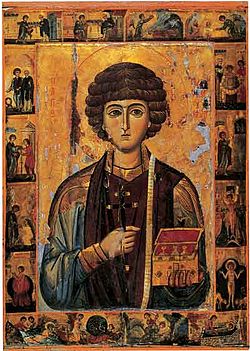
13th Century Icon, including scenes from his life,
from the Monastery of Saint Katherine, on Mount Sinai.
Единственная житийная икона св. Пантелеймона византийского времени.


At Nicomedia, says The Roman Martyrology, was Martyred Saint Pantaleon, a doctor, who, having been arrested on account of his Faith by order of the Emperor, Maximian, was tortured on the Rack and burned with flaming torches; he was consoled in his torments by an apparition of Our Lord; the sword put an end to his glorious combat. This was under Emperor Diocletian, about 303 A.D.

Saint Pantaleon is numbered by the Greeks among The Great Martyrs. Medical men honour him, after Saint Luke, as their principal Patron. He is one of "The Fourteen Auxiliary Saints".

Mass: Laetábitur.


English: The Church of Saint Pantaleon (Saint Panteleimon),
built in 1735-1739, is one of the oldest in Saint Petersburg, Russia.
Русский: Санкт-Петербург, Россия. Церковь св.
великомученика Пантелеимона на ул. Пестеля.
Photo: 4 June 2012.
Source: Own work.
Author: A.Savin.
(Wikimedia Commons)


The following Text is from Wikipedia - the free encyclopaedia.

Saint Pantaleon (Greek: Παντελεήμων [Panteleímon], "All-Compassionate"), counted in The West among the Late-Mediaeval Fourteen Holy Helpers [Editor: Or The Fourteen Auxiliary Saints] and in The East as one of The Holy Unmercenary Healers, was a Martyr of Nicomedia, in Bithynia, during The Diocletian Persecution of 303 A.D.

According to The Martyrologies, Saint Pantaleon was the son of a rich pagan, Eustorgius of Nicomedia, and had been instructed in Christianity by his Christian mother, Saint Eubula; however, after her death, he fell away from The Christian Church, while he studied medicine with a renowned physician, Euphrosinos; under the patronage of Euphrosinos, he became physician to The Emperor Maximian or Galerius.


Gorno Nerezi, Skopje, Republic of Madedonia.
Date: 6 October 2007 (original upload date).
Source: Own work.
(Wikimedia Commons)


He was won back to Christianity by Saint Hermolaus (characterised as a Bishop of The Church at Nicomedia), who convinced him that Christ was the better physician, signalling the significance of the exemplum of Pantaleon that Faith is to be trusted over medical advice, marking the direction European medicine was to take until the 16th-Century.

Saint Alphonsus Liguori wrote, regarding this incident:

He studied medicine with such success, that the Emperor Maximian appointed him his physician. One day as our Saint was discoursing with a Holy Priest, named Hermolaus, the latter, after praising the study of medicine, concluded thus: "But, my friend, of what use are all thy acquirements in this art, since thou art ignorant of the science of Salvation ?"
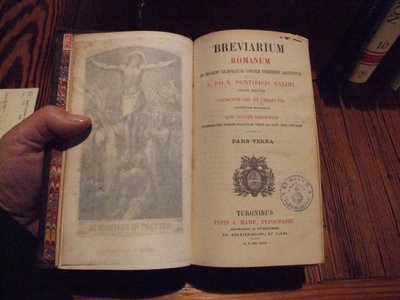
BREVIARIUM ROMANUM.

THE ROMAN BREVIARY.

LE BRÉVIAIRE.


English: A French Prayer Book of 1905 containing extracts from The Roman Missal,
and The Roman Breviary of the time, with French translations.
Français: Nouveau Paroissien Romain contenant en latin et en français les Offices et Messes
de tous les dimanches et de toutes les fêtes de l'année ecclésiastique.
File: File:Nouveau Paroissien Romain (1905).jpg
Uploaded: 6 May 2009.
Author: Perky.
(Wikimedia Commons)


Illustration: RORATE CAELI


The following Text is from The Pre-1911 Roman Breviary
(Volume II. Summer).
Translated out of Latin into English by
John, Marquess of Bute, K.T.
Date: 1879.

Saint Pantaleon.
Martyr.
Feast Day 27 July.

Simple.

All from The Common Office for a Simple Feast of one Martyr,
except the following Prayer throughout The Office.

Graciously hear us, we beseech Thee, O Almighty God,
and, at the petition of Thy Blessed Martyr, Pantaleon, 
be mercifully pleased to deliver us from all things which may hurt our bodies, 
and from all evil thoughts which may defile our Souls. 
Through Our Lord Jesus Christ Thy Son, 
Who liveth and reigneth with Thee, 
in the unity of The Holy Ghost, 
one God, 
World without end.

Amen.

Aftermath. Have You Forgotten Yet . . ?


Illustration: HDWALLSOURCE.COM


Aftermath.

Siegfried Sassoon (1919).


Have you forgotten yet . . ?


For the world’s events have rumbled on since those gagged days,
Like traffic checked while at the crossing of city-ways:
And the haunted gap in your mind has filled with thoughts that flow
Like clouds in the lit heaven of life; and you’re a man reprieved to go,
Taking your peaceful share of Time, with joy to spare.


But the past is just the same - and War’s a bloody game . . .
Have you forgotten yet . . ?
Look down, and swear by the slain of the War that you’ll never forget.


Do you remember the dark months you held the sector at Mametz –
The nights you watched and wired and dug and piled sandbags on parapets ?
Do you remember the rats; and the stench
Of corpses rotting in front of the front-line trench -
And dawn coming, dirty-white, and chill with a hopeless rain ?
Do you ever stop and ask, ‘Is it all going to happen again ?’


Do you remember that hour of din before the attack –
And the anger, the blind compassion that seized and shook you then
As you peered at the doomed and haggard faces of your men ?
Do you remember the stretcher-cases lurching back
With dying eyes and lolling heads—those ashen-grey
Masks of the lads who once were keen and kind and gay ?


Have you forgotten yet . . ?


Poem available on ABOUT.COM POETRY


26 July, 2015

Saint Anne. Mother Of The Blessed Virgin Mary. Feast Day 26 July.


Text and Illustrations from Wikipedia - the free encyclopaedia,
unless otherwise stated.

Saint Anne.
Mother of The Blessed Virgin Mary.
Feast Day 26 July.

Double of The Second-Class.

White Vestments.


English: Parish Church of Saint Ulrich in Ulrichsberg, Austria.
Statue of Saint Anne teaching The Virgin Mary to read (1722).
Deutsch: Pfarrkirche Sant Ulrich in Ulrichsberg.
Statue der Heiligen Anna, wie sie der
Jungfrau Maria das Lesen bei bringt (1722).
Photo: 20 June 2008.
Source: Own work.
Author: Wolfgang Sauber.
(Wikimedia Commons)


Saint Joachim and Saint Anne,
parents of The Virgin Mary.
This File: 2 October 2006.
User: Gipsy.
(Wikimedia Commons)


English: Joachim and the Angel.
Français: Joachim et l'Ange.
Artist: Albrecht Dürer (1471–1528).
Date: 1504.
Current location: Petit Palais, Paris, France.
Source/Photographer: Albrecht Dürer : œuvre gravé,
catalogue de l'exposition à Paris, au Musée du Petit Palais,
4 avril-21 juillet 1996. ISBN 9782879002705.
(Wikimedia Commons)


Saint Anne (also known as Ann or Anna, from Hebrew Hannah חַנָּה, meaning "Favour" or "Grace") of David's House and Line, was the Mother of the Virgin Mary, and Grandmother of Jesus Christ.

Joachim ("he whom YHWH has set up", Hebrew: יְהוֹיָקִים Yəhôyāqîm, Greek Ἰωακείμ Iōākeím) was the husband of Saint Anne and the father of Mary, the Mother of Jesus,. His Feast Day is 16 August.


Akathist Hymn to the Mother of God.
Réjouis toi Marie, 1/6.
Opéra d'images de Jean-Michel Mahenc.
Créé pour les Nocturnes de Notre-Dame de Paris - L'hymne acathiste : un magnifique poème byzantin du VIe siècle sur la Vierge Marie. Sommet de la spiritualité orthodoxe -
Commande du DVD : Tel 0160664564 - magali.barbizon@me.com
Available on YouTube at


The Akathist Hymn (Ἀκάθιστος Ὕμνος, unseated Hymn) is a Hymn of Eastern Orthodox tradition dedicated to a Saint, Holy Event, or one of the Persons of the Holy Trinity. The name derives from the fact that during the chanting of the Hymn, or sometimes the whole Service, the congregation is expected to remain standing in reverence, without sitting down (Ancient Greek ἀ- (a), [without, not] + κάθισις (káthisis), [sitting]), except for the aged or infirm.

Mary's mother is not named in the Canonical Gospels, nor in the Qur'an. Anne's name and that of her husband, Joachim, come only from New Testament apocrypha, of which the Protoevangelium of James (written perhaps around 150 A.D.) seems to be the earliest that mentions them.


Akathist Hymn to the Mother of God.
Réjouis toi Marie, 2/6.
Opéra d'images de Jean-Michel Mahenc.
Créé pour les Nocturnes de Notre-Dame de Paris - L'hymne acathiste : un magnifique poème byzantin du VIe siècle sur la Vierge Marie. Sommet de la spiritualité orthodoxe -
Commande du DVD : Tel 0160664564 - magali.barbizon@me.com
Available on YouTube at


Akathist Hymn to the Mother of God.
Réjouis toi Marie, 3/6.
Opéra d'images de Jean-Michel Mahenc.
Créé pour les Nocturnes de Notre-Dame de Paris - L'hymne acathiste : un magnifique poème byzantin du VIe siècle sur la Vierge Marie. Sommet de la spiritualité orthodoxe -
Commande du DVD : Tel 0160664564 - magali.barbizon@me.com
Available on YouTube at


Akathist Hymn to the Mother of God.
Réjouis toi Marie, 4/6.
Opéra d'images de Jean-Michel Mahenc.
Créé pour les Nocturnes de Notre-Dame de Paris - L'hymne acathiste : un magnifique poème byzantin du VIe siècle sur la Vierge Marie. Sommet de la spiritualité orthodoxe -
Commande du DVD : Tel 0160664564 - magali.barbizon@me.com
Available on YouTube at


Akathist Hymn to the Mother of God.
Réjouis toi Marie, 5/6.
Opéra d'images de Jean-Michel Mahenc.
Créé pour les Nocturnes de Notre-Dame de Paris - L'hymne acathiste : un magnifique poème byzantin du VIe siècle sur la Vierge Marie. Sommet de la spiritualité orthodoxe -
Commande du DVD : Tel 0160664564 - magali.barbizon@me.com
Available on YouTube at


The story bears a similarity to that of the birth of Samuel, whose mother Hannah had also been childless. Although Anne receives little attention in The Western Church, prior to the Late-12th-Century, dedications to Anne in The Eastern Church occur as early as the 6th-Century.

In the Eastern Orthodox Churches and Eastern Catholic Churches, she is revered as Hanna. In the Eastern Orthodox tradition, Hanna, is ascribed the title "Forbear of God", and both the Birth of Mary and the Dedication of Mary to the Temple are celebrated as two of the Twelve Great Feasts. The Dormition of Hanna is also a Minor Feast in the Eastern Church. In Protestant tradition, it is held that Martin Luther chose to enter religious life as a Roman Catholic Augustinian Monk after crying out to Saint Anne.


Akathist Hymn to the Mother of God.
Réjouis toi Marie, 6/6.
Opéra d'images de Jean-Michel Mahenc.
Créé pour les Nocturnes de Notre-Dame de Paris - L'hymne acathiste : un magnifique poème byzantin du VIe siècle sur la Vierge Marie. Sommet de la spiritualité orthodoxe -
Commande du DVD : Tel 0160664564 - magali.barbizon@me.com
Available on YouTube at


Saint Anne. Mother of The Blessed Virgin Mary.

Artist: Rene de Cramer.
“Copyright Brunelmar/Ghent/Belgium”.
Used with Permission.


The following Text is from The Saint Andrew Daily Missal,

The Church honours, with the Angels, in Holy Joy (Introit), The Mother of The Blessed Virgin Mary.

As her name signifies, [the name "Anne" derives from Hebrew. 'Hannah' meaning 'Grace"], Grace was poured on her, and she was Blessed by God for ever (Communion). "By His Grace, He made her deserve to be the Mother of The Mother of God" (Collect).

Filled with the Virtues which The Holy Ghost grants to good women, the Spouse of Saint Joachim surpassed all women by her Privileges and Graces (Epistle). Her Holiness made her leave everything for God, and she thereby acquired this Pearl and this Treasure (Gospel).

The Devotion to Saint Anne is founded on the bond which unites her to Mary and to The Incarnate Word. Its ancient Liturgy dates from the 6th-Century A.D. for The Eastern Church and the 8th-Century A.D. for The Western Church.

It was authorised by Pope Urban IV in 1378. In 1584, Pope Gregory XIII fixed 26 July as the date of The Feast and Pope Leo XIII, in 1879, extended it to The Whole Church.

Every Parish Priest celebrates Mass for the people of his Parish.

Ave Maris Stella.


Hail, Star of the Sea.


Ave Maris Stella.
Available on YouTube at


The following Text is from Wikipedia -the free encyclopaedia.

Ave Maris Stella (Hail Star of the Sea) is a Plainsong Vespers Hymn to Mary. It was especially popular in The Middle Ages and has been used by many composers as the basis of other compositions.

The creation of the original Hymn has been attributed to several people, including Saint Bernard of Clairvaux (12th-Century), Saint Venantius Fortunatus (6th-Century) and Hermannus Contractus (11th-Century). The Text is found in 9th-Century Manuscripts kept in Vienna, Austria, and in the Abbey of Saint Gall, Switzerland.

The melody is found in the Irish Plainsong "Gabhaim Molta Bríde", a piece in praise of Saint Bridget. The popular modern Hymn, Hail Queen Of Heaven, The Ocean Star, is loosely based on this Plainsong original.

It finds particular prominence in the "Way of Consecration to The Blessed Virgin Mary" by Saint Louis de Montfort.


Madonna and Child
(Galleria Borghese, Rome).
Date: Circa 1742.
Author: Pompeo Batoni (1708–1787).
(Wikimedia Commons)


The Plainchant Hymn has been developed by many composers, from pre-Baroque to the present day. The Roman Rite employs four different Plainchant tunes for the Ave Maris Stella; the first three are designated for Solemnities, Feasts, and Memorials of The Blessed Virgin Mary; a fourth is given in The Little Office of The Blessed Virgin Mary as an alternative to The Memorial Tone. These Plainchant Tones have been used as the Cantus Firmus for some Polyphonic Settings of The Mass, including those by Josquin and Victoria.

Renaissance Settings include those by Felice Anerio, Palestrina, Dufay and Byrd. Baroque Settings include Monteverdi's Vespro della Beata Vergine 1610. Romantic Settings include those by Dvorak, Grieg, and Liszt. Modern composers, who have either set the Text or used the Hymn as an inspiration, include Grace Williams, Peter Maxwell Davies, Otto Olsson and Trond Kverno.

Ave Maria.


You might wish to add this Ave Maria to your Daily Prayers.


Ave Maria.
Available on YouTube at

Wer Mein Fleisch Ißt Und Mein Blut Trinkt, Der Bleibt In Mir Und Ich In Ihm. Whoever Eats My Flesh And Drinks My Blood, Lives In Me And I In Him.


Illustration: THE RACCOLTA.TUMBLR.COM

25 July, 2015

Saint Christopher. Martyr. Feast Day 25 July.


Text from The Saint Andrew Daily Missal,
unless otherwise stated.

Saint Christopher.

Martyr.
Feast Day 25 July.

Simple.

Red Vestments.


Saint Christopher carrying The Christ Child.
Date: 1480-1490.
Museum Boymans-van Beuningen,
This File: 22 January 2007.
User: Alekjds.
(Wikipedia)


Saint Christoper was a native of Chanaan. His name ("Who bears Christ") expresses his love of Jesus. A generous Soul, he walked like a giant in The Way of Virtue.

The Piety of our Fathers, inspired by this grand allegory, caused them to place a colossal statue of Saint Christopher at the entrance to Cathedrals. He was Martyred towards 250 A.D.

He is one of "The Fourteen Auxiliary Saints".

Mass: In virtúte.


St Andrew Daily Missal (Traditional Mass)


Available (in U.K.) from

Available (in U.S.A.) from


Saint James. Apostle. Feast Day 25 July.


Text from The Saint Andrew Daily Missal,
unless otherwise stated.

Saint James The Greater.
   Apostle.
   Feast Day 25 July.

Double of The Second-Class.

Red Vestments.


Saint James the Greater.
He is depicted clothed as a Pilgrim; note the Scallop Shell, on his shoulder, and his Staff and Pilgrim's Hat, beside him.
Artist: Rembrandt (1606–1669).
Date: 1661.
(Wikimedia Commons)

Saint James, brother of Saint John, and son of Zebedee, was a native of Bethsaida, in Galilee. He is surnamed “the Greater”, i.e., the Elder.

One day, his mother, approaching The Saviour, asked of Him: “The favour for her two sons to be seated, one at His Right-hand and the other at His Left-hand, in His Kingdom” (Gospel). 

Christ then foretold their Martyrdom. Saint James “shall sit on a Throne to judge the Twelve Tribes of Israel” (Communion), “but he will first have to mix his blood with that of Jesus (Gospel) and undergo, like all the Apostles, a life of suffering and persecution, such as the Epistle describes”.

After the Ascension of Jesus Christ to Heaven, says The Office of today, James preached His Divinity in Judea and Samaria. 

He soon betook himself to Spain. When he returned to Jerusalem, Herod Agrippa, desiring to please the Jews, condemned him to death and he was beheaded towards the year 42 A.D., a short time before the Feast of Easter.

It would seem that, for fear of the Arabs, who were masters of Jerusalem, the body of the Saint was later carried to Compostella, in Spain, where he is greatly honoured. 25 July recalls the date of this Translation.


His name is inscribed in The Canon of The Mass, with that of Saint John, his brother (First List).

Every Parish Priest Celebrates Mass for the people of his Parish.

In Low Masses, Commemoration of Saint Christopher, by the Collects of the Mass: In virtúte.

Acerbicness Rules O.K.


“The Roaring Lion”.
Photographer: Yousuf Karsh (1908–2002).
Date: 30 December 1941.
Credit: Yousuf Karsh
Library and Archives Canada, e010751643.
(Wikipedia)

“I am enclosing two tickets to the first night of my new play.
“Bring a friend.
“If you have one.”
(George Bernard Shaw to Winston Churchill).

“Cannot possibly attend first night.
“Will attend second.
“If there is one.”
(Winston Churchill to George Bernard Shaw).

24 July, 2015

Saint Christina. Virgin And Martyr. Feast Day, Today, 24 July.


Text taken from The Saint Andrew Daily Missal,
unless otherwise stated.

Saint Christina.
Virgin and Martyr.
Feast Day 24 July.

Red Vestments.


English: Statue of Saint Christina,
The Church of Saint Christina,
Ravensburg, Germany.
Deutsch: Hl. Christina von Bolsena, Skulptur von Moriz Schlachter,
Pfarrkirche St. Christina, Ravensburg, Germany.
Photo: 20 January 2006.
Source: Own work.
Author: AndreasPraefcke.
(Wikimedia Commons)


Saint Christina was born in Tuscany, Italy. At the age of ten, she took away the silver idols, in her father's house, and broke them up. On this account, she was delivered up to the persecutors, tied to a post, and pierced with arrows.

She thus added, to the merit of her Virginity, that of Christian Fortitude (Collect). This was under the Persecutions of Emperor Diocletian towards 300 A.D.

Mass: Me exspectavérunt.


English: The Parish Church of Saint Christina,
Regensburg, Germany.
Deutsch: Pfarrkirche St. Christina, Ravensburg.
Photo: 20 January 2006.
Source: Own work.
Author: AndreasPraefcke.
(Wikimedia Commons)


The following Text is from Wikipedia - the free encyclopaedia.

Saint Christina of Bolsena, Italy, also known as Christina of Tyre, or, in the Eastern Orthodox Church, as Christina the Great Martyr, is Venerated as a Christian Martyr of the 3rd-Century. Archaeological excavations of an underground cemetery, constructed at her tomb, have shown that she was Venerated at Bolsena by the 4th-Century A.D.

The existence of Christina is relatively well attested. Although some versions of her legend place her in Tyre (Phoenicia), the most credible evidence points to Bolsena, Italy: An ancient town in central Italy, near an Etruscan site called Volsinium, with catacombs, in which archaeologists have found the remains of an Early-Christian Church and the tomb of a female Martyr.

Inscriptions, found on the site, confirm that this Martyr had a name like Christina and that the local community was Venerating her as a Saint by the end of the 4th-Century. Some corroborating evidence is provided by a 6th-Century mosaic in the Basilica of Saint Apollinare Nuovo, at Ravenna, Italy, which includes, in its Procession of Virgins, a Saint named Christina, wearing a Martyr's Crown.


The Mass at Bolsena.
Artist: Raphael (1483–1520).
Date: 1512.
This File: 30 March 2007.
User: David Sneek.
(Wikimedia Commons)


The Mass at Bolsena is a painting by the Italian Renaissance artist, Raphael. It was painted between 1512 and 1514 as part of Raphael's commission to decorate with frescoes the rooms that are now known as the Raphael Rooms, in the Apostolic Palace in the Vatican. It is located in the Stanza di Eliodoro, which is named after The Expulsion of Heliodorus from the Temple.

The Mass at Bolsena shows an incident that is said to have taken place in 1263. A Bohemian Priest, who doubted the Doctrine of Transubstantiation, celebrated Mass at Bolsena, Italy, where the Bread of the Eucharist began to Bleed. The following year, in 1264, Pope Urban IV instituted the Feast of Corpus Christi, to celebrate this miraculous event.


The Priest was saying Mass, and, when he doubted the Transubstantiation, Blood spouted from the Host and fell onto the Altar Cloth, in the shape of a Cross, and he was rec-converted.

Present in this painting, is a self-portrait of the artist, Raphael, as one of the Swiss Guard in the lower right of the fresco, facing out with bound-up hair. This is one of several instances in which Raphael has placed himself in his paintings. Also shown in the work is Pope Julius II (1443-1513), kneeling at the right, and his daughter, Felice della Rovere, shown on the left at the bottom of the steps, in profile, in dark clothes. The four Cardinals, to the right, have also been identified as Leonardo Grosso della Rovere, Raffaello Riario, Tommaso Riario and Agostino Spinola, relatives of Julius.


The Martyr, Christina, lived during the 3rd-Century. She was born into a rich family, and her father was Governor of Tyre. By the age of 11, the girl was exceptionally beautiful, and many wanted to marry her. Christina's father, however, envisioned that his daughter should become a pagan priestess.

To this end, he placed her in a special dwelling, where he had set up many gold and silver idols, and he commanded his daughter to burn incense before them. Two servants attended Christina.

According to legend, on one occasion, Christina was visited by an Angel, who instructed her in the True Faith. The Angel called her a Bride of Christ, and told her about her future suffering. Christina smashed all the idols in her room and threw them out the window.


In visiting his daughter, Christina's father, Urban, asked her where all the idols had disappeared. Christina was silent. Then, having summoned the servants, Urban learned the truth from them.

A second legend is connected to Saint Christina. The Miracle of Bolsena, often considered to be the catalyst for the Feast of Corpus Christi, recalls an event in the Umbrian region of Italy in 1263. A Priest, named Peter, from the City of Prague, nurtured doubts regarding the Transubstantiation of the Host during Mass, and, during his Pilgrimage toward Rome, Prayed to be relieved of his questions.

While saying the Words of Consecration, in the Church of Saint Christina, in Bolsena, Italy, the Host dripped Blood on his hands and on the Altar Cloth, below. The Miracle of Bolsena is depicted on the walls of the Vatican, in a painting by Raphael.


Related Posts Plugin for WordPress, Blogger...