Notre Dame de Rouen. The façade of the Gothic Church in France. Photographer: Hippo1947. Licence: SHUTTERSTOCK.

08 August, 2015

Ettal Abbey, Bavaria, Germany.


Text from Wikipedia - the free encyclopaedia,
unless otherwise stated.


Ettal Abbey in Winter.
Photo: 31 December 2007.
Source: Own work.
Author: Mattana.
(Wikimedia Commons)


English: Ettal Abbey, Bavaria, Germany.
Español: Monasterio de Ettal, Baviera, Alemania.
Photo: 22 March 2014.
Source: Own work.
Author: Diego Delso.
(Wikimedia Commons)


Ettal Abbey (Kloster Ettal) is a Benedictine Monastery in the village of Ettal, close to Oberammergau and Garmisch-Partenkirchen, in Bavaria, Germany. With a Community (as of 2005) of more than fifty Monks, with another five Monks at Wechselburg, Saxony, the Abbey is one of the largest Benedictine Houses and is a major attraction for visitors.

Ettal Abbey was founded on 28 April 1330, Saint Vitalis of Milan's Feast Day, by Emperor Ludwig the Bavarian, in the Graswang Valley, in fulfilment of an oath on his return from Italy, on a site of strategic importance on the primary trade route between Italy and Augsburg.

The Foundation legend is that Ludwig's horse genuflected three times on the site of the original Church, where a statuette of The Virgin Mary ("Frau Stifterin" or the "Ettal Madonna"), of the Pisano School, now stands, a gift from Ludwig to his new Foundation. This statue soon became an object of Pilgrimage. The Church is dedicated to the Assumption of The Blessed Virgin.


English: Wechselburg Priory, formerly Wechselburg Abbey (Kloster Wechselburg)
is a Benedictine Priory, in Wechselburg, Saxony, Germany, dissolved in the 16th-Century
and re-Founded in 1993. Five Monks from Ettal Abbey are located here.
Deutsch: Klosteranlage Wechselburg mit romanischer Basilika.
Photo: 24 July 2007.
Source: Own work.
Author: User:Kolossos.
(Wikimedia Commons)


The Foundation originally consisted of a Benedictine Double Monastery – a Community for men and another for women – and also a House of The Teutonic Knights.

The original Gothic Abbey Church, built between 1330 and 1370, was a modest structure in comparison to the great Churches of Mediaeval Bavaria.

The Abbey suffered great damage during the Reformation at the hands of the troops of Maurice of Saxony, but survived the troubles of The Thirty Years' War (1618–1648).


Ettal Abbey Side-Altars,
Bavaria, Germany.
Photo: 31 December 2007.
Source: Own work.
Author: Mattana.
(Wikimedia Commons)


In 1709, under Abbot Placidus II Seiz, the golden age of Ettal Abbey began with the establishment of the "Knights' Academy" ("Ritterakademie"), which developed into a highly successful School and began the educational tradition of the Abbey. In 1744, the Abbey and the Abbey Church were largely destroyed in a fire. The subsequent spectacular re-building in the Baroque Style, with a double-shelled Dome, was to the plans of Enrico Zuccalli, a Swiss-Italian architect working in Munich, who had studied with Bernini. The decoration was primarily carried out by Josef Schmutzer, of the Wessobrunn School of Stucco-ists, and Johann Baptist Straub, who was responsible for the Altars and the Chancel.

Ettal Abbey's importance, as a place of Pilgrimage, grew with the new buildings and it became one of the most important Monasteries in the Alpine Region.

The Abbey was Dissolved in 1803, during the Secularisation of Church property in Bavaria. The site was acquired, in 1809, by Josef von Elbing and sold by his descendants in 1856 to Count Pappenheim. Some small building works were completed during the 19th-Century, principally the renovation of the façade and the twin Bell-Towers.
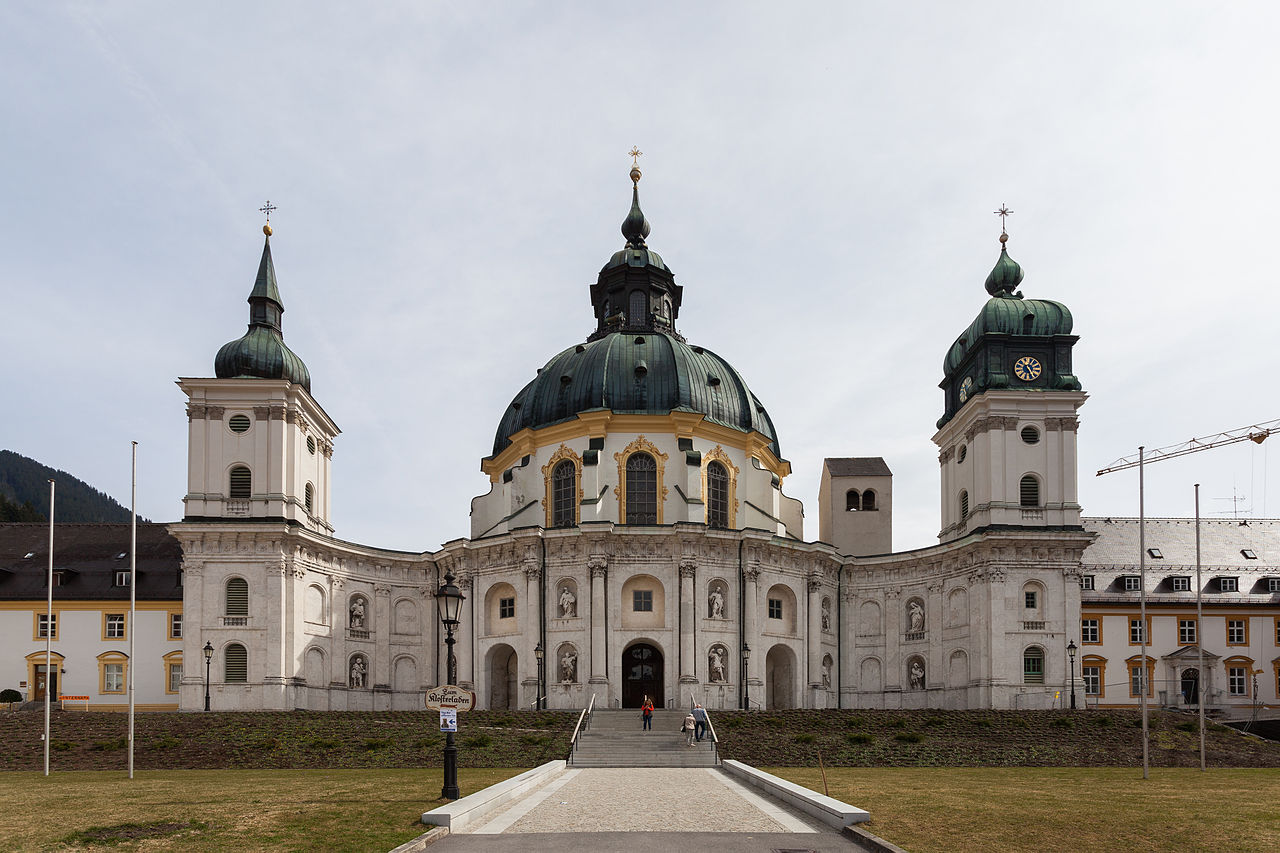


English: Ettal Abbey, Bavaria, Germany.
Español: Monasterio de Ettal, Baviera, Alemania.
Photo: 22 March 2014.
Source: Own work.
Author: Diego Delso.
(Wikimedia Commons)


The Assumption of The Blessed Virgin Mary,
Ettal Abbey. 
Bavaria, Germany.
Photo: 31 December 2007.
Source: Own work.
Author: Mattana.
(Wikimedia Commons)


In 1898, the buildings were acquired by Baron Theodor von Cramer-Klett and, in 1900, given to The Benedictines of Scheyern Abbey, who re-Founded the Monastery. It had been a member of The Bavarian Congregation of The Benedictine Confederation since 1900. The Abbey Church was declared a Minor Basilica in 1920.

During the Winter of 1940 – 1941, the German Pastor and Theologian, Dietrich Bonhoeffer (1906–1945), spent some months at the Monastery as the friend and guest of the Abbot. Like Bonhoeffer, a number of those in the Ettal Community were involved in the Conspiracy against Hitler. While at Ettal Abbey, Bonhoeffer also worked on his book "Ethics". Catholic Priest, Rupert Mayer, was kept at the Abbey, from 1939 to 1945, by the Nazis, to prevent him from further Anti-Nazi Preaching.

In 1993, Ettal Abbey re-Founded the former Wechselburg Abbey, in Saxony, an old Monastery of The Augustinian Canons, as a Benedictine Priory.


Interior of the Dome,
Ettal Abbey.
Photo: 31 December 2007.
Source: Own work.
Author: Mattana.
(Wikimedia Commons)


The Organ,
Ettal Abbey.
Photo: 31 December 2007.
Source: Own work.
Author: Mattana.
(Wikimedia Commons)


Ettal Abbey maintains a Byzantine Institute. The Abbot of Ettal Abbey, Joannes Hoeck, made a significant contribution, on the role of Patriarchs in Church government, at the Second Vatican Council.

The Monastery runs a brewery, a distillery, a bookstore, an Art Publishing House, an hotel, a cheese factory joint venture, and several smaller companies. The distillery produces Ettaler Kloster Liqueur, a herbal liqueur which, like that of the Carthusian Monks, comes in sweeter yellow, and more herbal green, varieties.

07 August, 2015

Saint Donatus. Bishop And Martyr. Feast Day, Today, 7 August.


Text from The Saint Andrew Daily Missal,
unless otherwise stated.

Saint Donatus.
Bishop and Martyr.
Feast Day 7 August.

Simple.

Red Vestments.


The Miracle of Saint Donatus.
Artist: José de Ribera (1591–1652).
Amiens, Museum of Picardy.
Date: 17th-Century.
Author: José de Ribera (1591–1652).
(Wikimedia Commons)


Saint Donatus, Bishop of Arezzo, Tuscany, Italy, was arrested under the Emperor Julian the Apostate and was beheaded in 362 A.D.


The following Text is from Wikipedia - the free encyclopaedia.

Donatus was Ordained a Deacon and Priest by Saint Satyrus of Arezzo, Bishop of that City, and continued to Preach in the City and in the surrounding region. At the death of Satyrus, Donatus was appointed a Bishop by Pope Julius I. A man named Anthimus was Donatus' Deacon.

During a Celebration of Mass, at the moment of the giving of Communion, in which a glass Chalice was being administered, some pagans entered the Church and shattered the Chalice in question. Donatus, after intense Prayer, collected all of the fragments and joined them together. There was a piece missing from the bottom of the Chalice; miraculously, however, nothing spilled from it. Astounded, seventy-nine pagans converted to Christianity.


A month after this episode, the Prefect of Arezzo, Quadratian, arrested Hilarian the Monk and Donatus. Hilarian was Martyred on 16 July 362 A.D., and Donatus was beheaded on 7 August at Arezzo.


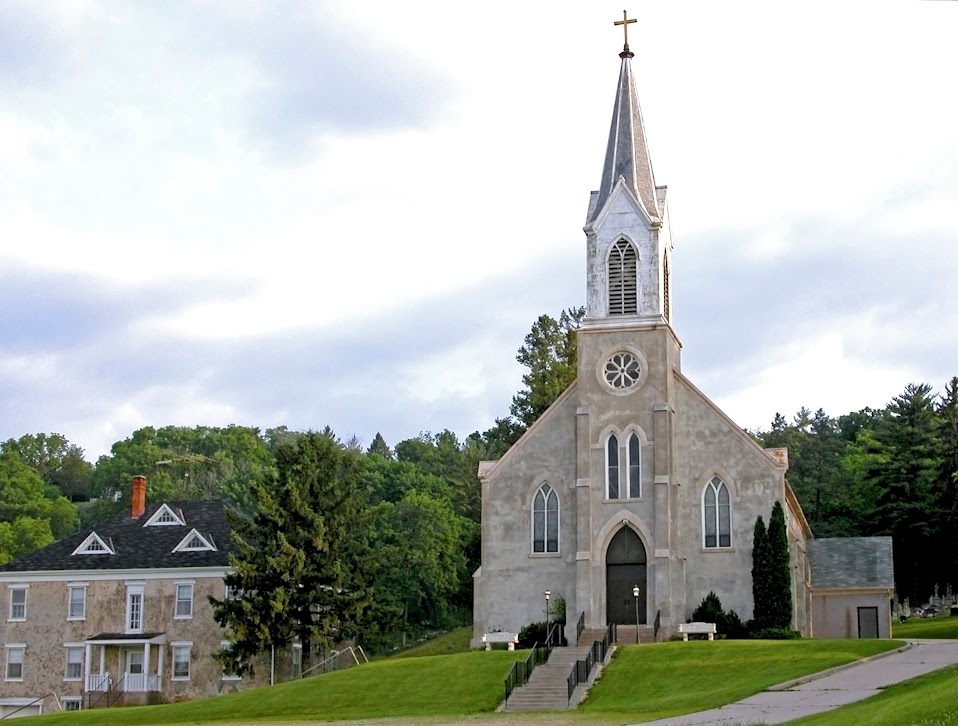
Saint Donatus Catholic Church,
Bellevue, Iowa,
United States of America.
Photo: 1 January 1970.
Photographer: 
Gary Schekel.
Illustration: GOOGLE+


Venice, Italy.
Photo: 30 December 2003.
Source: Own work.
Author: Blorg.
(Wikimedia Commons)

Saint Cajetan. Confessor. Feast Day 7 August.


Text from The Saint Andrew Daily Missal,
unless otherwise stated.

Saint Cajetan.
Confessor.
Feast Day 7 August.

Double.

White Vestments.


English: Saint Cajetan.
Italian: San Gaetano di Thiene.
Latin: Sanctus Caietanus.
Artist: Francesco Solimena (1657–1747).
This File: 22 February 2006.
User: Mathiasrex.
(Wikimedia Commons)


Saint Cajetan Founded the first Congregation of Clerks Regular, who endeavour to imitate the manner of life of the Apostles (Collect). Trust in God, which the Gospel recalls, was their great law; they therefore refrained from begging alms and waited until the Faithful brought them help of their own accord. They are also called Theatines.

This Saint's zeal for others' Salvation caused him to be called The Hunter of Souls. It was said that he was an Angel at the Altar and an Apostle in the Pulpit. He died at Naples on 7 August 1547.

Mass: Os justi.
Commemoration of Saint Donatus.

The Order Of Preachers (The Dominicans) Are On The Rise.


This Article is taken from RORATE CAELI


Saint Dominic.
Artist: Claudio Coello (1642 to 1693).
Dates: Approximately 1685.
Current location: Prado Museum , Madrid, Spain.
(Wikimedia Commons)


On The Feast of Saint Dominic (4 August) we share a bit of hope with Readers, concerning The Order of Friars Preachers (aka The Dominicans).

This past Sunday the Dominican Vocations Office of The Province of Saint Joseph, which represents the North-Eastern portion of The United States, sponsored a Dominican Rite Mass for "young men, 18-35 years old, considering a Vocation to The Order of Preachers."

The Sung Mass, at Saint Patrick's Church in Columbus, Ohio, was offered by Father Dominic Langevin, OP, the Assistant Master of Students at The Dominican House of Studies in Washington, D.C.


Codified in 1254, after Saint Dominic earlier wished to have his men use one Missal instead of offering regional variations of The Roman Rite, The Dominican Rite is fairly similar to what we know as The Traditional Latin Mass, although with distinct features such as the Celebrant invoking "Saint Dominic our father" in a shortened Confiteor and holding his arms in a cruciform position after the Consecration.

Following Summorum Pontificum, a renewed interest in The Dominican Rite has been demonstrated here and there, especially involving younger Friars and Student Brothers. But Sunday's explicit outreach to young men considering a Vocation to The Order of Preachers sends a clear message to Traditionally-minded Catholics that The Dominican Order is focusing on restoration and expansion.

Combined with a Traditional approach to Theology, exemplified by The Priestly Fraternity of Saint Peter sending Priests for graduate degrees at The Dominican House of Studies, it is no wonder vocations are booming -- at least in some parts of the world -- at The Order of Saint Dominic de Guzman.


THE SAINT ANDREW DAILY MISSAL


THE SAINT ANDREW DAILY MISSAL

Available (in U.K.) from

Available (in U.S.A.) from


"Parce Mihi Domine". "Spare Me, O Lord". Hauntingly Beautiful.


"Parce Mihi Domine". "Spare me, O Lord". 
Beautiful hauntingly. 
Spanish Composer: Christopher De Morales (1500-1553).

Text and Illustrations from Wikipedia - the free encyclopaedia,
unless otherwise stated.


Cristobal de Morales,
by Angelo Rossi.
The print is from the original The Andrea Adami 's Osservazioni per il ben regolare choir Cappella dei della Pontifical cantori. Catalogue 'nomi, Cognomi, and homeland i cantori Pontifici (Rome, 1711).
Date: 18th-Century.
Source: Dejiny hudby II. Renesance, p. 231.
Author: Angelo Rossi.
(Wikimedia Commons)


Cristobal de Morales (1500 - 1553) was a  Spanish  composer of the  Renaissance  and is Generally Considered to be the Most Influential Spanish composer before Victoria.

He was born in  Seville , Spain, and, after an exceptional early education there, Which included a Rigorous training in the classics, as well as musical study With some of the foremost composers, I have held posts at  Ávila  and  Plasencia .


Parce mihi Domine.
Cristobal de Morales (1500-1553).
Available on YouTube at
http://youtu.be/Uk1YMS2M0L4  .


Parce mihi Domine
(Job  7:16 -21)  

Parce mihi Domine, nihil enim sunt dies mei.
Quid est homo, quia magnificent eum?
Aut quid apponis erga cor tuum eum?
Cum diluculo visits, et subito probas illum.
I usquequo non michi parcis, nec dimittas me, ut glutiam salivam meam?
Peccavi.  Faciam quid tibi, or custos hominum?
Quare posuisti contrarium tibi me, et factus sum michimet ipsi gravis?
Cur non tollis peccatum meum, et quare non aufers iniquitatem meam?
Pulvere dormio in ecce nunc,  et si me quesieris mane, non subsistam.

Spare me O Lord for my days are nothing.
What is man, That thou magnifiest him:
or why settest thou thy heart toward him?
Thou dost visit him early in the morning,
And suddenly thou provest him. 
How long dost thou not spare me,
nor suffer me, That I swallow my spittle?
I have sinned. What shall I do to thee, O keeper of men?
Why hast thou set I contrary to thee, 
and I am become burdensome to myself? 
Why dost thou not take away my sin,
and why dost thou not take away mine iniquity?
Shall behold now I sleep in the dust,
and if thou seek me in the morning, 
I shall not be.


SAINT ANDREW THE DAILY MISSAL


SAINT ANDREW THE DAILY MISSAL

Available (in UK) from

Available (in USA) from


06 August, 2015

Pope Saint Sixtus II, Saint Felicissimus And Saint Agapitus. Martyrs. Feast Day 6 August.


Text from The Saint Andrew Daily Missal,
unless otherwise stated.

Pope Saint Sixtus II, Saint Feliccisimus
   and Saint Agapitus.
Martyrs.
Feast Day 6 August.

Simple.

Red Vestments.


Pope Saint Sixtus II and companions. 
(Cote Français 185, Fol. 96v. Vies de saints,

France, Paris, XIVe siècle, 
Richard de Montbaston et collaborateurs.)


Pope Saint Sixtus II was Consecrated Bishop of The Church of Rome in 257 A.D. The following year, while Celebrating The Sacred Liturgy, over the tomb of a Martyr, in the Cemetery, or Catacombs, of Saint Callistus, he was arrested by soldiers carrying out the edict of The Emperor, Valerian.


On the same day, 6 August, he was put to death and buried in the same Cemetery, along with “the Holy Martyrs Felicissimus and Agapitus, Deacons of Blessed Sixtus; Januarius, Magnus, Vincent, and Stephen, Sub-Deacons, all of whom were beheaded with him and buried in the Cemetery of Praetextatus. 

With them suffered also Blessed Quartus, as is related by Saint Cyprian”. (Roman Martyrology). 
Three days later, his famous Arch-Deacon, Saint Lawrence, was Martyred.


Illustration and Caption: CHRIST BEARERS


Pope Saint Sixtus II was Martyred in the 3rd-Century, during the cruel persecution of Valerian, with his two Deacons, Felicissimus and Agapitus. His name is mentioned in The Canon of The Mass among the Popes (First List).

Laurence, his first Deacon, seeing him led to death, exclaimed: "Why do you abandon me, Father, you who never offer The Holy Sacrifice without your Deacon ?" You will follow me in three days," replied Sixtus.

The Anniversary of The Martyrdom of Saint Laurence will be Solemnised in three days.

Mass: Sapiéntiam.


THE SAINT ANDREW DAILY MISSAL


THE SAINT ANDREW DAILY MISSAL

Available (in U.K.) from

Available (in U.S.A.) from


The Transfiguration Of Our Lord Jesus Christ. Feast Day 6 August.


Text and Illustrations from The Saint Andrew Daily Missal,
unless otherwise stated.

The Transfiguration of Our Lord Jesus Christ.
Feast Day 6 August.

Double of The Second-Class.


White Vestments.


This is My beloved Son, in Whom I am well pleased:
Hear ye Him.


The Feast of The Transfiguration of Jesus had long been Solemnised, on 6 August, in different Churches of The East and The West. To commemorate the victory which arrested, near Belgrade, in 1456, the invading tide of Islam, and which was announced at Rome on 6 August, Pope Callistus III extended The Feast to the whole Church.

It is The Feast of many Churches under the Title of Saint Saviour. This is why Pope Saint Pius X raised it to the Rank of Double of The Second-Class, for it is the old Title of the Cathedral of Rome, Saint John Lateran, formerly called the Basilica of Saint Saviour (Feast Day 9 November).

In Low Masses: Commemoration of The Holy Martyrs, Pope Saint Sixtus II, Felicissimus
and Agapitus.


THE SAINT ANDREW DAILY MISSAL


THE SAINT ANDREW DAILY MISSAL

Available (in U.K.) from

Available (in U.S.A.) from


Senior Citizen Discounts.


Whilst lots of unpleasant things are happening to The Catholic Church, and, in particular, to The Traditional Latin Mass and to those Faithful Catholics who support it, a little levity might help us get through the day.


05 August, 2015

The Dedication Of The Church Of Our Lady Of The Snow. Feast Day 5 August.


Text from The Saint Andrew Daily Missal,
unless otherwise stated.

The Dedication of The Church of Our Lady of The Snow.
Feast Day 5 August.

Greater-Double.

White Vestments.


The Papal Basilica of Saint Mary Major
(The Basilica of Our Lady of The Snow)
Photo: March 2006.
Source: Own work.
Author: Sixtus.
(Wikimedia Commons)


This Church was built at Rome, on Mount Esquiline, in the 4th-Century A.D., during the Pontificate of Pope Liberius. In The Middle Ages, a graceful and popular Tradition ascribed its Foundation to a noble Patrician, who, having been favoured with a vision of Our Lady, caused the Church to be built on a spot covered by a miraculous fall of snow.

This Sanctuary was rebuilt in the following Century and Dedicated, by Pope Sixtus III, in 432 A.D., to Mary, whom The Council of Ephesus (431 A.D.), had just proclaimed The Mother of God. The mosaics of The Triumphal Arch glorify this Divine Maternity, and the representations of the two Cities, of Bethlehem and Jerusalem, recall The Birth of Christ in The City of David, and that of The Church in The Cenacle of The Last Supper. These mosaics were restored in 1931-1934. The Basilica is also called Saint Mary of The Crib, because portions of The Crib are preserved here.

Saint Mary's, called "Major" because it is the largest and most important of the Churches Dedicated to The Blessed Virgin, is a Patriarchal Basilica. The great Nave is formed by two rows of forty-four Columns of White Marble and the Ceiling is covered with the first Gold brought from America.

In this Church, whose Dedication is Solemnised on this day, takes place many Celebrations, including: The inauguration of The Liturgical Year on The First Sunday in Advent; the Stations at Christmas; the Feast of Saint John; at Easter; on Rogation Monday; and on all Wednesdays in Ember Weeks.

Mass: Salve Sancta Parens.
The Creed is said.
Preface of The Blessed Virgin: Et te in Festivitáte.


"The Miracle of The Snow",
by Masolino da Panicale.
Christ and The Blessed Virgin Mary observe Pope Liberius,
who marks in the legendary snowfall the outline of the Basilica.
Artist: Masolino da Panicale (1383-1440).
Date: 15th-Century.
Current location: Galleria Nazionale d9i Capodimonte, Naples, Italy.
Source: The Yorck Project: 10.000 Meisterwerke der Malerei. DVD-ROM, 2002.
ISBN 3936122202. Distributed by DIRECTMEDIA Publishing GmbH.
(Wikimedia Commons)


The following Text is from Wikipedia - the free encyclopaedia, unless otherwise stated.

The Dedication of the Basilica of Saint Mary Major, previously known as Dedicatio Sanctae Mariae ad Nives (Dedication of The Church of Our Lady of The Snow) is a Liturgical Feast Celebrated on the 5 August in The Latin Form of The Catholic Church.

In The Roman Catholic Calendar of Saints, it has the Rank of Optional Memorial, and, in The General Roman Calendar of 1962, it is a Third-Class Feast. It Commemorates the Dedication of the restored Basilica of Santa Maria Maggiore, by Pope Sixtus III, just after The First Council of Ephesus.

This Major Basilica, located on the summit of The Esquiline Hill, in Rome, Italy, is called the Basilica of Saint Mary Major (Latin: Sancta Mariae Majoris) because it is the largest Church in Rome that is Dedicated to The Blessed Virgin Mary.


The Basilica of Saint Mary Major,
Rome, Italy.
Photo Credit: Fr Kevin Estabrook.


The Church was built during the Pontificate of Pope Liberius and is sometimes known as the "Basilica Liberii" or "Liberian Basilica".

Pope Pius V inserted this Feast into The General Roman Calendar in 1568, when, in response to the request of The Council of Trent, he reformed The Roman Breviary. Before that, it had been Celebrated at first only in the Church, itself, and, beginning in the 14th-Century, in all the Churches of the City of Rome.

Thus it appears in The Tridentine Calendar for Celebration as a Double. In Pope Clement VIII's Missal of 1604, it was given the newly-invented Rank of Greater-Double. In Pope Saint John XXIII's Classification, it became a Third-Class Feast. This 1960 Calendar, included in the 1962 Edition of The Roman Missal, is the Calendar whose privately and continued use, under certain conditions publicly, is authorised by the Motu Proprio Summorum Pontificum. Nine years later, the Celebration became an Optional Memorial.


Interior of Saint Mary Major,
Rome, Italy.
Photo: 15 February 2013.
Source: Own work.
(Wikimedia Commons)


Until 1969, The Feast was known as Dedicatio Sanctae Mariae ad Nives (Dedication of the Church of Our Lady of The Snow), a name that had become popular for the Basilica in the 14th-Century, in connection with a legend about its origin. That The Catholic Encyclopedia summarises: "During the Pontificate of Liberius, the Roman Patrician, John, and his wife, who were without heirs, made a vow to donate their possessions to The Virgin Mary.

They Prayed that she might make known to them how they were to dispose of their property in her honour. On 5 August, at the height of the Roman Summer, snow fell during the night on the summit of The Esquiline Hill.

In obedience to a vision of The Virgin Mary, which they had the same night, the couple built a Basilica in honour of Mary, on the very spot which was covered by snow.


English: Interior of the Basilica of Saint Mary Major, Rome, Italy.
Deutsch: Rom. Basilika Santa Mario Maggiore, Innenansicht.
Photo: 13 May 2003.
Source: Own work.
Author: Dnalor 01.
(Wikimedia Commons)


No Catholic Church can be honoured with the Title of Basilica unless by Apostolic Grant, or from Immemorial Custom. Saint Mary Major is one of only four Basilicas that, today, hold the Title of Major Basilica.

The other three Basilicas are Saint John Lateran, Saint Peter's and Saint Paul-outside-the-Walls. All other Catholic Churches that, either by Grant of the Pope or by Immemorial Custom, hold the Title of Basilica, are Minor Basilicas.


Interior of Saint Mary Major,
Rome, Italy.
Photo: 15 February 2013.
Source: Own work.
(Wikimedia Commons)


Until 2006, the four Major Basilicas, together with the Basilica of Saint Lawrence-outside-the-Walls, were referred to as the five "Patriarchal Basilicas" of Rome, associated with the five ancient Patriarchal Sees of Christendom (see Pentarchy). Saint Mary Major was associated with the Patriarchate of Antioch. In the same year (2006), the Title of "Patriarchal" was also removed from the Basilica of Saint Francis in Assisi.

The former five Patriarchal Basilicas, with the Basilica of The Holy Cross in Jerusalem and San Sebastian-outside-the-Walls, formed the Traditional Seven Pilgrim Churches of Rome, which are visited by Pilgrims to Rome and who are following the twenty kilometres (twelve miles) itinerary, established by Saint Philip Blacks on 25 February 1552, especially when seeking The Plenary Indulgence in Holy Years. For The Great Jubilee of 2000, Pope Saint John Paul II replaced Saint Sebastian's Church with The Shrine of Our Lady of Divine Love.

Pray For Vocations To The Priesthood.

04 August, 2015

Saint Dominic. Confessor. Feast Day 4 August.


The text from Saint Andrew Daily Missal,
Unless otherwise stated.

Saint Dominic.
Confessor.
Feast Day 4 August.

Greater-Double.

White vestments.


Saint Dominic Receives The Rosary from The Virgin Mary.
Stained-Glass Window, by Franz Mayer ,
in Carlow Cathedral, Ireland.
Photo: 3 September 2009.
Source: Own work.
(Wikimedia Commons)


Saint Dominic.
Artist: Claudio Coello (1642 to 1693).
Dates: Approximately 1685.
Current location: Prado Museum , Madrid, Spain.
(Wikimedia Commons)


The Church of France was ravaged by the heresy of The Albigenses, who, not satisfied with teaching false Doctrine, Pillaged the Churches and massacred the Priests. In 1215, Pope Innocent III saw in a dream the tottering walls of the Basilica of Saint John Lateran, Rome, held up by the powerful shoulders of a Friar. This Friar was Saint Dominic, Whose Preaching defended Catholic Doctrine against the new heresies (Epistle).

Before His birth, His mother saw in a vision, her child in the shape of a little dog, holding a torch in its mouth Which Was to Set the World on Fire.

Called Domains, Because His parents Attributed His birth to the Prayers of the holy Benedictine Abbot, Dominic of Silos, he truly belonged to The Lord, as His name suggests.

Born in Spain, of the noble family of Gusman, he distinguished himself by His purity, as is signified by the Lily That he holds (Alleluia) and his White Habit.


Illustration:  A VOICE OF ORANGE COUNTY


Having Witnessed the many evils Caused by the heretics in the South of France, he Founded, opposed to them, The Order of The Friars Preachers (Communion), whom-he armed with The Shield of Truth to teach Doctrine and The Sword of The Word to Preach it.

The Dominicans number many Saints of Both Sexes, who, like their Founder, ardently Studied The Word of God in the Gospel, Which, as Saint Dominic says, is The Book of Truth and "The Book of Charity."

[The Order of The Friars Preachers (OP) has given to The Church, as at 1945: Four Popes (Blessed Innocent V, Saint Pius V, Benedict XI, Benedict XIII); Numerous Cardinals, Bishops, Doctors, Preachers and Illustrious Writers. It numbers eleven Saints and four women Saints, Beatified 268 men and twenty-four Beatified women, 300 of whom-Martyrs. The Order of the Census, in 1935 there were 6,000 Showed Friars. The Dominican Nuns in The Second Order, and in The Third Order Regular, amount to 40,000.]

This Saint loved Our Lady in a special manner and Preached the Devotion to The Rosary. He died on 6 August 1221.

High: Os justi.

Missa Papae Marcelli. Giovanni Pierluigi Da Palestrina (1525-1594). The Tallis Scholars. Peter Phillips.


Text from Wikipedia - the free encyclopaedia.


The Coronation of Pope Paul VI, in 1963,
was the last time Palestrina's Mass Setting,
"Missa Papae Marcelli"
was used at a Papal Coronation.
It is high time it was used again.
Illustration: A CATHOLIC LIFE


Missa Papae Marcelli.
Composed by Palestrina.
Sung by:  The Tallis Scholars.
Director: Peter Phillips.
Available on YouTube at

03 August, 2015

If You Are Sad And Confused. If You Are Doubtful. If You Are Wavering In Your Faith. Watch This Video.


Our Lady of Lourdes
Parish Pastoral Theme 2014:
"The Church is Holy".
Available on YouTube at

O, My Saviour. O, Mon Sauveur.


O My Saviour Jesus Christ,
only object of my desires.
Illustration:  HOLY CARD HEAVEN


Obsecro Te
(I beseech Thee).

Priests who say this Prayer in thanksgiving after Mass
gain an indulgence of three Years applicable to The Souls in Purgatory
(Blessed Pope Pius IX, 1846).

He who says it, if possible, kneeling, may Obtain the pardon of any faults or mistakes
of Which he may sono stati guilty as the result of human frailty
During the Celebration of Mass (Blessed Pope Pius X, 1912).


I beseech Thee, most sweet Lord Jesus Christ,
That grant Thy Passion may be to me in power
by Which I may be Strengthened, protected and defended.

May Thy Wounds be to me food and drink,
by Which I may be nourished, inebriated and overjoyed.
May the sprinkling of Thy Blood be to me an ablution for all my sins.

May Thy Death testing me to everlasting life,
and Thy Cross be to me an eternal glory.
In These be my refreshment, my joy,
my preservation and sweetness of heart.

Who livest and reignest
World without end.

Amen.

The Finding Of The Body Of Saint Stephen. The First Martyr. Feast Day 3 August.


Text from The Saint Andrew Daily Missal,
unless otherwise stated.

The Finding of The Body of Saint Stephen.
The First Martyr.
Feast Day 3 August.

Semi-Double.

Red Vestments.


Stoning of Saint Stephen.
Artist: Jacopo & Domenico Tintoretto.
Altarpiece of San Giorgio Maggiore, Venice, Italy.
Photo: 11 April 2013.
Source: Own work.
Author: Smeat75.
(Wikimedia Commons)


The Church Solemnises on 26 December The Feast of Saint Stephen, and on 2 January The Octave of this Saint. She holds The Station on Passion Friday in the Church Dedicated to Saint Stephen, on Mount Coelius, at Rome.

On 10 August, she will Celebrate The Feast of Saint Laurence, whose "Remains, more precious," say the writers of the first Centuries, "than Gold and Precious Stones" are with those of the Deacon, Stephen, which had been Translated from Palestine to the Capital of The Christian World.

Today's Mass Commemorates the miraculous finding by a Priest of these Relics at Kapher-Gamala on 5 December 415 A.D., (Collect). Except The Collect, it is the same as that on 26 December, the date of the Translation of these Remains from Kapher-Gamala to Jerusalem.


For Gamaliel, the teacher of Saint Paul, so much esteemed among the doctors of Israel, that, at his death, it was declared that "the glory of Israel had disappeared", had buried twenty miles from that Town, at his Country House, The Holy Martyr, Stephen, Nicodemus, and his own son, Abibas. He, himself, was buried there. These precious Relics, long ignored, were miraculously discovered and wrought numerous cures.

The Introit and the Epistle recall how Stephen, filled with The Holy Ghost, convicted the Jews of error, and how they, hating Christ as their fathers hated Him (Gospel), seized Stephen and stoned him to death.

Let us honour Saint Stephen, and, imitating his Prayers for his persecutors (Epistle, Communion), let us learn by his example to love our enemies (Collect).

Mass: As on The Feast of Saint Stephen, 26 December, except one word in The Collect: "inventionem", instead of "natalitia": We Celebrate "the finding of his body" instead of "his birthday to immortality".

Related Posts Plugin for WordPress, Blogger...