Notre Dame de Rouen. The façade of the Gothic Church in France. Photographer: Hippo1947. Licence: SHUTTERSTOCK.

12 September, 2015

The Most Holy Name Of Mary. Feast Day, Today, 12 September.


Text from The Saint Andrew Daily Missal,
unless otherwise stated.

The Most Holy Name of Mary.
Feast Day 12 September.

Greater-Double.

White Vestments.


English: Bouguereau's L'Innocence.
Both young children and the Lamb
are symbols of innocence.
Artist: William-Adolphe Bouguereau (1825–1905).
Français: Bouguereau — L'Innocence.
Русский: "Невинность", картина Виллиама Бугро.
И маленький ребёнок, и ягнёнок — символы невинности.
Date: 1893.
Source/Photographer: http://www.illusionsgallery.com.
Author: William-Adolphe Bouguereau (1825–1905).
(Wikimedia Commons)


The Lady Altar,
Our Lady of the Rosary Catholic Church,
Blackfen, Kent,
England.
Date: 2012.
Author: MULIER FORTIS
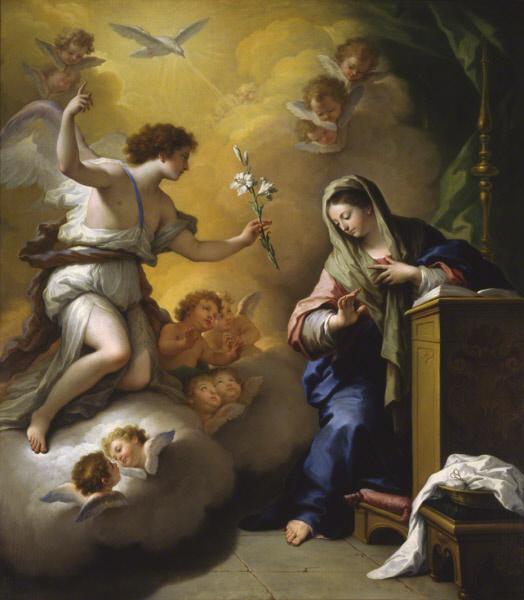


The Annunciation.
Artist: Paolo de Matteis (1662–1728).
Date: 1712.
Current location: Saint Louis Art Museum,
Missouri, United States of America.
Source: Own work.
(Wikimedia Commons)


Just as a few days after Christmas we celebrate The Holy Name of Jesus, so, after The Nativity of Mary, we glorify her Holy Name. Eight days after The Birth of The Virgin, according to the custom of the Jews, her holy parents, inspired by God, say Saint Jerome and Saint Antoninus, gave her the name of Mary.

Wherefore, during The Octave of The Nativity, The Liturgy gives a Feast in honour of this Holy Name.

Spain, with the approval of Rome, in 1513, was the first to celebrate it, and, in 1683, it was extended to the whole Church by Pope Innocent XI to thank Mary for the victory which John Sobieski, King of Poland, had just gained against the Turks, who besieged Vienna and threatened The West.

"The Name of The Virgin," says the Gospel, "was Mary." Thee Hebrew name of Mary, in Latin "Domina", means "Lady" or "Sovereign"; for the authority of her Son, Lord of The World, makes her a Sovereign from her birth, in fact, as well as in name [Eighth Lesson at Matins].

Whence, as we call Jesus "Our Lord", we say of Mary that she is "Our Lady". To pronounce her name is to proclaim her power.

Let us offer The Holy Sacrifice of The Mass to God, to honour The Most Holy Name of Mary and to obtain by her intercession her continual protection (Postcommunion).

Mass: Vultum tuum deprecabúntur.


English: The Assumption.
Deutsch: Maria Himmelfahrt, Hochaltar für St. Maria Gloriosa dei Frari in Venedig.
Français: L'Assomption de la Vierge.
Artist: Titian (1490–1576).
Date: 1516-1518.
Source/Photographer: The Yorck Project: 10.000 Meisterwerke der Malerei. DVD-ROM, 2002.
ISBN 3936122202. Distributed by DIRECTMEDIA Publishing GmbH.
(Wikimedia Commons)


O Most Holy Maiden Mary.
Estonian Philharmonic Chamber Choir.
Available on YouTube at


The following Article is taken from the Blog CATHOLICISM PURE AND SIMPLE

In accordance with Jewish custom, Our Lady’s parents named her, eight days after her birth, and were inspired to call her "Mary". The Feast of the Holy Name of Mary, therefore, follows that of her Birthday, as the Feast of the Holy Name of Jesus follows Christmas.

The Feast originated in Spain and was approved by the Holy See in 1513; Pope Innocent XI extended its observance to the whole Church in 1683, in thanksgiving to Our Blessed Lady for the victory on 12 September 1683 by John Sobieski, King of Poland, over the Turks, who were besieging Vienna and threatening the West. This day was commemorated in Vienna by creating a new kind of pastry and shaping it in the form of the Turkish half-moon. It was eaten along with coffee, which was part of the booty from the Turks.

The ancient Onomastica Sacra have preserved the meanings ascribed to Mary’s name by the early Christian writers and perpetuated by the Greek Fathers. “Bitter Sea,” “Myrrh of the Sea,” “The Light Giver,” “The Enlightened One,” “Lady,” “Seal of the Lord,” and “Mother of the Lord” are the principal interpretations. These etymologies suppose that the Hebrew form of the name is Maryãm, not Miryãm.


File:Bouguereau-Linnocence.jpg


From the time of Saint Jerome, until the 16th-Century, preferred interpretations of Mary’s name in the West were, “Lady,” “Bitter Sea,” “The Light Giver,” and, especially, “Star of the Sea.” Stella Maris was by far the favoured interpretation. The revival of Hebraic studies, which accompanied the Renaissance, led to a more critical appraisal of the meanings assigned to Our Lady’s name.

Miryãm has all the appearance of a genuine Hebrew name, and no solid reason has been discovered to warrant rejecting the Semitic origin of the word. The Hebrew name of Mary, Miryãm, (in Latin, Domina) means Lady, or Sovereign; this Mary is in virtue of her Son’s Sovereign Authority as Lord of the World. We call Mary "Our Lady", as we call Jesus "Our Lord", and when we pronounce her name, we affirm her power, implore her aid and place ourselves under her protection.


THE SAINT ANDREW DAILY MISSAL


THE SAINT ANDREW DAILY MISSAL

Available (in U.K.) from

Available (in U.S.A.) from


"This Will Be The First Time That Mass Has Been Celebrated In This Mediaeval Church Since Pre-Reformation Times."


Saint Augustine's Church,
Snave, Ashford, Kent.
It is possible that a small private Chapel stood on this site before the present building was commenced in the Late-13th-Century. The East End is unusual in that The Lady Chapel (more recently used as a school room) vies for importance with The Chancel.
Declared redundant in 1983, Saint Augustine's Church is now entirely maintained by
The Romney Marsh Historic Churches Trust.
Text: © 2014 Joan Campbell.
Photograph: © 2014 John Hendy.


Missa Cantata.
Saint Augustine's Church,
Snave, Ashford, Kent TN26 2QJ.

Saturday,
26 September 2015,
1200 hrs.

Celebrant:
Fr. Marcus Holden,
Rector of The Shrine of Saint Augustine,
Ramsgate, Kent.


Music:
The Victoria Consort.
Director:
Dominic Bevan.

Further Details:
Mrs. Marygold Turner
01580 291372.

Travel Directions:
See, below,


Permission for this Mass at Saint Augustine's Church,
Snave, Ashford, Kent, has been kindly given by


11 September, 2015

Missing The Twiddly Bits ? A 3D Printing Project Has Taken The Cost Out Of Baroque Detailing.


This Article can be read in full at RIBAJ.COM


Illustration: RIBAJ.COM


Could the inherent flexibility of 3D printing spark a return to more ornate and flamboyant forms of architecture?

That’s the question posed by architects Michael Hansmeyer and Benjamin Dillenburger with their Digital Grotesque project, which is thought to be the world’s first ever 3D printed room designed to echo the complex organic detailing of the Baroque period.

The project began as a commission from FRAC Centre in Orléans, France, for the practice to design and construct a grotto. It developed a software algorithm able to generate a complex form for the grotto that appears simultaneously synthetic and organic. Over the course of one month the design was 3D printed in large chunks, using a combination of sand and a binding agent, then assembled in just one day.

The resulting structure is both disturbing and reminiscent of HR Giger, famous designer of the sets in the movie Alien, while also being evocative of aspects of Renaissance and Baroque architecture. In addition, the structure is very robust with a similar compressive strength to solid sandstone.

My New Bathroom.


Bert, the odd-job man, did a great job on the new bathroom.
Illustration: PINTEREST

10 September, 2015

The Unbelievable Universe (Unless You Have The Gift Of Faith).


"Let Those Who Have Eyes, See . . ."


"Little Green Apples".
Sung by Roger Miller.
Available on YouTube at
https://youtu.be/XDv5ScIuw48


Some of the most breathtaking views in The Universe are created by Nebulae — hot, glowing clouds of gas. This new NASA/ESA Hubble Space Telescope image shows the centre of The Lagoon Nebula, an object with a deceptively tranquil name, in the Constellation of Sagittarius. The region is filled with intense winds from hot Stars, churning funnels of gas, and energetic Star formation, all embedded within an intricate haze of gas and pitch-dark dust.
Image Credit: NASA, ESA, J. Trauger (Jet Propulson Laboratory).
Illustration: NASA
Wikipedia states that Charles Darwin promoted "Natural Selection" to explain things.
He described himself as an Agnostic.
Wikipedia states that Richard Dawkins is an Atheist, a patron of the British Humanist Association, and a supporter of the Brights Movement. He is well known for his criticism of
In his 1986 book, The Blind Watchmaker, Dawkins argues against the Watchmaker Analogy, an argument for the existence of a Supernatural Creator based upon the complexity of living organisms. Instead, he describes evolutionary processes as analogous to a blind watchmaker.


If you travel for 15,000 Light Years,
and if you go to the Constellation of Sagittarius,
you will see this.
It is the spectacular cosmic pairing of the Star "Hen 2-427" — more commonly known as
"WR 124" — and the nebula "M1-67", which surrounds it. Both objects, captured here
by the NASA/ESA Hubble Space Telescope, are found in the Constellation of Sagittarius
and lie 15,000 light-years away.
The Star "Hen 2-427" shines brightly at the very centre of this explosive image,
and around the hot clumps of surrounding gas that are being ejected into Space
at over 93,210 miles (150,000 km) per hour.
Illustration: NASA
Charles Darwin promoted "Natural Selection" to explain things.
He described himself as "an Agnostic".


Although we are used to seeing Saturn's Moons lit directly by the Sun, sometimes we can catch them illuminated by "Saturn-Shine." Here, we see Saturn's Moon "Mimas" (upper right of The Rings of Saturn) lit by light reflected off of Saturn.
Illustration: NASA
Wikipedia states that Jainism believes The Universe is eternal
and has no need for a Creator Deity.


"Every time I hear a new-born baby cry,
I Believe",
by
The Bachelors.
Available on YouTube at


This NASA/ESA Hubble Space Telescope image shows Messier 96,
a Spiral Galaxy just over thirty-five million Light-Years away,
in the Constellation of Leo (The Lion). It is the nearest group containing
both bright Spirals and a bright Elliptical Galaxy (Messier 105).
Charles Darwin promoted "Natural Selection" to explain things.
He described himself as "an Agnostic".
Wikipedia states that Jainism believes The Universe is eternal
and has no need for a Creator Deity.
Wikipedia states that Richard Dawkins is an Atheist, a patron of the British Humanist Association, and a supporter of the Brights Movement. He is well known for his criticism of
Illustration: NASA

09 September, 2015

The Lady Chapel. Liverpool Anglican Cathedral.


The Lady Chapel,
Liverpool Cathedral, England.
The Lady Chapel of Liverpool Anglican Cathedral, designed by Giles Gilbert Scott,
overseen by G. F. Bodley. The Lady Chapel was the first part of the Cathedral to be
completed, in 1910, and retains many of the Gothic features of the original design.
As Scott grew in confidence, the rest of the Cathedral was re-designed and streamlined
to arrive at a much more massive, austere style of architecture.
Photo: © Andrew Dunn, 4 December 2005.
Source: Own work.
Author: Andrew Dunn.
(Wikimedia Commons)

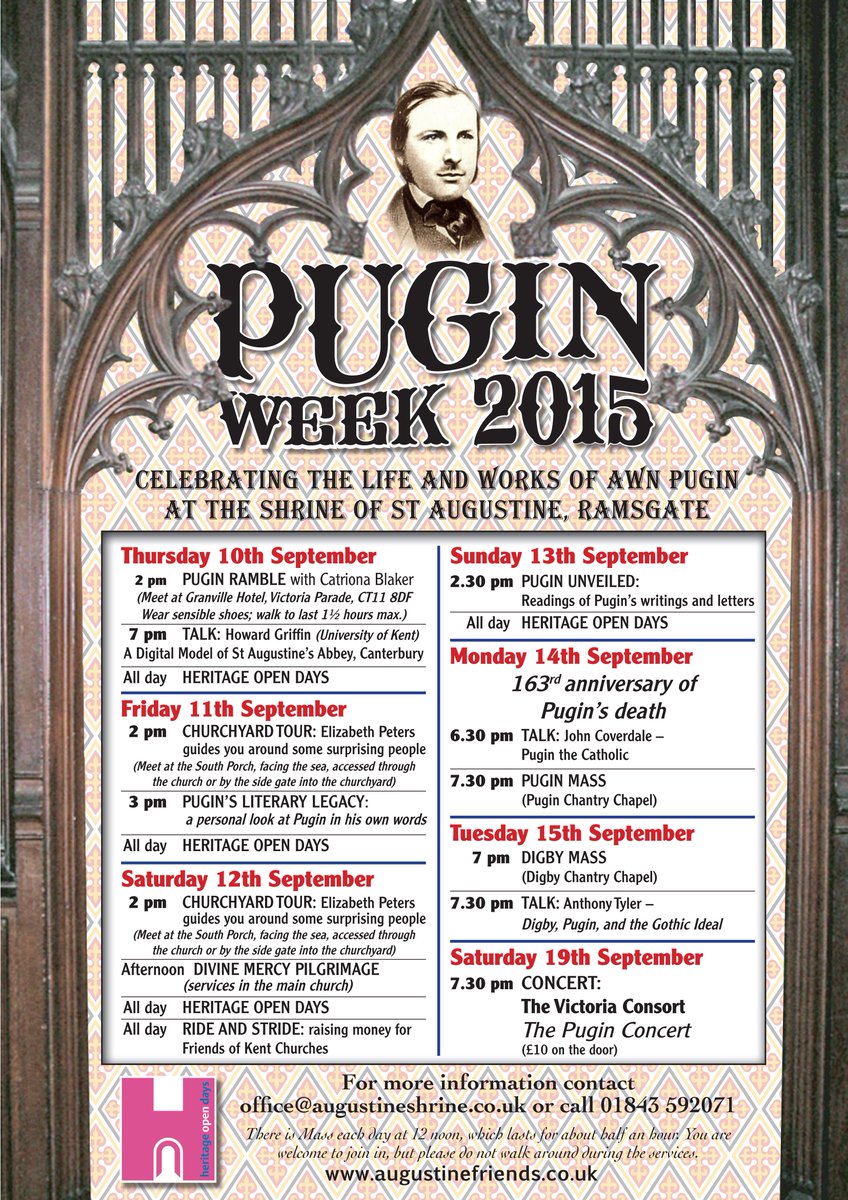
Augustus Welby Northmore Pugin Week 2015. The Shrine Of Saint Augustine, Ramsgate.


Embedded image permalink


Shrine of Saint Augustine,
Saint Augustine’s Road,
Ramsgate,
Kent CT11 9PA.
Telephone: 01843 592071.

08 September, 2015

Saint Adrian. Martyr. Feast Day 8 September.


Text from The Saint Andrew Daily Missal,
unless otherwise stated.

Saint Adrian.
Martyr.
Feast Day 8 September.

Simple.

Red Vestments.


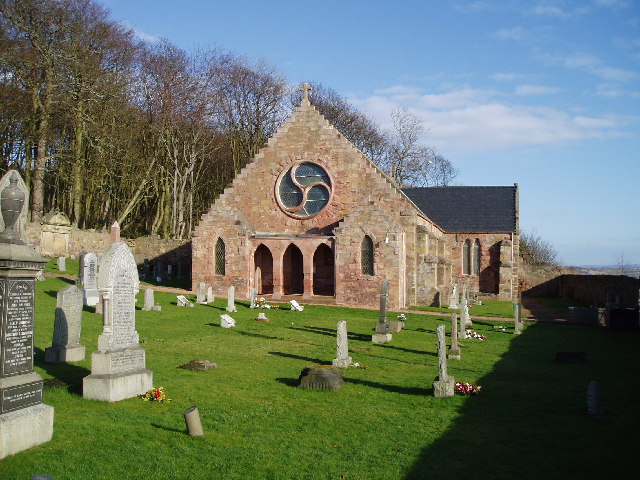
Saint Adrian's Church,
West Wemyss,
Scotland.
The Church was built in 1890.
Date: 20 February 2006.
Source: From geograph.org.uk.
Author: Kevin Rae.
(Wikimedia Commons)


"At Nicomedia", says The Roman Martyrology, "Saint Adrian, Martyr, and twenty-three other Saints, who, after undergoing many torments, had their legs crushed and thus ended their glorious fight under the Emperors Diocletian and Maximian, about 303 A.D.

"The body of Saint Adrian was later Translated to Rome on the day when his Feast is Solemnised".

Mass: In virtúte.


English: Stained-Glass Window, depicting Saint Adrian (centre)
in the Basilica of Saint-Nicolas, 


Meurthe-et-Moselle, Lorraine, France.

Below are the Armorial Crests of The House of Lorraine (left),

The House of Anjou (centre) 

and the City Arms of Saint-Nicolas-de-Port.
Deutsch: Bleiglasfenster (Baie 17) in der Basilika Saint-Nicolas in Saint-Nicolas-de-Port im Département Meurthe-et-Moselle (Lothringen/Frankreich), mit Fragmenten aus der Renaissance; Darstellung: Ehepaar Fiacre Fériet (links) und Jennon Thierie (rechts), hl. Adrian von Nikomedien; unten Wappen des Hauses Lothringen (links), des Hauses Anjou (Mitte) und Stadtwappen von Saint-Nicolas-de-Port.
Photo: 26 April 2015.
Source: Own work.
Author: GFreihalter.
(Wikimedia Commons)


The following Text is from Wikipedia - the free encyclopaedia.

Saint Adrian (also known as Hadrian), or Adrian of Nicomedia, was a Herculian Guard of the Roman Emperor Galerius Maximian. After becoming a convert to Christianity, with his wife Natalia, Adrian was Martyred at Nicomedia.

Saint Adrian and Saint Natalia lived in Nicomedia, during the time of Emperor Maximian, in the Early-4th Century. The twenty-eight-year-old Adrian was Head of the Praetorium.

It is said that, while presiding over the torture of a band of Christians, he asked them what reward they expected to receive from God. They replied:
"Eye hath not seen, nor ear heard, neither have entered into the heart of man, the things which God hath prepared for them that love him" (1 Corinthians 2:9).
He was so amazed at their courage that he publicly confessed his Faith, though he had not himself yet been Baptised. He was then immediately imprisoned. He was forbidden visitors, but accounts state that his wife Natalia came to visit him, dressed as a boy, to ask for his Prayers when he entered Heaven.

The executioners wanted to burn the bodies of the dead, but a storm arose and quenched the fire.


THE SAINT ANDREW DAILY MISSAL


THE SAINT ANDREW DAILY MISSAL

Available (in U.K.) from

Available (in U.S.A.) from


The Nativity Of The Blessed Virgin Mary. Feast Day 8 September.


Text from The Saint Andrew Daily Missal,
unless otherwise stated.

The Nativity of The Blessed Virgin Mary.
Feast Day 8 September.

Double of the Second-Class
      with a Simple Octave.

White Vestments.


Birth of The Virgin.
Artist: Bartolomé Esteban Murillo (1617–1682).
Date: 1660.
Current location: Louvre Museum, Paris, France.
Source/Photographer: Web Gallery of Art.
(Wikimedia Commons)


This very ancient Feast was already Solemnised in the 7th-Century A.D., and Pope Innocent IV, to fulfil the Vow made by the Cardinals before the election of his predecessor, gave it an Octave at The First Council of Lyons in 1245.

Today's date (8 September) served to fix The Feast of The Immaculate Conception on 8 December.

Mary is inseparable from Jesus in The Divine Plan, wherefore The Liturgy applies to her what Holy Scripture says of The Eternal Wisdom, which is The Word "by Whom all was made".


located along State Route 119 in Cassella, an unincorporated community in Marion Township, Mercer County, Ohio, United States. Built in 1858, the Church and its Rectory were
listed together on The National Register of Historic Places as a part of the
Photo: 27 May 2010.
Source: Own work.
Author: Nyttend.
(Wikimedia Commons)


Like Christ, The Virgin presides over the whole work of Creation, for, having been chosen of All Eternity to give us The Saviour, it is she, with her Son, whom God had chiefly in view when He created the World.

Every Parish Priest celebrates Mass for the people of his Parish.

Mass: Salve, sancta parens.
Commemoration: Saint Adrian.


THE SAINT ANDREW DAILY MISSAL


THE SAINT ANDREW DAILY MISSAL

Available (in U.K.) from

Available (in U.S.A.) from


07 September, 2015

Saint Volodymyr Cathedral, Kiev, Ukraine.


Saint Volodymyr's Cathedral (Ukrainian: Патріарший кафедральний собор св.
Володимира, Patriarshiy kafedralniy sobor sv. Volodimira) is a Cathedral in the
centre of Kiev. It is one 
of the City's major landmarks and the Mother Cathedral of
(The above Text is from Wikipedia - the free encyclopaedia.)
Illustration: PINTEREST

06 September, 2015

05 September, 2015

Saint Laurence Justinian. Bishop. Confessor. Feast Day 5 September.


Text from The Saint Andrew Daily Missal,
unless otherwise stated.

Saint Laurence Justinian.
Bishop and Confessor.
Feast Day 5 September.

Semi-Double.

White Vestments.


San Lorenzo Giustiniani adoring The Baby Jesus.
Private Neapolitan collection.
Artist: Luca Giordano (1632–1705).
Date: 17th-Century.
Author: Luca Giordano (1632–1705).
(Wikimedia Commons)


Saint Laurence, born in Venice, Italy, in the 15th-Century, of the illustrious family of Giustiniani, preferred the severe austerities of the Cloister to a glorious alliance arranged for him by his mother.

Looking at a Crucifix, he exclaimed: "It is Thou, O Lord, Who art my hope, and in Thee is consolation and strength." He then entered among The Canons of Saint George of Alga.

All hiss life, he practised the greatest austerity and it was chiefly in assiduous Prayer that he was inflamed with ardent love for God and Devotion to his neighbour. He was called by Pope Eugenius IV to share in the full power of Christ's Priesthood: He was made Patriarch of Grado, but, Transferring the See to Venice, in 1451, he became the first Patriarch of this City.

He died in 1455, saying: "I am going to Thee, O Good Jesus."

Mass: Státuit.


Artist: Gentile Bellini (1429–1507).
Date: 1465.
Current location: Accademia of Venice, Italy.
This File: 15 July 2007.
(Wikimedia Commons)


The following Text is from Wikipedia - the free encyclopaedia.

Lawrence Giustiniani, C.R.S.A. (Italian: Lorenzo Giustiniani, 1 July 1381 – 8 January 1456), is Venerated as a Saint by The Catholic Church. He was a Canon Regular, who was appointed as a Bishop and became the first Patriarch of Venice.

He was a member of the well-known Giustiniani family, which includes several Saints. The piety of his mother seems to have served as an inspiration for his own Spirituality, as he chose of a life of Prayer and Service. In 1404, after he had been Ordained a Deacon, at the suggestion of an uncle who was a Priest, he joined a Community of Secular Canons following a Monastic form of life on the Island of San Giorgio in Alga. He was admired by his fellows for his poverty, mortification, and fervency of Prayer. Two years after his Ordination to The Catholic Priesthood, in 1407, the Community accepted The Rule of Saint Augustine. He was chosen to be the first Prior of the Community.

Giustiniani promoted the Constitutions which he had established for the Canons of Saint George, which was embraced by other Communities of Canons in the region, and, shortly thereafter, he became the Prior General of a Congregation. He was so zealous in spreading it that he was looked upon as if he were the actual Founder of The Order.


In 1433, Pope Eugene IV, one of the Founders of the Monastery of San Giorgio, named Giustiniani as the Bishop of Castello. He found a Diocese in shambles, and his Administration was marked by considerable growth and reform. In 1451, Pope Nicholas V united the Diocese of Castello with the Patriarchate of Grado, and the Seat of the Patriarchate was moved to Venice, making Giustiniani the first Patriarch of Venice, a Post that he held for over four years.

It was during Giustiniani's rule that Constantinople fell to Muslim forces. Due to their Centuries of close trading partnerships with the Byzantine Empire, the people of Venice were in panic as to their future. He took a leading role in helping the Republic of Venice to deal with the crisis, working with the Senate to help chart its future, as well as with the Clergy and people to calm them.

He died on 8 January 8 1456, and was Canonised by Pope Alexander VIII (1689–1691). His works, consisting of Sermons, Letters and ascetic Treatises, have been frequently reprinted.

Pope Innocent XII (1691–1700) inserted his Feast Day in The General Roman Calendar for Celebration on 5 September, the Anniversary of his elevation to the Episcopate.


THE SAINT ANDREW DAILY MISSAL


THE SAINT ANDREW DAILY MISSAL

Available (in U.K.) from

Available (in U.S.A.) from


"This Will Be The First Time That Mass Has Been Celebrated In This Mediaeval Church Since Pre-Reformation Times."


Saint Augustine's Church,
Snave, Ashford, Kent.
It is possible that a small private Chapel stood on this site before the present building was commenced in the Late-13th-Century. The East End is unusual in that The Lady Chapel (more recently used as a school room) vies for importance with The Chancel.
Declared redundant in 1983, Saint Augustine's Church is now entirely maintained by
The Romney Marsh Historic Churches Trust.
Text: © 2014 Joan Campbell.
Photograph: © 2014 John Hendy.


Missa Cantata.
Saint Augustine's Church,
Snave, Ashford, Kent TN26 2QJ.

Saturday,
26 September 2015,
1200 hrs.

Celebrant:
Fr. Marcus Holden,
Rector of The Shrine of Saint Augustine,
Ramsgate, Kent.


Music:
The Victoria Consort.
Director:
Dominic Bevan.

Further Details:
Mrs. Marygold Turner
01580 291372.

Travel Directions:
See, below,


Permission for this Mass at Saint Augustine's Church,
Snave, Ashford, Kent, has been kindly given by

04 September, 2015

Related Posts Plugin for WordPress, Blogger...