Notre Dame de Rouen. The façade of the Gothic Church in France. Photographer: Hippo1947. Licence: SHUTTERSTOCK.

16 October, 2015

Saint Hedwig. Patroness of Silesia, Poland. Feast Day, Today, 16 October.


Text from The Saint Andrew Daily Missal,
unless otherwise stated.

Saint Hedwig.
Widow.

Feast Day 16 October.

Semi-Double.


White Vestments.


State Flag of Poland with Coat of Arms.
Symbolic version. Based on Image: Flag of Poland.svg and Image:Herb Polski.svg.
Note: the Coat-of-Arms used here is not the official, accurate, version.
Date: 26 June 2007.
Source: Own work.
Author: Aotearoa, Wanted.
(Wikimedia Commons)


The Basilica of Saint Hedwig,
Trzebnica, Poland.
This File: 25 May 2007.
User: Merlin.
(Wikimedia Commons)


Hedwig, of royal birth, and still more illustrious by the innocence of her life, was the daughter of Berthold, Prince of Carinthia, and aunt, on the mother's side, of Saint Elizabeth of Hungary.

Having married Henry, Duke of Poland, she fulfilled her duties as wife in so holy a fashion that The Church compares her to the strong woman, whose portrait is drawn for us by The Holy Ghost in today's Epistle.


She had three sons and three daughters. She macerated her body, both by Fasting and Watching [Editor: Prayer before The Blessed Sacrament], and by the roughness of her clothes. She was very charitable to the poor, whom she served at table.


Her husband, the Duke, having died, Hedwig, like the merchant mentioned in the Gospel, gave away all her riches to acquire the precious pearl of eternal life.


After Praying earnestly, and under Divine inspiration, she generously exchanged worldly pomp for The Life of The Cross (Collect), entering the Cistercian Monastery of Trebnitz, where her daughter was Abbess.

She died on 15 October 1243, and Poland honours her with special Veneration as her Patroness.


Mass: Cognóvi.


Saint Hedwig Church in Legnickie Pole, Poland.
Author: Marek i Ewa Wojciechowscy.
Permission: GFDL
Attribution: © Marek and Ewa Wojciechowscy / Trips over Poland / 
CC-BY-SA-3.0, 2.5, 2.0, 1.0 &; GDFL.
(Wikimedia Commons)

Polski: Kościół św. Jadwigi w Legnickim Polu pierwotnie stanowił kościół przyklasztorny benedyktynów, stąd jest wpisany na listę zabytków wspólnie z dawnym zespołem klasztornym. Obecnie jest zwykłym kościołem parafialnym.
English: The Church of Saint Hedwig, in Legnickie Pole, used to be part of the Benedictine Monastery and therefore it shares the inscription in the cultural monuments registry with the buildings of the former Monastery. Today, it is an ordinary Parish Church.


The following Text is from Wikipedia - the free encyclopaedia.

The Basilica of Saint Jadwiga (English: Hedwig), in Trzebnica, Poland, is a Convent for Cistercian Nuns, situated in Trzebnica (German: Trebnitz), North of Wrocław, in SilesiaPoland, Founded in 1203.

After a few decades of abandonment in the 19th-Century, it is an now an Abbey of The Sisters of Mercy of Saint Borromeo, since 1889.

The Abbey was established by the Silesian Piast, Duke Henry I (The Bearded), and his wife, Saint Hedwig of Andechs (Polish: Święta Jadwiga Śląska), confirmed by Pope Innocent III.


The image of Saint Hedwig is
taken from the web-site of
Saint Hedwig Parish,
872, Brunswick Avenue,
Trenton, New Jersey NJ 08638,
United States of America.
www.sainthedwigparish.com


The legend of its Foundation relates that Duke Henry, when out hunting, fell into a swamp, from which he could not extricate himself. In return for his rescue from this perilous position, he vowed to build the Abbey. With Hedwig's consent, her brother, Ekbert of Andechs, then Bishop of Bamberg, chose the first Nuns that occupied the Convent.

The first Abbess was Petrussa, from Kitzingen Abbey; she was followed by Gertrude, the daughter of Hedwig. The Abbey was richly endowed with lands by Duke Henry. When Hedwig became a widow in 1238, she went to live at Trzebnica and was finally buried there.


The Church of Saint Hedwig,
Legnickie Pole, Poland.
Photo: 2007.
Author: Marek i Ewa Wojciechowscy.
Permission: GFDL.
Attribution: © Marek and Ewa Wojciechowscy / Trips over Poland /
CC-BY-SA-3.0, 2.5, 2.0, 1.0 and GDFL.
(Wikimedia Commons)


Up to 1515, the Abbesses were First Princesses of The Piast dynasty and. afterwards, members of the nobility.

It is said that, towards the end of the 13th-Century, the Nuns numbered 120. The Abbey also became a mausoleum of many Rulers of the fragmented Silesian Piasts. In 1672, there were thirty-two Nuns and six Lay Sisters; in 1805, there were twenty-three Nuns and six Lay Sisters. At the Protestant Reformation, most of the Nuns were Poles, as were the majority until the 18th-Century.


English: Saint Hedwig of Andechs Church, 
Ząbkowice Śląskie, Poland.
Polski: Zabytkowy kościół 
parafialny p.w. św. Jadwigi w dawnym Sadlnie,
obecnie części Ząbkowic Śląskich.
Photo: July 2011.
Source: Own Work.
(Wikimedia Commons)


The Abbey of Trebnitz suffered so greatly during The Thirty Years War (1618 - 1648), that the Nuns fled across the Border onto the territory of the mostly-unaffected Polish–Lithuanian Commonwealth, as they did again in 1663, when the Turks threatened Silesia.

In 1742, in the aftermath of The First Silesian War and the Treaty of Breslau, Trebnitz found itself under the governance of Protestant Prussia and started to suffer from political discrimination.

The last Abbess, Dominica von Giller, died on 17 August 1810, and, on 11 November 1810, the Abbey was suppressed and Secularised, by Order of King Frederick William III. The building, which was extensive, was sold later and turned into a cloth factory.


English: Saint Hedwig of Andechs Church, 
Ząbkowice Śląskie, Poland.
Polski: Wnętrze zabytkowego kościoła 
parafialnego p.w. św. Jadwigi w dawnym Sadlnie,
obecnie części Ząbkowic Śląskich.
Photo: July 2011.
Source: Own Work.
(Wikimedia Commons)


In the 19th-Century, the ruined Abbey was bought by The Knights Hospitaller and, later, by The Order of Sisters of Saint Charles Borromeo, as a hospital.

The Church, a Basilica, has Pillars in the Late-Romanesque Style, to which Baroque additions were made from 1741. It features several paintings with scenes from the life of Saint Hedwig by Michael Willmann. After the Secularisation of the Abbey, it became the Trebnitz Parish Church.


File:4013viki Trzebnica, kościół św. Jadwigi. Foto Barbara Maliszewska.jpg

English: The Basilica of Saint Hedwig, Trzebnica, Poland.
Polski: Trzebnica, kościół, ob. par. p.w. śś. Bartłomieja i Jadwigi, 2 poł. XIII.
Photo: 29 June 2008.
Source: Own work.
(Wikimedia Commons)


File:5949 Trzebnica, kościół śś. Bartłomieja i Jadwigi. Foto Barbara Maliszewska.JPG

English: The Basilica of Saint Hedwig, Trzebnica, Poland.
Polski: Trzebnica, kościół, ob. par. p.w. śś. Bartłomieja i Jadwigi, 2 poł. XIII
Photo: 8 April 2006.
Source: Own work.
(Wikimedia Commons)


The grave of Saint Hedwig is located in a Chapel, to the Right of The High Altar, donated by her grandson, Archbishop Ladislaus of Salzburg, in 1267. The grave of Duke Henry I, her husband, is in front of The High Altar.

Among those buried in the Church, are: Henry I (The Bearded), Duke of Silesia-Wrocław, 1238; Saint Hedwig of Andechs, widow, 1243; Konrad von Feuchtwangen, Grand Master of The Teutonic Knights, 1296; Karolina of Legnica-Brieg, last scion of The Silesian Piasts, 1707.

Bogurodzica ("Mother of God"). The Blessed Virgin Mary, Queen Of Poland.


Zephyrinus is grateful to Bones, at THAT THE BONES YOU HAVE CRUSHED MAY THRILL
for the Text of this Article.


Coat-of-Arms of Poland.
Date: 22 November 2012.
Source: Own work.
Author: TRAJAN 117.
(Wikimedia Commons)


Bogurodzica - najpiękniejszy hymn Polski.
Available on YouTube at
https://youtu.be/ziJjXO-Bu50


Bogurodzica ("Mother of God") is a Polish Catholic Hymn dating back to between the 10th-
and 13th-Centuries, which has since then been sung in battle or facing an oppressor.

Bogurodzica dziewica, Bogiem sławiena Maryja,
U twego syna Gospodzina Matko zwolena, Maryja !
Zyszczy nam, spuści nam.
Kyrie eleison !

Twego dziela Krzciciela, bożycze,
Usłysz głosy, napełń myśli człowiecze.
Słysz modlitwę, jąż nosimy,
A dać raczy, jegoż prosimy:
A na świecie zbożny pobyt,
Po żywocie rajski przebyt.
Kyrie eleison !

It is sung in times of Peace, too, to commemorate those times when
The Blessed Virgin Mary has protected Poland,
of which she remains the only Queen.

Virgin, Mother of God, God-famed Mary !
Ask Thy Son, Our Lord, God-named Mary,
To have mercy upon us and hand it over to us !
Kyrie eleison !

Son of God, for Thy Baptist's sake,
Hear the voices, fulfill the pleas we make !
Listen to the Prayer we say,
For what we ask, give us today:
Life on Earth free of vice;
After life: paradise !
Kyrie eleison !

Let us also Pray it for the Polish Bishops.

Beata Es Virgo (Blessed Is The Virgin). Diego Ortiz, 16th-Century Maestro Di Capella Of The Chapel Royal Of Naples.


The Annunciation.
Date: 1712.
Current location: Saint Louis Art Museum,
Missouri, United States of America.
(Wikimedia Commons)


Portrait of Diego Ortiz
from the Title Page of his
"Trattado de Glosas" (1553).
This File 19 June 2009.
User: Capmo.
(Wikimedia Commons)


Diego Ortiz (1510 – 1570) was a Spanish composer and musicologist, in service to the Spanish Viceroy of Naples, and, later, to Philip II of Spain. Ortiz published influential treatises on both instrumental and vocal performance.


The following YouTube rendition, of Beata Es Virgo, is taken from Vespers,
for all Feasts of The Blessed Virgin Mary, in Naples in 1565.

The Versicle, Deus in aduitorium,
is followed by
the Antiphon, Ave Maria,
then Psalm 109, Dixit Dominus,
then the Motet, Beata Es Virgo.


Beata Es Virgo,
by Diego Ortiz.
Sung by Cantar Lontano.
Director: Marco Mencoboni.
Available on YouTube at


15 October, 2015

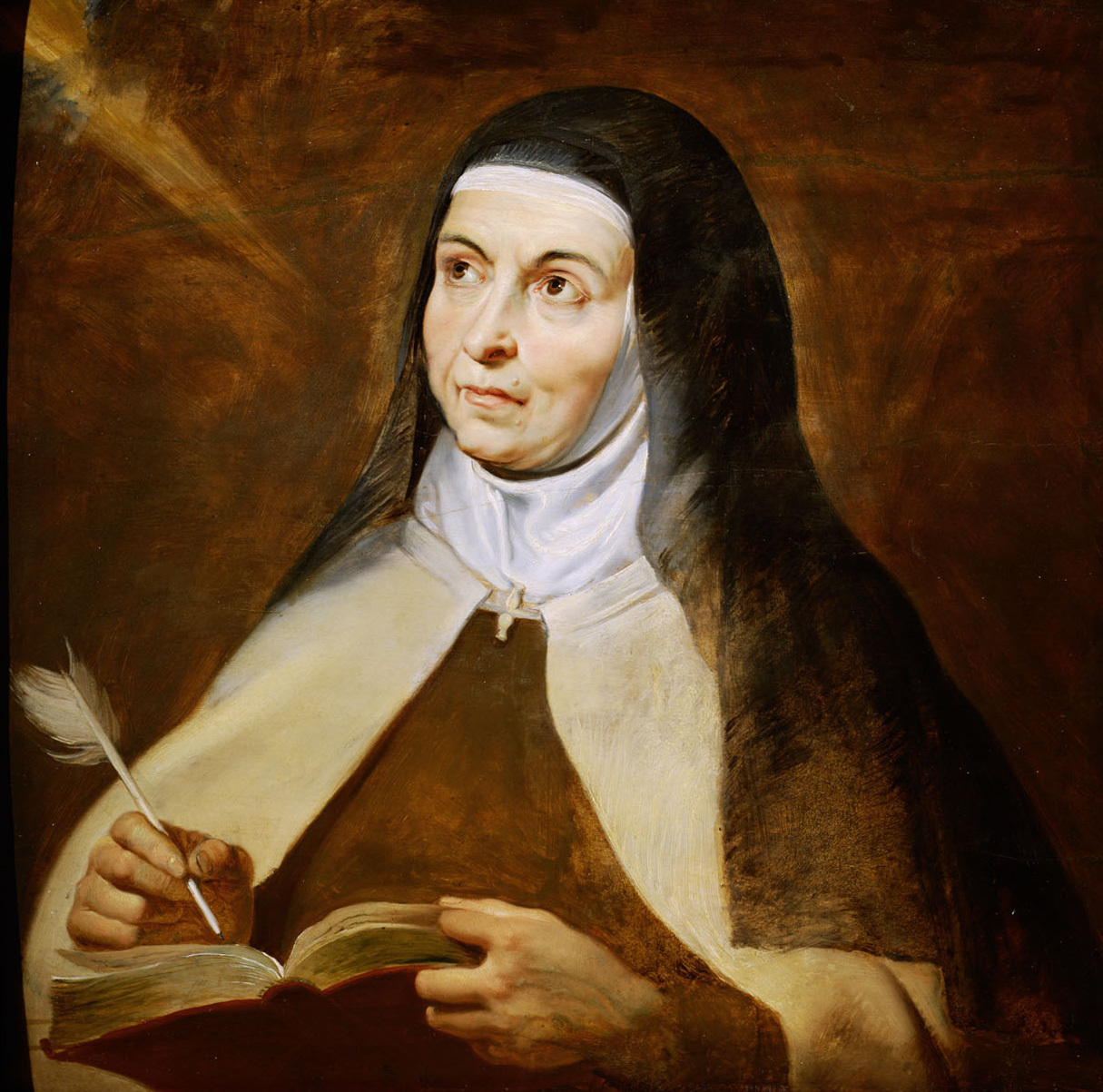
Saint Teresa Of Ávila (Saint Teresa Of Jesus). Virgin. Doctor Of The Church. Feast Day, Today, 15 October.


Text from The Saint Andrew Daily Missal,
unless otherwise stated.

Saint Teresa.
Virgin.
Feast Day 15 October.

Double.

White Vestments.

Saint Teresa of Ávila (Saint Teresa of Jesus)
(1515-1582).


Saint Teresa was born at Ávila, Spain. From her earliest childhood, she ardently desired to die a Martyr. At the age of eighteen, she entered The Order of Our Lady of Mount Carmel, and Consecrated herself to Christ, whom she chose for her spouse (Epistle).

[The Order of Mount Carmel, which spread over The East in Apostolic times, penetrated into The West in the 13th-Century. Illustrious Members of this Order, of much by their Sanctity, rank, or writings, are very numerous. Several have filled the greatest dignities in The Church.]

Her heart was so inflamed with Divine Love that she wrote: "How the enraptured Soul feels in this body its captivity and the misery of life ! It considers itself a slave sold in a foreign land; and, what is most bitter, is to see everywhere men's passionate love for this life, and so few banished ones who sigh like itself and Pray for the end of their exile." [Her autobiography, Chapter XXI.]


English: Saint Teresa Of Ávila (Saint Teresa Of Jesus).
One of the four female Doctors of The Church.
Deutsch: Hl. Therese von Avila.
Artist: Peter Paul Rubens (1577–1640).
Date: 1615.
Current location: Kunsthistorisches Museum, Vienna, Austria.
Source/Photographer: [1]
(Wikimedia Commons)


Counselled by Jesus, she made the difficult Vow of always doing what she judged most perfect.

She attained through Prayer the highest degree of Mystical Life, and there found such enlightenment concerning Divine things (Collect), that her works earned for her, from Popes Gregory XV and Urban VII, the august Title of Doctor of The Church, which has been given to no other woman.

[Editor: This last comment was dated 1945 in The Saint Andrew Daily Missal. Since then, three other women have gained the Title of Doctor of The Church. They are: Saint Thérèse of Lisieux (Thérèse de Lisieux (Saint Therese of The Child Jesus and of The Holy Face)); Saint Catherine of Siena; Saint Hildegard von Bingen. Wikipedia states that Saint Teresa of Ávila was given the Title of Doctor of The Church, by Pope Paul VI, in 1970.]


Saint Catherine of Siena.
One of the four female Doctors of The Church.
The Church of Santa Maria del Rosario in Prati, Roma, Italy.
Author: Anonymous.
(Wikimedia Commons)


"The best Prayer," she wrote, "and the most pleasing to God, is that which brings on improvement, showing itself in good works, and not the enjoyment which only serves for our own satisfaction." [Letter to the Bishop of Ávila.]

The influence of this humble Virgin, who converted thousands of Souls, manifestly proves the supreme importance of The Contemplative Life, addressing itself, directly, as it does, to God, The Author of All Good.

She died of Divine Love on 5-15 October. 1582. [Pope Gregory XIII, in order to reform The Roman Calendar, had ordered the suppression of ten days of the year 1582; the day after 4 October was to be called the 15th of the same month. It was during this historic night, of the 4th to the 15th, that Saint Teresa died.]

Mass: Dilexísti.


Hildegard von Bingen's musical compositions.
Chant for The Feast of Saint Ursula.
Sung by Anonymous 4
Saint Hildegard von Bingen is one of the
four female Doctors of The Church.
Available on YouTube at


Teresa-de-Lisieux.jpg

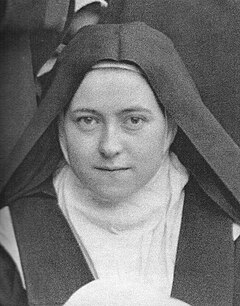
Saint Thérèse of Lisieux.
One of the four female Doctors of The Church.
English: Detail of Saint Therese of the Child Jesus
in the photograph taken in the courtyard of the
Monastery of Lisieux, Easter Monday, 15 April 1894.
Español: Detalle de Santa Teresa del Niño Jesús en la fotografía tomada en
el patio del monasterio de Lisieux el Lunes de Pascua, 15 de abril de 1894.
Français: Détail de Sainte Thérèse de l'Enfant Jésus dans la photographie
prise dans la cour du monastère de Lisieux lundi de Pâques, 15 Avril, 1894.
Italiano: Particolare di Santa Teresa del Bambino Gesù nella fotografia
scattata nel cortile del monastero di Lisieux Lunedi di Pasqua, April 15, 1894.
Date: 3 September 2014.
Source: 
Archivos del Carmelo de Lisieux.
Author: 
Celine Martin (Sor Genoveva de la Santa Faz).
(Wikimedia Commons)


The following Text is from Wikipedia - the free encyclopaedia.

Teresa of Ávila, also called Saint Teresa of Jesus, baptised as Teresa Sánchez de Cepeda y Ahumada (28 March 1515 – 4 October 1582), was a prominent Spanish Mystic, Roman Catholic Saint, Carmelite Nun, author during The Counter Reformation, and Theologian of Contemplative Life through Mental Prayer. She was a Reformer of The Carmelite Order and is considered to be a Founder of The Discalced Carmelites along with John of The Cross.

In 1622, forty years after her death, she was Canonised by Pope Gregory XV, and, on 27 September 1970, was named a Doctor of The Church by Pope Paul VI. Her books, which include her autobiography (The Life of Teresa of Jesus) and her seminal work El Castillo Interior (The Interior Castle), are an integral part of Spanish Renaissance literature as well as Christian Mysticism and Christian Meditation practices. She also wrote Camino de Perfección (The Way of Perfection).

After her death, Saint Teresa's cult was known in Spain during the 1620s, and for a time she was considered a candidate to become a National Patron Saint. A Santero image of Our Lady of The Conception, said to have been sent by Saint Teresa with one of her brothers to Nicaragua, is now Venerated as the Country's National Patroness at The Shrine of El Viejo. Pious Catholic beliefs also associate Saint Teresa with the esteemed religious image called Infant Jesus of Prague, with claims of former ownership and devotion.


THE SAINT ANDREW DAILY MISSAL


THE SAINT ANDREW DAILY MISSAL

Available (in U.K.) from

Available (in U.S.A.) from


A Little Levity To Lighten Your Day.


Now is the Winter of our Discount Tent.


(With apologies to Mr. Shakespeare).


Illustration: ANDREW SKURKA

14 October, 2015

Saint Callistus I. Pope And Martyr. Feast Day, Today, 14 October.


Text from The Saint Andrew Daily Missal,
unless otherwise stated.

Saint Callistus I.
Pope and Martyr.

Double.

Red Vestments.


English: Statue of Pope Saint Callistus I, Rheims Cathedral, France.
Français: Statue du pape St Calixte au trumeau du portail
central du transept Nord, Notre-Dame de Reims.
Photo: 16 April 2007.
Source: Own work.
Author: Vassil.
(Wikimedia Commons)


Callistus, a Roman by birth, succeeding Pope Saint Zephyrinus in The See of Saint Peter, was called to share in The Priesthood of Christ in its fullness (Epistle, Collect).

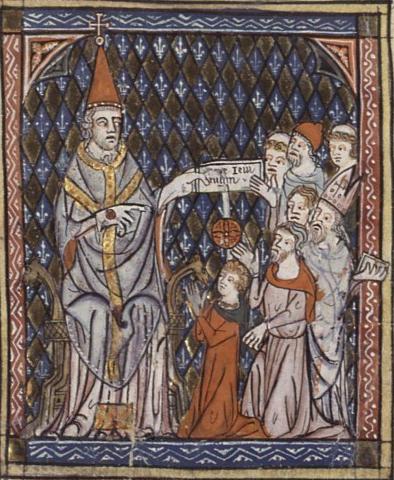
It was Pope Saint Callistus I who instituted The Ember Day Fasts. He suffered Martyrdom 223 A.D.


CalixtusI.jpg


English: Pope Saint Callistus I instituting The Ember Day Fasts.
Français: Saint Calixte Ier (Pope Calixtus I) instituant les jeûnes (instituting the fasts).
Cote : Français 185 , Fol. 201. Vies de saints, France, Paris, XIVe siècle,
Richard de Montbaston et collaborateurs.
(Wikimedia Commons)


The following Text is from Wikipedia - the free encyclopaedia.

Pope Callixtus I (died 223 A.D.), also called Callistus I, was the Bishop of Rome (according to Sextus Julius Africanus) from 218 A.D., to his death. He lived during the Reigns of The Roman Emperors Elagabalus and Alexander Severus. Eusebius and The Liberian Catalogue gave him five years of Episcopate (217 A.D. - 222 A.D.). He was Martyred for his Christian Faith and is Venerated as a Saint by The Catholic Church.

A Little Levity To Lighten Your Day.


13 October, 2015

The Miracle Of The Sun. 13 October 1917. Fatima.


Taken from CATHOLICISM PURE AND SIMPLE


The Miracle Of The Sun.
Fatima.
13 October 1917
Available on YouTube at


Today is The Day of World Reparation for ALL the horrible Sacrileges, Indifferences and Hatred, by which Our Lord in The Eucharist, is outraged.

Let us make fervent HOLY COMMUNIONS with Our Eucharistic Lord, offering Him all the Love of His Eternal Father, of His Eternal Spirit, of His Purist Mother, of His Most Chaste Foster Father, Saint Joseph, and of all the Angels and Saints, the Souls in Purgatory, and The Just, on Earth, in Loving Reparation, and Thanksgiving, for His Infinite Love and Mercy.

Tell many others. Let us make this a HUGE Act of Loving Reparation, and cry out with ALL our hearts:

"Viva Cristo Rey".


With that most profound respect which divine faith inspires,

O my God and Saviour Jesus Christ,

true God and true Man,

I adore Thee,


and with my whole heart I love Thee,

hidden in the most august Sacrament of the Altar,

in reparation of all the irreverences,

profanations and sacrileges, that I,

to my shame, may have until now committed,


as also for all those that have been committed against Thee,

or that may be committed for the time to come.

I offer to Thee, therefore, O my God,

my humble adoration, not indeed,

such as Thou art worthy of,


nor such as I owe Thee,

but such, at least,

as I am capable of offering;


and I wish that I could love Thee

with the most perfect love

of which rational creatures are capable.

In the meantime,

I desire to adore Thee now and always,


not only for those Catholics

who do not adore or love Thee

but also to supply the defect,

and for the conversion of all heretics,


schismatics, libertines,

atheists, blasphemers,

sorcerers, Mahomedans,

Jews and idolaters.


Ah ! Yes, my Jesus,

mayest Thou be known,

Adored and loved by all

and may thanks be continually given to Thee

in The Most Holy and August Sacrament !


Saint Edward (1003 - 1066). King And Confessor. Feast Day 13 October.


Roman Text from Wikipedia - the free encyclopaedia,
unless otherwise stated.

Italic Text from The Saint Andrew Daily Missal.

Saint Edward.
King and Confessor.
Feast Day 13 October.

Semi-Double.

White Vestments.


Saint Edward the Confessor.
Date: 13th-Century.
Source: http://molcat1.bl.uk/IllImages/
Kslides%5Cmid/K066/K066609.jpg
Author: Anonymous.
(Wikimedia Commons)


Edward, called "The Confessor", was a grand-son of Saint Edward, King and Martyr.

When he was raised to the Throne of England, "it was seen," says a historian, "what can be done by a King, who is the true father of his Subjects. All those who approached him endeavoured to regulate their lives according to his. Neither ambition, nor the love of riches, nor any of the passions which are unfortunately so common among Courtiers, were known at his Court."

He was everywhere called The Father of The Orphans, and of The Poor, and he was never happier than when he could distribute alms (Epistle). He always granted, what was requested of him, in the name of Saint John the Evangelist.

He died in 1066.

Mass: Os justi.


A Sealed Writ of Edward the Confessor,
issued in favour of Westminster Abbey.
This File: 16 April 2007.
User: Canley.
(Wikipedia)


The following Text is from Wikipedia - the free encyclopaedia.

Edward the Confessor (1003-1066), son of Æthelred the Unready and Emma of Normandy, was one of the last Anglo-Saxon Kings of England and is usually regarded as the last King of The House of Wessex, ruling from 1042 to 1066.

Edward has traditionally been seen as unworldly and pious, and his Reign is notable for the disintegration of Royal power in England and the advance in power of the Godwin family.


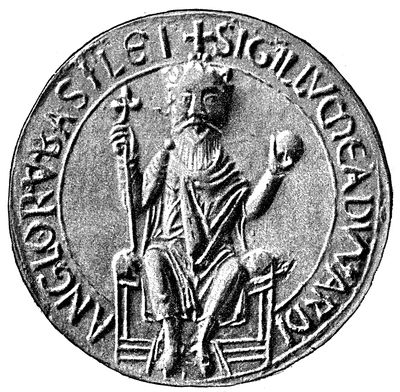
Edward's seal: SIGILLVM EADWARDI ANGLORVM BASILEI
(Seal of Edward. Crowned King of the English).
First Great Seal of Edward the Confessor.
Date: 1915.
Author: HISTORY OF ENGLAND by SAMUEL R. GARDINER.
(Wikimedia Commons)


Edward succeeded Cnut the Great's son, Harthacnut, restoring the Rule of The House of Wessex after the period of Danish Rule since Cnut conquered England in 1016. When Edward died in 1066, he was succeeded by Harold Godwinson, who was defeated and killed in the same year by the Normans, under William the Conqueror, at the Battle of Hastings.

Edward is called Confessor, the name for someone believed to have lived a Saintly life, but who was not a Martyr, in Latin S. Eduardus Confessor rex Anglorum, as opposed to S. Eduardus Martyr rex Anglorum. He was Canonised in 1161 by Pope Alexander III, and is Commemorated on 13 October by both The Church of England and The Roman Catholic Church in England and Wales.

Saint Edward was one of the National Saints of England, until King Edward III adopted Saint George as Patron Saint, in about 1350.


English: Bayeux Tapestry. Scene 1:
King Edward the Confessor and Harold Godwinson at Winchester.
Français: Tapisserie de Bayeux. Scène 1:
le roi Édouard le Confesseur reçoit son beau-frère
Harold Godwinson dans son palais de Winchester
et lui confie une mission.
Photo: 7 March 2013.
Source: Own work.
Author: Myrabella.
(Wikimedia Commons)


I Got Life.


Illustration: GOOGLE IMAGES


I Got Life.
Nina Simone.
Available on YouTube at


11 October, 2015

Feast Of The Maternity Of The Blessed Virgin Mary. Feast Day 11 October.


Feast of The Maternity of The Blessed Virgin Mary.
Feast Day 11 October.

Double of The Second-Class.

White Vestments.

Text is from Wikipedia - the free encyclopaedia,
unless otherwise stated.


Maternity of Mary 
from The Liturgical Year, 1910.


Feast of The Maternity of The Blessed Virgin Mary.
Illustration: Copyright Brunelmar/Ghent/Belgium,
Used With Permission.


The Solemnity of Mary, The Holy Mother of God is a Feast Day of The Blessed Virgin Mary under the aspect of her Motherhood of Jesus Christ, whom Christians see as The WordGod The Son.

Christians of Byzantine Rite and of both West and East Syrian Rites celebrate Mary as Mother of God on 26 December and The Coptic Church does so on 16 January.

The Feast is a Celebration of Mary's Motherhood of Jesus. The English Title "Mother of God" is a translation of the Latin Title Dei Genetrix, which means "She Who Generated God", as the corresponding Greek Title Θεοτόκος (Theotokos) means "She Who Gave Birth to God". This Title was dogmatically adopted at The First Council of Ephesus, in 431 A.D., as a way to assert that Jesus is God, and that his Mother can therefore be called Mother of God. The Title that the Feast celebrates is, thus, not only Mariological, but also Christological.


Ave Maris Stella (Hail, Star of the Sea)
is the Hymn at Vespers for
The Feast of The Maternity of The Blessed Virgin Mary.
Available on YouTube at
The Second Vatican Council stated: "Clearly, from earliest times, The Blessed Virgin is honoured under the Title of Mother of God." and, at an early stage, The Church in Rome celebrated on 1 January a Feast that it called The Anniversary (Natale) of The Mother of God. When this was overshadowed by the Feasts of The Annunciation and The Assumption, adopted from Constantinople at the start of the 7th-Century A.D., 1 January began to be celebrated simply as The Octave Day of Christmas, the "eighth day", on which, according to Luke 2:21, The Child was Circumcised and given the name "Jesus".

In the 13th- or 14th-Century, 1 January began to be Celebrated in Rome, as already in Spain and Gaul, as The Feast of The Circumcision of The Lord and The Octave of The Nativity, while still oriented towards Mary and Christmas, with many Prayers, Antiphons and Responsories glorifying The Maternity of Mary. Pope Saint John XXIII's 1960 Rubrical and Calendrical revision removed the mention of The Circumcision of Jesus and called 1 January, simply, The Octave of The Nativity.

The Feast of "The Maternity of The Blessed Virgin Mary" was established in Portugal, in 1914, for Celebration on 11 October, and was extended to the entire Catholic Church by Pope Pius XI in 1931. The 1969 revision of The Liturgical Year and The Calendar states: "1 January, The Octave Day of The Nativity of The Lord, is The Solemnity of Mary, The Holy Mother of God, and also The Commemoration of the conferral of The Most Holy Name of Jesus." It removed the 11 October Feast, even for Portugal, stating: "The Maternity of The Blessed Virgin Mary is Celebrated on 1 January in The Solemnity of Mary, The Mother of God." (The 11 October Feast is now Celebrated only by some Traditionalist Catholic individuals and groups.)


Ave Maris Stella (Hail, Star of the Sea)
is the Hymn at Vespers for
The Feast of The Maternity of The Blessed Virgin Mary.
Available on YouTube at
http://youtu.be/NOipola4doE


In his Apostolic Letter, Marialis Cultus, Pope Paul VI explained: "This Celebration is meant to Commemorate the part played by Mary in this Mystery of Salvation. It is meant also to exalt the singular dignity which this Mystery brings to The "Holy Mother . . . through whom we were found worthy to receive The Author of Life."

Roman Catholic Mariology is the systematic study of the person of The Blessed Virgin Mary and of her place in the economy of Salvation, within the Theology of The Catholic Church.

In the Catholic perspective, Mary has a precise place in the plan of Salvation and a special place within Tradition and Devotion. She is seen as having a singular dignity, and receives a higher level of Veneration than all other Saints. Roman Catholic Mariology thus studies not only her life, but also the Veneration of her in daily life, Prayer, Hymnsart (where she has been a favourite topic), music, and architecture in modern and ancient Christianity throughout the ages.


Maternity of Mary 
from The Liturgical Year, 1910.


The four Dogmas, of Perpetual Virginity, Mother of God, Immaculate Conception and Assumption, form the basis of Mariology. However, a number of other Catholic Doctrines about The Virgin Mary have been developed by reference to Sacred Scripture, Theological Reasoning and Church Tradition.

The development of Mariology is on-going and, since the beginnings, it has continued to be shaped by Theological analyses, writings of Saints, and Papal statements, e.g. while two Marian Dogmas are ancient, the other two were defined in the 19th- and 20th-Centuries; and Papal teachings on Mary have continued to appear in recent times.

10 October, 2015

Saint Francis Borgia. Confessor. Feast Day, Today, 10 October.


Text from The Saint Andrew Daily Missal,
unless otherwise stated.

Saint Francis Borgia.
Confessor.

Semi-Double.

White Vestments.


This Text is taken from JESUS-PASSION.COM

Francis Borgia.
 Duke of Gandia and Captain-General of Catalonia, was one of the handsomest, richest, and most honoured nobles in Spain, when, in 1539, there was laid upon him the sad duty of escorting the remains of his Sovereign, Queen Isabella, to the Royal Burying-Place at Granada. The coffin had to be opened for him that he might verify the body before it was placed in the tomb, and so foul a sight met his eyes that he vowed never again to serve a Sovereign who could suffer so base a change.

It was some years before he could follow The Call of his Lord; at length, he entered The Society of Jesus, to cut himself off from any chance of dignity or preferment. But his Order chose him to be its Head. The Turks were threatening Christendom, and Pope Saint Pius V sent his nephew to gather Christian Princes into a League for its defence.

The Holy Pope chose Francis to accompany him, and, worn out though he was, the Saint obeyed at once. The fatigues of the embassy exhausted what little life was left. Saint Francis died on his return to Rome, 10 October 1572.

REFLECTION.—Saint Francis Borgia learnt the worthlessness of Earthly greatness at the funeral of Queen Isabella. Do the deaths of friends teach us aught about ourselves ?


The following Text is from The Saint Andrew Daily Missal.

After providing for the settlement of his children, Saint Francis entered The Society of Jesus, where, despising all honours, he made a Vow out of Humility (Collect) to refuse all dignities., But, for obedience sake, he had to accept the Post of General of The Society. He died in 1572.

Mass: Of justi of Abbots.


THE SAINT ANDREW DAILY MISSAL


THE SAINT ANDREW DAILY MISSAL

Available (in U.K.) from

Available (in U.S.A.) from


Related Posts Plugin for WordPress, Blogger...