Notre Dame de Rouen. The façade of the Gothic Church in France. Photographer: Hippo1947. Licence: SHUTTERSTOCK.

01 July, 2016

May They Rest In Peace. Requiéscant In Pace.


Saint Benedict Ornate Wall Crucifix.
Image: AMAZON


1 July 1916, the first day of The Battle of the Somme,
was the worst day in the history of the British Army.

British Army casualties for the day were 60,000.

The Battle of the Somme lasted from
1 July 1916 until 18 November 1916.

In total, there were more than 1 million casualties.


Leyton Orient Football Club
Supporters visit The Somme Battlefields,
July 2011.
Available on YouTube at


Soldiers of the Australian 4th Division, 10th Field Artillery Brigade, on a duck-board track,
passing through Chateau Wood, near Hooge, in the Ypres salient, 29 October 1917.
The leading soldier is Gunner James Fulton and the second soldier is Lieutenant Anthony Devine.
The men belong to a Battery of the 10th Field Artillery Brigade.
Source: This image is available from the Collection Database of the
Australian War Memorial under the ID Number: E01220.
Author: Frank Hurley.
(Wikimedia Commons)


Frank Hurley.
(Editor: Frank Hurley was the photographer, who took the
photo (above) of Australian troops passing through Chateau Wood.)
Date: 1914.
Source: Scanned from The Endurance by
Caroline Alexander ISBN 074754123X.
Author: Frank Hurley (1885-1962).
(Wikimedia Commons)


The Battle of Passchendaele
(or Third Battle of Ypres or "Passchendaele")
July 1917 - November 1917.

In total, there were, approximately, 1 million casualties.


Battle of The Menin Road.
"Australian wounded on The Menin Road, near Birr Cross Road,
on 20 September 1917".
(Caption source: National Library of Australia, n.d. (1 June 2014).
Date: 1917.
Source: State Library of New South Wales file:a479035.
Author: Frank Hurley.
(Wikimedia Commons)


The Accrington Pals.

11th (Service) Battalion (Accrington),
East Lancashire Regiment.
Better known as
'The Accrington Pals' Battalion.


"Accrington Pals",
near Hyndburn Park School, Accrington, Lancashire, 1914.
[Accrington Battalion, East Lancashire Regiment, B Company, No. 1 Platoon.]
Photo kindly provided by Robert and Tony Robinson.


A month after the outbreak of war,
the "Accrington Observer and Times" reported,
on 8 September 1914, that an offer by the Mayor of Accrington, 
Captain John Harwood, to set up a Battalion,
had been accepted by The War Office.

As the recruitment began, on 14 September 1914, 104 men were drafted during the first three hours. Brothers, friends and
work-mates reported together. On 24 September 1914,
The Accrington Battalion had reached a full strength of
36 officers and 1,076 men.

About half of the Battalion were recruited from Accrington and the surrounding area; the remainder were recruited from the neighbouring towns of Burnley, Chorley, and Blackburn.


The 'Accrington Pals' Battalion is probably the most famous of
The "Pals" Battalions, which were erected in the early months of
World War I, in response to Kitchener's call to form a Volunteer Army.
It was formed by men from all walks of life from Accrington, Lancashire, and the surrounding area.

Groups of friends - "Pals" - came forward together, in anticipation of a great adventure. In its first major battle, the Battalion suffered devastating losses in the attack on Serre, France, on 1 July 1916, the first day of
The Battle of the Somme.

The losses were hard to bear in a community where everyone had a close relative or friend killed or injured.

Although the Battalion fought again,
the "Pals" concept was forever lost.


May They Rest In Peace.
Requiéscant In Pace.


"Dies Irae".
The Sequence in a Requiem Mass.
Available on YouTube at

Feast Of The Most Precious Blood Of Our Lord Jesus Christ. Feast Day 1 July.


Text from The Saint Andrew Daily Missal,
unless otherwise stated.

Feast of The Most Precious Blood of Our Lord Jesus Christ.
Feast Day 1 July.

Double of The First-Class.

Red Vestments.


“Copyright Brunelmar/Ghent/Belgium”.
Used with Permission.


The Liturgy, that admirable summary of the history of The Church, reminds us every year that, at this date in 1849, thanks to the French Army, the Revolution which had driven the Pope from Rome was vanquished.

To perpetuate the memory of this triumph, and to show that it was due to The Saviour's Merits, Blessed Pope Pius IX, at the time a refugee at Gaeta, Italy, instituted The Feast of The Precious Blood. Pope Pius XI, in 1934, raised it to the Rank of a First-Class Feast.


The Heart of Jesus has made this Adorable Blood circulate in His limbs; wherefore, as on The Feast of The Sacred Heart, the Gospel presents to our view the thrust of the lance which pierced the side of The Divine Crucified, Blood and Water gushing forth. [The Office of Matins speaks of The Blood which Christ shed at The Circumcision, and in The Garden of Olives, and The Flagellation (Scourging) at The Pillar, and The Crowning of Thorns, and on The Cross.]

Thus become united the two testimonies which The Holy Ghost bore to The Messias, when He was Baptised in The Water of The Jordan and when He was Baptised in Blood on The Cross (Gradual).

Let us do homage to The Precious Blood of Our Redeemer, which the Priest offers to God on the Altar.

Mass: Redemisti nos.
At Low Masses: Commemoration of The Octave Day of Saint John the Baptist.
Preface: Of The Cross.

Tickets, Please.


New York Central Railroad Locomotive.
Illustration: PINTEREST


Mediaeval Stained-Glass Window. Merton College, Oxford. Circa 1379-1406.


Mediaeval Stained-Glass Window.
Merton College, Oxford, England.
Date: Circa 1379-1406.
Photographer: Hesketh-Roberts, M.
Image Date: 2002.
Copyright: EnglishHeritage.NMR

30 June, 2016

Matthaeus Is Back Up And Blogging.


Image result for recovering from illness

Matthaeus is back up and Blogging 
at


Gentleman:


Zephyrinus notes that Matthaeus refers to Zephyrinus as
"ZEPHY" in the Comments Box of his latest Post
Obviously, he is still on medication, poor chap !!!
Welcome back, Matthaeus.
Illustration: PINTEREST


Adagio For Strings And Agnus Dei. Both By Samuel Barber.


Devastated German City
during World War II.
Available on YouTube at


"Adagio for Strings"
by Samuel Barber.
Available on YouTube at


"Agnus Dei"
by Samuel Barber.
Available on YouTube at

A 25-Year Guarantee Clinched The Decision To Re-Roof Westminster Cathedral In Asphalt.


Abutments to the copper domes and brick parapets were the biggest challenge.

Abutments to the Copper Domes and Brick Parapets
were the biggest challenge.
Illustration: RIBAJ


This Article can be read in full at RIBAJ

When Westminster Cathedral’s roof was first asphalted, back in 1903, it would have utilised naturally-occurring asphalt deposits dug up from an overseas lake.

These days, things are done a little differently. Instead, IKO’s Permaphalt – a polymer modified mastic asphalt – was specified for the extensive re-roofing of the Roman Catholic Cathedral by Cathedral Architect, Michael Drury from St Ann’s Gate Architects.


Illustration: RIBAJ


‘Asphalt had worked well for the Cathedral in the past and there was no reason why it shouldn’t again,’ he says, adding that the new roofing’s twenty-five-year guarantee clinched the decision for a like-for-like replacement.

Drury had identified the need to replace the roof surface as a priority, in his quinquennial inspection of the Cathedral, which was designed in the Early-Byzantine Style by J. F. Bentley. Although the roof had been repaired over the years, the report detected cracking in the surface and up-stands and the presence of moisture within.

IN ASSOCIATION WITH


29 June, 2016

Hitler Finds Out The UK Has Voted To Leave The European Union.


Hitler Finds Out The UK Has Voted To Leave The EU.
Available on YouTube at

The Holy Apostles Saint Peter And Saint Paul. Feast Day 29 June.


Text from The Saint Andrew Daily Missal,
unless otherwise stated.

The Holy Apostles Peter and Paul.
Feast Day 29 June.

Double of The First-Class
   with an Octave.

Red Vestments.


Saint Peter and Saint Paul.
Artist: El Greco (1541–1614).
Current location: Hermitage Museum,
Saint Petersburg, Russia.
Source/Photographer; Hermitage Torrent.
(Wikimedia Commons)


Today, the whole Church rejoices, for "God has Consecrated this day by the Martyrdom of The Apostles Peter and Paul" (Collect). In both the Grand Basilicas erected at Rome over the tombs "of these two Princes, who, by The Cross and The Sword, have obtained their seat in The Eternal Senate," [Hymn at Vespers] this double Martyrdom was Celebrated.

Later, on account of the distance which separates the two Churches, the Festival was divided, Saint Peter being more specially honoured on 29 June and Saint Paul on 30 June.

Saint Peter, Bishop of Rome, is the Vicar, that is to say the visible representative of Christ. As is shown in the Preface, Alleluia, Gospel, Offertory and Communion, the Jews had rejected Jesus. They also rejected His successor (Epistle). Displacing the religious centre of the World, Saint Peter then left Jerusalem for Rome, which became The Eternal City and The Seat of The Popes.


Saint Peter and Saint Paul.
“Copyright Brunelmar/Ghent/Belgium”.
Used with Permission.


Saint Peter, the first Pope, speaks in the name of Christ, Who has communicated to him His Doctrine of Infallibility. He is not guided by flesh and blood, but by the Heavenly Father, Who does not permit the Gates of Hell to prevail against The Church of which he is the foundation (Gospel).

Saint Peter, on receiving The Keys, is placed at the head of the "Kingdom of Heaven" upon Earth, that is to say The Church, and he reigns in the name of Christ, Who has invested him with His Power and Supreme Authority (Gospel).

The names of Saint Peter and Saint Paul head head the names of The Apostles in The Canon of The Mass (First List).

With "The Church, which did not cease Praying to God for Saint Peter" (Epistle), let us Pray for his successor "the Servant of God, our Holy Father the Pope" (Canon of The Mass).

Every Parish Priest Celebrates Mass for the people of his Parish.

Mass: Nunc scio.

"Pater Noster" "Отче Наш" ("Otche Nash" - Church Slavonic) By Igor Stravinsky.


God The Father and Angel.
Artist: Guercino (Giovanni Francesco Barbieri)
Date: 1620.
Current location: Musei di Strada Nuova
Genoa, Italy.
(Wikimedia Commons)


"Pater Noster"
"Отче Наш"
("Otche Nash" - Church Slavonic)
by Igor Stravinsky.
Available on YouTube at

О́тче нашъ, И́же еси́ на небесѣхъ,
да свѧти́тсѧ и́мѧ Твое́,
да прїи́детъ ца́рствїе Твое́:
да будетъ волѧ Твоѧ, я́ко на небеси́ и на земли́,
хлѣбъ нашъ насу́щный даждь намъ днесь,
и оста́ви намъ до́лги нашѧ,
ѧкоже и мы ѡставлѧемъ должнико́мъ нашымъ,
и не введи́ насъ во искуше́нїе,
но изба́ви насъ от лука́ваго.

And again . . .


"Pater Noster"
by Igor Stravinsky.
Available on YouTube at


English: Igor Stravinsky's signature.
Español: Firma de Ígor Stravinski.
Date: 1946.
Source: Own work.
Author: Jarould.
(Wikimedia Commons)

28 June, 2016

Prime Minister Announces: "England Very Miffed With Iceland".


Illustration: MIRROR

At 11.15 a.m., this morning, Mr. Cameron broadcast to the nation the following statement.

"This morning, the British Ambassador in Reykjavík handed
the Icelandic Government a final Note, stating that, unless
we heard from them by 11 o'clock, that they were prepared
at once to have a replay of yesterday evening's football match,
a State of High Dudgeon would exist between us. 

I have to tell you now that no such undertaking has been received, and that, consequently, this Country is very miffed with Iceland." 

God Save The Queen.

Gregorian Chant Of The Templars. Salve Regina. The Marian Anthem Of The Season.


"Mater Dolorosa"
(Mother of Sorrows).
Artist: Carlo Dolci (1616–1686).
Date: Circa 1650.
Current location: National Museum of Western Art,
Tokyo, Japan.
Source: Unknown.
(Wikimedia Commons)


"Salve Regina".
Chant of The Templars.
Available on YouTube at

The Biggest Pro-Life Event Of The Year. The All-Ireland Rally For Life. Belfast. 2 July 2016. Because Every Life Matters. Be There.


Illustration: LIFE INSTITUTE

For more information and updates, please visit the Web-Site at LIFE INSTITUTE

27 June, 2016

Within The Octave Of Saint John The Baptist.


Text from The Saint Andrew Daily Missal,
unless stated otherwise.

Within The Octave Of Saint John The Baptist.


English: The Voice in the Desert.
Français: La voix dans le désert.
Artist: James Tissot (1836-1902).
Date: Between 1886 and 1894.
Current location: Brooklyn Museum, New York City.
Credit line: Purchased by public subscription.
Source/Photographer: Online Collection of Brooklyn Museum;
Photo: Brooklyn Museum, 2007, 00.159.44_PS1.jpg.
(Wikimedia Commons)


The Church, honouring The Saints in proportion to the part they played in The Mystery of The Incarnation of The Word, gives to Saint John a special place. [The Rubrics which accompany the Bull Divino Afflatu of Pope Saint Pius X, establish the following order among the Feasts: "The Feasts of The Lord; of The Blessed Virgin; of The Angels; of Saint John the Baptist; of Saint Joseph; of The Holy Apostles."]

Each day in The Mass, as well as at The Confiteor, at The Suscipe and at The Nobis quoque peccatoribus, the name of Saint John the Baptist precedes that of The Apostles. It is the same in The Litany of The Saints. His Feast immediately precedes that of The Apostles Saint Peter and Saint Paul. By ending the Mission of The Prophets and commencing that of The Apostles, he is the link between The Old Testament and The New Testament.

Let us, also, give to Saint John the Baptist the place of honour which is due to him in our Veneration of The Saints. The Veneration must, indeed, be hierarchically ordered so that we may never forget that Jesus is the principal author of our Redemption, and that The Saints are more or less great as they are more or less united to Him as secondary instruments.


"Kyrie Eleison".
From The Mass in Honour of Saint John the Baptist
by Jean-René Quignard.
Sung by Saint Mary, Star-of-the-Sea, Schola,
Jackson, Michigan.
Available on YouTube at


The Feast of The Nativity of Saint John the Baptist falls in the Season when The Cycle shows us The Church which, as this Saint foretold, was born in the Baptism of The Holy Ghost and of Fire at Pentecost, and goes on continually developing herself. It is, indeed, to The Holy Precursor that she owes it to have known Jesus, The Spouse that makes her The Fruitful Mother of many Souls.

As with the Jews, a friend was the intermediary between The Bride and The Spouse and prepared The Wedding Feast, Saint John the Baptist is called in the Gospel "The Friend of The Spouse". It is he whom God has chosen to prepare for The Lord, by his Preaching and Baptism of Penance, a perfect people. And, after having adorned The Bride, he presents The Spouse to her. "John the Baptist was the man sent as a witness, so that, through him, all should believe in Jesus."

Jesus comes to him in the waters of The River Jordan and, at this Divine Contact, the water acquired the virtue which, in Baptism, causes our Souls to be born to Supernatural Life. As Saint John the Baptist Baptises Christ in The River Jordan, he hears The Voice of The Father proclaiming that Jesus is His Well-Beloved Son. He sees The Holy Ghost hovering over Him in the form of a Dove and he reveals that Jesus is "The Lamb of God".


"Agnus Dei".
From The Mass in Honour of Saint John the Baptist
by Jean-René Quignard.
Sung by Saint Mary, Star-of-the-Sea, Schola,
Jackson, Michigan.
Available on YouTube at


Let us remember that, after having Baptised The Master, the one who is called John the Baptist has also presided over our own Christening, for all The Baptistries (particularly that of Saint John Lateran, in Rome) are Dedicated to him, and his image is to be used for the adornment of Baptismal Fonts.

Having thus been brought by him to Jesus, let us also through Saint John the Baptist approach The Eucharist, reciting the words of The Agnus Dei, by which he indicated The Saviour.

Mass: As on The Feast Day. De ventre.


Jesus Testifies about John the Baptist.


And when they went their way, Jesus began to say to the multitudes concerning John:
What went you out into the desert to see ? a reed shaken with the wind ?
But what went you out to see ? a man clothed in soft garments ?
Behold they that are clothed in soft garments, are in the houses of Kings.
But what went you out to see ? a prophet ? yea I tell you, and more than a prophet.

For this is he of whom it is written:
Behold I send my Angel before thy face,
who shall prepare thy way before thee.

Amen I say to you, there hath not risen among them that are born of women
a greater than John the Baptist:
Yet he that is the lesser in The Kingdom of Heaven
is greater than he.


Giggle Doctors. We Bring Magical Moments To Sick And Disabled Children.


500,000 Smiles And Counting.

The Theodora Children’s Charity (originally Theodora Children's Trust) was founded in 1994 by two brothers, in memory of their mother, Theodora Poulie. When one of Theodora’s sons was hospitalised for many months as a child, she brought joy, laughter and storytelling to his bedside through her regular visits. Theodora inspired her sons to bring magical moments to all sick and disabled children.

To date, the lives of over half a million children have been improved, thanks to The Giggle Doctor programme that they created.


Celebrating Success

Twenty-one years on, with a team of twenty-five trained Theodora Giggle Doctors, we are visiting approximately 30,000 children and their families every year.

The profile of the Charity has grown and grown over past years. In 2003, The Theodora Children’s Charity was awarded The Guardian Charity Award which honours outstanding Charities. In 2012, the profile of The Theodora Children’s Charity was raised yet further, when Samantha Cameron hosted a Reception for The Charity at Number 10 Downing Street.


In 2013, the work of The Charity was again recognised when The Theodora Children’s Charity was a finalist in the Third Sector Excellence Awards for Small Charity, Big Achiever.

The Web-Site of The Theodora Children's Charity (where you can make a Donation and help sick and disabled children), is at THEODORA CHILDREN'S CHARITY

26 June, 2016

Poland Blasts The Council Of Europe Report On ABORTION.


This Article can be read in full at CENTER FOR FAMILY AND HUMAN RIGHTS


By Stefano Gennarini, J.D.

NEW YORK, June 24 (C-Fam) The Polish Government snapped back at European bureaucrats in a scathing response to a Report published last week by The Council of Europe that criticised Poland’s restrictive ABORTION Law and its treatment of women.

Donning the ceremonial tone and submissive deference that many Countries adopt in their interface with international bureaucrats, Poland accused The Council of Europe Commissioner for Human Rights, Latvian-American Nils Muižnieks, of “overstepping his mandate,” of bias and selectivity, and interfering in internal affairs in an official response to a Report of The Commissioner published last week.


In a section on “sexual and reproductive health” the Commissioner’s Report instructs Poland to decriminalise ABORTION, remove conscience protections for doctors and medical personnel, and enact mandatory comprehensive sexuality education.

Instead of bowing obsequiously, as is commonly assumed Nations will do in such situations, Poland replied that The Commissioner had his facts wrong, and that he both misunderstood Polish Law and the obligation of Poland under The European Convention on Human Rights.

“Polish Law in this regard has its sources in The Constitution and is conditioned by a widely-shared care of Polish Society for The Respect For Life,” was Poland’s specific response on the issue of ABORTION.


Regensburg ? Nürnberg ? Schweinfurt ? Bamberg ? Bayreuth ? Rothenburg ?


Illustration: ABEBOOKS


Gentleman:

Zephyrinus is holidaying in Northern Bavaria this year.
Illustration: PINTEREST


German Steam Locomotive.
Illustration: WORLD OF STEAM (GERMANY)


EnglishRothenburg, Franconia, North Bavaria.
Deutsch: Rothenburg ob der Tauber, Plönlein mit Sieberstor und Kobolzellertor.
Français: Rotemburg sur la Tauber, Place de Plönlein. Cette place était une place de marché.
Sur la gauche, on voit la porte Siebers; sur la droite, on voit la porte de Kobolzeller.
Cette vue est l'une des plus photographiées et peintes d'Allemagne.
Photo: 1 July 2008.
Source: Own work.
Author: Berthold Werner.
(Wikimedia Commons)


German Steam Locomotive.
Illustration: YOUTUBE

Saint John And Saint Paul. Martyrs. Feast Day, Today, 26 June.


Text from The Saint Andrew Daily Missal,
unless otherwise stated.

Saints John and Paul.
Martyrs.
Feast Day 26 June.

Double.

Red Vestments.


File:Basilique Santi Giovanni e Paolo de Rome.JPG

English: Basilica of the Church of The Holy Martyrs, John and Paul, 
on Mount Coelius, Rome.
The Lenten Station, for Friday after Ash Wednesday, is held at this Basilica.
Français: Vue d'ensemble de la Basilique Santi Giovanni e Paolo de Rome sur le Celio.
Photo: May 2009.
Source: Own work.
Author: LPLT.
(Wikimedia Commons)


The two brothers, John and Paul, were Romans and in the service of Constantia, daughter of Emperor Constantine. Julian the Apostate, having invited them to be among his familiar friends, they refused, so as to remain faithful to Jesus.

Ten days were allowed for them to deliberate, and they used them in distributing all they possessed to the Poor. They were then arrested and "without fearing those who can only kill the body, and beyond that can do nothing more" (Gospel), they became, in 362 A.D., brothers more than ever, by the same Faith and the same Martyrdom (Collect, Gradual, Alleluia).

The Church compares them "to the two olive-trees and to the two candle-sticks, mentioned in The Apocalypse, which shine before the Lord." [Response at Matins.]

"These Just Men," she [Editor: The Church] adds, "have stood before The Lord and have not been separated from one another." [Antiphon at The Magnificat.] Wherefore, both their names, mentioned in The Canon of The Mass (First List), pass on from generation to generation, while their bodies rest in peace (Epistle) in the ancient Church erected in their honour on Mount Coelius at Rome. It is there that The Station is held on The Friday after Ash Wednesday.

Let us enjoy today, with The Church, the double triumph of Saints John and Paul (Collect) and let us, like them, courageously confess Jesus before Men, so that He may recognise us for His own before His Angels (Gospel).

Mass: Multae tribulatiónes.
Commemoration of The Octave of Saint John the Baptist.


File:Roma-sangiovanniepaolo01.jpg

English: Basilica of The Holy Martyrs, John and Paul, Rome, Italy.
Italiano: SS. Giovanni e Paolo - Roma, Italia.
Photo: July 2006.
Source: Flickr
Author: Patrick Denker
Reviewer: Mac9
(Wikimedia Commons)


The following Text is from Wikipedia - the free encyclopaedia.

John and Paul were Saints in The Roman Empire. They were Martyred at Rome on 26 June. They should not be confused with the famous Apostles of the same names (see Saint PaulSaint John the Apostle). The year of their Martyrdom is uncertain according to their Acts; it occurred under Julian the Apostate (361 A.D. – 363 A.D.).

In the second half of the 4th-Century A.D., Byzantius, the Roman Senator, and Saint Pammachius, his son, fashioned their house on The Cælian Hill into a Christian Basilica. In the 5th-Century A.D., the Presbyteri Tituli Byzantii (Priests of The Church of Byzantius) are mentioned in an Inscription and among the signatures of The Roman Council of 499 A.D. The Church was also called the Titulus Pammachii, after Byzantius's son, the pious friend of Saint Jerome.

In the ancient apartments on the ground-floor of the house of Byzantius, which were still retained under the Basilica, the tomb of two Roman Martyrs, John and Paul, was the object of Veneration as early as the 5th-Century A.D.

The Sacramentarium Leonianum already indicates, in the Preface to The Feast of the Saints, that they rested within the City walls ("Sacr. Leon.", ed. Feltoe, Cambridge, 1896, 34), while, in one of the early itineraries to the tombs of The Roman Martyrs, their grave is assigned to the Church on The Cælian (De rossi, "Roma sotterrania", I, 138, 175).


(Basilica of Saints John and Paul).
Photo taken by Necrothesp, 14 May 2004.
Date: 1 July 2004 (original upload date).
Source: Transferred from en.wikipedia to Commons
Author: The original uploader was Necrothesp at English Wikipedia.
(Wikimedia Commons)


The Titulus Byzantii, or Pammachii, was consequently known at a very early date by the names of the two Martyrs (Titulus SS. Joannis et Pauli). That the two Saints are Martyrs of The Roman Church is historically certain; as to how and when their bodies found a resting-place in the house of Pammachius, under the Basilica, we only know that it certainly occurred in the 4th-Century A.D. The year and circumstances of their Martyrdom are likewise unknown.

According to their Acts, the Martyrs were eunuchs of Constantina, daughter of Constantine the Great, and became acquainted with a certain Gallicanus, who built a Church in Ostia. At the command of Julian the Apostate, they were beheaded secretly by Terentianus in their house on The Caelian Hill, where their Church was subsequently erected, and where they were buried.

The rooms on the ground-floor, of the above-mentioned house of Pammachius, were rediscovered under the Basilica of Santi Giovanni e Paolo in Rome. They are decorated with important and interesting frescoes, while the original tomb (Confessio) of Saints John and Paul is covered with paintings, of which the Martyrs are the subject. The rooms and the tomb form one of the most important Early-Christian Memorials in Rome.


English: Frescoes in the original Roman house
below the present-day Basilica of Santi Giovanni e Paolo, Rome, Italy.
Italiano: Roma , casa romana sotto la basilica
dei santi Giovanni e Paolo al Celio - affreschi.
Photo: 3 October 2004.
Source: Own work.
Author: user:Lalupa.
(Wikimedia Commons)


Since the erection of the Basilica, the two Saints have been greatly Venerated, and their names have been inserted in The Canon of the Mass. Their Feast Day is kept on 26 June.

The Basilica of 
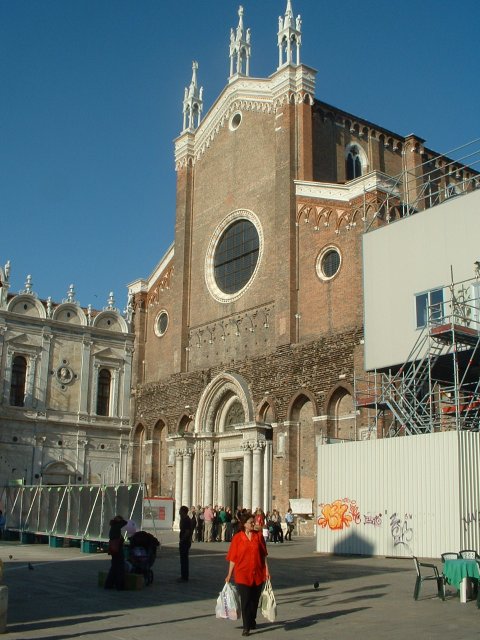
Santi Giovanni e Paolo, in Rome, is Dedicated to them, as well as the Basilica di San Zanipolo in Venice ("Zanipolo" being Venetian for "John and Paul").

The Lueneberg Manuscript (circa 1440–1450) mentions "The Day of John and Paul" in an early German account of The Pied Piper of Hamelin.

A small village next to Caiazzo, in the Campania region of Italy, is named Santi Giovanni e Paolo, in honour of these Martyrs. Many residents of this village bear the family name "San Giovanni," as do the descendants of immigrants to The United States from this village (in particular, in Michigan, New York, and Florida).
Related Posts Plugin for WordPress, Blogger...