Notre Dame de Rouen. The façade of the Gothic Church in France. Photographer: Hippo1947. Licence: SHUTTERSTOCK.

08 July, 2016

Saint Elizabeth. Queen Of Portugal. Widow. (1271 - 1336). Feast Day 8 July.


Text from The Saint Andrew Daily Missal,
unless otherwise stated.


Saint Elizabeth.
Queen of Portugal.
Widow.
Feast Day 8 July.

Semi-Double.


White Vestments.


Saint Elizabeth of Portugal
(Santa Isabel de Portugal),
Date: Circa 1635.
Current location: Museo del Prado, Madrid, Spain.
Source: http://www.museodelprado.es/uploads/tx_gbobras/P01239.jpg
Author: Francisco de Zurbarán (1598–1664).
(Wikimedia Commons)


The Church exhorts us, today, to praise God for The Holy Works of Blessed Elizabeth [Invitatory of Matins]. A daughter of Peter II, King of Aragon, she inherited the name and virtues of her Great-Aunt, Saint Elizabeth of Hungary.

Her father, seeing her Holiness, used to say that she would surpass all other women of Royal Race (Epistle, Communion). She married Denis I, King of Portugal.

She had received the prerogative of re-establishing Peace, where there had been divisions, and of mitigating the fury of War (Collect). When she became a widow, she took The Habit of The Third Order of Saint Francis, distributed her riches and acquired, at this price, The Precious Pearl and The Hidden Treasure of Life Everlasting (Gospel).

She died at Estremos, Portugal, in 1336, and her body has remained incorrupt.

MassCognóvi.


Photo: 10 February 2014.
Source: Own work.
Author: Jbribeiro1.
Attribution: © José Luiz Bernardes Ribeiro / CC-BY-SA-3.0.
(Wikimedia Commons)


The following Text is from Wikipedia - the free encyclopaedia.

Elizabeth of Aragon, more commonly known as Elizabeth of Portugal, (Third Order of Saint Francis, T.O.S.F.) (1271 – 1336); "Elisabet" in Catalan, "Isabel" in Aragonese, Portuguese and Spanish), was Queen Consort of Portugal, a Tertiary of The Franciscan Order and is Venerated as a Saint of The Roman Catholic Church.

Elizabeth showed an early enthusiasm for her Faith. She said the full Divine Office, daily, Fasted, and did other Penance, as well as attended twice-daily Choral Masses. Religious fervour was common in her family, as she could count several members of her family who were already Venerated as Saints. The most notable example is her Great-Aunt, Saint Elizabeth of Hungary, (Third Order of Saint Francis, T.O.S.F.), after whom she was named.


Admont Abbey, Austria.


Text is from Wikipedia - the free encyclopaedia,
unless otherwise stated.


Admont Abbey Library,
Austria.
Photo: 11 September 2009.
Source: Own work.
Author: © Jorge Royan / http://www.royan.com.ar
(Wikimedia Commons)


Admont Abbey (German: Stift Admont) is a Benedictine Monastery, located on The Enns River, in the Town of Admont, Austria. The oldest remaining Monastery in Styria, Austria, Admont Abbey contains the largest Monastic Library in the World, as well as a long-established Scientific Collection. It is known for its Baroque architecture, Art, and Manuscripts.

The Abbey's location, on the borders of the mountainous Gesäuse National Park (the name Admont derives from the Latin expression "ad montes," "at the mountains") is of unusual scenic beauty.

Dedicated to Saint Blaise, Admont Abbey was founded in 1074 by Archbishop Gebhard, of Salzburg, with the legacy of the Late-Saint, Hemma of Gurk, and settled by Monks from Saint Peter's Abbey, in Salzburg, Austria, under Abbot Isingrin. The second Abbot, Giselbert, is said to have introduced The Cluniac Reforms. Another of the early Abbots, Wolfhold, established a Convent for the education of girls of noble family, and the educational Tradition has remained strong ever since. The Monastery prospered during The Middle Ages and possessed a productive Scriptorium. Abbot Engelbert, of Admont, (1297–1327) was a famous scholar and author of many works.


English: Admont Abbey,
Styria, Austria.
Deutsch: Stift Admont, Foto: P. Gabriel Reiterer.
Photo: 21 September 2005.
Source: Photo: P. Gabriel Reiterer.
Author: User M. B. on de.wikipedia.
(Wikimedia Commons)


The Wars against the Turks, and The Reformation (Abbot Valentine was obliged to resign because of his Reformed views), caused a lengthy decline, but, with The Counter-Reformation, the Abbey flourished once again. In addition to the Secondary School, which later moved to Judenburg, there were faculties of Theology and Philosophy. Abbot Albert von Muchar was well known as an historian and taught at the University of Graz.

In the 17th- and 18th-Centuries, the Abbey reached a high point of artistic productivity, with the works of the world-famous Ecclesiastical Embroiderer, Brother Benno Haan (1631–1720), and the sculptor Joseph Stammel (1695–1765).

On 27 April 1865, a disastrous fire destroyed almost the entire Monastery. While the Monastic archives burned, the Library could be salvaged. Reconstruction began the following year, but was still not complete by 1890.


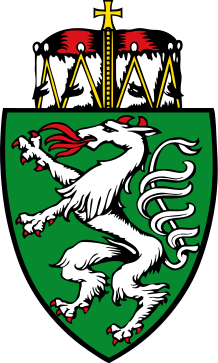
English: Coat-of-Arms of Styria, Austria.
Nederlands: Wapen van de deelstaat Stiermarken.
Deutsch: Landeswappen der Steiermark.
Date: Unknown date.
File: 2006-05-27.
Source: Based on Coat-of-Arms of Styria,
depicted on www.verwaltung.steiermark.at
Author: Unknown.
File: David Liuzzo.
(Wikimedia Commons)


The economic crises of the 1930s forced the Abbey to sell off many of its art treasures, and, during the period of The National Socialist government, the Monastery was Dissolved and the Monks evicted. They were able to return in 1946 and the Abbey, today, is again a thriving Benedictine Community.

From 1641, the Abbey was a Member of The Salzburg Congregation, which, in 1930, was merged into the present Austrian Congregation of The Benedictine Confederation.

The present Church was designed by the architect Wilhelm Bücher, to replace the former Church after the fire of 1865. It is inspired by Regensburg Cathedral and was the first Sacred Building in Austria in the Neo-Gothic Style. It incorporates 12th-Century Romanesque Side Doors. The two West Towers are sixty-seven metres tall, and the facade contains figures of Saint Benedict and Saint Scholastica. The figure of the Church's Patron, Saint Blaise, tops the Pinnacle of The Great West Door.


English: The Nave of Admont Abbey Church, Admont, Styria, Austria.
Deutsch: Langhaus der Stiftskirche Admont, Admont, Steiermark.
Photo: 18 June 2012.
Source: Own work.
Author: Zairon.
(Wikimedia Commons)


The Interior consists of a Central Aisle and two Side Aisles, off each of which are five Side Chapels and six Altars. The picture on the Altar of Mary, Maria Immaculata, by Martino Altomonte (1657–1745), is surrounded by fifteen carved Medallions of The Secrets of The Rosary, by Joseph Stammel. Both works of art were created in 1726 and survived the fire of 1856.

In a Side Chapel, is located the famous Crib of Admont, also by Stammel. It is open to view from 25 December to 2 February. The Gothic Crucifix, under The Triumphal Arch, dated 1518, is ascribed to Andreas Lackner.

A statue of Saint Blaise stands on top of The High Altar of White Carrara Marble. The Choir is decorated with Early-18th-Century Tapestries, by Benno Haan. In The Chapel of Saint Benedict, is a Baroque Corpus Christi, from the Workshop of Johann Meinrad Guggenbichler.


English: The Abbey Church,
Admont Abbey, 
Austria.
Deutsch: Stift Admont, Stiftskirche.
Photo: 14 February 2007.
Source: Own work.
Author: User:Fb78.
(Wikimedia Commons)


The Community at Admont consists of over twenty-seven Monks, under Abbot Bruno Hubl. The Abbey is responsible for: Twenty-seven Parishes; runs a Secondary School with about 600 pupils; and an Old People's Home in Frauenberg, Austria. Its various businesses and enterprises employ about 500 people, and it also has the management of the Museums and Collections, detailed below.

The Library Hall, built in 1776 to designs by the architect Joseph Hueber, is seventy metres long, fourteen metres wide and thirteen metres high, and is the largest Monastery Library in the World. It contains circa 70,000 volumes of the Monastery's entire holdings of circa 200,000 volumes. The Ceiling consists of seven Cupolas, decorated with frescoes by Bartolomeo Altomonte showing the stages of human knowledge up to the high point of Divine Revelation. Light is provided by forty-eight windows and is reflected by the original colour scheme of Gold and White. The architecture and design express the ideals of The Enlightenment, against which the sculptures by Joseph Stammel of "The Four Last Things" make a striking contrast.

The Abbey possesses over 1,400 Manuscripts, the oldest of which, from Saint Peter's Abbey, in Salzburg, Austria, were the gift of the Founder, Archbishop Gebhard, and accompanied the first Monks to settle here, as well as over 900 Incunabulae.


English: The Nave of Admont Abbey Church, Admont, Styria, Austria.
Deutsch: Langhaus der Stiftskirche Admont, Admont, Steiermark.
Photo: 18 June 2012.
Source: Own work.
Author: Zairon.
(Wikimedia Commons)


Since the Baroque period, the Abbots had accumulated a collection of "curiosities" and scientific specimens of various sorts, which were entirely destroyed in the fire of 1865. As part of the reconstruction, Father Gabriel Strobl determined to replace the lost collections, and so formed the nucleus of the modern Museums. Father Strobl was a botanist, but also worked on building up the insect collection, so much so that he became one of the great Entomologists of his day. The Natural History Museum now contains over 250,000 insect specimens, including one of the three largest collections of flies, or Diptera, in Europe. Other collections of, for example, minerals and rock, and exotic species, have also been formed.

The Abbey also houses two major Art Collections of Historical and Modern Art. The Historical Art Collection was begun in 1959 by Father Adalbert Krause, and has been significantly augmented since 1980. The present Museum was opened in 2003. The Collection particularly features Ecclesiastical Art, and contains, for example, many works of Ecclesiastical Embroidery by the famous Craftsman, Benno Haan, and of the Abbey Sculptor, Joseph Stammel.

Since 1997, the Abbey has also been building up a Collection of Contemporary Art, largely produced by young Austrian artists and often specially designed for the Abbey premises.


English: Admont Abbey Church viewed from the Park.
Deutsch: Ansicht der Stiftskirche Admont vom Park, Steiermark.
Photo: 3 May 2014.
Source: Own work.
Author: Uoaei1.
(Wikimedia Commons)


07 July, 2016

Pontifical Vespers And Benediction On Friday. Solemn High Mass On Saturday,


Illustration: LATIN MASS SOCIETY

Saint Cyril And Saint Methodius. Bishops And Confessors. Feast Day 7 July.


Text from The Saint Andrew Daily Missal,
unless otherwise stated.

Saint Cyril and Saint Methodius.
Bishops and Confessors.
Feast Day 7 July.

Double.

White Vestments.


English
"Saints Cyril and Methodius holding The Cyrillic Alphabet,",

a mural by Bulgarian iconographer Z. Zograf, 1848, Troyan Monastery, Bulgaria.
Deutsch: Die beiden Hl. Kyrill und Method.

Artist: Zahari Zograf (1810–1853)
Date: 1848.
Current location: Troyan Monastery, Bulgaria.
Source/Photographer: 
http://en.wikipedia.org/wiki/File:

Cyril-methodius-small.jpg
(Wikimedia Commons)


Still filled with a Holy Love for her Apostles, whose Octave she has concluded, The Church celebrates today The Feast of Saint Cyril and of Saint Methodius, "who both promised, under oath, to persevere in The Faith of Blessed Peter and of The Roman Pontiffs," [Fifth Lesson at Matins] and brought innumerable recruits, to Peter, from among the Bulgarians, Moravians and Bohemians [Hymn at First Vespers].

Brothers by blood,, they were born in the 9th-Century A.D., at Salonica, Greece, and distinguished themselves by their progress in The Sciences at Constantinople.

Anointed Bishops, by Pope Adrian II (Introit, Epistle, Alleluia), they converted The Slavonic Nations (Collect). To them is attributed The Slav Alphabet; into which tongue they translated The Scriptures and celebrated The Sacred Rites.

Saint Cyril died in 869 A.D., and was buried at Rome, near the Relics of Saint Clement, which he had brought from Chersonesus, Crimea. Saint Methodius died in 885 A.D.

Mass: Sacerdótes tui.


English: The Basilica of The Assumption of Mary,
and Saint Cyrillus and Saint Methodius,
Velehrad, Czech Republic.
Date: 20 December 2005.
Source: Originally from cs.wikipedia; description page is/was here.
Author: Original uploader was Cibtom at cs.wikipedia
(Wikimedia Commons)

Maire Reine Du Canada Pilgrimage. Early September 2016.


Illustration: NEW LITURGICAL MOVEMENT

More information on Marie Reine du Canada Web-Site at


"Wearing her Crown of Glory,
Our Lady of The Cape is setting forth
to conquer all hearts.

"Intende, prospere, procede, et regna,
O, Virgin of The Cape, we are going to see you,
Crowned like a Queen, going forth to conquer
the whole Nation.

"Intende, prospere, et regna,
and lead the whole Country to your feet"

- Fr. Columban,
Provincial of The Franciscans in Canada,
11 October 1904.

06 July, 2016

The Octave-Day Of Saints Peter And Paul. Apostles. 6 July.


Text is from The Saint Andrew Daily Missal,
unless stated otherwise.

The Octave-Day Of Saints Peter And Paul.
Apostles.
6 July.

Greater-Double.

Red Vestments.


Saint Peter and Saint Paul.
Artist: El Greco (1541–1614).
Current location: Hermitage Museum,
Saint Petersburg, Russia.
Source/Photographer; Hermitage Torrent.
(Wikimedia Commons)


Today concludes, by a special Mass, the concert of praise offered during eight days by The Church to The Apostles Peter and Paul, whose names are eternal (Introit, Epistle).

Mass: Sapiéntiam.
Preface: Of The Apostles.


Pontifical High Mass (Novus Ordo) on The Solemnity of Saints Peter and Paul,
29 June 2016, from the Cathedral of Saint Peter, Cologne, Germany.
Celebrant: Bishop Manfred Melzer, Titular Bishop of Carinola,
Auxiliary Bishop Emeritus of Cologne.
Available on YouTube at


English: Cologne Cathedral
(Cathedral of Saint Peter).
Latin: Ecclesia Cathedralis Sanctorum Petri.
Deutsch: Hohe Domkirche Sankt Petrus.
(Kölner Dom).
Photo: 6 September 2004.
Source: From de.wp
Author: Thomas Robbin.
(Wikimedia Commons)


Cologne Cathedral at night.
Photo: 6 September 2010.
Source: Own work.
(Wikimedia Commons)


English: Architectural detail on
The Great West Front,
Cologne Cathedral.
Português: Detalhe de catedral em Colônia.
Photo: 7 May 2016.
Author: Eduard Militaru.
(Wikimedia Commons)

The Garrison Keillor Radio Show. A Prairie Home Companion. Lake Wobegon.


GKpress.jpg

Garrison Keillor.
Date: Unknown.
Source: Prairie Home Companion's website
Author: Andrew Harrer / Bloomberg News / Landov.
Attribution: Prairie Home Productions.
(Wikimedia Commons)


The following Paragraph is from THE NEW YORK TIMES

Garrison Keillor’s “A Prairie Home Companion” signed off the air for good on
Saturday evening 
(2 July 2016), after forty-two seasons, as millions of listeners,
many in their cars on a holiday weekend, tuned in via public radio.


The Secret Lutherans.
News from Lake Wobegon
(A Prairie Home Companion).
Available on YouTube at

Oh, How It Used To Be !!!


The New York Central Railroad.
Sold by Art.com
Illustration: PINTEREST

05 July, 2016

Monastic Compline.


Illustration: WORTHPOINT


Monastic Compline
(Night Prayer).
Traditional Latin.
Sung by The Monks of Prinknash Abbey,
Gloucestershire, England.
Available on YouTube at


The famed Monastery of Jasna Góra, Poland,

is one of the last run by 
an important Order in the 
history of
The Monastic Tradition.
Photo: 10 March 2007.
Source: Own work.
Author: Skarabeusz.
(Wikimedia Commons)

The Prayer.


The Prayer.
Sissel and Josh Groban.
Available on YouTube at

OR


The Prayer.
Andrea Bocelli and Katharine Mcphee.
Available on YouTube at

OR


The Prayer.
Celine Dion and Josh Groban.
Available on YouTube at


I pray you'll be our eyes,
and watch us where we go.
And help us to be wise
in times when we don't know

Let this be our prayer,
when we lose our way
Lead us to a place,
guide us with your grace
To a place where we'll be safe

La luce che tu hai
I pray we'll find your light
nel cuore restera
and hold it in our hearts.
a ricordarci che
When stars go out each night,
eterna stella sei

Nella mia preghiera
Let this be our prayer
quanta fede c'e
when shadows fill our day

Lead us to a place,
guide us with your grace
Give us faith so we'll be safe

Sognamo un mondo senza piu violenza
un mondo di giustizia e di speranza
Ognuno dia la mano al suo vicino
Simbolo di pace, di fraternita

La forza che ci da
We ask that life be kind
e il desiderio che
and watch us from above
ognuno trovi amore
We hope each soul will find
intorno e dentro se
another soul to love

Let this be our prayer
Let this be our prayer,
just like every child

Need to find a place,
guide us with your grace
Give us faith so we'll be safe


E la fede che
hai acceso in noi,
sento che ci salvera


Saint Anthony Mary Zaccaria. Confessor. Feast Day, Today, 5 July.


Text from The Saint Andrew Daily Missal,
unless stated otherwise.

Saint Anthony Mary Zaccaria.
Confessor.
Feast Day 5 July.

Double.

White Vestments.


San Antonio Maria Zaccaria.jpg

English: Portrait of Saint Anthony Mary Zaccaria.
Español: Pintura de San Antonio Maria Zaccaria.
Date: Unknown.
Source: Archivo personal.
Author: Unknown.
(Wikimedia Commons)


Saint Anthony Mary was born, in 1502, of a noble family at Cremona, Italy. Penetrating of mind, added to integrity of life, raised him above his school fellows. Having won his Degree, of Doctor of Medicine, at Padua, he understood, by a warning from God, that he was called to heal Spiritual, rather than bodily, diseases.

Like the young man in the Gospel, he had from childhood observed The Commandments; he left everything to follow Jesus (Gospel). He Founded The Order of Clerks Regular, whose Members are called Barnabites [Editor: So named after the companion of Saint Paul.] Saint Anthony Mary gave them Saint Paul as model and protector. He was, like the great Apostle, filled with super-eminent knowledge of Christ (Collect). Wherefore, the Introit, Gradual, Alleluia, and Communion, apply to him the very words of the Apostle, and the Epistle is that in which The Doctor of the Gentiles gives to his Disciple, Timothy, the counsels that guided him in his teaching.

Consoled by a Heavenly vision of The Apostles, he died a Holy Death, at the age of thirty-six, in 1539.

Mass: Sermo meus.
Commemoration of The Octave of The Holy Apostles Peter and Paul.
Preface: Of The Apostles.


099MilanoSsBarnabaPaolo.JPG


English: The Church of Saint Barnabas and Saint Paul,
Milan, Italy.
Italiano: Milano - Chiesa dei Ss. Barnaba e Paolo.
Photo: August 2008.
Source: Own work.
Author: MarkusMark.


The following Text is from Wikipedia - the free encyclopaedia.

While in Milan, he laid the foundations of three Religious Orders: one for men (The Clerics Regular of Saint Paul, commonly known as The Barnabites); a female branch of un-cloistered Nuns, The Angelic Sisters of Saint Paul; and a Lay Congregation for married people, The Laity of Saint Paul, originally called The Married of Saint Paul, and sometimes referred to in North America as The Oblates of Saint Paul.


"The Congregation of The Regular Clerks of Saint Paul" was Canonically sanctioned by Pope Clement VII in 1533. The Barnabites' main devotions were the teachings of Saint Paul and emphasis on love for The Eucharist and Christ Crucified.

The Order was named after the companion of Saint Paul. Since The Order criticised what they saw as abuses in The Roman Catholic Church, Zaccaria soon gained a number of enemies, and, as The Order's Founder, he was twice investigated for Heresy, in 1534 and 1537. He was acquitted both times. In 1536, he stepped down as General of The Order and went to Vicenza, Italy, where he reformed two Convents and Founded The Order's second House.

On 15 January 1535, Pope Paul III approved The Angelic Sisters with the Bull, "Debitum pastoralis officii".

After his death, a number of cures were attributed to the intercession of Anthony Mary Zaccaria. Twenty-seven years after his death, his body was found to be incorrupt. His mortal remains are now enshrined at the Church of Saint Barnabas, Milan, Italy. He was Canonised by Pope Leo XIII on 27 May 1897. His Feast Day is Celebrated on 5 July. He is a Patron Saint of physicians.

04 July, 2016

"The Water Seller, Cairo."


The Water Seller, Cairo - Walter Charles Horsley (1855-1934) Oil on Canvas,:


"The Water Seller, Cairo".
By Walter Charles Horsley (1855-1934).
Illustration: PINTEREST

The Wonderful Joys Of Childhood.

La Belle France.


Morning's Coffee In Montmartre, Paris.:


Morning Coffee
in Montmartre, Paris.
Saved from 
Illustration: PINTEREST


"La Mer".
Sung by Charles Trenet.
Available on YouTube at


Restaurant, Paris, France:

Restaurant in Paris.
Saved from flickr.com
Illustration: PINTEREST


french:


Photo by Alys Geertsen on Flickr.
Illustration: PINTEREST


Paris street lights:


Montmartre, Paris.
Illustration: PINTEREST


Parisian Signs Panel - II -:


Parisien Café Sign.
Saved from 
la-la-la-bonne-vie.tumblr.com
Illustration: PINTEREST


03 July, 2016

'Ullo, John ! Gotta New Motor ?


184YUC 1939 Peugeot Model 202 Saloon by Pete Edgeler, via Flickr:

Photo by Pete Edgeler on Flickr.
Illustration: PINTEREST


The following Text is from Wikipedia - the free encyclopaedia.

"'Ullo John ! Gotta New Motor ?" is a song written by the comedian Alexei Sayle, originally released as a single in the UK in 1982. The single eventually achieved UK Top Twenty success in 1984, following a re-issue.

The song and its title have subsequently been adapted and re-used in a number of different cultural contexts.

Metropolitan Cathedral-Basilica Of The Nativity Of Saint Mary, Milan. Basilica Cattedrale Metropolitana Di Santa Maria Nascente, Milano.


English: Milan Cathedral.
Italiano: Milano - Duomo.
Photo: February 2009.
Source: Own work.
Author: MarkusMark.
(Wikimedia Commons)


The following Text is from Wikipedia - the free encyclopaedia,
unless stated otherwise.
Milan Cathedral (Italian: Duomo di Milano; Lombard: Domm de Milan) is The Cathedral Church of Milan, Italy. Dedicated to Saint Mary of The Nativity (Santa Maria Nascente), it is The Seat of The Archbishop of Milan, currently Cardinal Angelo Scola. The Gothic Cathedral took nearly six Centuries to complete. It is the second-largest Church in Italy, after Saint Peter's Basilica in Rome, and the third-largest in the World.

Milan's layout, with streets either radiating from The Duomo or encircling it, reveals that The Duomo occupies what was the most central site in Roman Mediolanum, that of the public Basilica facing The Forum.

The first Cathedral, the "new Basilica" (Basilica Nova), Dedicated to Saint Thecla, was completed by 355 A.D. It seems to share, on a slightly smaller scale, the Plan of the contemporaneous Church recently re-discovered beneath Tower Hill in London. An adjoining Basilica was erected in 836 A,D. The old Octagonal Baptistery, the Battistero Paleocristiano, dates to 335 A.D., and still can be visited under The Milan Cathedral. When a fire damaged the Cathedral and Basilica in 1075, they were rebuilt as The Duomo.


Saint Ambrose barring Emperor Theodosius I from Milan Cathedral.
Artist: Anthony van Dyck (1599–1641).
Date: 1619.
Current location: National Gallery, London.
(Wikimedia Commons)


English: Interior of The Metropolitan Cathedral-Basilica of The Nativity of Saint Mary, Milan.
Italiano: Interno del Duomo di Milano.
Photo: 1 January 2000.
Source: Own work.
Author: 
(Wikimedia Commons)


Milan Cathedral.
Photo: 31 December 2005.
Source: Own work.
Author: Mikko Virtaperk.
(Wikimedia Commons)


English: Stained-Glass Window, 
Milan Cathedral.
Italiano: Giovanni Battista Bertini (1799-1849) e Giuseppe Bertini (1825-1898),
vetrata (1833-62) dell'abside del Duomo di Milano.
Photo: 14 July 2007
Source: Own work.
Author: G.dallorto.
(Wikimedia Commons)


Stained-Glass Window,
Milan Cathedral.
Photo: 18 September 2013.
Source: Own work.
Author: Max_Ryazanov.
(Wikimedia Commons)

Pope Saint Leo II. Confessor. Feast Day 3 July.


Text from The Saint Andrew Daily Missal,
unless otherwise stated.

Saint Leo II.
Pope and Confessor.
Feast Day 3 July.

Semi-Double.

White Vestments.

LeoII.jpg

English: Portrait of Pope Saint Leo II.
[Papacy from 682 A.D. - 683 A.D.]
Español: imagen del papa leon II.
Source: Basilica di San Paolo fuori le Mura, Roma.
Author: Unknown.
(Wikimedia Commons)


Pope Saint Leo II, a Sicilian by birth, participated in the full Priesthood of Christ (Introit, Epistle, Gradual, Alleluia) on becoming Pope. Guided by The Holy Ghost, he gave their full value to the Spiritual Riches of The Church committed to his care by Jesus (Gospel, Communion).

He approved The Acts of The Sixth Council, which condemned those who taught that Christ had only one Will. Well-versed in Sacred Singing, he perfected the melodies of The Psalms and of The Hymns of The Church.

He was truly The Father of The Poor and, by his example and Preaching, led everyone to Virtue. He died in 683 A.D., and was buried in the Basilica of Saint Peter, Rome.

Let us imitate the example of this Saint (Collect), who was one of the successors of Saint Peter on The Pontifical Throne.

Mass: Sacerdótes tui.
Commemoration of The Octave of The Holy Apostles Peter and Paul.


LeoII.jpg


The following Text is from Wikipedia - the free encyclopaedia.

Pope Saint Leo II was a Sicilian by birth (the son of a man named Paul). He may have ended up being among the many Sicilian Clergy in Rome due to the Islamic Caliphate attacks on Sicily in
the Mid-7th-Century. Though elected Pope a few days after the death of Pope Saint Agathon on
10 January 681 A.D., he was not Consecrated until 17 August 682 A.D. Pope Saint Leo II was known as an eloquent Preacher, who was interested in music and noted for his Charity to the Poor. His successor was Pope Benedict II.


St Andrew Daily Missal (Traditional Mass)


Available (in U.K.) from

Available (in U.S.A.) from


02 July, 2016

Scholasticum.


Illustration: RORATE CAELI


This Article can be read in full at RORATE CAELI

In 2009, Pope Emeritus Benedict XVI, a great student and admirer of Saint Bonaventure, made a Pastoral Visit to Bagnoregio, Italy, the Saint’s hometown. On that historic visit, the Pope gave a speech about Saint Bonaventure in which he invited Priests “to learn from this great Doctor of The Church, to deepen their knowledge of his Teaching on Wisdom rooted in Christ.” Since that time, there has been renewed interest in Bagnoregio as a tourist destination.

In the Summer of 2016, The Scholasticum Institute, a Graduate Institution Dedicated to the Scholastic Theology of Saint Bonaventure of Bagnoregio and Saint Thomas Aquinas, opened its doors in the very town where Saint Bonaventure was raised and where Pope Emeritus Benedict XVI urged further Study of The Seraphic Doctor of The Church.

Pope Sixtus V explained the importance of Scholastic Theology: “[T]here has been discovered by Our ancestors, most wise men, Scholastic Theology, which two Doctors. glorious above all, the Angelic Saint Thomas, and the Seraphic Saint Bonaventure, most brilliant Professors in this capacity . . . with excellent genius, assiduous Study, great labours, and Vigils, have refined and decorated, and have passed on to those who would come after . . . ” He went on to say that “a salutary understanding and practice of this Science [Scholastic Theology] . . . could certainly always bring the greatest assistance to The Church.” (Triumphantis Hierusalem, § 10).

The Scholasticum Web-Site is at SCHOLASTICUM

The Visitation Of The Blessed Virgin Mary. Feast Day 2 July.


Text from The Saint Andrew Daily Missal,
unless otherwise stated.

The Visitation Of The Blessed Virgin Mary.
Feast Day 2 July.

Double of The Second-Class.

White Vestments.


The Visitation of The Blessed Virgin Mary.
“Copyright Brunelmar/Ghent/Belgium”. 
Used with Permission.


The Magnificat.
The Canticle of Mary.
John Michael Talbot wrote the music
and the words are from the Gospel of Luke 1:46-55.
Sung by Annie Karto., Jackie Francois, John Michael Talbot.
Available on YouTube at

The Canticle of Mary.
This is Mary's Great Exaltation of Praise to God.
For in her visit to Elizabeth, Mary's Faith is validated; that she will be The Mother of The World's Saviour - Jesus Christ ! And so, with Rejoicing and Thanksgiving for all His Mighty Deeds, His Mercy on the lowly and His Fulfillment of Covenant - Mary's Soul bursts forth with Joy to The Lord.


The Angel Gabriel had announced to Mary that God would soon give a son to Elizabeth. The Virgin at once betook herself to Hebron, where her cousin resided: That is The Mystery of The Visitation, which is Solemnised on the day following The Octave of The Nativity of Saint John the Baptist.

On this day, as in The Season of Advent, The Church recalls together the memories of The Precursor and of Jesus and Mary. For we then remarked, that the Friday in The Winter Ember Week recalled to us the same Mystery of The Visitation.

This Feast was instituted for the whole World in 1389, by Pope Urban VI, in order to obtain the end of the Great Western Schism. It was later on raised to The Rite of Double of The Second-Class by Blessed Pope Pius IX, for on this Feast was completed at Rome in 1849 the victory of The Church over the Revolution.


Mary visits Elizabeth and Jesus visits and Sanctifies John. Wherefore, Saint John leaps with joy and Elizabeth, filled with The Holy Ghost, exclaims: " Blessed art thou among women and Blessed is The Fruit of thy Womb" (Gospel).

The Virgin, Mother of God, who bears and gives birth to Him Who bears and produces all things (Gradual, Alleluia, Offertory, Communion) then pronounces a "Sublime Canticle" (Introit), The Magnificat.

Mass: Salve, sancta parens.


The same day:

Saint Processus and Saint Martinian.
Martyrs.
Feast Day 2 July.

Red Vestments.

Peter and Paul, cast into The Mamertine Prison, converted their two Warders, Processus and Martinian, and Baptised them. Brought before the statue of Jupiter, these new Christians refused to adore it and were put to death.

MassSapiéntiam.
Related Posts Plugin for WordPress, Blogger...