Notre Dame de Rouen. The façade of the Gothic Church in France. Photographer: Hippo1947. Licence: SHUTTERSTOCK.

25 July, 2016

Laon Cathedral.


The Nave,
Laon Cathedral
(Cathedral of Our Lady of Laon)
(Cathédrale Notre-Dame de Laon),
Picardy, France.
Illustration: PINTEREST


The Nave,
Laon Cathedral
(Cathedral of Our Lady of Laon)
(Cathédrale Notre-Dame de Laon),
Picardy, France.
The Nave has four tiers,
Photo: 1 February 2005.
Source: Own work.
Author: Paul Hermans.
(Wikimedia Commons)


"Salve Regina"
(Hail, Holy Queen).
Available on YouTube at


The following Text is from Wikipedia - the free encyclopaedia.

Laon Cathedral (Cathedral of Our Lady of Laon) (Cathédrale Notre-Dame de Laon) is one of the most important examples of Gothic Architecture of the 12th- and 13th-Centuries, earlier than the Cathedrals of Sens and Notre-Dame de Paris and ranking with them in importance. It is located in Laon, Picardy, France, and is The Seat of The Bishop of Laon. It has been Listed among the Monuments Historiques since 1840.

The current Cathedral is built on the site of an earlier edifice, commenced under the Episcopacy
of Gerfrid (774 A.D. - 800 A.D.). It was Consecrated on 6 September 800 A.D. in the presence of
The Holy Roman Emperor, himself.


The Great West Front of Laon Cathedral
(Cathedral of Our Lady of Laon)
(Cathédrale Notre-Dame de Laon),
Picardy, France.
Photo: 14 April 2015.
Source: Own work.
Author: Diliff.
Attribution: "Photo by DAVID ILIFF.
License: CC-BY-SA 3.0"
(Wikimedia Commons)

The Carolingian building was replaced under Bishop Élinand (1052–1095). The present building was inaugurated with the second Coronation of the future King Philip I. This Cathedral was torched during the Easter Insurrection on 25 April 1112. During the revolt, Laon's unpopular Bishop Waldric (in French Gaudry) was killed, despite taking the precaution of hiding in a barrel in the cellar of the Episcopal Palace. The Cathedral was not destroyed, however, and, after a repair programme lasting two years, it was re-Dedicated in 1114 under Bishop Barthélemy de Jur.


English: Laon Cathedral, Aisne, Picardie, France.
The Vault at The Transept Crossing.
Français: Notre-Dame de Laon, Aisne, Picardie, France. La voûte à la croisée du transept:
le chœur est au bas de la photo, la nef en haut, le transept dans le sens horizontal.
Photo: 1 September 2008.
Source: Own work.
Author: Tango7174.
(Wikimedia Commons)

NASA's Juno Spacecraft Approaches The Planet Jupiter. The Orbiting Jovian Moons Are: Io; Europa; Ganymede; Callisto.


This full-disc image of Jupiter was taken on
21 April 2014 with Hubble's Wide Field Camera 3 (WFC3).
Author: NASA, ESA, and A. Simon (Goddard Space Flight Center).
(Wikimedia Commons)


Juno's approach to the planet Jupiter.
Available on YouTube at
Credit: NASA/JPL-Caltech/SwRI,


The following Text is from SKY AT NIGHT MAGAZINE

NASA’s Juno Spacecraft is currently in orbit around Jupiter, following its five-year journey from Earth to study the Planet. But what is the Mission’s purpose, and what exactly will it be studying ?

Juno has travelled about 3 billion kilometres to get to Jupiter, launching in August 2011, performing an Earth fly-by in October 2013 and arriving at the Planet on 4 July 2016.

The Spacecraft will now begin orbiting The Gas Giant on a path that will take it over the Planet’s Poles. It will take fourteen days to complete each orbit and will do so thirty-seven times over the course of the Mission, flying low over Jupiter’s Cloud Tops as close as 4,100 km from the surface.


Juno is the first Solar-Powered Spacecraft designed to operate so far from the Sun. Because Jupiter’s orbit is five times farther from the Sun than Earth’s, the Planet receives twenty-five per cent less sunlight, but Juno has been equipped to face this challenge with three solar panels that extend outward to give the Spacecraft an overall span of sixty-six feet.

Ultimately, the Mission will seek to collect data to improve our understanding of how both Jupiter and The Solar System were formed and how they evolved.


Jupiter is an important Planet for Astronomers and Cosmologists because of its relatively massive size, as learning more about Giant Planets can help us understand the Exoplanets and Planetary Systems currently being discovered beyond our own.

Juno will attempt to determine how much water is in Jupiter’s atmosphere, which will tell NASA scientists a lot about how the Planet formed, and it will also measure the temperatures, cloud motions and composition of its atmosphere. It will spend time analysing Jupiter’s magnetic and gravity fields and exploring its magnetosphere, which will reveal information that will help scientists determine the Planet’s interior structure.

This Article can be read in full at SKY AT NIGHT MAGAZINE


Saint James. Apostle. Feast Day 25 July.


Text from The Saint Andrew Daily Missal,
unless otherwise stated.

Saint James The Greater.
Apostle.
Feast Day 25 July.

Double of The Second-Class.

Red Vestments.


Saint James the Greater.
He is depicted clothed as a Pilgrim;
note the Scallop Shell 
on his shoulder,
and his Staff and Pilgrim's Hat, beside him.
Artist: Rembrandt (1606–1669).
Date: 1661.
(Wikimedia Commons)


Saint James, brother of Saint John, and son of Zebedee, was a native of Bethsaida, in Galilee. He is surnamed "the Greater", i.e., the Elder.

One day, his mother, approaching The Saviour, asked of Him "the favour for her two sons to be seated, one at His right-hand and the other at His left-hand, in His Kingdom" (Gospel). Christ then foretold their Martyrdom. Saint James "shall sit on a Throne to judge the Twelve Tribes of Israel" (Communion), but he will first have to mix his blood with that of Jesus (Gospel) and undergo, like all the Apostles, a life of suffering and persecution, such as the Epistle describes.

After the Ascension of Jesus Christ to Heaven, says The Office of today, James preached His Divinity in Judea and Samaria. He soon betook himself to Spain. When he returned to Jerusalem, Herod Agrippa, desiring to please the Jews, condemned him to death and he was beheaded towards the year 42 A.D., a short time before The Feast of Easter.


It would seem that, for fear of the Arabs, who were masters of Jerusalem, the body of the Saint was later carried to Compostella, in Spain, where he is greatly honoured. 25 July recalls the date of this Translation.

His name is inscribed in The Canon of The Mass, with that of Saint John, his brother (First List).

Every Parish Priest celebrates Mass for the people of his Parish.

In Low Masses, Commemoration of Saint Christopher, by The Collects of The Mass: In virtúte.

24 July, 2016

Salisbury Cathedral.


The Nave of Salisbury Cathedral
(The Cathedral Church of The Blessed Virgin Mary),
Salisbury, England.
Illustration: PINTEREST


"Salve Regina"
(Hail, Holy Queen).
Available on YouTube at


The following Text is from Wikipedia - the free encyclopaedia.

Salisbury Cathedral (The Cathedral Church of The Blessed Virgin Mary, is an Anglican Cathedral in Salisbury, England, and one of the leading examples of Early English architecture. The main body of the Cathedral was completed in only thirty-eight years, from 1220 to 1258.

The Cathedral has the tallest Church Spire in The United Kingdom (123 m/404 ft). Visitors can take the "Tower Tour" where the interior of the hollow Spire, with its ancient wood scaffolding, can be viewed. The Cathedral also has the largest Cloister and the largest Cathedral Close in Britain (eighty acres (32 ha)).

The Cathedral contains the World's oldest working clock (from 1386) and has the best surviving of the four original Copies of Magna Carta (all four original Copies are in England). In 2008, the Cathedral celebrated the 750th Anniversary of its Consecration.

The Cathedral is The Mother Church of The Diocese of Salisbury and is The Seat of The Bishop of Salisbury, currently The Right Reverend Nick Holtam.


Salisbury Cathedral
(The Cathedral Church of The Blessed Virgin Mary),
Salisbury, England.
Photo: 13 April 2016.
Source: http://www.wyrdlight.com/
Author: Antony McCallum.
Attribution: WyrdLight.com
(Wikimedia Commons)

1964 Ford Thunderbird. The T-Bird.


1964 Ford Thunderbird Roadster
Downtown Orange, California,
United States of America.
Photo: 18 April 2010.
(CC Image Courtesy of Rex Gray on Flickr).
Illustration: AMERICANAUTOMOTORS.COM


"Fun, Fun, Fun,
until her Daddy takes the T-Bird away . . ."
The Beach Boys.
Available on YouTube at


Well she got her daddy's car
And she cruised through the hamburger stand now
Seems she forgot all about the library
Like she told her old man now
And with the radio blasting
Goes cruising just as fast as she can now

And she'll have fun fun fun
'Til her daddy takes the t-bird away
(Fun fun fun 'til her daddy takes the t-bird away)

Well the girls can't stand her
Cause she walks looks and drives like an ace now
(You walk like an ace now you walk like an ace)
She makes the Indy 500 look like a Roman chariot race now
(You look like an ace now you look like an ace)
A lotta guys try to catch her
But she leads them on a wild goose chase now
(You drive like an ace now you drive like an ace)

And she'll have fun fun fun
Til her daddy takes the t-bird away
(Fun fun fun 'til her daddy takes the t-bird away)
Well you knew all along
That your dad was gettin' wise to you now
(You shouldn't have lied now you shouldn't have lied)
And since he took your set of keys
You've been thinking that your fun is all through now
(You shouldn't have lied now you shouldn't have lied)

But you can come along with me
Cause we gotta a lot of things to do now
(You shouldn't have lied now you shouldn't have lied)

And we'll have fun fun fun now that daddy took the t-bird away
(Fun fun fun now that daddy took the t-bird away)
And we'll have fun fun fun now that daddy took the t-bird away
(Fun fun fun now that daddy took the t-bird away)
(Fun fun now that daddy took the t-bird away)


"Fun, Fun, Fun".
The Beach Boys.
Available on YouTube at

23 July, 2016

“In Paradisum”. “May The Angels Lead You Into Paradise”. The Antiphon From A Requiem Mass.


Saint Benedict Ornate Wall Crucifix.
Image: AMAZON

In paradisum deducant te angeli: in tuo adventu suscipiant te martyres, et perducant te in civitatem sanctam Ierusalem.

Chorus angelorum te suscipiat, et cum Lazaro, 
quondam paupere, aeternam habeas requiem. 

May The Angels lead you into Paradise:
May The Martyrs receive you at your coming,
And lead you into The Holy City, Jerusalem.

May The Choir of Angels receive you,
and, with Lazarus, who once was poor,
May you have Everlasting Rest.


“In Paradisum”. 
By: Gabriel Fauré.
Available on YouTube at


Traditional Latin Requiem Mass.
Illustration: LMS CHAIRMAN

The following Text is from Wikipedia - the free encyclopædia.

In Paradisum (English: “Into Paradise”) is an Antiphon from The Traditional Latin Liturgy of The Western Church’s Requiem Mass.

It is sung by The Choir as the body is being taken out of the Church. The Text of “In Paradisum”, with or without The Gregorian Melody, is sometimes included in musical settings of The Requiem Mass, such as those by Gabriel Fauré and Maurice Duruflé.


English: The Antiphon “In Paradisum”.
Deutsch: Antiphon zur Begräbnisfeier In paradisum deducant
te angeli - Zum Paradies mögen Engel dich geleiten.
Date: Mediæval.
Sources:
Author: Unknown.
(Wikimedia Commons)

A Wonderful Consolation
At The Death Of A Loved One.

Charterhouse School Memorial Chapel.


The Memorial Chapel,
Charterhouse School,
Godalming, Surrey, England.
Photo: 20 September 2013.
Source: Own work.
Author: Ainslie.
(Wikimedia Commons)


The following Text is from Wikipedia - the free encyclopaedia.

Charterhouse is an English Independent Boarding School in Godalming, Surrey. Founded by Thomas Sutton in 1611 on the site of the old Carthusian Monastery in Charterhouse Square, Smithfield, London, it educates over 800 Pupils, aged thirteen to eighteen years, and is one of the original seven English Public Schools, as defined by The Public Schools Act 1868 (which derived from The Clarendon Commission of 1864). Today, Pupils are still referred to as Carthusians, and Ex-Pupils as Old Carthusians.

Charging Full Boarders up to £36,000 per annum in 2015-2016, Charterhouse is predominantly a Boarding School and is amongst the most expensive Headmasters' and Headmistresses' Conference (HMC) Schools in The UK. It has educated one British Prime Minister and has a long list of notable alumni.


A Postcard, dated 15 August 1911, displaying the Arms of all The Major Public Schools in England.
From top to bottom (Left to Right): Tonbridge; Charterhouse; Winchester; Bedford; Haileybury;
Uppingham; Saint Pauls (Manchester) Grammar School; Merchant Taylor; Eton; Malvern;
King Edward VI (Birmingham); Repton; Clifton; Harrow; Saint Edwards; Shrewsbury;
Radley; Cheltenham; Malborough; Dulwich; Wellington; Rossall; Rugby.
Photo: 30 July 2014.
Source: Own work.
Author: Disclosure07.
(Wikimedia Commons)


Charterhouse School's Memorial Chapel, designed by Sir Giles Gilbert Scott and Consecrated in 1927, commemorates all those Carthusians who Died in Action: 700 in World War I and 350 in World War II. The whole School meets here three days each week for a short Service at 8:30 a.m., and on Sundays for Evensong, Matins, or a School Eucharist.

On Sundays, when there is an Evening Service, Catholic Pupils may instead attend Mass in The Founder's Chapel. Parents are welcome at Sunday Services, but tickets are required for Remembrance Sunday and The Carol Service.

Friday Morning Chapel is reserved for Congregational singing practice. Attendance at all Chapel Services is compulsory, except where individual exemptions are granted on Religious Grounds.


Charterhouse School Motto
"Deo Dante Dedi"
(God having given, I give).
This File: 31 March 2013.
(Wikimedia Commons)

Chapel provides a variety of Worship experience: Hymn-Singing; Psalm Chanting; the Choir performs a repertoire of Church Music; Candle-lit Carols; Eucharists in Millennium Chapel; Remembrance Sunday with The Sounding of The Last Post and The Silence.

Each year, there is a Confirmation Service in late-January and Pupils from any year group, except the Fourths (who hadn't been at the School when it was open to sign up), can be prepared for this.

The School retains The Old Chapel used by the School prior to 1927. However, when the School first moved to Godalming, Surrey, even this was not built, and the pupils walked the two miles to Shackleford Church, Surrey.

Pupils ever since have benefitted, because the time taken for the walk ruled out the continuance of Sunday School, which ran from 10 a.m. to 10:30 a.m. on Sundays, which has remained a non-teaching day ever since.

22 July, 2016

Lancing College Chapel.


The Nave,
Lancing College Chapel,
Sussex, England.
Photo: 15 August 2014.
Source: Own work.
Author: Diliff.
Attribution: "Photo by DAVID ILIFF.
License: CC-BY-SA 3.0".
(Wikimedia Commons)


Lancing College Motto:
"Beati Mundo Corde"
(Blessed are the pure in heart).
This File: 22 October 2013.
(Wikipedia)


The following Text is from Wikipedia - the free encyclopaedia.

Lancing College (formerly College of Saint Mary and Saint Nicolas), Lancing, Sussex, England, is a Co-Educational English Independent School in the British Public School Tradition, Founded in 1848 by Nathaniel Woodard.


Woodard's aim was to provide education "based on sound principle and sound knowledge, firmly grounded in The Christian Faith." Lancing was the first of a family of more than thirty Schools founded by Woodard (others include Hurstpierpoint College, Ardingly College, Bloxham School and Worksop College).

The School is a Member of The Headmasters' and Headmistresses' Conference. Girls were first admitted in 1970. The School is dominated by a Gothic Revival Chapel, and follows a High Church Anglican Tradition.


Lancing College Chapel,
Lancing, Sussex, England.
Photo: 15 August 2014.

Source: Own work.
Author: Diliff.
Attribution: "Photo by DAVID ILIFF.
License: CC-BY-SA 3.0".
(Wikimedia Commons)


The College of Saint Mary and Saint Nicolas (as it was originally known), in Shoreham-by-Sea, Sussex, was intended for the sons of Upper-Middle-Classes and Professional Men; in time, this became Lancing College, moving to its present site in 1857.

The School's buildings of the 1850s were designed by the architect Richard Cromwell Carpenter, with later buildings by John William Simpson.

Lancing College educates circa 550 Pupils between the ages of thirteen and eighteen; the
Co-Educational ratio is circa sixty:forty Boys to Girls. Roughly sixty percent of Pupils are Boarders, at a cost of £32,910 per year; circa forty percent are Day Pupils, at a cost of £23,130 per year. Occasional overnight stays are available to Day Pupils at an additional cost.

Extraordinary Form Mass For The Intention Of The Persecuted Church. Saint Mary Moorfields, Moorgate, London. On Friday, 29 July 2016, At 1930 hrs.


Illustration: LMS CHAIRMAN

Saint Mary Moorfields,
Friday 29 July, 7:30 p.m.

High Mass Celebrated by
Fr. Michael Lang (Cong. Orat.).
Saint Mary Moorfields,
Eldon Street, Moorgate,
London EC2M 7LS.

Music: Cantus Magnus.
Director: Matthew Schellhorn.

21 July, 2016

Holy Mass. Turn Ad Orientam Again !!!


Illustration: FR. Z's BLOG


Marlborough College Chapel.


The magnificent Marlborough College Chapel,
Marlborough, Wiltshire, England.


Marlborough College Motto:
"Deus Dat Incrementum"
(God Gives The Increase).
This File: 14 June 2016.
User: RaphaelQS.
(Wikipedia)


The following Text is from Wikipedia - the free encyclopaedia.

Marlborough College is an Independent Boarding and Day School in Marlborough, Wiltshire, England. Founded in 1843 for the sons of Church of England Clergy, it is now Co-Educational. For the academic year 2015-2016, Marlborough charges £9,610 per Term for Day Pupils, making it the most expensive Headmasters' and Headmistresses' Conference (HMC) Day School in the U.K. Fees for Full Boarders are up to £11,310 per Term - the twenty-eighth most expensive HMC Boarding School.

The Good Schools Guide described Marlborough as a "famous, designer label, Co-Ed Boarding School, still riding high." The School is a Member of the G20 Schools Group. A Sister School, in Johore, Malaysia, opened in 2012.


There are three Academic Terms in the year:

The Michaelmas Term, from early-September to mid-December (new Boys, Girls and Lower-Sixth candidates are now usually only admitted at the start of the Michaelmas Half);

The Lent Term, from mid-January to late-March;

The Summer Term, from late-April to late-June or early-July.

More information on Catholic Masses at Marlborough College
can be ascertained from MARLBOROUGH COLLEGE CHAPEL WEB-SITE

Saint Praxedes. Virgin. Feast Day 21 July.


Text from The Saint Andrew Daily Missal,
unless otherwise stated.

Saint Praxedes.
Virgin.
Feast Day 21 July.

Simple.

White Vestments.


.

The Basilica of Santa Prassede
(Saint Praxedes), 
Rome, Italy.
Photo: 18 April 2015.
Source: Own work.
(Wikimedia Comnmons)


The Feast of Saint Pius I, on 11 July, recalled to our mind Saint Pudentiana and her sister, Saint Praxedes, who placed their house at the disposal of this Holy Pontiff. Saint Pudentiana's Feast Day appears in the Cycle on 19 May, under the Reign of The Risen Lord, and Saint Praxedes's Feast Day is today, under the Reign of The Holy Ghost.

On the Tuesday of The Third Week in Lent, The Station is held at Rome in the Titular Church of Saint Pudentiana and on the Monday in Holy Week at the Titular Church of Saint Praxedes.


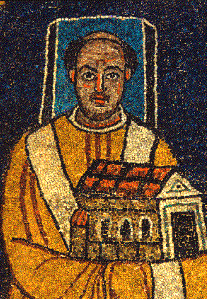
Pope Paschal I depicted in a mosaic in the Basilica of Santa Prassede, Rome, Italy.
He is presenting a model of the Basilica to Christ, and wears a square Halo,
which means he was alive at the time of the mosaic.
This File: 16 August 2005.
User: Marcus Cyron.
(Wikimedia Commons)


Saint Praxedes, a daughter of the Roman Senator, Pudens, Consecrated her Virginity to God (Epistle), and renounced her great wealth in favour of the Poor and of The Church. She thereby acquired the Treasure and precious Pearl of The Heavenly Kingdom (Gospel, Communion).

The Religious Ceremonies, which took place in her mansion, attracted the attention of the pagans. Many Christians were arrested there and led away to death.


English: The Apse,
Basilica of Santa Prassede, Rome, Italy.
Deutsch: Santa Prassede, Rom; Triumphbogen und Apsis.
Photo: 13 May 2009.
Source: Own work.
Author: Welleschik.
(Wikimedia Commons)


She died under Emperor Antonius in the 2nd-Century A.D., after having besought God to deliver her from the sight of such woeful scenes. Her body was laid by that of her father and sister in the Cemetery of her grand-mother, Priscilla.

Let us Celebrate joyfully The Feast of the blessed Virgin Praxedes, in order to obtain thereby feelings of loving devotion (Collect).


St Andrew Daily Missal (Traditional Mass)


Available (in U.K.) from

Available (in U.S.A.) from


20 July, 2016

U.S. Navy Ordered To Lower Sonar Use To Protect Whales, Dolphins, Sea-Mammals.


"Look. I'm sorry to bother you, old chap.
But would you be so kind as to turn your damn Sonar down a bit ?
My wife can't get a word in with that thing going !!!"
Illustration: NAVALTODAY.COM


A U.S. Federal Appeals Court has ordered the U.S. Navy to reduce the use of its Towed Array Sensor System, as it harms marine mammals.

The Ninth U.S. Circuit Court of Appeals, in California, found that a 2012 District Court decision, which allowed the U.S. Navy to use Low-Frequency Sonar for training, testing, and operations, was not in accordance with The Marine Mammal Protection Act.


Read the full Article at NAVALTODAY.COM

Neo-Gothic. Gothic Revival.


The Lady Chapel of Liverpool Anglican Cathedral, designed by Giles Gilbert Scott, overseen by 
G F Bodley. The Lady Chapel was the first part of the Cathedral to be completed in 1910 and retains many of the Gothic features of the original design.
As Scott grew in confidence, the rest of the Cathedral was redesigned and streamlined
to arrive at a much more massive, austere style of architecture
Photo: 4 December 2005.
Source: Own work.
Author: © Andrew Dunn.
(Wikimedia Commons)


Gothic Revival campus of The University of Mumbai, India, showing
the Rajabai Clock Tower still under construction in 1878.
Source: Original Photograph currently with The British Library.
Author: Unknown.
(Wikimedia Commons)


Text is from Wikipedia - the free encyclopaedia,
unless otherwise stated.

Gothic Revival (also referred to as Victorian Gothic, Neo-Gothic, or, Jigsaw Gothic, and, when used for School, College, and University buildings, as Collegiate Gothic) is an Architectural Movement that began in the Late-1740s in England.


Its popularity grew rapidly in the Early-19th Century, when increasingly serious and learned admirers of Neo-Gothic Styles sought to revive Mediaeval Gothic Architecture, in contrast to the Neo-Classical Styles prevalent at the time.

Gothic Revival draws features from the original Gothic Style, including Decorative Patterns, Finials, Scalloping, Lancet Windows, Hood Mouldings, and Label Stops.


Illustration: ENCYCLOPEDIA2.

The Gothic Revival Movement emerged in 19th-Century England. Its roots were inter-twined with deeply Philosophical Movements associated with a re-awakening of High Church or Anglo-Catholic Belief concerned by the growth of Religious Non-Conformism.

Ultimately, the "Anglo-Catholicism" Tradition of Religious Belief and Style became widespread for its intrinsic appeal in the Third-Quarter of the 19th-Century. Gothic Revival Architecture varied considerably in its faithfulness to both the ornamental style and principles of construction of its Mediaeval original, sometimes amounting to little more than Pointed Window Frames and a few touches of Gothic Decoration on a building otherwise on a wholly-19th-Century Plan and using contemporary materials and construction methods.


The unifying style of Parliament Hill,
Ottawa, Canada, is Gothic Revival.
Photo: 16 August 2006.
Source: Own work.
Author: Digging.holes.
(Wikimedia Commons)

In parallel to the ascendancy of Neo-Gothic Styles in 19th-Century England, interest spread rapidly to the Continent of Europe, in Australia, South Africa and to The Americas; indeed, the number of Gothic Revival and Carpenter Gothic structures built in the 19th- and 20th-Centuries may exceed the number of authentic Gothic structures that had been built previously.


Photo: 8 August 2011.
Source: Own work.
(Wikimedia Commons)


The Gothic Revival was paralleled, and supported, by "Mediaevalism", which had its roots in antiquarian concerns with survivals and curiosities. As "industrialisation" progressed, a reaction against machine production and the appearance of factories also grew. Proponents of the picturesque,  such as Thomas Carlyle and Augustus Pugin, took a critical view of industrial society and portrayed pre-industrial Mediaeval society as a Golden Age. To Pugin, Gothic Architecture was infused with the Christian values that had been supplanted by Classicism and were being destroyed by industrialisation.


An example of Russian Gothic Architecture.
Date: 2007.
Author: Сергей Ильин-Михальский (Sergey Ilyin-Mikhalski).
(Wikimedia Commons)

Gothic Revival also took on political connotations; with the "rational" and "radical" Neo-Classical Style being seen as associated with Republicanism and Liberalism (as evidenced by its use in The United States and, to a lesser extent, in Republican France), the more Spiritual and Traditional Gothic Revival became associated with Monarchism and Conservatism, which was reflected by the choice of styles for the rebuilt Government Centres of The Parliament of The United Kingdom in London and Parliament Hill in Ottawa.

19 July, 2016

Saint Joseph's Cathedral, Swansea, Wales.


Text from Wikipedia - the free encyclopaedia,
unless stated otherwise.


Saint Joseph's Cathedral,
Greenhill, Swansea, Wales.
Photo: 2 August 2012.
Source: This file was derived from Saint Josephs Cathedral Swansea.JPG.
Derivative work: Rabanus Flavus.
(Wikimedia Commons)


The Cathedral Church of Saint Joseph – also known as Saint Joseph's Cathedral or Swansea Cathedral – is a Grade II-Listed Roman Catholic Cathedral in Swansea, Wales. It is the Seat of The Bishop of Menevia and Mother Church of The Diocese of Menevia. The Cathedral was built in the Late-19th-Century and is located in the Greenhill area of Swansea.

Originally built as a Church, Saint Joseph's was conceived by Father Wulstan Richards, OSB, who came to Greenhill in 1875. It was designed by Peter Paul Pugin and took two years to build at a cost of £10,000. The building was officially opened on 25 November 1888 while still under construction. Built as a Church, it was converted to a Cathedral in 1987 for the redefined Diocese of Menevia. It was designated a a Grade II Listed Building on 30 March 1987.


The Nave,
Saint Joseph's Cathedral,
Greenhill, Swansea, Wales.
Illustration: LATIN MASS SOCIETY


The Plan of the building is that of an Apsidal Chancel, flanked by Side Chapels, with a Seven-Bay Aisled Nave, a Polygonal Tower with Spire in the North-West corner and twin Porches on the Western facade. Its walls are Coursed Bull-Nosed Masonry with Bath Stone Dressings and Red Dumfries Stone in the Nave Piers and Responds.

The Cathedral has a modern Pantile Roof and there is a Gabled Parapet, topped with a Finial, on the Western Side of the building above a small Arched Opening over a Four-Light geometric Traceried Window.

The Nave has Three-Light Clerestory Traceried Windows and the East facade has a Lower-Clerestory and a Three-Light Window under a Corbelled Gable with a Finial. The Ceiling has Radiating Ribs that extend to the Walls.

Related Posts Plugin for WordPress, Blogger...