Notre Dame de Rouen. The façade of the Gothic Church in France. Photographer: Hippo1947. Licence: SHUTTERSTOCK.

04 August, 2016

Saint Dominic. Confessor. Feast Day 4 August.


Text from The Saint Andrew Daily Missal,
unless otherwise stated.

Saint Dominic.
Confessor.
Feast Day 4 August.

Greater-Double.

White vestments.


Saint Dominic Receives The Rosary from The Virgin Mary.
Stained-Glass Window, by Franz Mayer ,
in Carlow Cathedral, Ireland.
Photo: 3 September 2009.
Source: Own work.
Author: Andreas F. Borchert .
(Wikimedia Commons)


Saint Dominic.
Artist: Claudio Coello (1642 to 1693).
Dates: Approximately 1685.
Current location: Prado Museum , Madrid, Spain.
(Wikimedia Commons)


The Church of France was ravaged by the heresy of The Albigenses, who, not satisfied with teaching false Doctrine, pillaged the Churches and massacred the Priests. In 1215, Pope Innocent III saw in a dream the tottering walls of the Basilica of Saint John Lateran, Rome, held up by the powerful shoulders of a Friar. This Friar was Saint Dominic, whose Preaching defended Catholic Doctrine against the new heresies (Epistle).

Before his birth, his mother saw in a vision, her child in the shape of a little dog, holding a torch in its mouth, which was to set the World on fire.

Called "Dominic", because his parents attributed his birth to the Prayers of the Holy Benedictine Abbot, Dominic of Silos, he truly belonged to The Lord, as his name suggests.

Born in Spain, of the noble family of Gusman, he distinguished himself by his purity, as is signified by the Lily That he holds (Alleluia) and his White Habit.


Illustration:  A VOICE OF ORANGE COUNTY

Having witnessed the many evils caused by the heretics in the South of France, he Founded, opposed to them, The Order of The Friars Preachers (Communion), whom he armed with The Shield of Truth, to teach Doctrine, and The Sword of The Word, to Preach it.

The Dominicans number many Saints of both sexes, who, like their Founder, ardently studied The Word of God in the Gospel, which, as Saint Dominic says, is The Book of Truth and The Book of Charity.

[The Order of The Friars Preachers (O.P.) has given to The Church, as at 1945: Four Popes (Blessed Innocent V, Saint Pius V, Benedict XI, Benedict XIII); Numerous Cardinals, Bishops, Doctors, Preachers and illustrious writers.

It numbers eleven Saints and four female Saints, Beatified 268 men and twenty-four Beatified women and 300 Martyrs. The Census of The Order, in 1935, showed there were 6,000 Friars. The Dominican Nuns in The Second Order, and in The Third Order Regular, amount to 40,000.]

This Saint loved Our Lady in a special manner and Preached The Devotion to The Rosary. He died on 6 August 1221.

Mass: Os justi.

Mullin Museum Poised To Invade Monterey Car Week With An Octet Of French Beauties.


1939 Delage D8-120.
Illustration: HEMMINGS DAILY.

File:Delage logo.svg


English: Logo of Delage.
Русский: Логотип французской
автомобилестроительной компании Delage.
Date: Circa 1905.
Source: Vectorisation of a personal scan.
Author: Louis Delâge.
(Wikimedia Commons)


This Article is taken from HEMMINGS DAILY.
Posted by Terry Shea.
All images courtesy of The Mullin Automotive Museum.
Web-Site of The Mullin Automotive Museum is HERE

We all have our preferences when it comes to cars, whether your favourites wear a Bow-Tie, a Bow-Tie with Chequered Flags, a Blue Oval, a Blue-and-White Propeller-Inspired Badge, or any number of exotic creatures on the Radiator Cap.

We can argue all we want about whose machines were faster, or smoother or just plain better, but you'd be hard pressed to find anyone in any camp that doesn't find Coach-Built Pre-War French Automobiles beautiful.


1937 Delahaye 135 M.
Illustration: HEMMINGS DAILY


Mullin also plans to exhibit a 1939 Delage D8-120 (see illustration, above), an eight-cylinder-powered, three-position Cabriolet exhibiting the typically French beauty and elegance of the Late-Pre-World War II era. From the hand of Henri Chapron, the prolific designer whose work spanned parts of seven decades, this four-place Cabrio, like the pair of Delages, seems well-suited for Pebble Beach.

The Oxnard, California-based Mullin Automotive Museum contains many other French Cars, the vast majority from 1951 or earlier. It’s certainly worth a visit if your travels take you to Southern California. At the very least, if you are on The Monterey Peninsula during the third week of August, you will get a chance to glimpse at least a portion of the collection.


Zephyrinus will be attending The Monterey Car Week.
Illustration: PINTEREST


MONTEREY CAR WEEK
and
CONCOURS D'ELEGANCE.

15 AUGUST - 21 August 2016.


1937 Delahaye 145 M Coupe.
Illustration: HEMMINGS DAILY

A Tradition going back over half a Century, The Pebble Beach Concours d'Elegance is where the World's Collector Cars meet and compete. Only the 200 best Collector Cars in the World roll onto the legendary 18th-Fairway of Pebble Beach Golf Links, California, United States of America, and only a handful of those will receive official recognition for style, technical merit and historical accuracy.

But the Concours D'Elegance is only the final event in a packed week celebrating The Classic Automobile. All over Monterey County, Classic Cars take to streets, golf courses, parks and the world-renowned Mazda Raceway Laguna Seca, surrounding visitors with Automobiles from yesteryear.

Need to experience Monterey Auto Week on a budget ? Make sure to refer to our Concours on a Shoestring page.

Visit The "Monterey Car Week Travel Alerts" page for the latest traffic schedules and road closures in the area.

1927 Delage ERA .
Illustration: HEMMINGS DAILY

The New York Central Railroad. "Within The Oval".


"Within The Oval".
The New York Central Railroad.
Available on YouTube at


Educational film, made by The New York Central (NYC) Railroad, showing the activities of the Railroad in the early 1950s. Archival footage of Trains with Diesel, Electric and Steam Locomotives are seen in operation, as well as some behind-the-scenes activities.

Naturally you'll see scenes of the famous named Trains of The NYC, such as "The 20th Century Limited", "Commodore Vanderbilt" and "Pacemaker".


"The Zephyr".
Photo by siehputz on Flickr (cc).
Illustration: PINTEREST


A New York Central System Locomotive.
Illustration: PINTEREST

03 August, 2016

The Finding Of The Body Of Saint Stephen. The First Martyr. Feast Day 3 August.


Text from The Saint Andrew Daily Missal,
unless otherwise stated.

The Finding of The Body of Saint Stephen.
The First Martyr.
Feast Day 3 August.

Semi-Double.

Red Vestments.


Stoning of Saint Stephen.
Artist: Jacopo & Domenico Tintoretto.
Altarpiece of San Giorgio Maggiore, Venice, Italy.
Photo: 11 April 2013.
Source: Own work.
Author: Smeat75.
(Wikimedia Commons)

The Church Solemnises on 26 December The Feast of Saint Stephen, and on 2 January The Octave of this Saint. She holds The Station on Passion Friday in the Church Dedicated to Saint Stephen, on Mount Coelius, at Rome.

On 10 August, she will Celebrate The Feast of Saint Laurence, whose "Remains, more precious," say the writers of the first Centuries, "than Gold and Precious Stones" are with those of the Deacon, Stephen, which had been Translated from Palestine to The Capital of The Christian World.

Today's Mass Commemorates the miraculous finding by a Priest of these Relics at Kapher-Gamala, near Jerusalem, on 5 December 415 A.D., (Collect). Except The Collect, it is the same as that on 26 December, the date of The Translation of these Remains from Kapher-Gamala to Jerusalem.


For Gamaliel, the teacher of Saint Paul, so much esteemed among The Doctors of Israel, that, at his death, it was declared that "the glory of Israel had disappeared", had buried twenty miles from that Town, at his Country House, The Holy Martyr, Stephen, Nicodemus, and his own son, Abibas. He, himself, was buried there. These precious Relics, long ignored, were miraculously discovered and wrought numerous cures.

The Introit and the Epistle recall how Stephen, filled with The Holy Ghost, convicted the Jews of error, and how they, hating Christ as their fathers hated Him (Gospel), seized Stephen and stoned him to death.

Let us honour Saint Stephen, and, imitating his Prayers for his persecutors (Epistle, Communion), let us learn by his example to love our enemies (Collect).

Mass: As on The Feast of Saint Stephen, 26 December, except one word in The Collect: "inventionem", instead of "natalitia": We Celebrate "the finding of his body" instead of "his birthday to immortality".

First Mass In 745 Years In "Krak Des Chevaliers". First Mass Since 1271 !!!


English: Krak des Chevaliers, Syria.
Français: Krak des Chevaliers, Syrie.
Photo: 2 April 2010.
Source: Own work.
Author: Bernard Gagnon.
(Wikimedia Commons)


The following Text is from Wikipedia - the free encyclopaedia.

Krak des Chevaliers is a Crusader Castle in Syria and one of the most important preserved Mediaeval Castles in the World. The site was first inhabited in the 11th-Century by a settlement of Kurdish troops, dispatched there by the Mirdasids; as a result, it was known as Hisn al-Akrad, meaning the "Castle of The Kurds".

In 1142, it was given by Raymond II, Count of Tripoli, to The Knights Hospitaller. It remained in their possession until it fell in 1271. It became known as Crac de l'Ospital; the name Krak des Chevaliers was coined in the 19th-Century.


FR. Z's BLOG has a riveting Post
on the first Mass in 745 Years in "Krak Des Chevaliers".
The first Mass since 1271 !!!
Celebrated by Fr Aubry of The Fraternity of Saint Vincent Ferrer.
See the Video at


Drone footage of the War-Damaged
Crusader Castle of Krak des Chevaliers, Syria.
Available on YouTube at

All Aboard For Mauch Chunk !!!


Illustration: PINTEREST


The Lehigh Valley Railroad.

Route Of The Black Diamond.

Lehigh Valley Trains use Pennsylvania Station
in the heart of New York City.

All First-Class, Air-Conditioned,
Streamliner Service to
Mauch Chunk.


The following Text is from Wikipedia - the free encyclopaedia.

The Lehigh Valley Railroad (Reporting Mark LV) was one of a number of Railroads built in The North-Eastern United States, primarily to haul anthracite coal. It was authorised 21 April 1846 in The U.S. State of Pennsylvania and incorporated/established on 20 September 1847 as The Delaware, Lehigh, Schuylkill and Susquehanna Railroad Company.

On 7 January 1853, the name was changed to Lehigh Valley Railroad. It was sometimes known as The Route of The Black Diamond, named after the anthracite it transported. At the time, anthracite was transported by boat down The Lehigh River; the Railroad was meant to be faster transportation. The Railroad ended operations in 1976 and merged into Conrail that same year.

02 August, 2016

Night Train.


Night Train.
Arizona, United States of America.
Illustration: PINTEREST

01 August, 2016

The Feast Of Saint Peter's Chains. 1 August. Plus, Happy Lammas Day.


Text from The Saint Andrew Daily Missal,
unless otherwise stated.


Saint Peter's Chains.
Feast Day 1 August.

Greater-Double.


White Vestments.


[Today is also Lammas Day. See The Breviary notes, below.]


English: The Interior of the Basilica of Saint Peter-in-Chains
(San Pietro-in-Vincoli), Rome, Italy.
Deutsch: San Pietro-in-Vincoli, Gesamtansicht des Innenraums.
Photo: 20 May 2012.
Source: This file was derived from: SPIV small.jpg.
Derivative work: Rabanus Flavus.
(Wikimedia Commons)


The Miracle of The Chains.
18th-Century fresco,
in the centre of the Coffered Ceiling
of the Basilica of
Saint Peter-in-Chains
(San Pietro-in-Vincoli), Rome, Italy.
Photo: 26 December 2009.
Derivative work: Alberto Fernandez Fernandez.
(Wikimedia Commons)


The Church Venerates on this day in the Basilica of Saint Peter-Ad-Vincula (Saint Peter-in-Chains), on Mount Esquiline, Rome, Italy, The Chains with which The Prince of The Apostles was fettered (Collect, Epistle).

This Church, where The Station is held on the Monday of The First Week in Lent and on the Monday in The Octave of Pentecost, was built over The Baths of Trajan and restored towards the middle of the 5th-Century A.D., by the Princess Eudoxia, whence the name of Eudoxian Basilica, sometimes given to it. It was Dedicated on this day.

The date of 1 August was chosen so as to substitute a Solemnity in honour of the Apostle, Bishop of Rome, and Head of The Church (Alleluia, Gospel, Communion) for the pagan festival which used to be kept at Rome in honour of the Emperor Augustus.


English: The Chains of Saint Peter in the "Basilica di San Pietro in Vincoli", Rome, Italy.
Italiano: Le Catene di San Pietro, conservate nella Basilica di San Pietro in Vincoli a Roma.
Date: August 2008.
Source: Own work.
Author: Original Photo by Raja Patnaik.
Post-processed and uploaded by Alessio Damato
(with permission of the author).
(Wikimedia Commons)


[As a compliment to the Emperor Augustus, the Romans gave his name to the sixth Month of the Year, formerly called Sextilis, for, in Old Rome, the Year began in March. The word "August" comes from Augustus, as July is from Julius Caesar. The following Months kept their denominations of seventh (September), eighth (October), ninth (November), and tenth (December).]

The Chains of Saint Peter are in two portions; one having eleven links of lengthened shape to bind the hands, and, the other, twenty-three links, to the last of which are fixed two half-circles, to hold the neck.

The Popes used to send, as a rich present, a few particles of the filings of these Chains, enclosed in a Golden Key. They symbolise the power of The Keys by which Saint Peter unbinds from sin.

They were also put into Rings or Crosses, to preserve from dangers (Collect). On the same day, The Church honours Saint Paul. There are preserved, with Saint Peter's Chains, four links of The Chains which bound Saint Paul's arms during his captivity at Rome.

Mass: Nunc scio vere, as on 29 June.
Commemoration of Saint Paul by The Collects of The Mass of 30 June.
Commemoration of The Holy Machabees.
Creed.
Preface of The Apostles.

BREVIARIUM ROMANUM.

THE ROMAN BREVIARY.

LE BRÉVIAIRE.


English: A French Prayer Book of 1905 containing extracts from The Roman Missal,
and The Roman Breviary of the time, with French translations.
Français: Nouveau Paroissien Romain contenant en latin et en français
les Offices et Messes de tous les dimanches et de toutes les fêtes de l'année ecclésiastique.
File: Nouveau Paroissien Romain (1905).jpg
Uploaded: 6 May 2009.
Author: Perky.
(Wikimedia Commons)


Illustration: RORATE CAELI

The following Text is from The Pre-1911 Roman Breviary
(Volume II. Summer).
Translated out of Latin into English by
John, Marquess of Bute, K.T.
Date: 1879.

1 August.

Lammas Day.

In some English-speaking Countries in The Northern Hemisphere,

1 August is Lammas Day (Anglo-Saxon "hlaf-mas", "Loaf-Mass"),

The Festival of The Wheat Harvest,
and is the first Harvest Festival of the Year.

Feast of Saint Peter-in-Chains.


Greater-Double.

Included, in The Common Office for an Apostle, is:

The Prayer.

O God,
Who didst make the chains to fall off
from the hands of Thy Blessed Apostle Peter,
and didst cause him to go away unhurt
out of prison, make to fall off from us,
we beseech Thee, the chains of our sins,
and in Thy great mercy
deliver us from all evil.

Through Our Lord Jesus Christ Thy Son,
Who liveth and reigneth with Thee,
in the unity of The Holy Ghost,
one God, World without end.

Amen.

Craftsmen Selling Cases In Ahmedabad, India. By Edwin Lord Weeks (1849-1903).


Craftsmen selling cases in Ahmedabad, India.
Artist: Edwin Lord Weeks (1849-1903).
Illustration: PINTEREST

31 July, 2016

Bean’s Bread, Pease Loaf, And Lammastide.


Illustration: MEDIEVAL HISTORIES


This Article is taken from, and can be read in full at, MEDIEVAL HISTORIES


Lammastide means the time has come for "hlafmaesse",
or "Loaf-Mass", the ancient offering to God
of The First Bread of The Season.
What went before was a meagre time.


Hunger in haste then
seized Waste by the maw
And wrung him so by the belly
that both his eyes watered;
The Breton he buffeted
about the cheeks
That he looked lantern-jawed
all his life after.

He beat them so both
that he near burst their ribs;
Had not Piers with a Pease-Loaf
Prayed Hunger to cease
They had been buried both
believe thou none other !
`Suffer them to live,’ he said
let them eat with the hogs
Or else beans and bran
baked up together,
Or else milk and mean ale’
thus Prayed Piers for them.

Loungers for fear thereof
fled into barns
And flapped on with flails
from morning till eve,
So that Hunger less hardily
looked upon them,
For a potful of pease
that Piers had made.


Labourer with a spade,
from Piers Plowman.
Source: Bodleian Library,
MSDouce 104, f 039r/wikipedia.
Illustration: MEDIEVAL HISTORIES


The following Text is from Wikipedia - the free encyclopaedia.

In some English-speaking Countries in The Northern Hemisphere, 1 August is Lammas Day (Anglo-Saxon hlaf-mas, "Loaf-Mass"), the Festival of The Wheat Harvest, and is the first Harvest Festival of the year. On this day, it was customary to bring to Church a loaf made from the new crop, which began to be harvested at Lammastide.

The loaf was Blessed, and in Anglo-Saxon England, it might be employed afterwards to work magic; a book of Anglo-Saxon charms directed that the "lammas bread" be broken into four bits, which were to be placed at the four corners of the barn, to protect the garnered grain.

In many parts of England, tenants were bound to present freshly-harvested wheat to their landlords on or before the first day of August. In the Anglo-Saxon Chronicle, where it is referred to regularly, it is called "The Feast of First Fruits". The Blessing of First Fruits was performed annually in both The Eastern and Western Churches on the first or the sixth of August (the latter being The Feast of The Transfiguration of Christ).

Lammas has coincided with The Feast of Saint Peter in Chains, Commemorating Saint Peter's miraculous deliverance from prison, but, in The Liturgical reform of 1969, The Feast of Saint Alphonsus Liguori was Transferred to this day, the day of Saint Alphonsus' death.


Bring Back Devout, Profound, Sacred Liturgy.


Illustration: FR. Z's BLOG


"My Lord And My God".
Illustration: PINTEREST

Cistercian Monastic Life At Holy Cross Abbey.


Monastic Life.
Holy Cross Abbey.
Available on YouTube at

30 July, 2016

Heaven Was On Display In The 13th-Century Former Premonstratensian Convent Of Altenberg-An-Der-Lahn, Germany.


One of the prized possessions of The Städel Museum, Frankfurt, Germany, is this Retable
from the Late-13th-Century and Early-14th-Century. It comes from the former
Premonstratensian Convent of Altenberg-An-Der-Lahn, Germany.
Illustration: MEDIEVAL HISTORIES


This Article can be read in full at MEDIEVAL HISTORIES.

This Summer, head for Frankfurt and
The Städel Museum, which shows a unique reunion
of The Altenberg Altar and its
Liturgical Treasures from circa 1300.

Art historians tend to look at specific pieces of art apart. However, Retables, Alters, Textiles, Reliquaries, etc. all constituted living Liturgical ensembles, presenting the Officiating Priests and onlookers with powerful 3D images of The Holiest of Holies.

In The Städel Museum, Frankfurt, Germany, visitors are currently invited to experience such an ensemble, which has been lovingly recreated around one of the prized possessions of the Museum: A Retable of the Late-13th-Century and Early-14th-Century, which comes from the former Premonstratensian Convent of Altenber- an-der-Lahn, Germany.

From about 1330 onward, this Retable formed the core of an ensemble, which furnished The Choir and High Altar of the Convent Church built between 1260 and 1270. The Altarpiece entered The Städel Collection and its superb holdings of Early-German Paintings in 1925.


English: The High Altar,
Altenberg Monastery.
Deutsch: Kloster Altenberg (Solms).
Photo: 9 September 2012.
Source: Own work.
Author: Cherubino.
(Wikimedia Commons)


English: Altenberg Monastery,
Deutsch: Kloster Altenberg (Solms).
Photo: 9 September 2012.
Source: Own work.
Author: Cherubino.
(Wikimedia Commons)

Mediaeval And Late-Gothic Chalices.


Mediaeval Hungarian Chalice.
Photo by Kotomi_ on Flickr (cc).
Illustration: PINTEREST


Hungarian Late-Gothic Chalice.
Circa 1500.
Silver. Gold. Precious Stones. Engraved. Chased.
Illustration: PINTEREST


The Coronation Chalice.
12th-Century.
Most of the Kings of France were Crowned
at the Cathedral of Notre-Dame de Reims
(Our Lady of Reims Cathedral).
This was the Chalice used to Crown the Kings.
Saved from flickr.com
Illustration: PINTEREST

How Many Prayers Were Offered Up In This Magnificent Abbey ?


Whitby Abbey, Yorkshire, England.
Illustration: PINTEREST


The following Text is from Wikipedia - the free encyclopaedia.

Whitby Abbey is a ruined Benedictine Abbey overlooking The North Sea on the East Cliff above WhitbyYorkshire, England. It was disestablished during The Dissolution of The Monasteries under the auspices of King Henry VIII. It is a Grade I Listed Building in the care of English Heritage and its Site Museum is housed in Cholmley House.

The first Monastery was Founded in 657 A.D. by the Anglo-Saxon era King of Northumbria, Oswy (Oswiu), as Streoneshalh (the older name for Whitby). He appointed Lady Hilda, Abbess of Hartlepool Abbey and Grand-Niece of Edwin, the first Christian King of Northumbria, as Founding Abbess.

The Double Monastery of Celtic Monks and Nuns was home to the great Northumbrian poet Cædmon. In 664 A.D., The Synod of Whitby - at which King Oswiu ruled that the Northumbrian Church would adopt The Roman calculation of Easter and Monastic Tonsure - took place at the Abbey.

Streoneshalch was laid waste by the Danes in successive raids between 867 A.D. and 870 A.D., under Ingwar and Ubba, and remained desolate for more than 200 years. The existence of 'Prestebi', meaning the habitation of Priests in Old Norse, at The Domesday Survey, may point to the revival of Religious Life. The old Monastery, given to Reinfrid, comprised about forty ruined Monasteria vel Oratoria, similar to Irish Monastic ruins with numerous Chapels and Cells.

Have You Taught Your Child To Pray ?


Saved from carmelodaimiel.com
Illustration: PINTEREST


Saved from flickr.com
Illustration: PINTEREST

29 July, 2016

Saints Felix, Simplicius, Faustinus, Beatrice. Martyrs. Feast Day 29 July.


Text from The Saint Andrew Daily Missal,
unless otherwise stated.

SS. Felix, Simplicius, Faustinus and Beatrice.
Martyrs.
Feast Day 29 July.

Simple.

Red Vestments.


The statue of Saint Beatrice (on the Right) is part of a group of twenty-four statues
installed above the Colonnade entrance above the Basilica of Saint Peter's, Rome.


English: Martyrdom of Saint Simplicius and Saint Faustinus.
Français: Martyre de saint Simplice et de saint Faustin.
Date: 14th-Century.
Author: Richard de Montbaston et collaborateurs.
(Wikimedia Commons)


The Holy Pontiff, Felix II, is a Pope of the 4th-Century A.D. He was Martyred in Tuscany, Italy, in the time of The Arians, 365 A.D. [Editor: See The Breviary Notes (below), reference the dispute about Felix.]

Saints Simplicius and Faustinus, denounced as Christians to the persecutors, were put to death at Rome under Emperor Diocletian in 304 A.D. Saint Beatrice, their sister, was arrested and strangled in prison. Pope Leo II placed the Relics of these three Martyrs in a Church at Rome Dedicated in their names.

Mass: Sapiéntiam.

BREVIARIUM ROMANUM.

THE ROMAN BREVIARY.

LE BRÉVIAIRE.


English: A French Prayer Book of 1905 containing extracts from The Roman Missal,
and The Roman Breviary of the time, with French translations.
Français: Nouveau Paroissien Romain contenant en latin et en français
les Offices et Messes de tous les dimanches et de toutes les fêtes de l'année ecclésiastique.
File: File:Nouveau Paroissien Romain (1905).jpg
Uploaded: 6 May 2009.
Author: Perky.
(Wikimedia Commons)


Illustration: RORATE CAELI

The following Text is from The Pre-1911 Roman Breviary
(Volume II. Summer).

Translated out of Latin into English by
John, Marquess of Bute, K.T.
Date: 1879.

The Holy Martyrs, Felix, Simplicius, Faustinus, and Beatrix (Beatrice).
Feast Day 29 July.

Simple.

The Martyrology says that Simplicius, Faustinus, and Beatrix (Beatrice) were two brothers and a sister, who suffered at Rome under Diocletian. Concerning Felix, there has been much dispute. The Missal and Breviary, by suppressing the Title of Pope or Bishop (always given in such cases) seem to confirm the view, now generally adopted by historians, viz., that he was an African Martyr, who suffered on 10 November, and whose Relics were brought to Rome on 29 July, but the Martyrology retains another theory, now generally rejected, which identifies this Saint with one Felix, intruded into the See of Rome by Constantius during the Pontificate of Liberius, and now commonly regarded as an Anti-Pope of very dubious orthodoxy.

Saint Martha. Virgin. Feast Day 29 July.


Text is from The Saint Andrew Daily Missal,
unless otherwise stated.

Saint Martha.
Virgin.
Feast Day 29 July.

Semi-Double.

White Vestments.


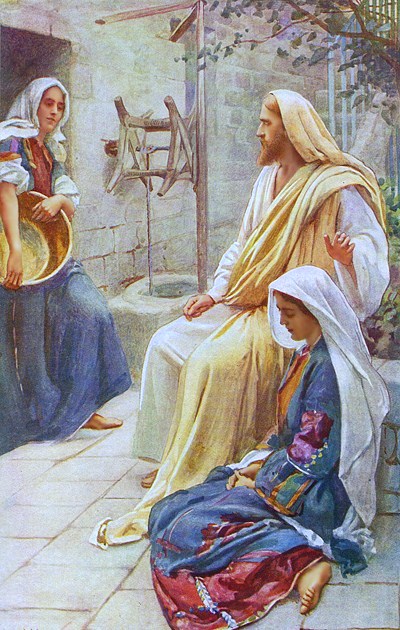
Jesus at the house of Mary and Martha.
Artist: Harold Copping (1863–1932).
Date: 1927.
(Wikimedia Commons)


After having celebrated, on the 22nd of this month, the Feast of Saint Mary Magdalen, we honour today, Martha, her sister.

The daughter of noble and rich parents, she lived at Bethany, two miles from Jerusalem. "Jesus", says Saint John, "loved Martha and her sister Mary and Lazarus," wherefore He preferred to dwell at their house when He was in Judea. There He spent the days which preceded His death.

Martha, who was the eldest, therefore often had the honour of being the hostess of Jesus (Gospel, Communion), The Divine Spouse, to Whom she had Consecrated her Virginity (Epistle). While busy with serving Jesus, she requested Him to bid Mary help her. And Jesus, without blaming her for ministering to His wants, made her understand that certain Souls, called by God, choose a still better part, since they commence on Earth what all shall do in Heaven.


Active life, with all its labours and fatigues endured for the sake of Christ, Whom we serve in our neighbour, is very meritorious; "happy, however, is the home where Mary causes the complaint of Martha" [Saint Bernard of Clairvaux: Sermon III of The Assumption] and refuses to take away from Prayer a life which ordinary occupations might appear to claim.

God is indeed the author of all Grace and wishes to be recognised as such; and Contemplative Life, which puts Souls in direct contact with Him, assures their personal Sanctification more fully and obtains more efficaciously the Graces by which a Christian Apostleship becomes fruitful.

Let us esteem at its just value the position that Jesus reserves to Mary, and, if He calls us to share in Martha's solicitude, let us endeavour, like The Saints, to make up by The Spirit of Prayer, for what is wanting in active life.

Mass: Dilexísti.
Commemoration of Saints Felix, Simplicius, Faustinus and Beatrice. Martyrs.


THE SAINT ANDREW DAILY MISSAL

Available (in U.K.) from

Available (in U.S.A.) from


Mary Teaches Us How To Worship.


The Text in this Article, dated 2015, is from THE HERMENEUTIC OF CONTINUITY


The Blessed Virgin Mary Prays for us.
Illustration: SHUTTERSTOCK


Mary teaches us to Worship:
Sermon by Fr Timothy Finigan.
"A Day With Mary".
Available on YouTube at


Fr Timothy Finigan says the following (in 2015) on THE HERMENEUTIC OF CONTINUITY

"The Day With Mary came to The Parish of Margate a couple of weeks ago. Claudio has now put up on YouTube the Sermon that I gave at Mass on the theme of how Our Lady, as our Advocate, assists us at our Worship.

"It is always embarrassing to see your own Sermon on video - it reminds me of the Sermon Classes we had as Seminarians. There is much to criticise, but I hope that it might be of some use."

Consider The Lilies Of The Field, How They Grow: They Labour Not, Neither Do They Spin, But I Say To You, That Not Even Solomon In All His Glory Was Arrayed As One Of These . . .


English: Art Nouveau, Stained-Glass Window, PETIT PALAIS, Paris, France.
Français: Un vitrail du Petit Palais, à Paris.
Illustration: ART NOUVEAU STYLE

Related Posts Plugin for WordPress, Blogger...