Notre Dame de Rouen. The façade of the Gothic Church in France. Photographer: Hippo1947. Licence: SHUTTERSTOCK.

08 February, 2026

Irish Bishop Says Ireland Has Lost “300 Classes Of Primary School Children” To Abortion In One Year.


Photo Credit: Seth Sawyers (CC BY 2.0).


Irish Bishop Says Ireland Has Lost “300 Classes Of
Primary School Children” To Abortion In One Year.

Bishop Kevin Doran of Achonry and Elphin 
drew attention to the impact of Abortion on population.

This Article is taken from, and can be read in full at,

Sexagesima.


Noah’s Sacrifice.
Date: Between 1847 and 1853.
(1806–1870).
(Wikimedia Commons)


Text is from “The Liturgical Year”.
By: Abbot Guéranger, O.S.B.

   Volume 4.
   Septuagesima.

The Church offers to our consideration, during this week of Sexagesima, the history of Noah and the deluge.

Man has not profited by the warnings already given him. God is obliged to punish him once more, and by a terrible chastisement.

There is found out of the whole human race only one Just Man; God makes a covenant with him, and with us, through him. But, before he draws up this new alliance, He would show that He is the Sovereign Master, and that man, and the Earth whereon he lives, subsist solely by His power and permission.


As the ground-work of this week’s instructions, we give a short passage from The Book of Genesis. It is read in The Office of this Sunday’s Matins.

This awful chastisement of the human race by the deluge was a fresh consequence of sin. This time, however, there was found one Just Man; and it was through him and his family that the World was restored.

Having once more mercifully renewed His covenant with His creatures, God allows the Earth to be re-peopled, and makes the three sons of Noah become the fathers of the three great families of the human race.


This is the Mystery of The Divine Office during the week of Sexagesima. The Mystery expressed in today’s Mass is of still greater importance, and the former is but a figure of it.

The Earth is deluged by sin and heresy. But, the word of God, the seed of life, is ever producing a new generation; A race of men, who, like Noah, fear God.

It is the word of God that produces those happy children, of whom the beloved disciple speaks, saying: “They are born not of blood, nor of the will of the flesh, nor of the will of man, but of God”.


Let us endeavour to be of this family; or, if we are already numbered among its members, let us zealously maintain our glorious position.

What we have to do, during these days of Septuagesima, is to escape from the deluge of Worldliness, and take shelter in the Ark of Salvation; we have to become that good soil, which yields a hundred-fold from the Heavenly Seed.

Let us flee from the wrath to come, lest we perish with the enemies of God; let us hunger after that world of God, which converteth and giveth life to our Souls [Editor: Psalm XVIII].


With the Greeks, this is the seventh day of their week “Apocreos”, which begins on the Monday after our Septuagesima Sunday. They call this week “Apocreos”, because they then begin to abstain from flesh-meat, which abstinence is observed till Easter Sunday.

Aelred Of Rievaulx. (Part Ten).


Rievaulx Abbey, Yorkshire.
Date: 2011.
This file is licensed under the
Attribution: WyrdLight.com
Author: Antony McCallum
(Wikimedia Commons)


Dr. Marsha Dutton.
“The Historical Works Of Saint Aelred Of Rievaulx”.
“Part Two: The Lament For King David”.
Available on YouTube

PART ELEVEN FOLLOWS.

“A Day With Mary”. Venues For 2026.


Sexagesima Sunday.


The Seed is The Word of God.
Artist: René de Cramer.
“Copyright Brunelmar/Ghent/Belgium”.
Used with Permission.


Text from The Saint Andrew Daily Missal,
unless stated otherwise.

Sexagesima Sunday.

Station at Saint Paul-without-the-Walls.

Semi-Double.

Privileged Sunday of The Second Class.

Violet Vestments.

As on Septuagesima Sunday, and on those which follow until Passion Sunday, The Church teaches us “to Celebrate the Paschal Sacrament” by “the Scriptures of both Testaments” (Prayer of Holy Saturday after the Seventh Prophecy).

Through the whole of this week, the Divine Office is full of the thought of Noah. God, seeing man’s wickedness was great upon the Earth, said: “I will destroy man, whom I have created”; and He told Noah: “I will establish my Covenant with thee and thou shalt enter into the Ark.”


For forty days and forty nights, rain fell on the Earth, while the Ark floated on the waters which rose above the mountain tops and covered them; and, in this whirlpool, all men were carried away “like stubble” (Gradual); only Noah and his companions in the Ark remaining alive.

Then, God remembered them, and, at length, the rain ceased. After some time, Noah opened the window of the Ark and set free a dove, which returned with a fresh olive leaf, and Noah understood that the waters no longer covered the Earth.


“Exsurge, quare obdormis, Domine ?”
The Introit for Sexagesima Sunday.
Available on YouTube

And God told him: “Go out of the Ark, thou and thy wife, thy sons and the wives of thy sons, with thee” (Communion). And the rainbow appeared as a sign of reconciliation between God and men.

That Noah’s story is related to the Paschal Mystery is shown by the fact that The Church reads it on Holy Saturday [Second Prophecy); and this is how she, herself, applies it, in the Liturgy, to Our Lord and His Church. “The just wrath of The Creator drowned the guilty World in the vengeful waters of The Flood, only Noah being saved in the Ark.


“But then the admirable power of love lavéd (washed) the World in blood” [Hymns for the Feast of The Precious Blood]. It was the wood of the Ark which saved the human race and it is that of The Cross, which, in its turn, saves the World.

“Thou, alone,” says The Church, speaking of The Cross, “hast been found worthy to be, for this shipwrecked World, the Ark which brings safely into port” [Hymn at Lauds in Passiontide].

“The open door in the side of the Ark, by which those enter who are to escape from The Flood, and who represent The Church, are, as is explained in the Liturgy, a type of The Mystery of Redemption; for, on The Cross, Our Lord had His Sacred Side opened and, from this Gate of Life, went forth The Sacraments, giving true life to Souls. Indeed, The Blood and Water, which flow from thence, are symbols of The Eucharist and of Holy Baptism” [Lessons from Saint Chrysostom and Saint Augustine, Matins of the Feast of The Precious Blood].


“Exsúrge, Dómine”.
The Introit for Sexagesima Sunday.
Available on YouTube

“O God, Who by water didst wash away the crimes of the guilty World, and, by the overflowing of the deluge didst give a figure of regeneration, that one and the same element might, in a Mystery, be the end of vice and the origin of virtue: Look, O Lord, on the face of Thy Church and multiply in her Thy regenerations, opening the fonts of Baptism all over the World for the renovation of the Gentiles” [Blessing of the Baptismal Font on Holy Saturday].

“In the days of Noah,” says Saint Peter, “eight Souls were saved by water, whereunto Baptism, being of the like form, now saveth you also.”


On Maundy Thursday, when the Bishop Blesses the Holy Oil from the olive tree, which is to be used for The Sacraments, he says: “When of old, the crimes of the World were atoned for by the waters of The Flood, a dove, foreshadowing the gift to come, announced by an olive branch, the return of Peace to the Earth.

“And this indeed is made clear by its effects in latter times: When the waters of Baptism, having washed away all guilt of sin, the unction of the oil makes us joyous and serene.” The Blood of Christ is The Blood of The New Covenant, which Almighty God has made with man, through His Son. “Thou,” cries The Church, “Who, by an olive branch, didst command the dove to proclaim Peace to the World.”


“Commovisti, Domine, terram . . .”
The Tract for Sexagesima Sunday.
Available on YouTube

Peace is often mentioned in The Mass, which is the Memorial of The Passion: “Pax Domini sit semper vobiscum.” And we shall find the Collect for Easter Friday, speaking of the Paschal Sacrament, as the Seal of Reconciliation between God and man.

Above all, however, in his Divinely-Appointed Mission as father of all succeeding generations, Noah is a figure of Christ [Sixth Lesson of Septuagesima Sunday]; he was truly the second father of the human race and he remains the type of life continually renewed. We are told in the Liturgy that the olive branch, by means of its foliage, is a symbol of the prosperous fertility bestowed by Almighty God upon Noah when he came forth from the Ark, and the Ark, itself, is called by Saint Ambrose, in today’s Office, the “seminarium,” or nursery, that is, the place containing the seed of life which is to fill the World.


Now, Christ, much more than Noah, was the second Adam, peopling the World with a race of believing Souls, faithful to God. On Holy Saturday, in the Prayer following the Second Prophecy, which is concerned with Noah, The Church humbly asks Almighty God to “peacefully effect,” by His Eternal Decree, “the work of human Salvation,” and to “let the whole World experience and see that, what was fallen, is raised up; what was old, is made new,” and that “all things are re-established, through Him from Whom they received their first being, Our Lord Jesus Christ”.

It was through The Word that God made the World in the beginning (Last Gospel), and it is by the Preaching of His Gospel that Our Lord came to bring men to a new birth. “Being born again,” says Saint Peter, “not of corruptible seed, but incorruptible, by The Word of God, Who liveth and reigneth for ever . . . And this is The Word, which, by the Gospel, hath been preached unto you”.


Benediction after Mass.
Sexagesima Sunday,
Available on YouTube

From this, we can see why today’s Gospel is taken from the Parable of the Sower, for “the seed is The Word of God”. If, in Noah’s days, men perished, Saint Paul tells us, it was because of their unbelief, while, at the same time, it was by Faith that Noah “framed the Ark . . . by the which he condemned the World, and was instituted heir of the justice which is by Faith”.

In the same way, those who believe in Our Lord’s words will be saved.

According to Saint Augustine’s exposition, “as there were three floors in the Ark, so there are three different Spiritual Harvests”. In today’s Epistle, Saint Paul recounts all that he did and suffered in the course of preaching The Faith to the Gentiles and, indeed, he, The Apostle to the Gentiles, was the outstanding Preacher of the Word.


He is the “Minister of Christ”, that is, the one whom God had chosen to unfold to all Nations the good news of The Incarnate Word. “Who will grant me”, cries Saint John Chrysostom, “to walk around Saint Paul’s body, to embrace his tomb, to behold the dust of that body which filled up what was lacking in Christ’s Sufferings, which bore the marks of His Wounds, which, everywhere, spread abroad, like good seed, The Preaching of The Gospel ? [In The Office for The Octave of Saint Peter and Saint Paul].

The Roman Church has fulfilled this desire, in the case of her own children, by making a Station on this day to the Basilica of Saint Paul-without-the-Walls. “Through the Church’s Neophytes”, we read in the Liturgy, “the Earth is renewed, and thus renewed, she brings forth fruit, as it were, from the dead”! [Easter Monday at Matins].

Every Parish Priest Celebrates Mass for the people of his Parish.

Mass: Exsurge, quare obdormis.
Collects: As on Septuagesima Sunday.
Preface: Of The Holy Trinity.
Common Preface. On Weekdays.

A Little Levity To Lighten Your Day.


The Two Ronnies.
“Four Candles”.
The Hardware Shop Sketch, 1976.
Available on YouTube

Auch, Capital Of Gascony, France, With Its Cathedral, Sainte-Marie d'Auch.


Auch, Capital of Gascony, France,
with its Cathedral, Sainte-Marie d'Auch.
Illustration: SHUTTERSTOCK


The Choir of Auch Cathedral.
Le Choeur de la Cathédrale d'Auch.
Available on YouTube

The following Text is from Wikipedia - the free encyclopædia.

Auch Cathedral Basilica (French: Basilique Cathédrale Sainte-Marie d’Auch) is a Roman Catholic Church located in the Town of Auch in the Midi-Pyrénées, France

It is a National Monument, and is the Seat of the Archbishopric of Auch.

Under The Concordat of 1801, the Ecclesiastical Office 
was dissolved and annexed to the Diocese of Agen, but 
re-established in 1822. 

The Cathedral contains a suite of eighteen Renaissance Stained-Glass Windows by Arnaud de Moles.

MUSIC.

The wonderful music and singing, contained in these YouTube Videos of the Choir of Sainte-Marie d’Auch, are Montserrat Caballé and Vangelis singing/playing “Like A Dream” and Montserrat Caballé singing “The Prayer”.


English: Auch Cathedral, Gascony, France.
Français: La Cathédrale Sainte-Marie d'Auch.
Available on YouTube


English: Auch Cathedral, France.
Français: Cathédrale d’Auch.
Photo: 1 August 2007.
Source: Own work.
Author: Vassil
(Wikimedia Commons)


Choir Stalls, Auch Cathedral, France.
Photo: 24 September 2011.
Source: Own work.
Author: PMRMaeyaert
(Wikimedia Commons)


Choir Stalls, Auch Cathedral, France.
Photo: 1884.
(1840–1905).
(Wikimedia Commons)

07 February, 2026

My Queen (R.I.P.).


“The Queen’s Soliloquy”.
Tribute to Her Majesty, Queen Elizabeth II (R.I.P.),
on her Platinum Jubilee in 2022.
Available on YouTube

This Article is a re-print from 2022.

Your Majesty.
Many Congratulations on your Platinum Jubilee.
Thank You for your dedicated service to your people.
Deo Gratias.

Building “The Immaculata”. Deo Gratias.


Building “The Immaculata”.
Exploring the inside of “The Immaculata”.
Available on YouTube

This Article can be read in full at FR. Z's BLOG

Busy Pope Gets Another Nuisance Call From Eccles The Blogger Asking For Insider Information.


“Oh, hello Eccles.
“I’m a bit up in the air, at present, and a bit busy”.
“Call me back later”.

The excellent Blog that Eccles publishes, 
ECCLES IS SAVED”, 
can be read 

Be Prepared To Be Moved. Greatly Moved.


Available on YouTube

«Плотію» - Почаївський напів Диригент: Євген Савчук Національна заслужена академічна капела України "Думка". Святковий концерт у Римі на честь Папи Венедикта XVI та отців Папського Синоду відбувся з нагоди всенародної прощі до Собору святої Софії (Рим, 13 -15 жовтня 2012). В цих днях Патріярх Святослав освятив відновлений Собор Святої Софії, а в стінах Українського Католицького Університету святого Климентія Папи відбулася наукова конференція.

The Association Of Lawyers For The Defence Of The Unborn.


The Association Of Lawyers For The Defence Of The Unborn.

Abortion Law and Pro-Life matters contained in a Quarterly Newsletter, published by the Association of Lawyers for the Defence of the Unborn (ALDU) between 1979 and 2005. 

The Blog of the Association of Lawyers for the 
Defence of the Unborn contains the Text of those 
Newsletters (see, above) as originally published.

The Blog of the Association of 
Lawyers for the Defence of the Unborn 
can be read


The Association of Lawyers for the Defence of the Unborn (ALDU) published a Quarterly Newsletter every year from 1979 until 2006. 

In the ALDU Blog, Robin Haig, Chairman of ALDU for over fifteen years, will include extracts from those Newsletters, making additional comments on Legal Issues concerning Abortion and related matters. 

The complete, searchable Text of the Newsletters 
is contained on the ALDU Newsletters Blog


The Complete Up-To-Date (2025) List Of The Thirty-Eight Doctors Of The Catholic Church.


“The Mass Of The Foundation Of The Trinitarian Order”.
Artist: Juan Carreño de Miranda.
Illustration: LOUVRE


This Article has been updated on 23 January 2026 to include the latest Saint to be accorded the Title of Doctor of The Church.

On All Saints’ Day, Saturday, 1 November 2025, Saint Cardinal John Henry Newman was proclaimed a Doctor of the Church by Pope Leo XIV.

This Article, by Dr. Marcellino D'Ambrosio, is taken from, and can be read in full at, CROSSROADS INITIATIVE

The Title “Doctor of The Church,” unlike the popular Title “Father of The Church,” is an official designation that is bestowed by the Pope in recognition of the outstanding contribution a person has made to the understanding and interpretation of The Sacred Scriptures and the development of Christian Doctrine.

As of 2026, the Official List includes thirty-eight men and women who hail from all ages of The Church’s history.

Of these, four are women:

Catherine of Siena;
Teresa of Avila;
Therese of Lisieux; 
Hildegard of Bingen.

And twenty-four are quoted in The Catechism of The Catholic Church.


Those who are not quoted in The Catechism of The Catholic Church are:

Ephræm;
Isidore;
“The Venerable Bede”;
Albert the Great;
Anthony of Padua;
Peter Canisius;
Robert Bellarmine;
John of Avila;
Hildegard of Bingen;
Gregory of Narek;
Lawrence of Brindisi.

There are three requirements that must be fulfilled by a person in order to merit being included in the ranks of the “Doctors of The Catholic Church”:

1.   Holiness that is truly outstanding, even among Saints;

2.   Depth of Doctrinal Insight;

3.   An extensive Body of Writings which The Church can recommend as an expression of the authentic and life-giving Catholic Tradition.


During the era of The Church Fathers, (approximately 100 A.D. - 800 A.D.), eight Doctors of The Church particularly stand out, and are called “Ecumenical Fathers”, because of their widespread influence. Bronze statues of several of these eight are to be found in Saint Peter’s Basilica, Rome.

Four of these hailed from The Western (Latin-speaking) half of The Roman Empire.


St. Ambrose
340 A.D. - 397 A.D.


St. Jerome 345 A.D. - 420 A.D.


354 A.D. - 430 A.D.


540 A.D. - 604 A.D.


Four of The Ecumenical Fathers, also deemed Doctors of The Church, came from The Eastern (Greek-speaking) Roman Empire:


295 A.D. - 373 A.D.


330 A.D. - 379 A.D.


330 A.D. - 390 A.D.


345 A.D. - 407 A.D.


There are eight other Doctors of The Church from The Patristic Period, making, in total, sixteen Fathers from The Patristic Period who are recognised as Doctors of the Church:


306 A.D. - 373 A.D. (Syriac).


315 A.D. - 368 A.D. (Latin).


315 A.D. - 387 A.D. (Greek).


376 A.D. - 444 A.D. (Greek).


390 A.D. - 461 A.D. (Latin).


400 A.D. - 450 A.D. (Latin).


St. Isidore of Seville
(last of The Latin Fathers)
560 A.D. - 636 A.D.
(Wikimedia Commons)


(last of the Greek Fathers)
676 A.D. - 749 A.D.


There are eleven Doctors of The Church from the Middle Ages, all of them except the last from the Latin or Western Church:


673 A.D. - 735 A.D.


St. Peter Damian
1007 - 1072.
(Wikimedia Commons)


1033 - 1109.


1090 - 1153.


St. Hildegard of Bingen
1098 - 1179.
(Wikimedia Commons)


1195 - 1231.


St. Albert the Great
1200-1280.
(Wikimedia Commons)


1217-1274.


1225-1274.


1347-1379.


951 A.D. - 1003
(from the Armenian Church).

There are seven Doctors of The Catholic Church who were prominent in the 16th-Century Catholic Reformation, all from the Latin Church:


St. John of Avila
1499-1569.
(Wikimedia Commons)


1515-1582.


St. Peter Canisius
1521-1597.
(Wikimedia Commons)


1542-1591.
(Wikimedia Commons)

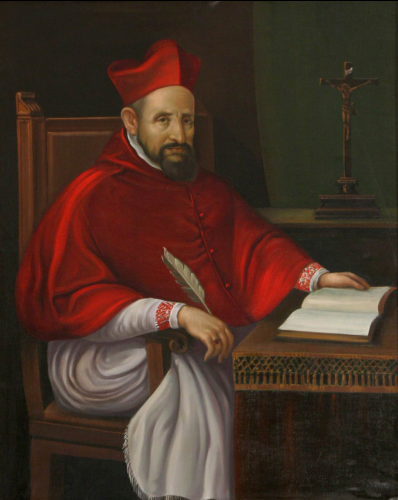
Saint Robert Bellarmine.png

St. Robert Bellarmine.
1542-1621.
(Wikimedia Commons)


St. Lawrence of Brindisi.
1559-1619.
(Wikimedia Commons)


1567-1622.
(Wikiquote)

There are also a further four Doctors of The Church, all from the Latin Church:


St. Alphonsus Liguori
1696-1787.
(Wikimedia Commons)


1873-1897.


Saint Irenaeus (130 A.D. - 202 A.D.).
Bishop of Lugdunum, in Gaul (now Lyon, France).
(Wikimedia Commons)


Saint John Henry Newman (1801 - 1890).
(Wikipedia)

This list and definition of the Doctors of The Church was adapted and updated from that provided by Louis Miller, Beacons of Light: Profiles of Ecclesiastical Writers Cited in the Catechism (Liguori, MO: Liguori, 1995), 61-62.
Related Posts Plugin for WordPress, Blogger...