

Tewkesbury Abbey.
Photo: 20 July 2006.
Source: Own work.
Author: Velela
(Wikimedia Commons)


“Sanctuary”. King Edward IV and Lancastrian fugitives at Tewkesbury Abbey. Artist: Richard Burchett (1815 – 1875) [1]
King Edward IV and his Yorkist Troops are beseeched by a Priest to stop the pursuit of their Lancastrian foes, who have sought Sanctuary within Tewkesbury Abbey.
Date: 1867.
Collection: Guildhall Art Gallery, London.
(Wikimedia Commons)
This Article was promulgated by Zephyrinus
reading a riveting Post on the excellent Blog
which Zephyrinus urges all Readers to go to
and have a look at. You won't be disappointed.

“The Two Armies Engage”.
Artist: Graham Turner.
Image: studio88
Illustration: ONCE I WAS A CLEVER BOY

Text from Wikipedia - the free encyclopædia,
unless stated otherwise.
The forces loyal to The House of Lancaster were completely defeated by those of the rival House of York under their Monarch, King Edward IV.
The Lancastrian Heir to The Throne, Edward, Prince of Wales, and many prominent Lancastrian Nobles, were killed during The Battle, or executed.
The Lancastrian King, Henry VI of England, who was a prisoner in The Tower of London, died, or was murdered, shortly after The Battle.
The Battle of Tewkesbury restored Political stability to England until the death of King Edward IV in 1483.
Belligerents.
(☩ indicates either Killed-in-Battle
or Executed afterwards).
The House of York.

The White Rose of York.
Date: 18 January 2011.
Source: Own work.
File is Licensed
under the Creative Commons Attribution-
Share Alike 3.0 Unported, 2.5 Generic,
2.0 Generic and 1.0 Generic Licence.
Author: Sodacan
(Wikimedia Commons)

The House of Lancaster.

Date: 18 January 2011.
Source: Own work.
File is Licensed
under the Creative Commons Attribution-
Share Alike 3.0 Unported, 2.5 Generic,
2.0 Generic and 1.0 Generic Licence.
Author: Sodacan
(Wikimedia Commons)
Available on YouTube
Commanders and Leaders.
The House of York:
Kind Edward IV.

Coat-of-Arms of Edward, 4th Duke of York,
before he became King Edward IV.
Illustration: PINTEREST
Edward IV (28 April 1442 – 9 April 1483) was King of England from 4 March 1461 to 3 October 1470,[1] then again from 11 April 1471 until his death in 1483. He was a central figure in The Wars of The Roses, a series of Civil Wars in England fought between the Yorkist and Lancastrian
factions between 1455 and 1487.
Duke of Gloucester.

English:
Coat-of-Arms of Richard, Duke of Gloucester,
later King Richard III of England.
Magyar: Richárd, gloucesteri herceg
(a későbbi III. Richárd) címere.
Date: 12 November 2011.
Source: SVG elements from File:England Arms-label ermine.svg and File:Lionel of Antwerp Arms.svg
File is Licensed under the
3.0 Unported Licence.
Author: Melinda Rácz
(Wikimedia Commons)
Baron Hastings.
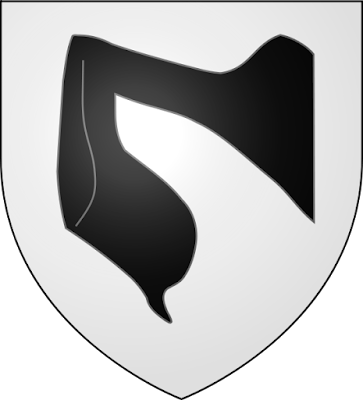
English: Coat-of-Arms of Baron Hastings.
Français: Famille des Barons Hastings.
Blazon:
English: Argent, a maunche Sable.
Français : D'argent, à la manche de sable.
Reference: Folio 57v de l'fr:Armorial de Gelre.
Source: Own work.
File is Licensed under the
Creative Commons Attribution 3.0 Unported Licence.
Artist: Jimmy44
(Wikimedia Commons)

Edward of Westminster, Prince of Wales, is brought to King Edward IV for questioning in the aftermath of The Battle of Tewkesbury. King Edward IV's brothers, Richard (on the King's Right) and George (on the King's Left),
along with Baron Hastings, stand near the King.
Date: 1864.
Source: Doyle, James William Edmund (1864) "Edward IV" in A Chronicle of England: B.C. 55 – A.D. 1485, London: Longman, Green, Longman, Roberts & Green, pp. p. 424 Retrieved on 12 November 2010.
Author: James William Edmund Doyle (1822–1892).
Engraver: Edmund Evans (1826–1905).
(Wikimedia Commons)

The House of Lancaster.
Duke of Somerset ☩.

Coat-of-Arms of The Duke of Somerset.
Date: 4 August 2013.
Source: Own work.
File is Licensed under the
3.0 Unported Licence.
Author: Sodacan
(Wikimedia Commons)
Either to escape the Cannonade and Volleys of Archery
from King Edward IV's Army, or because he saw an opportunity to outflank King Edward's, The Duke of Somerset led at least part of his men via some of the "evil lanes" to attack King Edward's Left Flank.
Although taken by surprise, King Edward's men resisted stoutly, beating back The Duke of Somerset's attack among the hedges and banks. At the vital moment, the 200 Spear Men that King Edward had earlier posted in the woods, far out on The Left of The Battlefield, attacked The Duke of Somerset's forces from his own Right Flank and The Rear, as The Duke of Gloucester's forces also joined in the fighting.
Somerset’s forces were routed, and his surviving Troops tried to escape across The River Severn. Most were cut down as they fled. The Long Meadow, leading down to The River,
is known to this day as “Bloody Meadow”. [23]

The Duke of Somerset galloped up to Baron Wenlock, commanding the Lancastrian Centre, and demanded to know why Wenlock had failed to support him. According to legend (recounted in Edward Hall’s Chronicle, written several years afterwards, though from first-hand accounts), he did not wait for an answer, but dashed out Wenlock’s brains with a Battle-Axe[24], before seeking Sanctuary in Tewkesbury Abbey.
Duke of Somerset, from the County of Somerset, is a Title that has been created five times in The Peerage of England. It is particularly associated with two families: The Beauforts, who held the Title from its creation in 1448, and The Seymours, from its creation in 1547, in whose name the Title is still held.
The present Dukedom is unique, in that the first holder
of the Title created it for himself in his capacity of
Lord Protector of The Kingdom of England, using a power granted in the Will of his nephew King Edward VI.
The only Subsidiary Title of The Duke of Somerset is Baron Seymour, which is used as a Courtesy Title by the eldest son and heir of the Duke. This Courtesy Title [Editor: Baron] is the lowest in Rank of all heirs to Dukedoms in The Peerages
of The British Isles, yet the holder's Precedence is higher than his Title suggests, by virtue of the Seniority of the Dukedom of Somerset (the only more Senior Non-Royal Duke is
[Editor: The Duke of Norfolk is the Premier Duke
in The Peerage of England, and, also, as Earl of Arundel,
the Premier Earl. The Duke of Norfolk is, moreover,
The Earl Marshal and Hereditary Marshal of England. The Seat of The Duke of Norfolk is Arundel Castle, in Sussex, although the Title refers to the County of Norfolk. The current Duke (in 2021) is Edward Fitzalan-Howard, 18th Duke of Norfolk. The Dukes have, historically, been Catholic, a state of affairs known as Recusancy in England. All past and present Dukes of Norfolk have been descended from
Edward I (see Dukes of Norfolk Family Tree)].
Earl of Devon ☩.

Coat-of-Arms of The Earl of Devon.
Date: 3 May 2017.
Source: Own work.
File is Licensed under the
4.0 International Licence.
Author: TheDukeOfExeter
(Wikimedia Commons)
The Title of Earl of Devon was created several times in The English peerage, and was possessed first (after The Norman Conquest of 1066) by The “de Redvers” Family (alias “de Reviers”, “Revieres”, etc.), and, later, by The Courtenays.
It is not to be confused with the Title of Earl of Devonshire, held, together with the Title Duke of Devonshire, by The Cavendish Family of Chatsworth House, Derbyshire, although The Letters Patent for the creation of the latter Peerage used the same Latin words “Comes Devon(iæ)”.[1] It was
a re-invention, if not an actual continuation, of
the Pre-Conquest Office of Ealdorman of Devon.[2]
Baron Wenlock ☩.

Coat-of-Arms of The 1st Baron Wenlock.
Date: 21 September 2020.
Source: Own work.
File is Licensed under the
4.0 International Licence.
Artist: Thom.lanaud
(Wikipedia)
At The Battle of Tewkesbury on 4 May 1471,
he commanded the middle of the Lancastrian Line. However, the Lancastrians suffered a crushing defeat, and Wenlock died on the Battlefield. He was allegedly killed by his own Commander, The Duke of Somerset, who blamed Wenlock’s indecisiveness for the defeat.[6]
The Duke of Somerset had led the Right Flank of the Lancastrian Line forward, and expected Wenlock to support him, but Wenlock held back (some suggest deliberately) and the Duke's men were slaughtered. After the Duke's Flank retreated, he either summoned Wenlock or rode to him, and supposedly killed him with a single blow to the head. [7] Some sources suggest that Wenlock was committed to the cause, but that Somerset had bungled the planned manoeuvre, coming out of the woods too early, and emerging in front of the enemy, instead of behind, thereby preventing Wenlock's men from shooting at them. [3]
John Wenlock, 1st Baron Wenlock KG (1400 – 4 May 1471) was an English Politician, Diplomat, Soldier, and Courtier. He fought on the sides of both The Yorkists and The Lancastrians in The Wars of The Roses.[1] He has been called "the Prince of Turncoats", [2] although some historians suggest the label may not be fair.[3] Others contend that, even when Wenlock was not actually changing sides, he was engaged in "fence sitting par excellence." [2]
Although Wenlock is often remembered for his military exploits (he fought in six of the major Battles of The Wars of The Roses, as well as the Sieges of The Tower of London and Dunstanburgh Castle), most of his Public Service was in the Diplomatic Field, and contemporary accounts record him as being regarded as "very clever". [2]
Strength.
The House of York:
5,000 - 6,000.
The House of Lancaster:
6,000.

Casualties and Losses:
The House of York:
Unknown.
The House of Lancaster:
2,000.
Prince Edward of Westminster ☩ .

Coat-of-Arms of Prince Edward of Westminster.
Illustration: TUDOR BLOGGER
Edward of Westminster (13 October 1453 – 4 May 1471), also known as Edward of Lancaster, was the only son of King Henry VI of England and Margaret of Anjou. He was killed aged seventeen at The Battle of Tewkesbury, making him the only Heir Apparent to The English Throne to die in Battle.
The following Paragraph is from TUDOR BLOGGER
Edward of Westminster, Prince of Wales, was
the Lancastrian Heir to the Throne. He was the only
child of the Lancastrian King, Henry VI, and his wife, Margaret of Anjou. His father was overthrown in 1461 and Edward went into exile in Scotland and then France with his mother. He was the last Heir Apparent to die in Battle,
when he was killed at The Battle of Tewkesbury in 1471, allegedly by the future King Richard III.


%20BEING%20DIFFICULT,%20AGAIN-1.png444.png)


