Notre Dame de Rouen. The façade of the Gothic Church in France. Photographer: Hippo1947. Licence: SHUTTERSTOCK.

27 May, 2026

Saint John I. Pope And Martyr. Who Reigned From 523 A.D. - 526 A.D. Feast Day 27 May. Red Vestments.


Text, unless stated otherwise, is from “The Liturgical Year”,
by Abbot Guéranger, O.S.B.

Translated from the French by Dom Laurence Shepherd, O.S.B.
   Volume 8.
   Paschal Time.
   Book II.

Re-published by St. Bonaventure Publications, 
July 2000. www.libers.com


Illustration of Pope Saint John I.
Date: 1911.
Source: http://www.archive.org/
details/livesofpopes01artauoft
Author: Artaud de Montor, Alexis François.
(Wikimedia Commons)


The Palm of Martyrdom was won by this holy Pope, not in a victory over a pagan persecutor, but in battling for The Church's liberty against a Christian King. But the King was a Heretic and, therefore, an enemy of every Pontiff that was zealous for the triumph of The True Faith.

The state of Christ's Vicar, here on Earth, is a state of combat; and it frequently happens that a Pope is veritably a Martyr, without having shed his blood. Pope Saint John I, whom we honour, today, was not slain by the sword; a loathsome dungeon was the instrument of his Martyrdom; but there are many Popes who are now in Heaven with him, Martyrs, like himself, who never even passed a day in prison or in chains; the Vatican was their Calvary.

They conquered, yet fell in the struggle with so little appearance of victory, that Heaven had to take up the defence of their reputation, as was the case with that angelic Pontiff of the 18th-Century, Pope Clement XIII.


Today's Saint (Pope Saint John I) teaches us, by his conduct, what should be the sentiment of every worthy member of The Church. He teaches us that we should never make a compromise with Heresy, nor approve the measures taken by Worldly policy for securing what it calls the rights of Heresy.

If the past ages, aided by the Religious indifference of governments, have introduced the toleration of all Religions, or even the principle that "all Religions are to be treated alike by the State," let us, if we will, put up with this latitudinarianism, and be glad to see that The Church, in virtue of it, is guaranteed from legal persecution; but, as Catholics, we can never look upon it as an absolute good.

Whatever may be the circumstances in which Providence has placed us, we are bound to conform our views to the principles of our Holy Faith, and to the infallible teaching and practice of The Church - out of which there is but contradiction, danger and infidelity.

The Holy Liturgy thus extols the virtues and courage of our Saint, Pope Saint John I.


This image is a faithful representation of an icon
inside the Basilica of Saint Paul-Outside-the-Walls.
Source: 
http://cckswong.tripod.com/pope1_50.htm
Author: Unknown.
(Wikimedia Commons)


Pope John I (Latin: Ioannes PP. I, Italian: Giovanni I; circa 470 A.D. – 18 May 526 A.D.) was Pope from 13 August 523 A.D. to 18 May 526 A.D. He was a native of Siena (or the "Castello di Serena"), near Chiusdino, in Italy. He is the first Pope known to have visited Constantinople while in Office.

While a Deacon, in Rome, he is known to have been a partisan of the Anti-Pope, Laurentius, for, in a “Libellus”, written to Pope Symmachus in 506 A.D, John confessed his error in opposing him, condemned Peter of Altinum and Laurentius, and begged pardon of Symmachus.

He would then be the "Deacon John" who signed the “Acta” (Ecclesiastic Publication) of The Roman Synod of 499 A.D., and 502 A.D.; the fact The Roman Church only had seven Deacons, at the time, makes identifying him with this person very likely. He may also be the "Deacon John" to whom Bœthius, the 6th-Century A.D. philosopher, dedicated three of his five Religious “Tractates”, or “Treatises”, written between 512 A.D., and 520 A.D.

John was very frail when he was Elected to The Papacy as Pope John I. Despite his protests, Pope John was sent by the Arian King, Theodoric the Great, - Ruler of The Ostrogoths, a Kingdom in present-day Italy - to Constantinople, to secure a moderation of a Decree against The Arians, issued in 523 A.D., of Emperor Justin, Ruler of The Byzantine, or East Roman, Empire.


King Theodoric threatened that, if John should fail in his mission, there would be reprisals against The Orthodox, or non-Arian, Catholics in The West. John proceeded to Constantinople with a considerable entourage: His Religious companions included Bishop Ecclesius of Ravenna, Bishop Eusebius of Fanum Fortunae, and Sabinus of Campania. His secular companions were the Senators, Flavius Theodorus, Inportunus, Agapitus, and the patrician Agapitus.

Emperor Justin is recorded as receiving John honourably and promised to do everything the embassy asked of him, with the exception of restoring converts from Arianism to Catholicism to their original beliefs. Although John was successful in his mission, when he returned to Ravenna, Theodoric's Capital in Italy, Theodoric had John arrested on the suspicion of having conspired with Emperor Justin. John was imprisoned at Ravenna, where he died of neglect and ill treatment. His body was transported to Rome and buried in the Basilica of Saint Peter.

The Liber Pontificalis credits John with making repairs to the Cemetery of The Martyrs, Nereus and Achilleus, on the Via Ardeatina, that of Saints Felix and Adauctus, and the Cemetery of Priscilla.

Pope John I is depicted in art as looking through the bars of a prison, or imprisoned with a Deacon and a Sub-Deacon. He is Venerated at Ravenna and in Tuscany.


The following Text is from The Saint Andrew Daily Missal.

Saint John I.
   Pope and Martyr.
   Feast Day 27 May.

Simple.

Red Vestments.

Pope Saint John I (523 A.D. - 526 A.D.) governed The Church at the time when the Arian King Theoderic ravaged Italy. This King, having artfully enticed him to Ravenna, caused him to be thrown into a dark dungeon where he died.

His body was buried in Rome in the Basilica of Saint Peter.

Mass: In Paschaltime: Protexisti.
Mass: Out of Paschaltime: Sacerdotes Dei.

Saint Bede The Venerable. Confessor And Doctor Of The Church. Feast Day 27 May. White Vestments.


Text is from The Saint Andrew Daily Missal,
unless otherwise stated.

Saint Bede The Venerable.
   Confessor.
   Doctor of The Church.
   Feast Day 27 May.

Double.

White Vestments.


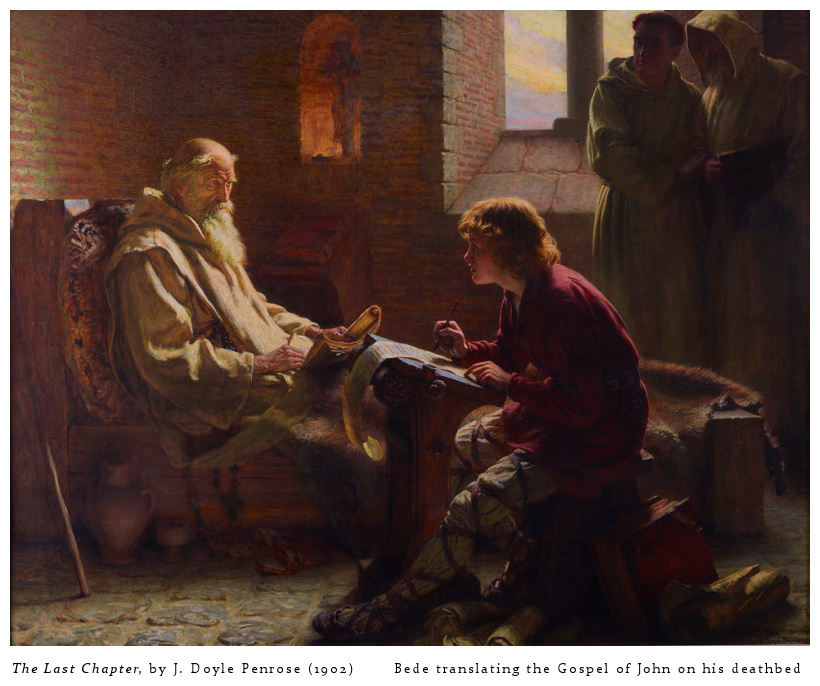
The Venerable Bede,
translating The Gospel of John, on his deathbed.
Artist: James Doyle Penrose.
Date: 1902.
Exhibition History: 
Source/Photographer: 
(Wikimedia Commons)


Born at Yarrow, in Northumberland, England, Bede was committed, as a child, to Saint Benedict Biscop, Abbot of the Benedictine Monastery at Wearmouth.

The Holy Ghost filled him with Wisdom and Intelligence (Introit), wherefore his writings, penetrated by Holy Doctrine (Epistle), were read aloud in the Churches, even in his lifetime. 

As it was not permissible to call him “Saint”, he was called “Venerable,” a Title he kept after his death.

He was one of the most learned Churchmen in the 8th-Century A.D., and his name is found among those of the Doctors of The Church.

Not satisfied with teaching men the Law and the Prophets, he also practised the most beautiful Virtues (Gospel). 

On the eve of the Ascension, he received the Last Sacraments, embraced his brethren, lay down on the ground upon his hair cloth, said twice “Glory be to The Father, and to The Son, and to The Holy Ghost”, and fell asleep in The Lord on 27 May 735 A.D.

Let us honour Saint Bede, the Holy Doctor, that we may always be enlightened by his Wisdom and helped by his Merits (Collect).

Mass: In médio.
Commemoration: Saint John I
(Collects: Mass: Sacerdótes Dei).


Tomb of the Venerable Bede,
Durham Cathedral, Durham, England.
Photo: 4 May 2008.
Source: 
Author: robert scarth
(Wikimedia Commons)


The following Text is from Wikipedia - the free encyclopædia.

Bede (Old English: Bǣda or Bēda; 672 A.D. – 26 May 735 A.D.), also referred to as Saint Bede or the Venerable Bede (Latin: Bēda Venerābilis), was an English Monk at the Monastery of Saint Peter at Monkwearmouth and its companion Monastery, Saint Paul’s, in modern-day Jarrow (see Monkwearmouth-Jarrow), England, both of which were located in the Kingdom of Northumbria.

He is well known as an author and scholar, and his most famous work, “Historia ecclesiastica gentis Anglorum” (“The Ecclesiastical History of The English People”) gained him the Title of “The Father of English History”.

In 1899, Bede was made a Doctor of The Church by Pope Leo XIII; he and the recently-accorded Saint John Henry Newman are the only natives of Great Britain to achieve this designation (Anselm of Canterbury, also a Doctor of The Church, was originally from Italy).

Bede was, moreover, a skilled linguist and translator, and his work made the Latin and Greek writings of the Early-Church Fathers much more accessible to his fellow Anglo-Saxons, contributing significantly to English Christianity

Bede’s Monastery had access to an impressive Library, which included works by Eusebius and Orosius, among many others.

Ember Wednesday After Pentecost. Red Vestments.


Illustration: FR. Z's BLOG


Text is from The Saint Andrew Daily Missal,
unless stated otherwise.

Ember Wednesday After Pentecost.

Station at Saint Mary Major.

Indulgence of 30 Years and 30 Quarantines.

Semi-Double.

Red Vestments.


Rogation Day.
Circa 1950:
The Vicar and Sunday School Children go out into the fields
to Bless The Crops. The little boy is carrying a symbolic 
Tree of Plenty.
Picture Credit: Hulton Archive/Getty Images.
Illustration: ABOUT RELIGION

“FORTITUDE”.

“The Gift of Fortitude is a permanent power which The Holy Ghost communicates to our Will to assist us in overcoming the difficulties which might deter us in the practice of what is right.”
[Rev. M. Meschler.]

The Ember Days always fall during The Octave of Pentecost. The Church then offers up to God the first-fruits of the new Season, and Prays for the Priests who, on the coming Saturday, are about to receive The Holy Ghost in The Sacrament of Holy Orders.

The Station on Ember Wednesday was always held at Saint Mary Major. It was at the feet of The Blessed Virgin, whom The Holy Ghost filled with His Grace in The Cenacle, that the newly-Baptised gathered together.

The Liturgy reminded them of the Miracle of Pentecost (Lesson) and the marvels wrought by The Apostles, as a result of which the number of those who believed in The Lord was greatly increased (Epistle).

Moved by The Holy Ghost, The Catechumens also believed in Jesus: They turned to Him, and Jesus gave them to eat of The Bread that would make them live for ever (Gospel).

Let us implore The Divine Consoler to enlighten us always more and more and to place us in full possession of The Truth (Collect).

Mass: Deus, dum egrederéris.
Sequence: Veni, Sancte Spiritus.
Creed.
Preface: For Pentecost.
Communicantes: For Pentecost.
Hanc igitur: For Pentecost.


Ember Day Service.
1950.
Illustration: ABOUT RELIGION


Sunday School Children Celebrate Rogation Day in 1953.
A photo at Market Lavington Museum, Wiltshire, England.
Illustration: MARKET LAVINGTON MUSEUM


Saint Michael’s Church, Bunwell, Norfolk, England, 
has always been the centre of Village Life. In this picture, taken on Rogation Sunday, April 1967, the Rector, Rev. 
Samuel Collins, followed by the Choir, Parishioners, 
and The New Buckenham Silver Band, walk 
The Parish Boundaries and Bless the Stream.
Illustration: BUNWELL HERITAGE GROUP

26 May, 2026

“Nightmare”. By: Artie Shaw. 1938. Film Noir. Bête Noire. Art Noir.


“Nightmare”.
By: Artie Shaw.
1938.
Available on YouTube


Illustration: PINTEREST


Illustration: PINTEREST


Illustration: PINTEREST


Illustration: PINTEREST


“Nightmare”.
By: Artie Shaw.
1938.
Available on YouTube

Liturgy Conference In Leuven, Belgium. “Tradition And Reform Of The Roman Rite: The Usus Antiquior In Contemporary Catholicism”.


Text and Illustrations, unless otherwise stated, 

Liturgy Conference in Leuven, Belgium.
October, 2026.

“Tradition And Reform Of The Roman Rite: 
The Usus Antiquior In Contemporary Catholicism”.

Thursday, 22 October 2026 — Friday, 23 October  2026.


This Article is taken from, and can be read in full at,


“A Day With Mary”. Saint Anselm’s, Dartford, Kent. Saturday, 30 May 2026.


The Web-Site of
“A Day With Mary” can be found


An Aide-Mémoire. A Provocative Thought. An Interesting, Stimulating, Idea. Four Very-Early Popes. Read Up On Them.


Saint Peter’s Basilica, Rome.
Illustration: SAINT PETER’S

An Aide-Mémoire. 

A Provocative Thought. 

An Interesting, Stimulating, Idea. 

Four Very-Early Popes. 

Read Up On Them.

Pope Saint Soter (166 A.D. – 175 A.D.).

Pope Saint Eleutherius (175 A.D. – 189 A.D.).

Pope Saint Victor I (189 A.D. – 199 A.D.).

Pope Saint Zephyrinus (199 A.D. – 217 A.D.).

N.B. (Nota Bene):
Zephyrinus’s use of A.D. in these Articles is his direct response, and a challenge, to all the Modernistic, Woke, Apologists, who try to instil into the English language new, farcical, terms of
BCE (Before The Common Era) and CE (Common Era) !!!

The Shrine Of Our Lady Of Consolation, West Grinstead, Sussex, And Its Dedicated Mass “Astitit Regina”.


Missale Romanum of Vindobonæ (Vienna), Austria,
dated 1861.
In which is contained the Mass
IN FESTO.
BEATÆ MARIÆ VIRGINIS.
DE CONSOLATIONE APUD WEST GRINSTEAD.
SOCIETATIS CINCTURATORUM PATRONÆ.
Authorised by The Sacred Congregation of Rites, Rome,
17 July 1885.
The Mass is located in this Missal in the Section entitled:
MISSÆ PROPRIÆ
DIŒCESIUM ANGLIÆ
for the Second Sunday in July.
Photo: 25 May 2024.
Source: Own work.
Author: Zephyrinus.
All Illustrations: Zephyrinus.


The Introit of the Mass “Astitit Regina”.
(The Queen stood on Thy right hand,
in gilded clothing; surrounded with variety.)
(Psalm 44).


Shrine of Our Lady of Consolation.
Available on YouTube


The Web-Site of The Shrine of Our Lady of Consolation 
can be found HERE

The following Text is from 
The Shrine of Our Lady of Consolation.

Part of the Catholic Diocese of Arundel & Brighton, The Shrine of Our Lady of Consolation, in West Grinstead, Sussex, is the first Shrine in honour of Our Blessed Lady to be established in England since before the Reformation.


Illustration:

Please use our Web-Site to discover more about the Shrine history and for information on Pilgrimages to the Shrine.

For all the latest Parish news and Mass times, please see 
our joint Web-Site with Saint Gabriel’s Church, Billingshurst.


Donations.

To make a donation, please go to the Diocese “Just Giving” page HERE and specify that your donation is for The Shrine Church of Our Lady of Consolation, West Grinstead.


Or better still please consider setting up a Standing Order,
or increasing an existing one (for any amount, no matter how small). Please contact our Shrine Administrator, Kate Goddard, via westgrinstead@abdiocese.org.uk or phone
01403 710273.

Thank you.


Shrine Prayer.

O God, who through The Virgin Mary has willed to give to 
your people The True Consolation, Jesus Christ; grant to us who Venerate her, under the Title of Our Lady of Consolation, the Grace to co-operate with her in the work of Redemption, we ask this through Christ Our Lord.

Amen.

Our Lady of Consolation of West Grinstead,
Have pity on us.

Saint Francis of Assisi,
Pray for us.

Blessed Francis Bell,
Pray for us.


History of The Shrine of Our Lady of Consolation.
Available on YouTube


The following Text is from 
The Isle of Wight Catholic History Society. 

Their Web-Site is HERE

The Isle of Wight Catholic History Society arranged a Pilgrimage for The Year of Faith to The Shrine of Our Lady 
of Consolation at West Grinstead and to Arundel Cathedral.


Illustration:

It is particularly pleasing for our Pilgrimage to be on this Feast of Our Lady of Walsingham, 2013. (Those of us who are older Catholics, will remember it as the Feast of Our Lady of Ransom, and the work of the Guild of Our Lady of Ransom).

This day marks the anniversary of the installation 
of Bishop Philip Egan, eighth Bishop of Portsmouth.


We were delighted to have had Fr. Jonathan 
and some members of the Ordinariate with 
us on the Feast of their principal Patron. 

If you were unable to go to Walsingham, 
this Pilgrimage is a most appropriate substitute.


Illustration:

West Grinstead was an important centre for The Church during Penal Times. The Faith was never lost, thanks largely to the Caryll family, who were a wealthy land-owning Sussex family who built the “Priest’s House”, (now the Presbytery) 
in the Mid-Sixteenth-Century.

During Penal Times, most Priests who secretly returned to England from abroad, headed for this West Grinstead House, ideally situated deep in the wooded area of West Sussex.


Our own two Island [Editor: Isle of Wight] Martyrs, 
Blessed Robert Anderton and Blessed William Marsden, 
were probably heading for West Grinstead when they 
were caught and executed in 1586.


Blessed Francis Bell (R.I.P.).
Illustration:

West Grinstead’s seclusion and the well-planned 
secrecy with Priests disguised as servants and farm 
workers meant that no Priest was ever caught here. 

This we know from the fact that the house has 
survived, as it was the custom for the authorities 
to burn down any house where a Priest was found. 

From West Grinstead, Priests were sent to different 
parts of the Country to minister in secret to The Faithful.

In the house, is a Secret Hiding Hole for 
Priests, and a Chapel, in what used to be the 
hay loft, where secret Masses were Celebrated.


The end of the Penal Days brought an obvious 
end to the secrecy surrounding the place, and 
the present magnificent Church was built in 1876. 

At the same time, Our Lady’s Statue at West Grinstead was Crowned by the Papal Delegate, representing Pope Leo XIII.


Illustration:

The Solemn Crowning at The Shrine in Sussex, in 
thanksgiving for the preservation of The Faith in Penal 
Times, was the first such Crowning since the Reformation.

A School and Orphanage were also opened. 

In 1889, Mgr. Denis’ Curate, Fr. Francis Bourne (later to 
be Cardinal Archbishop of Westminster), started the first Diocesan Seminary for Priests here, in the place where, 300 years earlier, the facilities at West Grinstead were not large enough for a Seminary, and, after a few years, it moved to a purpose-built new Seminary at Wonersh, near Guildford.


The present Shrine of Our Lady was erected in 1882 in thanksgiving for the preservation of The Faith and the important role that West Grinstead played in Penal Times.


Illustration:

The Church, Sanctuary, and The High Altar, were Consecrated to The Glory of God and Honour of Our Lady, on 16 July 1896.

The Shrine painting of Our Lady can be seen 
to the Left of The High Altar, with its Stone Canopy. 

The painting is based on the “Consolata” painting in Turin.


As you look at the Sanctuary, you will see that the 
Reredos depicts scenes from the Life of Mary: The Presentation; Assumption; Coronation of Our Lady; 
The wedding of Mary and Joseph.

The four statues at the top of the Reredos show Saint 
Bruno, Saint Thomas, Saint Aloysius, Saint Francis of Assisi.

Outside in the graveyard are buried: The novelist, 
Antonia White; the portrait painter, James Gunn; the 
famous writer and poet, Hilaire Belloc. This year (2013) 
marks the sixtieth anniversary of his death.


The Parish Priest [Editor: In 2013] is Fr. David Goddard, 
(a former Anglican Priest, and a contemporary of 
Fr. John Catlin), and is well-known to those of us in Ryde.

About ten years ago, he visited Ryde twice to talk 
about the history of the Shrine and, on another occasion, about the Extraordinary Form of The Mass. He also advised Saint Mary’s Parish on the purchase of the new Organ in 2007.

In 2009, his son, Fr. Matthew Goddard FSSP, 
came to Ryde shortly after his Ordination in 2009 
for a Solemn High Mass at Saint Mary’s; and, again, in October 2013, for a Year of Faith Day of Recollection.

Most Pilgrims took the opportunity to visit the Secret Chapel and Priest’s Hiding Hole in the attic above the Presbytery (once the hay loft).

For further information on the West Grinstead Shrine visit www.consolation.org.uk
Related Posts Plugin for WordPress, Blogger...