Notre Dame de Rouen. The façade of the Gothic Church in France. Photographer: Hippo1947. Licence: SHUTTERSTOCK.

28 August, 2026

“When You Were Sweet Sixteen”. Sung By: The Fureys.


“When You Were Sweet Sixteen”.
Sung By: The Fureys.
Available On YouTube

“Beavers And Moose Won’t Take It Anymore”. “Trade War”. Sung By: Canadian Resistance Army.


“Trade War”.
Sung By: Canadian Resistance Army.
“Beavers And Moose Won’t Take It Anymore”.
Available On YouTube

The Band Of The Coldstream Guards Pay Deep Respect To Dolly Parton (R.I.P.) At Buckingham Palace. God Bless Her.


The Band Of The Coldstream Guards Pay Deep Respect To Dolly Parton (R.I.P.) At Buckingham Palace. God Bless Her.
Available On YouTube

The Band Of The Coldstream Guards Pay Deep Respect To Dolly Parton (R.I.P.) At Buckingham Palace. God Bless Her.


The Band Of The Coldstream Guards 
Pay Deep Respect To Dolly Parton (R.I.P.) 
At Buckingham Palace.
God Bless Her.
Available On YouTube

We Will Always Love You. The Royal Marines Band Pays Deep Respect To Dolly Parton (R.I.P.). God Bless Her.


“I Will Always Love You”.
Composed By: Dolly Parton (R.I.P.).
A Tribute To Dolly Parton By The Royal Marines Band.
Available On YouTube

Neuschwanstein Castle, Schwangau, Bavaria, Germany. King Ludwig II Of Bavaria’s Creation. (Part Ten).


Photo: 31 July 2013.
Source: Own work.
This File is licensed under the
Attribution:
© Thomas Wolf, www.foto-tw.de
(Wikipedia)


The Throne Hall, Neuschwanstein Castle.
Photograph by Joseph Albert 1886. 
Postcard published 1890 - 1900. 
Detroit Publishing Co. Print No. 17479.
Date: 1886.
Source:
Photochrom from Photoglob AG Zürich (PZ, 17479); Views of Germany in the Photochrom Print Collection. This image is available from the United States Library of Congress's Prints and Photographs division under the digital ID ppmsca.00180.
Author: Josef Albert (1825–1886).
(Wikimedia Commons)


Text is from Wikipedia - the free encyclopædia,
unless stated otherwise.

Throughout, the design pays homage to the German legends of Lohengrin, the Swan Knight. Hohenschwangau, where King Ludwig spent much of his youth, had decorations of these sagas. These themes were taken up in the operas of Richard Wagner

Many rooms bear a border depicting the various Operas written by Wagner, including a Theatre permanently featuring the Set of one such Play. 


Saint George and the Dragon.
Neuschwanstein Castle.
Schloss Neuschwanstein.
Photo: 23 August 2008.
Source: Own work.
This File is licensed under the 
Author: Hedwig Storch.
(Wikimedia Commons)

Many of the Interior rooms remain undecorated, with only fourteen rooms finished before Ludwig’s death. 

With the Palace still under construction at the King’s death, one of the major features of the Palace remained unbuilt: A massive Keep, which would have formed the highest point and central focus of the whole edifice, was planned for the middle of the Upper Courtyard, but was never built, at the decision of the King’s family. The Foundation for the Keep is visible in the Upper Courtyard.[49]

Neuschwanstein Castle consists of several individual structures which were erected over a length of 150 metres on the top of a Cliff Ridge. 

The elongated building is furnished with numerous Towers, ornamental Turrets, Gables, Balconies, Pinnacles, and Sculptures. 


Sängerhalle (Singer’s Hall, Music Room), Neuschwanstein Castle, Bavaria, Germany. Photograph by Joseph Albert 1886.
Postcard published circa 1890 — 1900. Detroit Publishing Co. Print No. 17484.
Source: Photochrom from Photoglob AG Zürich (PZ, 17484); Views of Germany in the Photochrom print collection, Library of Congress, Reproduction number LC-DIG-ppmsca-00185.
Author: Josef Albert (1825 — 1886).
(Wikimedia Commons)


Following the Romanesque Style, most Window openings are fashioned as biforia and triforia

Before the backdrop of the Tegelberg, and the Pöllat Gorge in the South, and the Alpine foothills with their Lakes in the North, the whole collection of individual buildings provide varying picturesque views of the Palace from all directions.

PART ELEVEN FOLLOWS.

Westminster. Rouen. Chinon. Poitiers. The Four Centres Of Power For Henry II Plantagenet. Mediæval King Of England 1154 – 1189. Friend And Foe Of Thomas à Becket. (Part Nine).


Soundtrack from Simon Schama’s
“A History of Britain”,
which included King Henry II’s reign.
Sung by Emma Kirkby and Lucie Skeaping.
Music by John Harle.
Available on YouTube


Text from Wikipedia - the free encyclopædia,
unless stated otherwise.

The most commonly quoted, as handed down by oral Tradition, is: “Who will rid me of this troublesome Priest ?’, but, according to historian Simon Schama, this is incorrect; he accepts the account of the contemporary biographer Edward Grim, writing in Latin, who gives us: “What miserable drones and traitors have I nourished and brought up in my household, who let their Lord be treated with such shameful contempt by a low-born Cleric”.

Many variations have found their way into popular culture.


The Angevin Empire
and claims of King Henry II of England
(Red, Buff, Orange, Yellow).
Blue is the Royal Domain and Vassal States
of the French King.
Date of construction of File:
5 January 2011,
Source:
Author:
France_blank.svg: Eric Gaba
Derivative work: Hchc2009.
(Wikimedia Commons)


Whatever Henry said, it was interpreted as a Royal Command, and four Knights, Reginald FitzUrse, Hugh de Morville, William de Tracy, and Richard le Breton, set out to confront the Archbishop of Canterbury.

On 29 December 1170, they arrived at Canterbury. According to accounts left by the Monk, Gervase of Canterbury, and eyewitness Edward Grim, they placed their weapons under a tree outside the Cathedral, and hid their Mail Armour under cloaks, before entering to challenge Becket.

The Knights informed Becket he was to go to Winchester to give an account of his actions, but Becket refused. It was not until Becket refused their demands, to submit to the King’s will, that they retrieved their weapons and rushed back inside for the killing. Becket, meanwhile, proceeded to the Main Hall for Vespers.


A Seal of the Abbot of Arbroath, Scotland, showing the murder of Becket. Arbroath Abbey was Founded eight years after the death of Saint Thomas a’Becket and dedicated to him.
It became the wealthiest Abbey in Scotland.
Date: Mediæval Seal. Photo from the 1850s.
Source: Cosmo Innes and Patrick Chalmers (eds.), 
Liber S. Thome De Aberbrothoc;
Registrorum Abbacie De Aberbrothoc,
Volume 2, Edinburgi (Bannatyne Club) 1848-1856.
(Wikimedia Commons)


The four Knights, wielding drawn Swords, caught up with him in a spot near a door to the Monastic Cloister.

Several contemporary accounts of what happened next exist; of particular note is that of Edward Grim, who was himself wounded in the attack. This is part of the account from Edward Grim:

“The wicked Knight leapt suddenly upon him, cutting off the top of the crown which the unction of Sacred Chrism had dedicated to God.

PART TEN FOLLOWS.

Saint Augustine. Bishop. Confessor. Doctor Of The Church. Feast Day 28 August. White Vestments.


Text from The Saint Andrew Daily Missal,
unless stated otherwise.

Saint Augustine.
   Bishop.
   Confessor.
   Doctor Of The Church.
   Feast Day 28 August.

Double.

White Vestments.


Saint Augustine.
Bishop. Confessor. Doctor Of The Church.
Artist: René de Cramer.
The Saint Andrew Daily Missal.
“Copyright Brunelmar/Ghent/Belgium”.
Used with Permission.


Saint Augustine of Hippo.
Illustration: FRANCISCAN MEDIA


Augustine was born in 354 A.D., at Tagasta, near Algiers, Algeria. His mother, Saint Monica, taught him early to Pray. Although he had received with delight her Holy Teaching, he went headlong into the gravest disorders.

Carthage, North Africa, not offering him a theatre worthy of his genius, he went to Rome and obtained the post of Master of Rhetoric at Milan, North Italy. "My iniquities," he confesses, "were like a snowball growing in size as it rolls." His desolate mother Prayed to God incessantly with tears, still following the steps of her son.

Saint Ambrose, Bishop of Milan, received him kindly and enlightened him in Divine Knowledge. One day, inspired by Heaven, he opened the Epistles of Saint Paul and read: "Wallow not in debauchery and impurity; but clothe yourselves in Our Lord Jesus Christ." His irresolution immediately ceased and, at thirty-three years of age, on Easter Eve, 387 A.D., he was Baptised.


Seven months after this great happiness, Saint Monica died, asking her son to "remember her at The Altar of God". Augustine, becoming a Priest, offered The Holy Sacrifice for her. "Lord," he often said, "have mercy on my mother; she was good, she pardoned easily, pardon her also her sins."

Made Bishop of Hippo [Editor: In modern-day Algeria], at the age of forty-one, in 395 A.D. (Alleluia, Communion), he began from that moment to live Canonically, that is to say, in Common with his Clerks. [The word Canon (Canonicus), derived from Kanon, in the sense of a List of Clerks attached to a Church, with a Stipend for their subsistence. To live Canonically, was to live in Common. Later on, it meant to lead a Regular Life, under a Rule.]

This Community gave Bishops and Priests to many Churches, and thus The Institute of Saint Augustine spread little by little in Africa and, more specially, in Gaul [France]. The Rule of Saint Augustine, which makes him one of The Four Great Founders of Religious Orders [The Benedictine Order, The Franciscan Order, The Augustinian Order, The Dominican Order], is drawn from the 211th Epistle, which he wrote for Nuns, and which, later on, was adapted for men.


[NOTE: These details appeared in the 1945 Edition of The Saint Andrew Daily Missal. The best-known Augustinian Orders are: The Canons Regular of Saint Augustine and The Hermits of Saint Augustine. The Canons Founded many Congregations; that of Windeshem, with the Mystic Writers John Ruysbroeck and Thomas a Kempis; The Lateran Congregation, which has Monasteries in England, France, Belgium, and America. The Hermits have now, in Europe, Mexico, and The Philippine Islands, more than sixty Monasteries, 280 Mission Stations, with more than 2,000 Members.]


Owing to the sublimity of his knowledge, and the ardour of his love, this Saint was also one of The Four Great Doctors of The West [Editor: Saint Augustine; Saint Gregory the Great; Saint Jerome; Saint Ambrose].

He died in 430 A.D., after an Episcopate of thirty-six years, reciting The Penitential Psalms.

Mass: In médio.
Commemoration: Saint Hermes, from The Collects of Mass: Lætábitur.


The Four Great Doctors of The Church, represented
with attributes of The Four Evangelists:
Saint Augustine, with an Eagle;
Saint Gregory the Great, with a Bull;
Saint Jerome (Hieronymus), with an Angel;
Saint Ambrose, with a Winged Lion.
Artist: Pier Francesco Sacchi (circa 1485–1528).
Date: 1516.
Source/Photographer: Uploaded by Twice25, 9 April 2008.
(Wikimedia Commons)

Church Of Saint Pantaleon, Rome.


Apse Ceiling.
Church of Saint Pantaleon, Rome.
Illustration: FR. Z's BLOG

Saint Hermes. Martyr. Feast Day 28 August. Red Vestments.


Text from The Saint Andrew Daily Missal,
unless stated otherwise.

Saint Hermes.
   Martyr.
   Feast Day 28 August.

Simple.

Red Vestments.


English: Church of Saint Hermes,
Ronse, East Flanders, Belgium.
Nederlands: Sint-Hermeskerk in Ronse, Belgium.
Photo: 13 July 2007.
Source: Own work.
(Wikimedia Commons)

“At Rome,” says The Roman Martyrology, “the triumph of Saint Hermes, a very eminent personage, who, after having been some time in prison, was beheaded with several other Saints, under the Judge, Aurelian, as related in The Acts of Pope Saint Alexander ( circa 133 A.D.)”.

Mass: Lætábitur.

27 August, 2026

Cathedral And Metropolitan Church Of Saint Stephen And All Saints, Vienna, Austria. (Part Seven).


English: 
Cathedral and Metropolitan Church of 
Saint Stephen and All Saints, Vienna, Austria.
Deutsch: 
Dom-und-Metropolitankirche zu 
Sankt Stephan und allen Heiligen, 
Wien, Österreich.
Photo: 8 October 2017.
Source: Own work.
This File is licensed under the 
(Wikimedia Commons)


Text from Wikipedia - the free encyclopædia, unless stated otherwise.

The official Viennese “ell” length standards for verifying the measure of different types of sold cloth are embedded in the Cathedral wall, to the Left of the main entrance.

The Linen “ell”, also called Viennese Yard, (eighty-nine centimetres (thirty-five inches)), and the Drapery “ell” (seventy-seven centimetres (thirty inches)) length standards, consist of two iron bars.


The Viennese “ells” are mentioned for the first time in 1685 by the Canon Testarello della Massa in his book “Beschreibung der ansehnlichen und berühmten St. Stephans-Domkirchen”.[10]

A Memorial Tablet gives a detailed account of Wolfgang Amadeus Mozart’s relationship with the Cathedral, including the fact that he had been appointed an adjunct Music Director here shortly before his death.


This was his Parish Church when he lived at the “Figaro House” and he was married here, two of his children were Baptised here, and his Funeral was held in the Chapel of The Cross in the Cathedral.[11]


English: Saint Stephen’s Cathedral, Vienna.
German: Der Stephansdom, Wien.
Artist: Rudolf von Alt (1812–1905).
Date: 1832.
Collection: Belvedere.
Source/Photographer:
The Yorck Project (2002)
10.000 Meisterwerke der Malerei (DVD-ROM), 
distributed by DIRECTMEDIA Publishing GmbH. 
(Wikimedia Commons)

Adjacent to the Catacomb entrance is the Capistran Chancel, the Pulpit from which Saint John Capistrano and Hungarian General John Hunyadi preached a Crusade in 1456 to repel Muslim invasions of Christian Europe.

The 18th-Century Baroque statue shows the Franciscan Friar under an extravagant sunburst, trampling on a beaten Turk. This was the original Cathedral’s main Pulpit until it was replaced by Niclaes Gerhaert van Leyden’s Pulpit in 1515.


A figure of Christ is known affectionately to the Viennese as “Christ with a toothache” (“Zahnwehherrgott”).

At the South-West corner are various Memorials from when the area outside the Cathedral was a Cemetery, as well as a recently-restored 15th-Century Sun-Dial on a Flying Buttress.

Altars.

The main part of the Church contains eighteen Altars, with more Altars in the various Chapels. The High Altar and the Wiener Neustadt Altar are the most famous.

The first focal point of any visitor is the High Altar, built over seven years from 1641 to 1647 as part of the first refurbishment of the Cathedral in the Baroque Style.


The Altar was built by Tobias Pock at the direction of Vienna’s Bishop, Philipp Friedrich Graf Breuner, with Marble from Poland, Styria and Tyrol.

The High Altar represents the stoning of the Church’s Patron, Saint Stephen. It is framed by figures of Patron Saints from the surrounding areas — Saints Leopold, Florian, Sebastian and Rochus — and surmounted with a statue of Saint Mary which draws the beholder’s eye to a glimpse of Heaven, where Christ waits for Stephen (the first Martyr) to ascend from below.

The Wiener Neustädter Altar at the head of the North Nave was ordered in 1447 by Emperor Frederick III, whose tomb is located in the opposite direction.


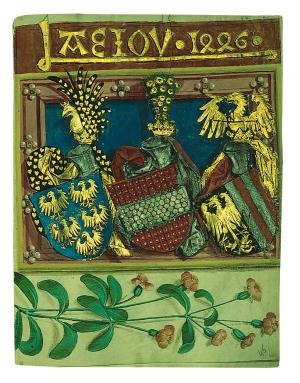
On the Predella is his famous A.E.I.O.U. device. Frederick ordered it for the Cistercian Viktring Abbey (near Klagenfurt) where it remained until the abbey was closed in 1786 as part of Emperor Joseph II's anti-clerical reforms.

It was then sent to the Cistercian monastery of St. Bernard of Clairvaux (founded by Emperor Frederick III) in the city of Wiener Neustadt, and finally sold in 1885 to St. Stephen's Cathedral when the Wiener Neustadt monastery was closed after merging with Heiligenkreuz Abbey.


English:
A.E.I.O.U. Illumination from records of King Frederick.
Deutsch:
A.E.I.O.U. Buchmalerei in der Handregistratur König Friedrichs IV. (des späteren Kaisers Friedrich III.).
Date: 1446.
Author: Unknown.
(Wikimedia Commons)

“A.E.I.O.U.” (sometimes A.E.I.O.V.) was a symbolic device coined by Emperor Frederick III (1415 – 1493) and historically used as a motto by the Habsburgs.

One note in his notebook (discovered in 1666), though not in the same hand, explains it in German and Latin as: “All the World is subject to Austria” (“Alles Erdreich ist Oesterreich untertan” or “Austriæ est imperare orbi universo”).[1]

Frederick habitually signed buildings such as Santa Maria dell’Anima in Rome,[2] Burg Wiener Neustadt, or Graz Cathedral, as well as his tableware and other objects 
with the vowel graphemes.[3]

PART EIGHT FOLLOWS.

Saint Joseph Calasanctius. Confessor. Feast Day, Today, 27 August. White Vestments.


Text from The Saint Andrew Daily Missal,
unless otherwise stated.

Saint Joseph Calasanctius.
   Confessor.
   Feast Day 27 August.

Double.

White Vestments.


English: Church of Saint Thomas, Zaragoza, Spain.
The Altarpiece is of San José de Calasanz (Saint Joseph Calasanctius. A painting by José Luzan. Dated 1767.
Español: Zaragoza - Iglesia de Santo Tomás o de 
los Escolapios - Retablo de San José de Calasanz. 
Pintura de José Luzán de 1767.
Photo: 26 December 2009.
Source: Own work.
Author: Ecelan
(Wikimedia Commons)

The Church, having just Celebrated the Feast Day of the Assumption, Venerates on this day a Saint who had a special Devotion to Our Lady.

Saint Joseph Calasanctius was born in Aragon, Spain, of a noble family, and, from his youth, showed his Charity towards children. While studying Theology at Valencia, he had to defend himself against the enticements of a powerful and noble lady, and he made a Vow to enter into Holy Orders.

Having become a Priest, he was apprised by Divine Revelation that he was destined to teach and to train children, especially those of the Poor (Offertory).

He Founded, in consequence, the Order of the Poor Clerks Regular of the Pious Schools of The Mother of God (Collect) [Editor: Latin: Ordo Clericorum Regularium pauperum Matris Dei Scholarum Piarum, Sch. P. or S. P., or, in short, Piarists].


English: Logo of the Order of the Poor Clerks Regular of
the Pious Schools of The Mother of God. Or, the Piarists.
Español: Escudo de los Escolapios.
Photo: 28 November 2010.
Source: Own work.
(Wikimedia Commons)

Like Jesus, he let little children come to him (Communion) and taught them to fear God (Introit). Wherefore, the Gospel repeats the consoling words of The Master: “Whosoever shall receive one of these little ones in My name, receiveth Me.”

“What is there greater,” writes Saint John Chrysostom, “than to discipline minds, than to form tender youths to good habits? God has shown us that their Souls are worthy of such zeal and of such solicitude that, for them, He did not spare His Son.” [Lessons of The Third Nocturn at Matins.]

Saint Joseph Calasanctius ( 1648 aged ninety-two).

Mass: Veníte, fílii.


English: Saint David depicted in a Stained-Glass Window. Chapel of Saint Joseph Calasanctius, 
Kyjov, Czech Republic.
Čeština: 
Svatý David. Vitráž v kapli sv. Josefa Kalasanského
v Kyjově. Zhotovila firma Veselý a Verner,
malba oken chrámových, Praha - Karlín.
Photo: 1 June 2012.
Source: Own work.
Author: Radek Linner
(Wikimedia Commons)

“A Treatise On Chancel Screens And Rood Lofts. Their Antiquity, Use, And Symbolic Signification”. By: Augustus Welby Pugin.


Illustration: GOOGLE BOOKS


Text is from:
“A Treatise On Chancel Screens And Rood Lofts.
Their Antiquity, Use, And Symbolic Signification”.
By: Augustus Welby Pugin.

First Published in 1851 by Charles Dolman, London.

This 2005 edition published by Gracewing Publishing, 
who have given permission for this Article.


Illustration: GOOGLE BOOKS

INTRODUCTION.
By: Roderick O’Donnell,
Feast of The English and Welsh Martyrs,
4 May 2005.

“A Treatise On Chancel Screens And Rood Lofts. 
Their Antiquity, Use, And Symbolic Signification” 
is Pugin’s last Book.

Published in the Spring of 1851, it was a considered response 
to the attacks made on him during the so-called “Rood Screen Controversy”, which had broken out in 1848 over the role of the Rood Screen in the new and long-awaited Saint George’s Cathedral in Southwark. These attacks had been orchestrated in the pages of the “Rambler” magazine.

Pugin worked on the Book intermittently from 1848 to 
its printing in December 1850 and subsequent publication, 
by Charles Dolman, a few months later. In it, he returns to 
the methods, first deployed with devastating effect in “Contrasts” (1836), of combining polemic with antiquarian scholarship, the latter ranging from Notes and Sketches of Churches he had seen, to published and drawn records culled mostly from his own remarkable Library.

Although the polemics of “Contrasts” are largely avoided, 
the four vignettes on the “Ambonoclast” and the “Conclusion” show him still relishing controversy.

“Ambonoclasm” — Rood Screen smashing — is a term that Pugin borrowed from the historian Abbé J.-B. Thiers, whose “Dissertations Ecclésiastiques sur les principaux Autels des Eglises, Les Jubés des Eglises, La Clôture du Chœur des Eglises” (1688) had first cited in his “Present State of Ecclesiastical Architecture in England”.

The “Treatise” is a strongly-argued and well-laid-out work, 
far less muddled than the publications of his mid-career, and while some stock themes are repeated, there is no suggestion here of Pugin having reached the end of his tether.

Though it was reviewed by the “Tablet” in May 1851 and in 
the “Ecclesiologist” in June 1851 — as part of a campaign to distance the “Ecclesiologist Society” (formerly the “Cambridge Camden Society”) from Pugin — the Book has never received the attention it deserves.

These Illustrations on Google Books are limited in number. Pages displayed are by permission of Gracewing Publishing.

Gracewing Publishing Books are obtainable from


Illustration: GOOGLE BOOKS


Illustration: GOOGLE BOOKS

26 August, 2026

And . . . For Comparison: “We Will Always Love You”. Dolly Parton (R.I.P.). God Bless You.


“I Will Always Love You”.
Sung By: Dolly Parton.
Available On YouTube

“We Will Always Love You”. Dolly Parton (R.I.P.). God Bless You.


“I Will Always Love You”.
Sung By: Dolly Parton.
Available On YouTube

Psalm 41 “Sicut Cervus”. (Douay - Rheims Version). Composer: Giovanni Pierluigi da Palestrina. Sung By: VOCES8. And Also Sung By: Stile Antico.


“Sicut Cervus”.
From Psalm 41 
(Douay - Rheims Version).
Composer: 
Giovanni Pierluigi da Palestrina.
Sung By: VOCES8.
Available On YouTube


“Sicut Cervus”. 
From Psalm 41 
(Douay - Rheims Version). 
Composer: 
Giovanni Pierluigi da Palestrina. 
Sung By: Stile Antico.
Available On YouTube


Psalm 41.
 Quemadmodum desiderat.
(The fervent desire of the Just after God: 
Hope in afflictions.)
(Douay - Rheims Version).


Sicut cervus desiderat ad fontem aquarum,
ita desiderat anima mea ad te, Deus.

As a Deer longs for Springs of Water,
so my Soul longs for you, O God.


Quemadmodum desiderat cervus ad fontes aquarum, 
ita desiderat anima mea ad te, Deus.
Sitivit anima mea ad Deum fortem vivum: 
quando veniam et parebo ante faciem Dei ?

Fuerunt mihi lacrimae meae panis die ac nocte,  
dum dicitur mihi quotidie: 
Ubi est Deus tuus ?

Haec recordatus sum, 
et effudi in me animam meam:  
   Quoniam transibo in loco tabernaculi 
admirabilis, usque ad domum Dei, 
in voce exsultationis et confessionis, 
sonus epulantis.


Quare tristis es, anima mea, 
et quare conturbas me? 
Spera in Deo, quoniam confitebor illi: 
Salutare vultus mei.

Deus meus, ad me ipsum anima mea conturbata est:  Propterea memor ero tui de terra Iordanis 
et Hermoniim, a monte modico.

Abyssus abyssum invocat 
in voce cataractarum tuarum; 
omnia excelsa tua et fluctus 
tui super me transierunt.


In die mandavit Dominus misericordiam suam, 
et nocte canticum eius apud me: 
Oratio Deo vitæ meæ.

Dicam Deo: Susceptor meus es; 
quare oblitus es mei ?
Quare contristatus incedo, 
dum affligit me inimicus ?

Dum confringuntur ossa mea, 
exprobraverunt mihi qui tribulant me; 
dum dicunt mihi per singulos dies: 
Ubi est Deus tuus ?

Quare tristis es, anima mea, 
et quare conturbas me ?
Spera in Deo, quoniam adhuc confitebor illi: 
Salutare vultus mei et Deus meus.


Unto the end, 
understanding to the sons of Core.

Even as the Hart desireth 
after the fountains of waters: 
So doth my Soul desire after thee, O God.

My Soul hath thirsted after God the strong living: 
When shall I come and appear 
before the face of God ?


My tears have been breads unto me day and night: 
Whilst it is said to me daily: 
Where is thy God ?

These things have I remembered, 
and have poured out my Soul in me, 
because I shall pass into the place of a 
marvellous tabernacle, even to the house of God. 
In the voice of exultation, and confession: 
The sound of one feasting.

Why art thou sorrowful my Soul ? 
Why dost thou trouble me ? 
Hope in God, because yet I will confess to him: 
The salvation of my countenance,and my God. 


My Soul is troubled toward myself; 
therefore will I be mindful of thee 
from the land of Jordan, and Hermoniim 
from the little mountain.

Depth calleth on depth, 
in the voice of Thy flood-gates. 
All Thy high things, and Thy ways 
have passed over me.

In the day, 
Our Lord hath commanded His mercy: 
And in the night, a song of Him. 
With me is Prayer to the God of my life:


I will say to God: Thou art my defender. 
Why hast Thou forgotten me ? 
And why go I sorrowful, 
whilst mine enemy afflicteth me ?

Whilst my bones are broken, mine enemies 
that trouble me have upbraided me: 
Whilst they say to me day by day: 
Where is thy God ?

Why art thou heavy, O my Soul ? 
Why dost thou trouble me ? 
Hope in God, because yet I will confess to Him: 
The salvation of my countenance, and my God.
Related Posts Plugin for WordPress, Blogger...