Notre Dame de Rouen. The façade of the Gothic Church in France. Photographer: Hippo1947. Licence: SHUTTERSTOCK.

19 September, 2026

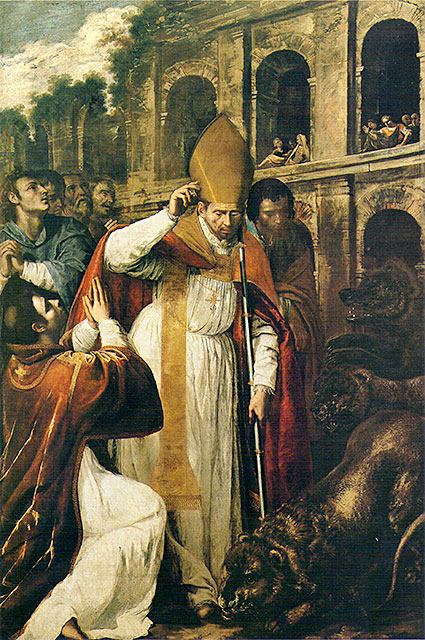
Saint Januarius And His Companions. Martyrs. Feast Day 19 September. Red Vestments.


English: The Martyrdom of Saint Januarius
in the Amphitheatre at Pozzuoli.
Artist: Artemisia Gentileschi (1593–1653).
Date: Circa 1636.
Current location: 
Cathedral in Pozzuoli, Naples, Italy
Source/Photographer: 
(Wikimedia Commons)


Text from The Saint Andrew Daily Missal,
unless stated otherwise.

Saint Januarius (San Gennaro) and his Companions.
   Martyrs.
   Feast Day 19 September.

Double.

Red Vestments.


“At Pozzuoli, in Campania, Italy,” says The Roman Martyrology, “The Feast of The Holy Martyrs, Januarius (San Gennaro), Bishop of Beneventum, Festus (his Deacon), Desiderius (his Lector), Socius, a Deacon of the Church at Misenum, Proculus, a Deacon of Pozzuoli, Eutychius, and Acutius, who, after having been bound with chains, were beheaded, under Emperor Diocletian (305 A.D.).

“The body of Saint Januarius was taken to Naples and honourably buried in the Church where his blood is still preserved in a glass phial. When the phial is placed near the head of the Holy Martyr, the blood liquefies and bubbles as if it had just been shed.”

This Miracle, known as The Miracle of Saint Januarius, still takes place. The blood, contained in two glass phials where it is coagulated into a dark-red mass, increases in volume and weight; on liquefying, it becomes bright-red, while the surface is covered with bubbles, wherefore it is said to boil.

The Miracle takes place three times a year: 

During the Feast of May, lasting nine days, from the First Sunday in the Month; 

In September, during eight days, from 19 September to 
26 September; 

On 16 December.

Mass: Salus autem.
Gospel: Sedénte Jesu.

The Divine Celebration.


Illustration by
FLICKR


TENTERDEN, KENT.

CHURCH OF SAINT ANDREW.


Masses are Celebrated

at the

Church of Saint Andrew,
47, Ashford Road,
Tenterden, Kent TN30 6LL,

at 1200 hrs,

EVERY SUNDAY
and on Feast Days and Holy Days of Obligation.


RAMSGATE, KENT.

SAINT AUGUSTINE'S CHURCH.

Zephyrinus is grateful to Tony V at PRAY TELL UNCHAINED
for providing information on Masses in Ramsgate, Kent.

The Ramsgate Web-Site is 


Mass at Saint Augustine’s, Ramsgate, Kent.


Saint Augustine’s Shrine,
Ramsgate, Kent.

Times of Masses.

RAMSGATE, KENT.

Saint Augustine’s Church,
Saint Augustine’s Road,
Ramsgate,
Kent CT11 9PA.
Telephone: 01843 592 071.

Masses at

1200 hrs on every Sunday

and

0930 hrs on Fridays.


RAMSGATE, KENT.

SAINT ETHELBERT
AND
SAINT GERTRUDE CHURCH.


Saint Ethelbert and Saint Gertrude Church,
Ramsgate, Kent.
Illustration:

Saint Ethelbert and Saint Gertrude Church,
72, Hereson Road,
Ramsgate,
Kent CT11 7DS.

Mass at

0930 hrs every Wednesday.


CHISLEHURST,
KENT.

SAINT MARY’S CHURCH.


Saint Mary’s Church,
Chislehurst, Kent.


Illustration: S. Wood.


Illustration: Artur.
CHISLEHURST, KENT.

Saint Mary’s Church
28 Crown Lane,
Chislehurst,
Kent BR7 5PL.
E-Mail: chislehurst@rcaos.org.uk
Telephone: 020 8467 3215.

Mass at

1100 hrs every Sunday

and

1930 hrs every Friday.


LEIGH-ON-SEA,
ESSEX.

CHURCH OF OUR LADY OF LOURDES
AND SAINT JOSEPH.


Our Lady of Lourdes and Saint Joseph Church,

LEIGH-ON-SEA, ESSEX.

Our Lady of Lourdes and Saint Joseph Church,
161, Leigh Road,
Leigh-on-Sea,
Essex SS9 1J.
Telephone: 01702 478078.
E-Mail: leighonsea@dioceseofbrentwood.org

Mass at

1600 hrs on The First Sunday of every Month.

Followed by
Solemn Vespers
and
Benediction.


“The Mass Of The Foundation Of The Trinitarian Order”.
Artist: Juan Carreño de Miranda.
Illustration: LOUVRE


THE SAINT ANDREW DAILY MISSAL


THE SAINT ANDREW DAILY MISSAL

Available (in U.K.) from

Available (in U.S.A.) from

Available (in Ireland) from


Ember Saturday In September. Violet Vestments.


Text from The Saint Andrew Daily Missal,
unless stated otherwise.

Ember Saturday in September.
In 2026, it is Celebrated on 19 September.

Station at Saint Peter’s.

Violet Vestments.


Iona Abbey,
Scotland.

On the fifteenth day of the seventh month of the year, the Jews used to celebrate, at the conclusion of the harvest, The Feast of Tabernacles, and lived during eight days under tents, or huts made of foliage, in remembrance of the nomadic life of the Israelites in the desert (Second Lesson).

This Feast was preceded, on the tenth of the month, by the very solemn Day of Expiation, called Holy (First Lesson). On this day, the High Priest purified himself in the basin which stood before the Sanctuary *, then, taking the blood of the victims, he entered The Holy of Holies and Prayed near The Mercy-Seat (Epistle). [* The Holy Water Stoups in our Churches recall this basin, known as "The Brazen Sea".]

The Saturday in The September Ember Week, formerly the seventh month of the year, recalls this Feast, both of Penance and Joy.


The Prophets, Micheas, Zacharias, and Daniel, whose writings were read through during the night, or Vigil, preceding the Sunday *, speak in similar terms of the Salvation brought by God to those who atone for their sins and implore His protection amid the dangers that threaten them. [* Formerly, Mass was not said on Saturday morning; but, after a night passed in Prayer and reading the Scriptures, The Holy Sacrifice was offered at dawn. Hence the large number of Collects and Lessons which characterise The Mass of The Saturday in Ember Week.]

The Epistle shows the new alliance which Jesus Christ has established between our repentant Souls and God, by offering to Him, in the real Holy of Holies, which is Heaven, The Blood which He shed upon The Cross to atone for our sins.

In the same way that Jesus delivered the woman whom Satan had bound for eighteen years, and like the gardener mentioned in the Gospel, the Priests heal our Souls, and, by their Prayers and their untiring zeal, ward off from Souls the rigours of Divine Justice, making them produce the sweet fruits of Penance and good works; this Mass is, therefore, eminently suited for an Ordination.

After the Kyrie, The Tonsure is conferred; after The First Lesson are Ordained The Door-Keepers; after The Second Lesson are Ordained The Readers; after The Third Lesson are Ordained The Exorcists; after The Fourth Lesson are Ordained The Acolytes; after The Fifth Lesson are Ordained The Sub-Deacons; after the Epistle are Ordained The Deacons, and, before the last verse of The Tract, are Ordained The Priests.

Mass: Veníte, adorémus.


THE SAINT ANDREW DAILY MISSAL


THE SAINT ANDREW DAILY MISSAL

Available (in U.K.) from

Available (in U.S.A.) from

Available (in Ireland) from

18 September, 2026

Ottobeuren Abbey, Bavaria, Germany. (Part Three).


The façade of Ottobeuren Basilica,
designed by Johann Michael Fischer, has been
hailed as the pinnacle of Bavarian Baroque architecture.
Photo: 21 June 2019.
Source. Own work.
This File is licensed under the
Attribution: Diego Delso.
Author: Diego Delso.
(Wikimedia Commons)


Rococo-Style Nave of Ottobeuren Abbey.
Photo: 21 June 2019.
Source. Own work.
This File is licensed under the
Attribution: Diego Delso.
Author: Diego Delso.
(Wikimedia Commons)


Text is from Wikipedia - the free encyclopædia,
unless stated otherwise.

Rupert ushered in the most flourishing period in the history of Ottobeuren, which lasted until its Secularisation in 1802. 

In the zenith of its glory, Ottobeuren fell victim to the German mediatisation, along with all the other Imperial Abbeys of the Holy Roman Empire. 

On 1 December 1802, Ottobeuren was Secularised and its territory annexed to Bavaria.[5] 


Ottobeuren Abbey, Bavaria, Germany.
Photo: 29 December 2017.
Source: Own work.
This File is made available under the 
(Wikimedia Commons)

At the time, the territory of the Imperial Abbey covered 266 square kilometers and had about 10,000 inhabitants.[6

From 1711 – 1725, Rupert II erected the present Monastery, the architectural grandeur of which has merited for it the name of “the Swabian Escorial”, attesting to the economic significance of the Abbey. 

It was famous for its book illuminations.[7] The Abbey Library features Stucco Ceilings by Johann Baptist Zimmermann and Ceiling Paintings by Elias Zobel.[8]

In 1737 Rupert II also began the building of the present Church, completed by his successor, Anselm Erb, in 1766.

The Church was named a Minor Basilica by Pope Pius XI in 1926.[9]

PART FOUR FOLLOWS.

“I WIll Find You” Theme: “The Last Of The Mohicans”. Sung By: Clannad.


“I WIll Find You”
Theme: “The Last Of The Mohicans”.
Sung By: Clannad.
Available On YouTube

Tie-Wig. Bob-Wig. Bag-Wig. Periwig. Queue. Chiving Lay. Solitaire. Macaroni. Sunday Buckle. (Part One).


A Gentleman’s Wig.
Text and Illustrations: GERI WALTON


Of all the fashions of the 1700s, perhaps the Wig most resembles “character of that period, embodying the artificiality, the mixture of dignity and affectation, and the pompous conventionality.”[1]

The Wig did not suddenly appear overnight, but rather grew into popularity, until, at one point, Wigs were so fashionable, that, if you wore your own hair, you tried to make it appear as if it were a Wig.

During Louis XIV’s reign, big flowing Wigs were popular, but, towards the end of Louis XV’s reign in 1774, smaller Wigs became fashionable, until even they disappeared.


Many of the Wigs that gentlemen wore were created from real human hair, and it was common for fashionable Beaus to keep their Wig looking perfect, by carrying in their side pocket “a Tortoiseshell Wig-Comb … for constant use.”[2]

It also became common for people to sell their hair to earn extra money. In fact, at one point, real hair became worth so much, people who had long flowing locks were sometimes threatened or attacked for their hair.

In the 1700s, all sorts of Wigs came in and out of fashion. Among the fashionable Wigs of the times were three:

The Tie-Wig.
Known as The Ramillies Wig (sometimes spelled Ramilies);

The Bob-Wig;

The Bag-Wig.


Tie-Wigs became popular during Queen Anne’s reign, but they were not a Wig that was at first considered full dress.

They acquired their name (“Tie-Wig”) because the Wig’s curls were tied up, or the Wig was tied to the head. Lord Bolingbroke, an English politician, government official, and leader of the Tories, was among the first to wear and popularise the Wig in England. He created a great scandal, when after being hastily summoned to see the Queen, he appeared in his Tie-Wig.

“This Wig had a plaited tail, tied at the top with a large ribbon bow, and at the bottom with a smaller one. The Queen remarked that she supposed, next time, Lord Bolingbroke would come in his night-cap.”[3]

PART TWO FOLLOWS.

Saint Joseph Of Cupertino. Confessor. Feast Day 18 September. White Vestments.


Saint Joseph of Cupertino.
Date: 1750.
Credit Line: Gift of Everett Fahy.
Source/Photographer: 
This File is made available under the 
(Wikimedia Commons)


Text from “The Liturgical Year”.
   By: Abbot Guéranger, O.S.B.
   Volume 14.
   Time After Pentecost.
   Book V.

While, in France, the rising spirit of Jansenism was driving God from the hearts of the people, a humble son of Saint Francis, in Southern Italy, was showing how easily love may span the distance between Earth and Heaven.

“And I, if I be lifted up from the Earth, will draw all things to Myself,” [Saint John xii. 32.] said Our Lord; and time has proved it to be the most universal of His prophecies.

On the Feast of The Holy Cross, we witnessed its truth, even in the domain of social and political claims. We shall experience it in our very bodies on the great day, when we shall be taken up in the clouds to meet Christ, into the air. [Saint Paul 1 Thess. iv. 16.]


Saint Joseph of Cupertino.
Available on YouTube

But Joseph of Cupertino had experience of it without waiting for the Resurrection: Innumerable witnesses have borne testimony to his life of continual ecstasies, wherein he was frequently seen raised high in the air. And these facts took place in what men are pleased to call the noon-day of history.

Joseph died at the place and time he had foretold, namely, Osimo in Picenum, in the sixty-first year of his age.

He was famous for Miracles after his death; and was enrolled among the Blessed by Pope Benedict XIV and among the Saints by Pope Clement XIII.

Pope Clement XIV, who was of the same Order, extended his Office and Mass to the Universal Church.

Saint Joseph Of Cupertino. Confessor. Feast Day, Today, 18 September. White Vestments.


Text from The Saint Andrew Daily Missal,
unless stated otherwise.

Saint Joseph of Cupertino.
   Confessor.
   Feast Day 18 September.

Double.

White Vestments.


English: Saint Joseph of Cupertino is lifted in flight
at the sight of The Basilica of Loreto
Italiano: S. Giuseppe da Copertino si eleva in volo
alla vista della Basilica di Loreto.
Artist: Ludovico Mazzanti (1686-1775).
Date: 18th-Century.
Current location: 
Church of Saint Joseph of Cupertino, Osimo, Italy.
Source/Photographer:
(Wikimedia Commons)

A humble son of Saint Francis, whose Stigmata we Commemorated yesterday, Saint Joseph also glorifies The Cross of Jesus, which The Liturgy exalted, recently, on
14 September (The Exaltation of The Holy Cross).

Like the Seraphic Patriarch, he strove to remain attached to The Cross by absolute Poverty, heroic Obedience, and Virginal Purity.

Such was his spirit of sacrifice and Prayer, that he accepted with Holy Patience and great serenity to be misunderstood and calumniated (Offertory). Wherefore, God, Who exalts the humble, caused him to pass from the rank of Brother to that of Clerk and to be made a Priest.

He wrought such Miracles that he implored Heaven to withdraw from him the remarkable powers with which he was endowed. He died a Holy Death at Osimo, Italy, in 1663.

Mass: Diléctio Dei.
Gospel: Loquebátur Jesus.


The following Text is from Wikipedia - the free encyclopædia.

Joseph of Cupertino, O.F.M. Conv. (Italian: Giuseppe da Copertino) (17 June 1603 – 18 September 1663) was an Italian Conventual Franciscan Friar who is honoured as a Christian Mystic and Saint. He was said to be prone to miraculous levitation and intense ecstatic visions.


English: The Nave,
Altarpiece: The Miracle of Saint Joseph of Cupertino.
Français: La partie droite de la nef de la
Tableau du retable: Le miracle de
Italiano: Il lato destro della navata della
Pala d'altare: Il miracolo di Giuseppe da Copertino da Giuseppe Nogari.
Giuseppe Nogari (1699–1766).
Photo: 30 May 2016.
Source: Own work.
(Wikimedia Commons)
Related Posts Plugin for WordPress, Blogger...