
444.png)
English:
Cathedral and Metropolitan Church of
Saint Stephen and All Saints, Vienna, Austria.
Deutsch:
Dom-und-Metropolitankirche zu
Sankt Stephan und allen Heiligen,
Wien, Österreich.
Photo: 8 October 2017.
Source: Own work.
This File is licensed under the
Share Alike 4.0 International licence.
Author: C.Stadler/Bwag
(Wikimedia Commons)

Text from Wikipedia - the free encyclopædia, unless stated otherwise.
The official Viennese “ell” length standards for verifying the measure of different types of sold cloth are embedded in the Cathedral wall, to the Left of the main entrance.
The Linen “ell”, also called Viennese Yard, (eighty-nine centimetres (thirty-five inches)), and the Drapery “ell” (seventy-seven centimetres (thirty inches)) length standards, consist of two iron bars.

The Viennese “ells” are mentioned for the first time in 1685 by the Canon Testarello della Massa in his book “Beschreibung der ansehnlichen und berühmten St. Stephans-Domkirchen”.[10]
A Memorial Tablet gives a detailed account of Wolfgang Amadeus Mozart’s relationship with the Cathedral, including the fact that he had been appointed an adjunct Music Director here shortly before his death.
This was his Parish Church when he lived at the “Figaro House” and he was married here, two of his children were Baptised here, and his Funeral was held in the Chapel of The Cross in the Cathedral.[11]

Adjacent to the Catacomb entrance is the Capistran Chancel, the Pulpit from which Saint John Capistrano and Hungarian General John Hunyadi preached a Crusade in 1456 to repel Muslim invasions of Christian Europe.
The 18th-Century Baroque statue shows the Franciscan Friar under an extravagant sunburst, trampling on a beaten Turk. This was the original Cathedral’s main Pulpit until it was replaced by Niclaes Gerhaert van Leyden’s Pulpit in 1515.
A figure of Christ is known affectionately to the Viennese as “Christ with a toothache” (“Zahnwehherrgott”).
At the South-West corner are various Memorials from when the area outside the Cathedral was a Cemetery, as well as a recently-restored 15th-Century Sun-Dial on a Flying Buttress.
Altars.
The main part of the Church contains eighteen Altars, with more Altars in the various Chapels. The High Altar and the Wiener Neustadt Altar are the most famous.
The first focal point of any visitor is the High Altar, built over seven years from 1641 to 1647 as part of the first refurbishment of the Cathedral in the Baroque Style.
On the Predella is his famous A.E.I.O.U. device. Frederick ordered it for the Cistercian Viktring Abbey (near Klagenfurt) where it remained until the abbey was closed in 1786 as part of Emperor Joseph II's anti-clerical reforms.
The Linen “ell”, also called Viennese Yard, (eighty-nine centimetres (thirty-five inches)), and the Drapery “ell” (seventy-seven centimetres (thirty inches)) length standards, consist of two iron bars.

The Viennese “ells” are mentioned for the first time in 1685 by the Canon Testarello della Massa in his book “Beschreibung der ansehnlichen und berühmten St. Stephans-Domkirchen”.[10]
A Memorial Tablet gives a detailed account of Wolfgang Amadeus Mozart’s relationship with the Cathedral, including the fact that he had been appointed an adjunct Music Director here shortly before his death.
This was his Parish Church when he lived at the “Figaro House” and he was married here, two of his children were Baptised here, and his Funeral was held in the Chapel of The Cross in the Cathedral.[11]

English: Saint Stephen’s Cathedral, Vienna.
German: Der Stephansdom, Wien.
Artist: Rudolf von Alt (1812–1905).
Date: 1832.
Collection: Belvedere.
Source/Photographer:
The Yorck Project (2002)
10.000 Meisterwerke der Malerei (DVD-ROM),
distributed by DIRECTMEDIA Publishing GmbH.
(Wikimedia Commons)
Adjacent to the Catacomb entrance is the Capistran Chancel, the Pulpit from which Saint John Capistrano and Hungarian General John Hunyadi preached a Crusade in 1456 to repel Muslim invasions of Christian Europe.
The 18th-Century Baroque statue shows the Franciscan Friar under an extravagant sunburst, trampling on a beaten Turk. This was the original Cathedral’s main Pulpit until it was replaced by Niclaes Gerhaert van Leyden’s Pulpit in 1515.
A figure of Christ is known affectionately to the Viennese as “Christ with a toothache” (“Zahnwehherrgott”).
At the South-West corner are various Memorials from when the area outside the Cathedral was a Cemetery, as well as a recently-restored 15th-Century Sun-Dial on a Flying Buttress.
Altars.
The main part of the Church contains eighteen Altars, with more Altars in the various Chapels. The High Altar and the Wiener Neustadt Altar are the most famous.
The first focal point of any visitor is the High Altar, built over seven years from 1641 to 1647 as part of the first refurbishment of the Cathedral in the Baroque Style.
The Altar was built by Tobias Pock at the direction of Vienna’s Bishop, Philipp Friedrich Graf Breuner, with Marble from Poland, Styria and Tyrol.
The High Altar represents the stoning of the Church’s Patron, Saint Stephen. It is framed by figures of Patron Saints from the surrounding areas — Saints Leopold, Florian, Sebastian and Rochus — and surmounted with a statue of Saint Mary which draws the beholder’s eye to a glimpse of Heaven, where Christ waits for Stephen (the first Martyr) to ascend from below.
The Wiener Neustädter Altar at the head of the North Nave was ordered in 1447 by Emperor Frederick III, whose tomb is located in the opposite direction.
The High Altar represents the stoning of the Church’s Patron, Saint Stephen. It is framed by figures of Patron Saints from the surrounding areas — Saints Leopold, Florian, Sebastian and Rochus — and surmounted with a statue of Saint Mary which draws the beholder’s eye to a glimpse of Heaven, where Christ waits for Stephen (the first Martyr) to ascend from below.
The Wiener Neustädter Altar at the head of the North Nave was ordered in 1447 by Emperor Frederick III, whose tomb is located in the opposite direction.
On the Predella is his famous A.E.I.O.U. device. Frederick ordered it for the Cistercian Viktring Abbey (near Klagenfurt) where it remained until the abbey was closed in 1786 as part of Emperor Joseph II's anti-clerical reforms.
It was then sent to the Cistercian monastery of St. Bernard of Clairvaux (founded by Emperor Frederick III) in the city of Wiener Neustadt, and finally sold in 1885 to St. Stephen's Cathedral when the Wiener Neustadt monastery was closed after merging with Heiligenkreuz Abbey.


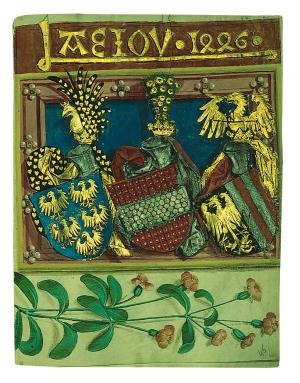
English:
A.E.I.O.U. Illumination from records of King Frederick.
Deutsch:
A.E.I.O.U. Buchmalerei in der Handregistratur König Friedrichs IV. (des späteren Kaisers Friedrich III.).
Date: 1446.
Source: http://www.aeiou.at/aeiou.
Author: Unknown.
(Wikimedia Commons)
“A.E.I.O.U.” (sometimes A.E.I.O.V.) was a symbolic device coined by Emperor Frederick III (1415 – 1493) and historically used as a motto by the Habsburgs.
One note in his notebook (discovered in 1666), though not in the same hand, explains it in German and Latin as: “All the World is subject to Austria” (“Alles Erdreich ist Oesterreich untertan” or “Austriæ est imperare orbi universo”).[1]
Frederick habitually signed buildings such as Santa Maria dell’Anima in Rome,[2] Burg Wiener Neustadt, or Graz Cathedral, as well as his tableware and other objects
PART EIGHT FOLLOWS.

No comments:
Post a Comment