

An old pack of British Woodbine cigarettes,
photographed at the Musée Somme 1916, Albert, France.
This design is often regarded as a magnificent example of
Late-Victorian typographical design by aficionados.
Photo: 4 September 2013.
Source: Own work.
This File is made available under the
Author: Alf van Beem
(Wikimedia Commons)

“Who Was Woodbine Willie ?”
Available on YouTube
In The Great War (World War I), the British Army Chaplain Geoffrey Studdert Kennedy MC was affectionately nicknamed “Woodbine Willie” by troops on the Western Front, to whom he handed out cigarettes, along with Bibles and spiritual comfort.

“Woodbine Willie”.
On the outbreak of World War I, Studdert Kennedy volunteered as a Chaplain to the Army on The Western Front, where he gained the nickname “Woodbine Willie”.[5]
In 1917, he was awarded the Military Cross at Messines Ridge after running into No-Man's Land to help the wounded
His nickname “the Cigarette Saint of No-Man’s Land” and the reverence shown at his funeral — where mourners tossed packets of Woodbines onto his cortege — speak volumes
about the spiritual impact he had.
He’s commemorated in Worcester Cathedral
with a plaque that calls him
“A Poet: A Prophet: A Passionate seeker after Truth”.
Image of Geoffrey Anketell Studdert Kennedy
(G. A. Studdert Kennedy), The Bookman Special
Christmas Number (December 1918).
Photo: 1918.
Source: GOOGLE BOOKS
Author: Hodder & Stoughton.
(Wikimedia Commons)
In the 1890s, Woodbine cigarettes were offered at a margin of 19%, with a possible maximum discount of 10%. In the United Kingdom, the brand was sold at very low advertising costs and total expenditure on sales promotion for all cigarettes and tobacco brands in 1925 was only 2d per pound of tobacco sold.[7]
The intricate 19th-Century packet design remained in use until the Mid-1960s. Although Wills changed the packaging, Woodbine sales continued to drop.
In common parlance, the unfiltered high-tar Woodbine was one of the brands collectively known as “gaspers” until about 1950, because new smokers found their harsh smoke difficult to inhale.
A filtered version was launched in the United Kingdom in 1948, but was discontinued in 1988. Woodbines came in four different packs: Five cigarettes, ten cigarettes, twenty cigarettes and fifty cigarettes.
The intricate 19th-Century packet design remained in use until the Mid-1960s. Although Wills changed the packaging, Woodbine sales continued to drop.
In common parlance, the unfiltered high-tar Woodbine was one of the brands collectively known as “gaspers” until about 1950, because new smokers found their harsh smoke difficult to inhale.
A filtered version was launched in the United Kingdom in 1948, but was discontinued in 1988. Woodbines came in four different packs: Five cigarettes, ten cigarettes, twenty cigarettes and fifty cigarettes.
Gordon Rollings played a man who engaged in numerous activities (including waiting for the bus or setting up a beach chair) and would always end in misery. He then would grab a packet of Woodbines from his pocket and light one, followed by a happy tune and a man reading the line “Light up life with a Woodbine ! It’s Britain’s best-selling cigarette !”.[9][10][11] at the end.
The ads were never played on TV however, as all television commercials for cigarettes were banned on 1 August 1965.[12][13] A jingle was also made to promote Woodbine in the Late-1950s or Early-1960s.[14]


The ads were never played on TV however, as all television commercials for cigarettes were banned on 1 August 1965.[12][13] A jingle was also made to promote Woodbine in the Late-1950s or Early-1960s.[14]

A Woodbine vending machine, in Staffordshire
County Museum, Shugborough Hall, England.
Photo: 22 November 2012.
Source: Own work.
This File is licensed under the
Share Alike 3.0 Unported licence.
Author: Andy Mabbett
(Wikimedia Commons)
Woodbines were the oft-mentioned cigarette of choice for Tristan Farnon (Brian Sinclair), the younger of the two veterinary brothers in James Herriot’s semi-autobiographical All Creatures Great and Small series.
Princess Alice of Battenberg, mother of Prince Philip and mother-in-law of Queen Elizabeth II, who Founded a Nursing Order of Greek Orthodox Nuns in 1949, smoked Woodbines.
Prince Philip’s biographer Gyles Brandreth wrote of Princess Alice during her time at Buckingham Palace: “They say you could always tell when she was coming along the corridor, because of the whiff of Woodbines in the air. The idea of the Duke of Edinburgh’s mum, dressed as a Nun, smoking her Woodbine . . . it’s wonderful !” [15]
Legendary North East England comedian Bobby Thompson always smoked Woodbines on stage and also mentioned them frequently in his act.[16]
John Lennon was originally fond of smoking Woodbines while he was a student and into the early 1960s, before switching to smoking the French-made Gauloises Bleues. After switching, Lennon mocked the use of Woodbines during a documentary film that chronicled the Beatles’ first visit to America.[17]
Van Morrison, a Northern Irish singer-songwriter, mentions buying Woodbines in the song “Cleaning Windows” (“Bought five Woodbines at the shop on the corner // And went straight back to work”[18]) as a pictorial description of the main character of the song, who is a simple working man.
Flogging Molly, an Irish-American Celtic punk band, mentions smoking Woodbines in their song “Factory Girls”. The song is about an old woman, and has the line, “Choking on Woodbine // cigarettes just kill time.”[19]
In the Adrian Mole series of novels and related TV series, old-aged pensioner character Bert Baxter had often smoked Woodbines as depicted.
In the 1992 film “Howards End”, Leonard Bast (Samuel West) references the brand while telling the Schlegel sisters (Emma Thompson and Helena Bonham Carter) about his all-night walk through the forest. He describes how tired and hungry he was by dawn: “I didn't know when you’re walking, you want breakfast, lunch, and tea, during the night as well. And all I had was a packet of Woodbines.” His working-class position and accent indicate the brand may be a cheap favourite.

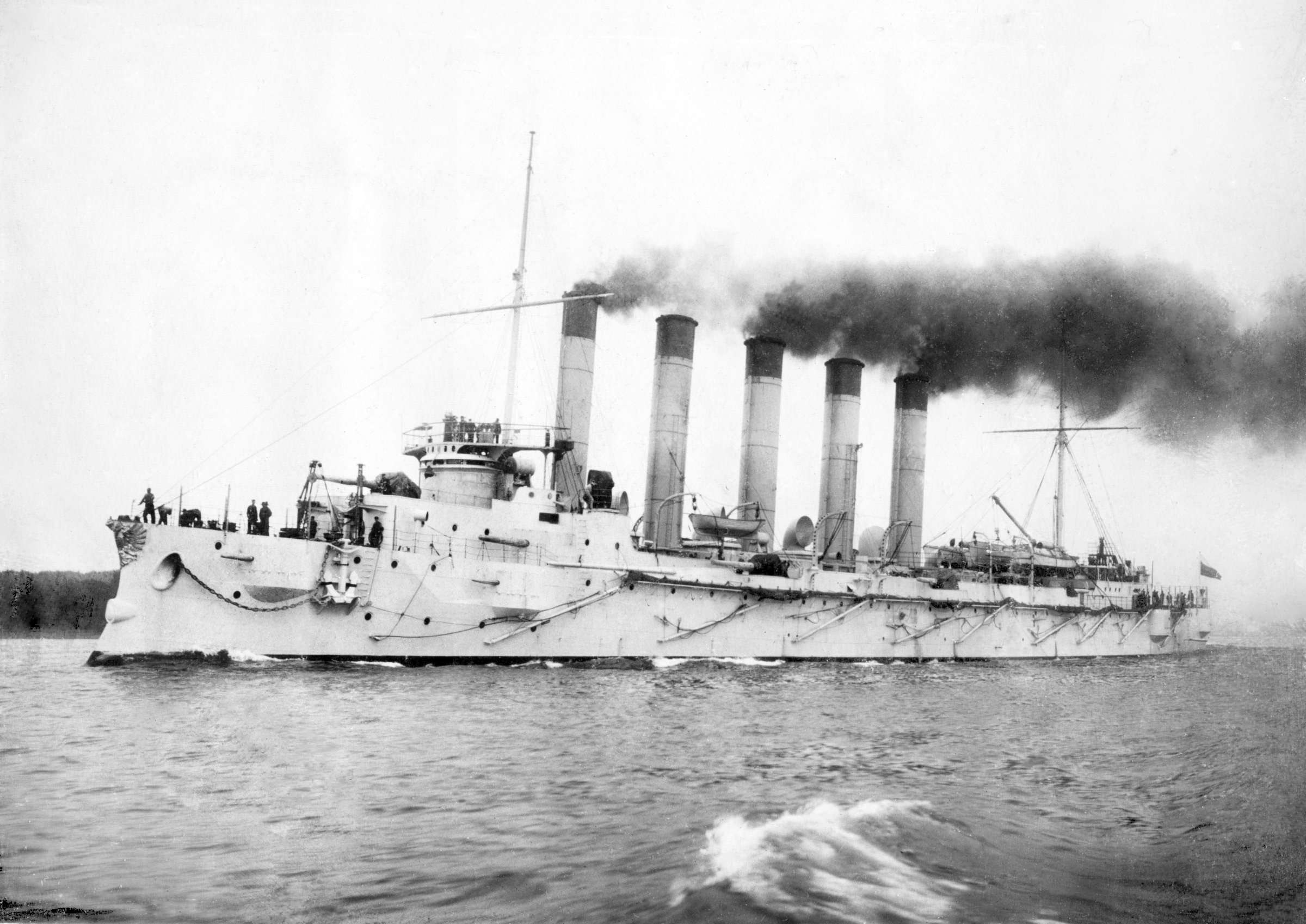
English: The Imperial Russian Cruiser “Askold”,
during Sea Trials, Kiel, Germany.
(See the reference to “Packet of Woodbines), below).
Русский: Бронепалубный крейсер Аскольд
на испытаниях в Киле, 1901 год.
Date: 1901.
Source:
Author: Unknown.
(Wikimedia Commons)
Woodbines are mentioned in Sheffield United’s club anthem “The Greasy Chip Butty Song”.[20] Gordon Landsborough’s Glasshouse Gang war series include several characters smoking Woodbines (often until so short as to burn their lips), Landsborough using the popularity of these cigarettes among British soldiers, especially of lower-class background.
Woodbines are the brand smoked by the protagonist in Brian Moore’s The Emperor of Ice-Cream.
Some Late-19th-Century to Early-20th-Century steamships sported as many as five long and thin smokestacks (sometimes including a dummy one), notably the Russian cruiser Askold, earning them the nickname “Packet of Woodbines” among sailors.

No comments:
Post a Comment