

“The Greeting”.
Artist: Walter Langley (1852–1922).
Date: 1904.
(Wikimedia Commons)

A Story Of The Cornish Language.
Available on YouTube
Text is from Wikipedia - the free encyclopædia.
Walter Langley (8 June 1852 – 21 March 1922) was an English Painter and Founder of the Newlyn School of “Plein Air” Artists.
In 1884, Langley was elected a Member of the RBSA and continued to exhibit widely throughout the U.K, and abroad. Later in his career, his reputation grew.
One of Langley’s paintings was singled out as “a beautiful and true work of art” by Leo Tolstoy, in his book “What is Art ?”, while, in 1895, Langley was invited by The Uffizi to contribute a self-portrait to hang alongside those of Raphael, Rubens and Rembrandt in their collection of portraits of great artists.

A December 2025 image of the Cornish landscape,
showing its rugged beauty and, in the distance,
the iconic, haunting, sinister, Dartmoor !!!
One wonders whether the intrepid Dr. Watson and
Sherlock Holmes are still wandering around Dartmoor, ignorant of the danger following them in the shape of
“The Hound of The Baskervilles”, which, according to Sir Arthur Ignatius Conan Doyle, inhabited Dartmoor !!!
Illustration:
Arthur Matelot
(Our Cornwall Mediæval, Liturgical,
and Historical Landscape Correspondent).
Cornwall (Cornish: Kernow), is a Ceremonial County and Unitary Authority area of England within the United Kingdom.
Cornwall is a peninsula, bordered to the North and West by the Celtic Sea, to the South by the English Channel, and to the East by the County of Devon, over the River Tamar.
Cornwall has a population of 536,000 and covers an area of 3,563 km2 (1,376 sq mi). The Administrative Centre, and only City in Cornwall, is Truro, although the Town of Saint Austell has the largest population.

Still retaining their traditional character, the villages of Kingsand and Cawsand, in Cornwall, situated on the Rame Peninsula, are popular with tourists. They are untouched by time with a fascinating smuggling and fishing past.
Illustration: CORNISH TRADITIONAL COTTAGES
The Sound Of The Cornish Language.
Available on YouTube

Cornish Pilchards.
Delicious.
Illustration: AMAZON

Cornish Pilchard
(Sardina Pilchardus).
Photo: April 2011.
Source: Own work.
Attribution: © Citron / CC-BY-SA-3.0
Author: Citron/ CC-BY-SA-3.0.
(Wikimedia Commons)
Cornish Rugby.
Available on YouTube

"Between The Tides".
Artist: Walter Langley (1852–1922).
Date: 1901.
(Wikimedia Commons)

" The Waif ".
Artist: Walter Langley (1852–1922).
Date: 1889.
(Wikimedia Commons)
The area is noted for its wild moorland landscapes, its long and varied coastline, its attractive villages, its many place-names derived from the Cornish language, and its very mild climate. Extensive stretches of Cornwall’s coastline, and Bodmin Moor, are protected as an Area of Outstanding Natural Beauty.

English: Saint Piran's Flag.
Flag of Cornwall.
Kernowek: Baner Peran, Baner Kernow.
Ænglisc: Cornwealla fana.
Brezhoneg: Banniel Sant Piran.
Cymraeg: Baner Cernyw.
Deutsch: Flagge von Cornwall.
Français: Drapeau de saint Piran.
Drapeau des Cornouailles.
Gaeilge: Bratach na Chorn.
Latina: Vexillum Cornubiæ.
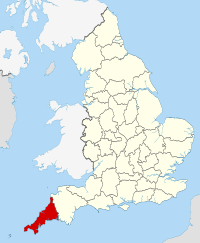
The County of Cornwall.
Shown within England.
Date: 16 November 2010.
Source: Ordnance Survey OpenData: County boundaries
and GB coastline. National Geospatial-Intelligence Agency Irish, French, and Isle of Man coastlines,
Lough Neagh and Irish border.
Author: Nilfanion
(Wikimedia Commons)

Cornish Pasty.
Illustration: CORNISH PASTY ASSOCIATION

A fascinating Zephyrinus Christmas armchair journey to sea-straddled Cornwall, or “Kernow.”
ReplyDeleteThough as Zephyrinus’ notes tell, Truro is not the largest city, yet it has a soaring majestic cathedral as reviewed previously by Zephyrinus—and we must note, a magnificent massive 1887 “Father” Henry Willis pipe organ (with subsequent additions and technical upgrades by the firm of Noel Mander), complete with glorious tubas and full reed complements, perched high up in one of the fan-vaulted arches near the crossing (so this scribe understands: Zephyrinus will have to travel to Cornwall with the capable aides Jeeves and Perkins in the Charabanc to verify the location matter; unless as Grand Admiral, he were to voyage out the Medway to rocky Cornwall—maybe in the summer when the angry Atlantic is somewhat becalmed), but the instrument has a marvelous “speaking” situation and sound. —note by Dante P
A welcome Comment from our Liturgical Organ and Travel Correspondent, Dante P, for which we are most grateful.
DeleteIt is always of great interest to be updated on the state of the Organs in Europe's magnificent Cathedrals. It is due to our Correspondent, Dante P, that we continue to be appraised of all developments.
The notion of Zephyrinus (Grand Admiral Extraordinaire) sailing majestically down to Cornwall next year, no doubt with Perkins and Jeeves eager to “assist” in provisioning one's Yacht, is intriguing, to say the least. To sail approximately 500 miles to Penzance, with Perkins and Jeeves on board, is, probably, a bad move.
The worst case scenario, of course, would be to finally make it to, say, The Tamar Valley and/or Dartmoor, only to find that The Hound of The Baskervilles is still roaming free.
The “dodgy” sitution would be compounded, if rumours persist in Watson and Holmes still being up in The Scottish Highlands and sightings occurring of Moriarty and Colonel Sebastian Moran being seen in Truro High Street.
Watch this space.
Egads! The “Hound of the Baskervilles!” This reader had no idea the Baskervilles and associated Hound, were situated en route to Cornwall in Dartmoor, Devon.
DeleteTrout-fishing in the Scottish Highlands with accommodations at Zephyrinus’ fabled castle is the, ah, less eerie, less spine-tingling, um, better option! -Note by Dante P
Quite right, Dante P. The Scottish Highlands offers a much better prospect of finishing one's Christmas Holiday in one piece !!!
DeleteThe Highlands continue to offer most pleasant refreshment, both in cultural “free-time” and the outstanding Distilleries, where one does, occasionally, tarry for a few minutes.
Stories are still emanating from The South-West of England (Devon/Cornwall) that the Constabulary suspect that Professor Moriarty and Colonel Sebastian Moran are active in the area.
Does Zephyrinus continue to contemplate a sojourn down into Devon/Cornwall with that level of dodginess extant ? With the possibility that Holmes and Watson might not be around to assist, and with Perkins and Jeeves definitely around “to assist”, one thinks it prudent to remain in The Highland for a “wee bit longer”.