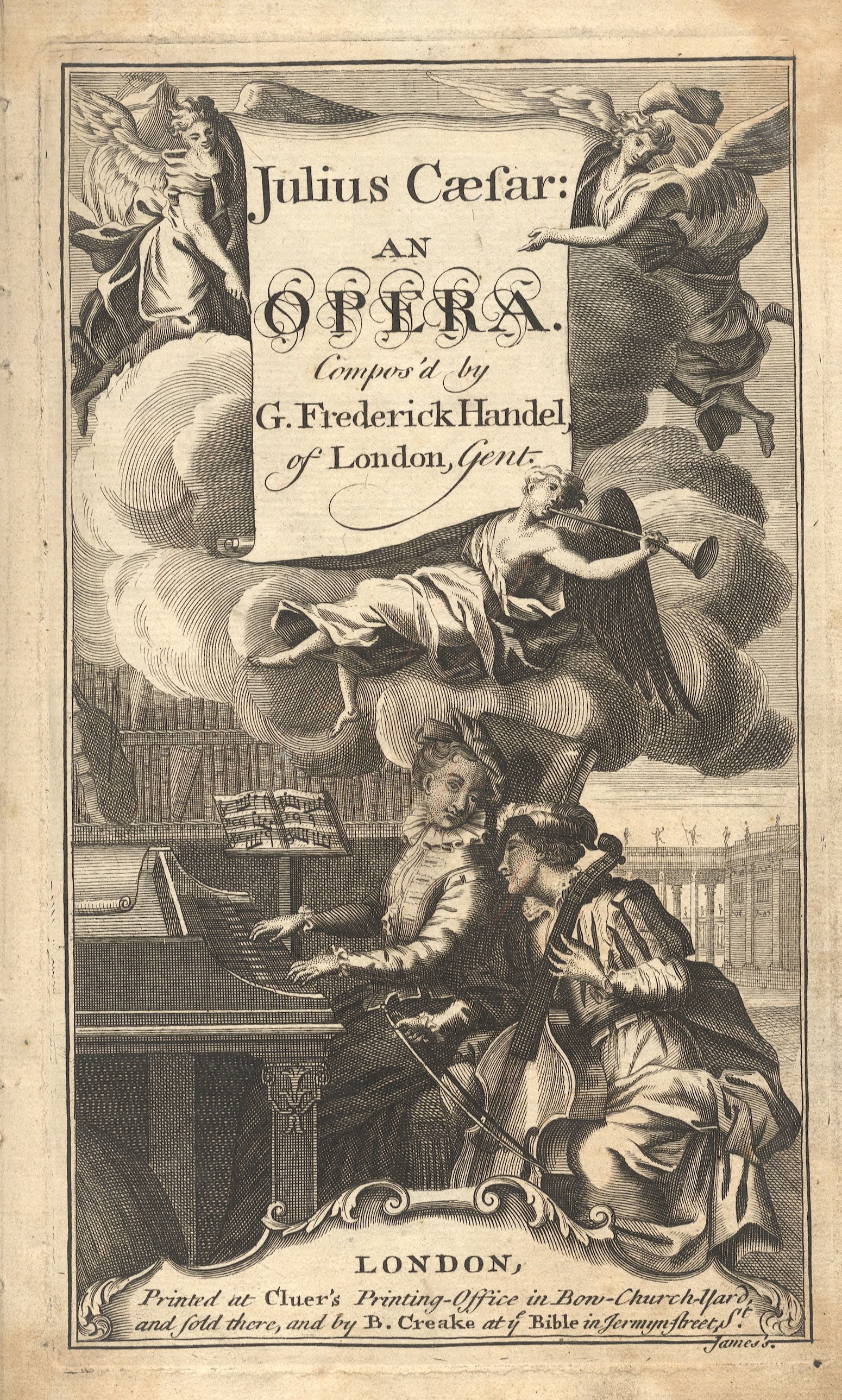
George Frideric Handel’s Opera “Giulio Cesare in Egitto” (“Julius Caesar in Egypt”).
First Edition manuscript published by Cluer in 1724.
Source: Scanned image, Bonhams.
Author: Cluer.
(Wikimedia Commons)

“Se pietà di me non senti”.
Sung By: Sabine Devieilhe.
From Handel’s “Giulio Cesare in Egitto”.
Available on YouTube
Text is from Wikipedia - the free encyclopædia,
unless stated otherwise.
“Giulio Cesare in Egitto” (“Julius Caesar in Egypt”),
“Giulio Cesare in Egitto” (“Julius Caesar in Egypt”),
commonly known as “Giulio Cesare”, is a dramma per musica (opera seria) in three acts composed by George Frideric Handel for the Royal Academy of Music in 1724.
The libretto was written by Nicola Francesco Haym, who used an earlier libretto by Giacomo Francesco Bussani, which had been set to music by Antonio Sartorio (1676).
The opera was a success at its first performances, was frequently revived by Handel in his subsequent opera seasons, and is now one of the most often performed Baroque operas.
The opera’s plot is loosely based on historical events during the Roman Civil War of 49 B.C. — 45 B.C.
The opera’s plot is loosely based on historical events during the Roman Civil War of 49 B.C. — 45 B.C.
“Ombra mai fu”.
From Handel’s “Xerxes”.
Sung by: Andreas Scholl.
Available on YouTube
Text is from Wikipedia - the free encyclopædia,
unless stated otherwise.
“Ombra mai fu” (“Never was a shade”), also known as “Largo from Xerxes” or “Handel’s Largo”, is the opening aria from the opera Serse (Xerxes) (1738) by George Frideric Handel.
The opera was a commercial failure, lasting only five performances in London after its premiere.
In the 19th-Century, however, the aria was re-discovered and became one of Handel’s best-known pieces.
Handel adapted the aria from the setting by Giovanni Bononcini, who, in turn, adapted it from the setting by Francesco Cavalli.
All three composers had produced settings of the same opera libretto by Nicolò Minato.