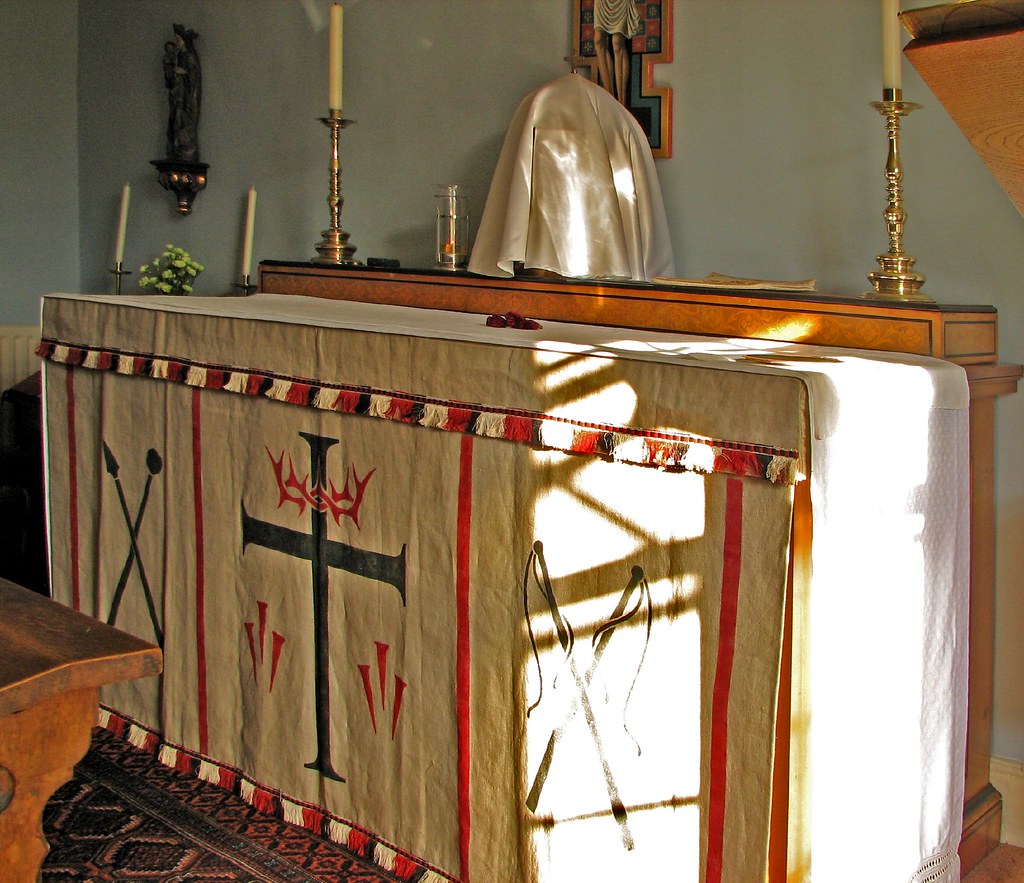
Lenten Array at Saint Birinus, Dorchester.
The Lady Altar in the Tame Chapel, at Fairford, in Gloucestershire, has a Reredos of 1913, by Geoffrey Webb, covered during Lent with Lenten Array.
The Reredos Veil is decorated with a Central Rood Group,
in Grisaille, with Ox-Blood Stencilling around it.
The Tabernacle containing the image of Our Lady, that forms an Upper Level of the Reredos, is enclosed with doors and the backs of the doors are also Stencilled.
Sadly, these seem to be the extent of the surviving Lenten Array; the Blue Frontal (Editor: Antependium) remains in place during Lent, as does the very Festal Dorsal with its Armorial embroidery.
Consequently The Lenten Veiling rather loses its impact.
The following Text is taken from
The Author is Fr. Lawrence Lew, O.P.
As Passiontide arrives, some Sacristans will be retrieving those Violet drapes and ironing them in preparation for the Traditional Roman custom of Veiling Sacred Images, etc, in the fortnight before The Sacred Triduum.
However, in The Sarum Use, the Sacred Images and the
Altar were already Veiled on Ash Wednesday, and, rather
than Violet Cloth (which would have been an expensive dye
to acquire), Bleached Linen, with simple Lenten and Passion designs, are used: The idea was for a general negation
of colour during Lent.
Lenten Array at Saint Birinus, Dorchester.
The following Text is taken from
“In [The Sarum] Tradition “according to the rules that in all the Churches of England be observed, all images [are] to be hid from Ash Wednesday to Easter Day.”
“This is called The Lenten Array and it includes a Curtain, which hides the Reredos, a Frontal [Editor: Antependium], which covers the Altar, and Veils, which cover other Statues and Pictures in the Church.
“The colour was Lenten White, which was natural linen material, and was sometimes referred to as Ash Colour.
“According to “An Introduction to English Liturgical Colours”: “The explanation of this use of White, which is closely akin to Ashen, is “in this time of Lent, which is a time of mourning, all things that make to the adornment of the Church are either laid aside or else covered, to put us in remembrance that we ought now to lament and mourn for our Souls, dead in sin, and continually to Watch, Fast, Pray, give Alms . . .”, wherefore “the Clothes that are hanged up this time of Lent in the Church have painted on them nothing else but the Pains, Torments, Passion, Blood-Shedding, and Death, of Christ, that now we should only have our minds fixed on The Passion of Christ, by Whom only we were redeemed.”
“This practice made a startling transformation of the Church, for the whole of the Lenten Season, so that Easter, literally, burst forth like The Lord from the tomb, when the Church was returned to normal state.”
“Care must be taken that too many devices, or symbols,
are not introduced on to the Hangings and Veils, or the austerity of the Lenten Symbolism will be lost, and it
will give a “Festive”, rather than a restraining, atmosphere
to the Interior of the Church.”