Photo: 31 July 2013.
Source: Own work.
This File is licensed under the
Share Alike 3.0 Germany Licence.
Attribution:
© Thomas Wolf, www.foto-tw.de
Author: Thomas Wolf, www.foto-tw.de
(Wikipedia)


The Throne Hall, Neuschwanstein Castle.
Photograph by Joseph Albert 1886.
Postcard published 1890 - 1900.
Detroit Publishing Co. Print No. 17479.
Date: 1886.
Source:
Photochrom from Photoglob AG Zürich (PZ, 17479); Views of Germany in the Photochrom Print Collection. This image is available from the United States Library of Congress's Prints and Photographs division under the digital ID ppmsca.00180.
Author: Josef Albert (1825–1886).
(Wikimedia Commons)

Text is from Wikipedia - the free encyclopædia,
unless stated otherwise.
Neuschwanstein embodies both the contemporaneous architectural fashion known as “Castle Romanticism” (German: Burgenromantik) and King Ludwig II’s enthusiasm for the Operas of Richard Wagner.
In the 19th-Century, many Castles were constructed or reconstructed, often with significant changes, to make them more picturesque.
Palace-building projects similar to Neuschwanstein had been undertaken earlier in several of the German States and included Hohenschwangau Castle, Lichtenstein Castle, Hohenzollern Castle, and numerous buildings on the Rhine, such as Stolzenfels Castle.[10] Marienburg Castle, begun in 1858 for the King of Hanover, was completed in 1867.

.png444.png)
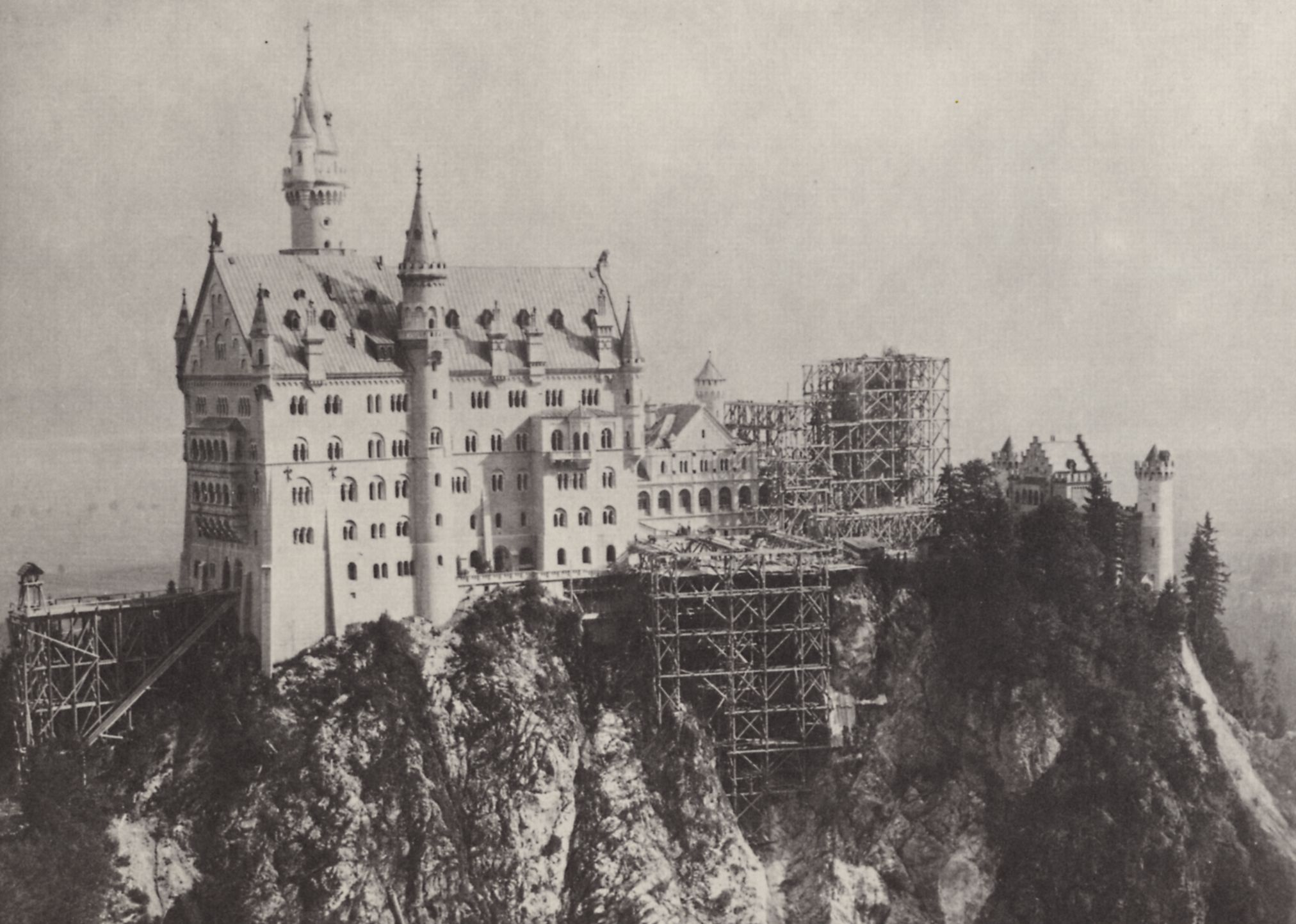
Neuschwanstein Castle: The Bower is still missing, Rectangular Tower under construction.
Schloss Neuschwanstein während der Bauarbeiten.
Date: 1882 — 1885.
Source: http://images.zeno.org/
(Zenodot Verlagsgesellschaft mbH).
Author: Johannes Bernhard.
(Wikimedia Commons)
Ludwig believed both buildings represented a Romanticist interpretation of the Middle Ages, as well as the musical mythology of his friend Wagner, whose Operas “Tannhäuser” and “Lohengrin” had made a lasting impression on him.[13]
In February 1868, Ludwig’s grandfather, King Ludwig I, died, freeing the considerable sums that were previously spent on the abdicated King’s “Appanage”.[8][nb 4]
[Editor: An “Appanage” is the grant of an Estate, Title, Office, or other thing of value, to a younger child of a Monarch, who would otherwise have no inheritance under the system of primogeniture (where only the eldest child inherits). It was common in much of Europe].

Painting of Neuschwanstein Castle.
Artist: Hubert Sattler (1817 - 1904).
Date: Before 1904.
Source: Dorotheum.
(Wikimedia Commons)
This allowed Ludwig II to start the architectural project of building a private refuge in the familiar landscape far from the capital, Munich, so that he could live out his idea of the Middle Ages.
PART THREE FOLLOWS.