Notre Dame de Rouen. The façade of the Gothic Church in France. Photographer: Hippo1947. Licence: SHUTTERSTOCK.

07 September, 2012

Saint Bernard of Clairvaux, Abbot and Doctor of the Church (Part Seven)


Text and Illustrations from Wikipedia - the free encyclopedia,
unless otherwise stated.

20 August (Feast of Saint Bernard of Clairvaux, Abbot and Doctor)
Double
White Vestments


Altar of Saint Bernard in the North Transept of Ebrach Abbey, Germany.
Author: Mattana
Photo: June 2012. 
(Wikimedia Commons) 


In 1139, Bernard assisted at the Second Council of the Lateran, in which the surviving adherents of the schism were definitively condemned. About the same time, Bernard was visited at Clairvaux by Saint Malachy, Primate of All Ireland, and a very close friendship formed between them. Malachy wanted to become a Cistercian, but the Pope would not give his permission. Malachy would die at Clairvaux in 1148.

Contest with Abelard

Towards the close of the 11th-Century, a spirit of independence flourished within schools of philosophy and theology. This led for a time to the exaltation of human reason and rationalism. The movement found an ardent and powerful advocate in Peter Abelard. Abelard's treatise on the Trinity had been condemned as heretical in 1121, and he himself had thrown his book into the fire. 

However, Abelard continued to develop his teachings, which were controversial in some quarters. Bernard, informed of this by William of St-Thierry, is said to have held a meeting with Abelard, intending to persuade him to amend his writings, during which Abelard repented and promised to do so. 

But, once out of Bernard's presence, he reneged. Bernard then denounced Abelard to the Pope and cardinals of the Curia. Abelard sought a debate with Bernard, but Bernard initially declined, saying he did not feel matters of such importance should be settled by logical analyses.


The Choir of Ebrach Abbey, Germany.

Author: Mattana
Photo: June 2012. 
(Wikimedia Commons) 


Bernard's letters to William of St-Thierry also express his apprehension about confronting the pre-eminent logician. Abelard continued to press for a public debate, and made his challenge widely known, making it hard for Bernard to decline. In 1141, at the urgings of Abelard, the archbishop of Sens called a Council of Bishops, where Abelard and Bernard were to put their respective cases. so Abelard would have a chance to clear his name.

Bernard lobbied the prelates on the evening before the debate, swaying many of them to his view. The next day, after Bernard made his opening statement, Abelard decided to retire without attempting to answer. The Council found in favour of Bernard and their judgment was confirmed by the Pope. Abelard submitted without resistance, and he retired to Cluny Abbey to live under the protection of Peter the Venerable, where he died two years later.

Cistercian Order and Heresy

Bernard had occupied himself in sending bands of monks from his overcrowded monastery into Germany, Sweden, England, Ireland, Portugal, Switzerland, and Italy. Some of these, at the command of Pope Innocent II, took possession of Three Fountains Abbey, from which Pope Eugenius III would be chosen in 1145.

Pope Innocent II died in the year 1143. His two successors, Pope Celestine II and Pope Lucius II, reigned only a short time, and then Bernard saw one of his disciples, Bernard of Pisa, and known thereafter as Eugenius III, raised to the Chair of Saint Peter.


Detail of the Altar of Saint Bernard of Clairvaux,

The North Transept, Ebrach Abbey, Germany.
Author: Mattana
Photo: June 2012. 
(Wikimedia Commons) 


Bernard sent him, at the Pope's request, various instructions, which comprise the Book of Considerations, the predominating idea of which is that the reformation of the Church ought to commence with the sanctity of the Pope. Temporal matters are merely accessories; the principles, according to Bernard's work, were that piety and meditation were to precede action.

Having previously helped end the schism within the Church, Bernard was now called upon to combat heresy. Henry of Lausanne, a former Cluniac monk, had adopted the teachings of the Petrobrusians, followers of Peter of Bruys and spread them in a modified form after Peter's death.

Henry of Lausanne's followers became known as Henricians. In June 1145, at the invitation of Cardinal Alberic of Ostia, Bernard travelled in Southern France. His preaching, aided by his ascetic looks and simple attire, helped doom the new sects. Both the Henrician and the Petrobrusian faiths began to die out by the end of that year. 

Soon afterwards, Henry of Lausanne was arrested, brought before the bishop of Toulouse, and probably imprisoned for life. In a letter to the people of Toulouse, undoubtedly written at the end of 1146, Bernard called upon them to extirpate the last remnants of the heresy. He also preached against the Cathars.


PART EIGHT FOLLOWS


02 September, 2012

Saint Bernard of Clairvaux, Abbot and Doctor of the Church (Part Six)


Text and Illustrations from Wikipedia - the free encyclopedia,
unless otherwise stated.


20 August (Feast of Saint Bernard of Clairvaux, Abbot and Doctor)
Double
White Vestments


Altar of Saint Bernard in the North Transept of Ebrach Abbey, Germany.
Author: Mattana
Photo: June 2012. 
(Wikimedia Commons) 


Ebrach Abbey, Germany.
Author: Mattana
Photo: June 2012.
(Wikimedia Commons)


In the year 1128, Bernard of Clairvaux participated in the Council of Troyes, which had been convoked by Pope Honorius II, and was presided over by Cardinal Matthew, Bishop of Albano. The purpose of this Council was to settle certain disputes of the bishops of Paris, and regulate other matters of the Church of France.

The bishops made Bernard Secretary of the Council, and charged him with drawing up the synodal statutes. After the Council, the bishop of Verdun was deposed. It was at this Council that Bernard traced the outlines of the Rule of the Knights Templar, who soon became the ideal of Christian nobility. He later praised them in his De Laude Novae Militiae.

Again, reproaches arose against Bernard, and he was denounced, even in Rome. He was accused of being a monk who meddled with matters that did not concern him. Cardinal Harmeric, on behalf of the Pope, wrote Bernard a sharp letter of remonstrance stating: "It is not fitting that noisy and troublesome frogs should come out of their marshes to trouble the Holy See and the cardinals."

Bernard answered the letter by saying that, if he had assisted at the Council, it was because he had been dragged to it by force. In his response Bernard wrote: "Now, illustrious Harmeric, if you so wished, who would have been more capable of freeing me from the necessity of assisting at the Council than yourself? Forbid those noisy troublesome frogs to come out of their holes, to leave their marshes . . . Then your friend will no longer be exposed to the accusations of pride and presumption".

This letter made a positive impression on Harmeric, and in the Vatican.


Altar of Saint Bernard of Clairvaux, Ebrach Abbey, Germany. 
Die Abteikirche der ehemaligen Zisterzienserabtei in Ebrach. 
Author: Thomas Mirtsch
Photo: June 2012. 
(Wikimedia Commons) 


Bernard's influence was soon felt in provincial affairs. He defended the rights of the Church against the encroachments of kings and princes, and recalled to their duty Henri Sanglier, archbishop of Sens and Stephen of Senlis, bishop of Paris.

On the death of Pope Honorius II, which occurred on 14 February 1130, a schism broke out in the Church by the election of two popes, Pope Innocent II and Pope Anacletus II.

Innocent II, having been banished from Rome by Anacletus, took refuge in France. King Louis VI convened a national Council of the French bishops at Étampes, and Bernard, summoned there by consent of the bishops, was chosen to judge between the rival popes. He decided in favour of Innocent II. This caused the pope to be recognized by all the great powers.

He then went with him into Italy and reconciled Pisa with Genoa, and Milan with the Pope. The same year, Bernard was again at the Council of Reims, at the side of Innocent II. He then went to Aquitaine, where he succeeded for the time in detaching William X of Aquitaine, Count of Poitiers, from the cause of Anacletus.

In 1132, Bernard accompanied Innocent II into Italy, and, at Cluny, the Pope abolished the dues which Clairvaux used to pay to that abbey. This action gave rise to a quarrel between the White Monks and the Black Monks, which lasted 20 years.


Statue of Saint Bernard of Clairvaux, kneeling before Christ on the Cross, in Bamberg, Germany.
Bamberg, Alter Ebracher Hof, Bernhardskreuz von 1738 von Daniel Friedrich Humbach.
Photo: Andreas Praefcke. 
September 2008. 
(Wikimedia Commons) 


In May of that year, the Pope, supported by the army of Emperor Lothair III, entered Rome, but Lothair, feeling himself too weak to resist the partisans of Anacletus, retired beyond the Alps, and Innocent sought refuge in Pisa in September 1133.

Bernard had returned to France in June and was continuing the work of peace-making which he had commenced in 1130. Towards the end of 1134, he made a second journey into Aquitaine, where William X had relapsed into schism.

Bernard invited William X to the Mass which he celebrated in the Church of La Couldre. At the Eucharist, he "admonished the Duke not to despise God as he did His servants".

William yielded and the schism ended. Bernard went again to Italy, where Roger II of Sicily was endeavouring to withdraw the Pisans from their allegiance to Innocent. He recalled the city of Milan to obedience to the Pope, as they had followed the deposed Anselm V, Archbishop of Milan.

For this, he was offered, and he refused, the archbishopric of Milan. He then returned to Clairvaux. Believing himself at last secure in his Cloister, Bernard devoted himself with renewed vigour to the composition of the works which would win for him the title of "Doctor of the Church".

He wrote at this time his sermons on the Song of Songs. In 1137, he was again forced to leave his solitude, by order of the Pope, to put an end to the quarrel between Lothair and Roger of Sicily. At the Conference,  held at Palermo, Bernard succeeded in convincing Roger of the rights of Innocent II. He also silenced the final supporters who sustained the schism. Anacletus died of "grief and disappointment" in 1138, and, with him, the schism ended.


PART SEVEN FOLLOWS


31 August, 2012

Adoration of the Blessed Sacrament


CLICK on the Link, above, and be reminded how beautiful it is to go to Benediction.


When was the last time you went to Benediction ?

Why not ask your Parish Priest to start having Benediction ?


Il santissimo Sacramento.

Le très-saint Sacrement.

El santisimo Sacramento.

Allerheiligstes Altarsacrament.

The Most Holy Sacrament of the Altar.


30 August, 2012

Saint Bernard of Clairvaux, Abbot and Doctor of the Church (Part Five)


Text and Illustrations from Wikipedia - the free encyclopedia,
unless otherwise stated.

20 August (Feast of Saint Bernard of Clairvaux, Abbot and Doctor)
Double
White Vestments


Coats of Arms of Saint Bernard of Clairvaux (left), 
Johannes I. Stantenat of Salem (right). 
Codex Salemitanus IX c, Bl. 18v, 1494. 
Heidelberg, University Library. 
(Wikimedia Commons) 


The little community of reformed Benedictines at Cîteaux, which would have so profound an influence on Western monasticism, grew rapidly. Three years later, Bernard was sent with a band of twelve monks to found a new house at Vallée d'Absinthe, in the Diocese of Langres. Bernard named it Claire Vallée, or Clairvaux, on 25 June 1115, and the names of Bernard and Clairvaux would soon become inseparable.

During the absence of the Bishop of Langres, Bernard was blessed as abbot by William of Champeaux, Bishop of Châlons-sur-Marne. From that moment a strong friendship sprang up between the abbot and the bishop, who was professor of theology at Notre Dame of Paris, and the founder of the Abbey of St. Victor.

The beginnings of Clairvaux Abbey were trying and painful. The regime was so austere that Bernard became ill, and only the influence of his friend William of Champeaux and the authority of the general chapter could make him mitigate the austerities. The monastery, however, made rapid progress. Disciples flocked to it in great numbers and put themselves under the direction of Bernard. 

His father and all his brothers entered Clairvaux to pursue religious life, leaving only Humbeline, his sister, in the secular world. She, with the consent of her husband, soon took the veil in the Benedictine nunnery of Jully-les-Nonnains. Gerard of Clairvaux, Bernard's older brother, became the cellarer of Citeaux. The abbey became too small for its members and it was necessary to send out bands to found new houses. 

In 1118, Trois-Fontaines Abbey was founded in the diocese of Châlons; in 1119, Fontenay Abbey in the Diocese of Autun and in 1121, Foigny Abbey, near Vervins, in the diocese of Laon. In addition to these victories, Bernard also had his trials. During an absence from Clairvaux, the Grand Prior of Cluny went to Clairvaux and enticed away Bernard's cousin, Robert of Châtillon. This was the occasion of the longest and most emotional of Bernard's letters.


Birnau Pilgrimage Church, Germany: Interior view, with "Honigschlecker" putto (centre) 
Photo: Andreas Praefcke (2005)
Sculptor: Joseph Anton Feuchtmayer (1696 - 1770)
(Wikimedia Commons)


"Honigschlecker" (honey eater) putto in Birnau pilgrimage church, Germany. The putto refers to St. Bernard of Clairvaux who was called doctor mellifluus ("the teacher with words like honey") for his eloquence in preaching. The stucco statue, which was created by J.A. Feuchtmayer around 1750, is one of the best-known, if not the best-known, and an excellent example, of his famous technique to give his stuccos an alabaster-like gloss.


In the year 1119, Bernard was present at the first general Chapter of the Order, convoked by Stephen of Cîteaux. Though not yet 30 years old, Bernard was listened to with the greatest attention and respect, especially when he developed his thoughts upon the revival of the primitive spirit of regularity and fervour in all the monastic orders. 

It was this general Chapter that gave definitive form to the Constitutions of the Order and the regulations of the Charter of Charity which Pope Callixtus II confirmed, 23 December 1119. In 1120, Bernard authored his first work, De Gradibus Superbiae et Humilitatis, and his homilies, which he entitled De Laudibus Mariae

The monks of the abbey of Cluny were unhappy to see Cîteaux take the lead rôle among the Religious Orders of the Roman Catholic Church. For this reason, the Black Monks attempted to make it appear that the rules of the new Order were impracticable. 

At the solicitation of William of St. Thierry, Bernard defended the Order by publishing his Apology, which was divided into two parts. In the first part, he proved himself innocent of the charges of Cluny, and, in the second part, he gave his reasons for his counterattacks. 

He protested his profound esteem for the Benedictines of Cluny, whom he declared he loved equally as well as the other religious orders. Peter the Venerable, abbot of Cluny, answered Bernard and assured him of his great admiration and sincere friendship. In the meantime, Cluny established a reform, and Abbot Suger, the minister of Louis VI of France, was converted by the Apology of Bernard. 

He hastened to terminate his worldly life and restore discipline in his monastery. The zeal of Bernard extended to the bishops, the clergy, and lay people. Bernard's letter to the archbishop of Sens was seen as a real treatise, "De Officiis Episcoporum." About the same time he wrote his work on Grace and Free Will.


Saint Bernard of Clairvaux, depicted in a 
stained glass window in Saint Aidan's Cathedral, Enniscorthy, County Wexford, Ireland. 
A work by Augustus Welby Northmore Pugin (1812 - 1852). 
(September 2009).
(Wikimedia Commons) 


PART SIX FOLLOWS


29 August, 2012

Kyrie


Cologne Cathedral, Interior
Germany
Author: Thomas Robbin
Photo: September 2004
(Wikimedia Commons)


Requiem Mass at Our Lady of Good Counsel Church, New York


This Article can be found on THE SOCIETY OF ST. HUGH OF CLUNY Blog.


Requiem Mass at Our Lady of Good Counsel, New York Posted by Stuart Chessman

A Sung Requiem Mass, with absolution at the catafalque, according to the 1962 liturgical books, will be celebrated at 11am on Saturday, 1 September 2012, in New York City.

The Requiem Mass will take place at Our Lady of Good Counsel Church, E. 90th Street, between 3rd and 2nd Avenues in Manhattan. 


Our Lady of Good Counsel Church, New York.
Author: Jim.henderson
Photo: April 2010.
(Wikimedia Commons)


The Mass will be offered by Fr. Justin Wylie, a priest of the Holy See’s mission to the United Nations. Fr. Wylie, a noted preacher, will give a sermon after the absolution. Fr. Wylie is a regular celebrant of the Traditional Latin Mass in local New York Churches.

(The Church of Our Lady of Good Counsel is conveniently served by the 4-5-6 subway trains at the E. 86th Street station. The church is also close to the 15, 86, 98, 101, 102, and 103 bus lines.)

Thomas H. Poole designed the Church of Our Lady of Good Counsel, which was completed in 1892. Its stone exterior is notable for crenellated coping and turrets. Inside, the ornate and spacious interior is decorated with lacy gothic details, galleries on three sides, and beautiful stained glass windows.

Published in Masses

Saint Bernard of Clairvaux, Abbot and Doctor of the Church (Part Four)


Text and Illustrations taken from Wikipedia - the free encyclopedia,
unless otherwise stated.

20 August (Feast of Saint Bernard of Clairvaux, Abbot and Doctor)
Double
White Vestments


Bernard of Clairvaux, as shown in the church 
of Heiligenkreuz Abbey, near Baden bei Wien, Lower Austria. 
Portrait (1700) with the true effigy of the Saint 
by Georg Andreas Wasshuber (1650-1732), 
(painted after a statue in Clairvaux with the true effigy of the saint). 
Photo taken June 2006 by Georges Jansoone. 
(Wikimedia Commons) 


Following the Christian defeat at the Siege of Edessa, the Pope commissioned Bernard to preach the Second Crusade. The last years of Bernard's life were saddened by the failure of the Crusaders, the entire responsibility for which was thrown upon him.

Bernard died at age 63, after 40 years spent in the cloister. He was the first Cistercian placed on the calendar of saints, and was canonized by Pope Alexander III on 18 January 1174.

In 1830, Pope Pius VIII bestowed upon Bernard the title "Doctor of the Church".


Cîteaux Abbey.
Saint Bernard of Clairvaux, a monk of Cîteaux Abbey, left it to found Clairvaux Abbey in 1115, of which he was the first abbot. His influence in the Cistercian Order, and beyond, is of prime importance. He reaffirmed the importance of strict observance to the Rule of Saint Benedict. 
Author: G CHP
Photo: July 2008. 
(Wikimedia Commons) 


Bernard's parents were Tescelin, Lord of Fontaines, and Aleth of Montbard, both belonging to the highest nobility of Burgundy. Bernard was the third of a family of seven children, six of whom were sons. At the age of nine years, Bernard was sent to school at Châtillon-sur-Seine, run by the secular canons of Saint-Vorles.

Bernard had a great taste for literature and devoted himself for some time to poetry. His success in his studies won the admiration of his teachers. Bernard wanted to excel in literature in order to take up the study of the Bible. He had a special devotion to the Virgin Mary, and he would later write several works about the Queen of Heaven.

Bernard would expand upon Anselm of Canterbury's role in transmuting the sacramentally-ritual Christianity of the Early Middle Ages into a new, more personally held, faith, with the life of Christ as a model and a new emphasis on the Virgin Mary.


The Cloisters at Citeaux Abbey.
L'abbaye de Cîteaux — Cloître de la bibliothèque du XVIe siècle. 
Classée monument historique. Restaurée. 
Author: G CHP
Photo: July 2008. 
(Wikimedia Commons)


In opposition to the rational approach to divine understanding that the scholastics adopted, Bernard would preach an immediate faith, in which the intercessor was the Virgin Mary.

Bernard was only nineteen years of age when his mother died. During his youth, he did not escape trying temptations and, around this time, he thought of retiring from the world and living a life of solitude and prayer.

In 1098, Saint Robert of Molesme had founded Cîteaux Abbey, near Dijon, with the purpose of restoring the Rule of St Benedict in all its rigour. Returning to Molesme, he left the government of the new abbey to Saint Alberic, who died in the year 1109.

In 1113, Saint Stephen Harding had just succeeded him as third Abbot of Cîteaux, when Bernard and thirty other young noblemen of Burgundy sought admission into the Cistercian order.


PART FIVE FOLLOWS


27 August, 2012

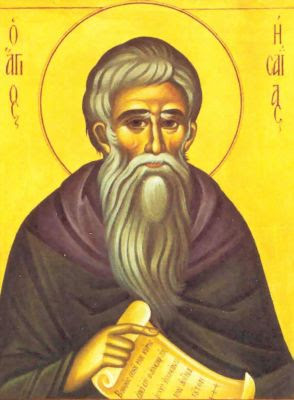
Isaiah the Solitary: The Remembrance of God and Praying with Sweetness of Heart


This Article is taken from the Blog, ENLARGING THE HEART, for Friday, 24 August 2012.


Our teacher Jesus Christ, out of pity for mankind and knowing the utter mercilessness of the demons, severely commands us: ‘Be ready at every hour, for you do not know when the thief will come; do not let him come and find you asleep’ (cf Matt. 24:42-43).

[...] Stand guard, then, over your heart and keep a watch on your senses; and if the remembrance of God dwells peaceably within you, you will catch the thieves when they try to deprive you of it.

When a man has an exact knowledge about the nature of thoughts, he recognizes those which are about to enter and defile him, troubling the intellect with distractions and making it lazy.

Those who recognize these evil thoughts for what they are remain undisturbed and continue in prayer to God.

[...] What…is meant by the worship of God?

It means that we have nothing extraneous in our intellect when we are praying to Him: neither sensual pleasure as we bless Him, nor malice as we sing His praise, nor hatred as we exalt Him, nor jealousy to hinder us as we speak to Him and call Him to mind.

For all these things are full of darkness; they are a wall imprisoning our wretched soul, and if the soul has them in itself it cannot worship God with purity.

They obstruct its ascent and prevent it from meeting God: they hinder it from blessing Him inwardly and praying to Him with sweetness of heart, and so receiving His illumination.

As a result the intellect is always shrouded in darkness and cannot advance in holiness, because it does not make the effort to uproot these thoughts by means of spiritual knowledge.

When the intellect rescues the soul’s senses from the desires of the flesh and imbues them with dispassion, the passions shamelessly attack the soul, trying to hold its senses fast in sin; but if the intellect then continually calls upon God in secret, He, seeing all this, will send His help and destroy all the passions at once.

I entreat you not to leave your heart unguarded, so long as you are in the body.

[...] Up to his last breath [a man] cannot know what passion will attack him; so long as he breathes, therefore, he must not leave his heart unguarded, but should at every moment pray to God for His help and mercy.

Isaiah the Solitary (died 489 A.D. / 491 A. D.): On Guarding the Intellect, 12-15, Text from G.E.H. Palmer, Philip Sherrard, and Kallistos Ware (trans. and eds.) The Philokalia: The Complete Text, vol. I (Faber & Faber, London & Boston: 1979).

Note: The word "intellect", in the Philokalia, translates the Greek "nous", which the translators define as follows:

the highest faculty in man, through which – provided it is purified – he knows God or the inner essences or principles of created things by means of direct apprehension or spiritual perception. Unlike the dianoia or reason, from which it must be carefully distinguished, the intellect does not function by formulating abstract concepts and then arguing on this basis to a conclusion reached through deductive reasoning, but it understands divine truth by means of immediate experience, intuition or ‘simple cognition’ (the term used by St Isaac the Syrian). The intellect dwells in the ‘depths of the soul’; it constitutes the innermost aspect of the heart (St Diadochos). The intellect is the organ of contemplation, the ‘eye of the heart’ (Makarian Homilies).

26 August, 2012

Saint Bernard of Clairvaux, Abbot and Doctor of the Church (Part Three)


Text and Illustrations taken from Wikipedia - the free encyclopedia,
unless otherwise stated.

20 August (Feast of Saint Bernard of Clairvaux, Abbot and Doctor)
Double
White Vestments


Saint Bernard of Clairvaux, 
depicted in a Mediaeval manuscript.


Bernard of Clairvaux, O.Cist (1090 – August 20, 1153) was a French abbot and the primary builder of the reforming Cistercian Order.

After the death of his mother, Bernard sought admission into the Cistercian Order. Three years later, he was sent to found a new abbey at an isolated clearing in a glen known as the Val d'Absinthe, about 15 km southeast of Bar-sur-Aube. According to tradition, Bernard founded the monastery on 25 June 1115, naming it Claire Vallée, which evolved into Clairvaux.

There, Bernard would preach an immediate faith, in which the intercessor was the Virgin Mary." In the year 1128, Bernard assisted at the Council of Troyes, at which he traced the outlines of the Rule of the Knights Templar, who soon became the ideal of Christian nobility.

On the death of Pope Honorius II, a schism broke out in the Church. Louis VI of France convened a national Council of the French bishops at Étampes in 1130, and Bernard was chosen to judge between the rivals for pope.


Henry I (Beauclerc), King of England 1100 - 1135,
with whom Bernard of Clairvaux had discussions 
regarding the king's reservations about Pope Innocent II.

After the Council of Étampes, Bernard went to speak with the King of England, Henry I, Beauclerc, about the king's reservations regarding Pope Innocent II. Beauclerc was sceptical because most of the bishops of England supported Anacletus II; he convinced him to support Innocent. 

Germany had decided to support Innocent through Norbert of Xanten, who was a friend of Bernard's. However, Innocent insisted on Bernard's company when he met with Lothair III of Germany. Lothair became Innocent's strongest ally among the nobility. Despite the Councils of Étampes, Wurzburg, Clermont, and Rheims all supporting Innocent, there were still large portions of the Christian world supporting Anacletus.

At the end of 1131, the kingdoms of France, England, Germany, Castile, and Aragon, supported Innocent; however, most of Italy, southern France, and Sicily, with the patriarchs of Constantinople, Antioch, and Jerusalem, supported Anacletus. Bernard set out to convince these other regions to rally behind Innocent.


Anacletus II, previously a monk at Cluny Abbey. 
He was the rival to Innocent II to become Pope.
(Google Images)


The first person, whom he went to, was Gerard of Angoulême. He proceeded to write a letter, called Letter 126. This letter questioned Gerard's reasons for supporting Anacletus. Bernard would later comment that Gerard was his most formidable opponent during the whole schism. 

After convincing Gerard, Bernard traveled to visit the Count of Poitiers. He was the hardest for Bernard to convince. He did not pledge allegiance to Innocent until 1135. After that, Bernard spent most of his time in Italy convincing the Italians to pledge allegiance to Innocent. He traveled to Sicily in 1137 to convince the king of Sicily to follow Innocent. 

The whole conflict ended when Anacletus died on January 25, 1138. In 1139, Bernard assisted at the Second Council of the Lateran. Bernard denounced the teachings of Peter Abelard to the pope, who called a Council at Sens, in 1141, to settle the matter. 

Bernard soon saw one of his disciples elected as Pope Eugenius III. Having previously helped end the schism within the Church, Bernard was now called upon to combat heresy. In June 1145, Bernard travelled in southern France and his preaching there helped strengthen support against heresy.


PART FOUR FOLLOWS.

Prayer for Priests


Illustration taken from
(Google Images)


This prayer was found on a Prayer Card at the back of my local Church.

Rather than leave it to lie there, unseen and unappreciated, I copy it, here, on this Blog, to permit the World to pray for their Priests.

O Jesus, I pray:

for Your faithful and fervent Priests;
for Your unfaithful and tepid Priests;
for Your Priests labouring at home or abroad in distant mission fields;
for Your tempted Priests;
for Your lonely and desolate Priests;
for Your young Priests;
for Your dying Priests;
for the Souls of Your Priests in Purgatory.

But, above all, I recommend to You
the Priests who are dearest to me:

the Priest who baptised me;
the Priest who absolved me from my sins;
the Priest at whose Masses I have assisted
and who gave me Your Body and Blood in Holy Communion;
the Priests who taught and instructed me;
the Priests to whom I am indebted in any other way.

Jesus, keep them all close to Your heart,
and bless them abundantly,
in time and in eternity.

Amen.

Happy Zephyrinus !!!


Happy Zephyrinus to all readers of this Blog.

Today is the Feast of Saint Zephyrinus, Pope and Martyr.


Text taken from The Saint Andrew Daily Missal.
Illustrations taken from Wikipedia - the free encyclopedia,
unless otherwise stated.


26 August. Feast of Saint Zephyrinus, Pope and Martyr.
Simple.
Red Vestments.


Pope Saint Zephyrinus
(199 A.D. - 217 A. D.)


Pope Saint Zephyrinus succeeded Pope Saint Victor on the pontifical throne and, like him, was martyred (Gospel). He abolished the use of wooden chalices, in the celebration of the Holy Sacrifice, and ordered them to be replaced by glass chalices. He prescribed that all the Faithful should receive Holy Communion on Easter Day.

He had to defend the dogma of the Unity of God and the Trinity of Persons against the Sabellians. Besides this intestine strife, he had to suffer persecution. God always supported him in his trials, in order to enable him to support the flock of Christ (Epistle).

He died in 217 A.D., after a pontificate of seventeen years.

24 August, 2012

Church of the Sacred Heart, Limerick, is saved by the Institute of Christ the King, Sovereign Priest. Thanks be to God.


Church of the Sacred Heart, Limerick


The following Article can be found on RORATE CAELI Blog.

Follow the Link, below:

Church of the Sacred Heart, Limerick, is saved by the Institute of Christ the King, Sovereign Priest. Thanks be to God.

Saint Bernard of Clairvaux, Abbot and Doctor of the Church (Part Two)


Text taken from The Saint Andrew Daily Missal.
Illustrations taken from Wikipedia - the free encyclopedia,
unless otherwise stated.

20 August (Feast of Saint Bernard of Clairvaux, Abbot and Doctor)
Double
White Vestments


Vision of Saint Bernard 
(with Saint Benedict and Saint John the Evangelist)
by Fra Bartolomeo (1472 - 1517)
(the Uffizi Gallery, Florence)


Pope Eugenius III, who had been trained by Saint Bernard to the monastic life, solicited and received his counsels. At the Council of Etampes, he put an end to the schism, which, opposing Anacletus to Innocent III, troubled the clergy and people of Rome.

He was consulted by William of Aquitaine, by the Duchess of Lorraine, by the Countess of Brittany, by Henry, son of the King of France, by Peter, son of the King of Portugal, by Louis VI, Louis VII, Conrad, Lothaire and by the Abbot of Saint Denis. He silenced the famous Doctor Abelard at the Council of Laon, and his powerful logic unmasked the errors of Arnold of Brescia and of Peter de Bruys (Gospel).


The Uffizi Gallery, Florence.

Author: Chris Wee

Photo: May 2006. 

(Wikimedia Commons) 

Lastly, he attacked Islam, and, by preaching the Second Crusade at Vezelay, he stirred up the whole of Europe by his overpowering eloquence.

Saint Bernard died at Clairvaux on 20 August 1153 and his body was laid at the foot of the altar of the Blessed Virgin. He left 160 monasteries which he had founded in Europe and Asia. His writings, replete with doctrines inspired by divine wisdom, caused him to be placed among the Doctors of the Church by Pope Pius VIII.

Let us have recourse to the intercession in Heaven of the one who, on Earth, taught us the way of life (Collect). Let us ask him to give us his love for the Mother of God, and let us piously recite the Anthem of the Season, Salve Regina, of which the three last invocations, "O Clement, O Loving, O Sweet Virgin Mary", are attributed to him.


PART THREE FOLLOWS


21 August, 2012

Saint Bernard of Clairvaux, Abbot and Doctor of the Church (Part One)


Text taken from The Saint Andrew Daily Missal.
Illustrations taken from Wikipedia - the free encyclopedia,
unless otherwise stated.

20 August (Feast of Saint Bernard of Clairvaux, Abbot and Doctor)
Double
White Vestments


Saint Bernard of Clairvaux 
(Abbot and Doctor of the Church) 
(1090 - 1153)

The Church is pleased to honour, during the Octave of the Assumption, Saint Bernard, the honey-mouthed Doctor (Doctor Mellifluus), whose principal title of glory is to have celebrated, with ineffable tenderness and ardent piety, in his prayers, his books and sermons, the varied greatness of Mary.

Born in 1091, of a noble Burgundian family, he succeeded, at the age of 22, in winning over to Christ thirty noblemen, who, with him, embraced monastic life at Citeaux. There, the Cistercian Order, a branch of the old Benedictine trunk, acquired a new vigour which enabled it to cover the whole of Europe with its shoots.

"The just", says the Offertory, "shall flourish like the palm-tree, he shall grow up like the cedar of Libanus."

And in the famous monastery which Bernard founded a short time afterwards, in the Vale of Clairvaux, on the Left Bank of the Aube, and whose first Abbot he became (Communion), he each day lavished on a community of seven hundred monks the treasures of doctrine and wisdom with which God endowed him and which make his name immortal (Introit, Epistle, Gradual).

An austere monk, a great Christian orator and a learned Doctor, he was the luminary, mentioned in the Gospel, which enlightened the world in the 12th-Century.


PART TWO FOLLOWS


Matins of the Feast of Saint Bernard of Clairvaux.

14 August, 2012

Marian Anthems


Text is taken from The Saint Andrew Daily Missal.
Illustrations taken from Wikipedia - the free encyclopedia,
unless otherwise stated.


Saint Peter and Saint Paul Church,

Reichenau Island, Lake Constance, South Germany. 
Hermann Contractus was a monk in this Abbey and is accredited with creating the Marian Anthems of Alma Redemptoris and Ave Regina. 
Photo taken by en:User:Ahoerstemeier (November 2001). 
(Wikimedia Commons) 


There are four main Marian Anthems (you will note that they are in alphabetical order and are used, thus, during the Liturgical Year).


Alma Redemptoris
(From First Vespers of Advent until Second Vespers of 2 February, inclusive.)
The authorship of this Anthem is attributed to Hermann Contractus, a monk of the Abbey of Reichenau (+1054);


and also listen to the ALMA REDEMPTORIS, here.


Ave Regina
(From Compline on 2 February until Maundy Thursday, inclusive.)
The authorship of this Anthem is attributed to Hermann Contractus, a monk of the Abbey of Reichenau (+1054).
The insertion of this Anthem in the Divine Office is attributed to Pope Clement VI (1342 - 1352);


Regina Caeli
(From Compline on Holy Saturday until Trinity Sunday, inclusive.)
The authorship of this Anthem is attributed to Pope Gregory V (+998 A.D.);


Salve Regina
(From First Vespers of Trinity Sunday until Advent.)
This Marian Anthem is attributed to Adhemar de Monteil, Bishop of Le Puy, France, (+1098). The three final invocations were added by Saint Bernard of Clairvaux (1091 - 1153).


The Angelus


Deutsch: Sixtinische Madonna, Szene: Maria mit Christuskind, 
Hl. Papst Sixtus II. und Hl. Barbara
Current location: Gemäldegalerie, Dresden.
Source/Photographer: The Yorck Project: 10.000 Meisterwerke der Malerei. 
DVD-ROM, 2002. ISBN 3936122202. Distributed by DIRECTMEDIA Publishing GmbH.
Permission: [1]
Madonna and Child by Raphael (1483 - 1520).
(Wikimedia Commons)


12 August, 2012

10 August, 2012

Worcester Cathedral - Part Three


Text and Illustrations from Wikipedia - the free encyclopedia,
unless otherwise stated.


The High Altar, Worcester Cathedral.
Author: Mattana
January 2008. 
(Wikimedia Commons)


The East End was re-built over the Norman Crypt by Alexander Mason between 1224 and 1269, coinciding with, and in a very similar Early English style to, Salisbury Cathedral. From 1360, John Clyve finished off the Nave, built its Vault, the West Front, the North Porch and the Eastern Range of the Cloister.

He also strengthened the Norman Chapter House, added Buttresses and changed its Vault. His masterpiece is the Central Tower of 1374, originally supporting a timber, lead-covered Spire, now gone. Between 1404 and 1432, an unknown architect added the North and South Ranges to the Cloister, which was eventually closed by the Western Range by John Chapman, 1435–38. The last important addition is Prince Arthur’s Chantry Chapel to the right of the South Choir Aisle, 1502–04.

Worcester Cathedral was extensively restored from 1857 to 1874 by W. A. Perkins and Sir George Gilbert Scott. Most of the fittings and the stained glass date from this time.


Exterior statuary at Worcester Cathedral.
Author: Mattana
January 2008.
(Wikimedia Commons)

Misericords

Thirty-Nine of the Misericords date from 1379 and include a complete set of the Labours of the Months. The subject matter includes biblical stories, mythology and folklore. Three of the misericords are Victorian replacements, such as N-02, Judas in the jaws of Satan.

Bells

The Tower has a ring of twelve bells, plus three semitone bells and a non-swinging bourdon. The current peal of 15 ringing bells were cast in 1928 by John Taylor & Co., of Loughborough, from the metal of the original ring, cast in 1869. The ring is the fifth-heaviest ring of twelve in the world, only the bells in the Cathedrals of Liverpool, Exeter, York and St Paul's, London are heavier. The bells are also considered to be one of the finest-toned rings ever cast. The bells hang in a wooden frame that was constructed in 1869 for the previous ring. Worcester Cathedral is unique in having a purpose-built teaching centre equipped with eight special training bells, linked to computers.

Worcester Cathedral has three choirs: the Worcester Cathedral Choir (the main Choir which has both a boys' and a girls' treble line, which normally work independently); Worcester Cathedral Chamber Choir, and the Worcester Cathedral Voluntary Choir.


Two views of the Gothic Nave.
Author: Mattana
January 2008.
(Wikimedia Commons)


All three Choirs were involved in the BBC broadcast of the Midnight and Christmas Morning Services in 2007, with the boys and the girls of the Cathedral Choir, respectively, taking the lead in the two services. Since the 18th-Century, Worcester Cathedral Choir has taken part in the Three Choirs Festival, the oldest music festival in the world.

The composer, Edward Elgar, spent most of his life in Worcestershire. The first performance of the revised version of his Enigma Variations - the version usually performed - took place at the Cathedral during the 1899 Three Choirs Festival. He is commemorated in a stained glass window, which contains his portrait.

Worcester Cathedral has a long history of organs, dating back to at least 1417. There have been many re-builds and new organs in the intervening period, including work by Thomas Dallam, William Hill and most famously Robert Hope-Jones in 1896. The Hope Jones organ was heavily re-built in 1925 by Harrison & Harrison, and then regular minor works kept it in working order until Wood Wordsworth and Co were called in 1978. It was a large four-manual organ with 61 speaking stops. It had a large Gothic Revival case with heavily decorated front pipes as well as two smaller cases either side of the quire.


Gothic Triforium and Clerestory.
Author: Mattana
January 2008.
(Wikimedia Commons)


This organ (apart from the large transept case and pedal pipes) was removed in 2006 in order to make way for a new instrument by Kenneth Tickell, which was completed in the summer of 2008. The Nave has a three-manual Rodgers organ.


Worcester Cathedral. 
View of the Tower from the South-East. 
Author: Philip Halling.
August 2005.
Wikimedia Commons.


Notable organists at Worcester have included Thomas Tomkins (from 1596), Hugh Blair (from 1895), Ivor Atkins (from 1897) and David Willcocks (from 1950). The present organist (from 2012) is Dr Peter Nardone.

Worcester Cathedral is the host of the annual graduation ceremonies for the University of Worcester. These ceremonies are presided over by the Chancellor of the University, and take place over three days in November.


THIS CONCLUDES THE ARTICLE ON WORCESTER CATHEDRAL.

Related Posts Plugin for WordPress, Blogger...