Notre Dame de Rouen. The façade of the Gothic Church in France. Photographer: Hippo1947. Licence: SHUTTERSTOCK.

18 August, 2014

Basilica Of Santa Maria Del Mar And The Cathedral Of The Holy Cross and Saint Eulalia, Barcelona, Spain.


Text and Illustrations from Wikipedia - the free encyclopaedia,
unless otherwise stated.


Basilica of
Santa Maria del Mar,
Barcelona, Spain.
Photo: 20 September 2012.
Source: Own work.
Author: Jiuguang Wang.
(Wikimedia Commons)


Santa Maria del Mar (Catalan pronunciation: [ˈsantə məˈɾi.ə ðəɫ ˈmar]) is an imposing Church in the Ribera district of Barcelona, Spain, built between 1329 and 1383, at the height of Catalonia's maritime and mercantile pre-eminence. It is an outstanding example of Catalan Gothic, with a purity and unity of style that is very unusual in large Mediaeval buildings.

The first mention of a Church of Santa Maria del Mar dates from 998 A.D. The construction of the present building was promoted by Canon Bernat Llull, who was appointed Arch-Dean of Santa Maria in 1324. Construction work started on 25 March 1329, when the Foundation Stone was laid by King Alfonso IV of Aragon (King Alfonso III of Catalonia), as commemorated by a Tablet, in Latin and Catalan, on the façade that faces the Fossar de les Moreres.

The architects in charge were Berenguer de Montagut (designer of the building) and Ramon Despuig, and, during the construction, all the Guilds of the Ribera Quarter were involved. The walls, the Side Chapels and the façades, were finished by 1350.


Català: Església de Santa Maria del Mar vista des del Passeig del Born.
English: Exterior of the Basilica of Santa Maria del Mar, Barcelona, Spain.
Photo: 19 July 2011.
Source: Own work.
Author: Kippelboy.
(Wikimedia Commons)


The Bell-Tower of the
Basilica of Santa Maria del Mar,
Barcelona, Spain.
Photo: 5 February 2007.
Source: Own work; de:User:Ralf Roletschek,
Fahrradmonteur.de
Author: Ralf Roletschek.
(Wikimedia Commons)


In 1379, there was a fire that damaged important parts of the Works. Finally, on 3 November 1383, the last stone was laid and on 15 August 1384 the Church was Consecrated. In 1428, an earthquake caused several casualties and destroyed the Rose Window in the West End. The new window, in the Flamboyant Style, was finished by 1459 and, one year later, the glass was added. The images and the Baroque Altar were destroyed in a fire in 1936. The Chapel of the Blessed Sacrament, adjacent to the Apse, was added in the 19th-Century.

From the outside, the Basilica of Santa Maria del Mar gives an impression of massive severity that belies the Interior. It is hemmed in by the narrow streets of the Ribera, making it difficult to obtain an overall impression, except from the Fossar de les Moreres and the Plaça de Santa Maria, both of them former burial grounds.


Exterior of the Basilica of Santa Maria del Mar,
Barcelona, Spain.
Photo: 10 October 2012.
Source: Own work.
Author: Dror Feitelson.
(Wikimedia Commons)


English: The Great West Door,
the Basilica of Santa Maria del Mar,
Barcelona, Spain.
Català: Església de Santa Maria del Mar. Barcelona.
Español: Iglesia de Santa Maria del Mar. Barcelona.
Photo: 9 September 2013.
Source: Own work.
(Wikimedia Commons)


The latter is dominated by the West End of the Church with its Rose Window. Images of Saint Peter and Saint Paul occupy Niches, on either side of the Great West Door, and the Tympanum shows the Saviour, flanked by Our Lady and Saint John. The North-West Tower was completed in 1496, but its companion was not finished until 1902.

In contrast with the Exterior, the Interior gives an impression of light and spaciousness. It is of the Basilica type, with its three Aisles forming a single space with no Transepts, and no architectural boundary between Nave and Presbytery. The simple Ribbed Vault is supported on slender Octagonal Columns, and abundant daylight streams in through the tall Clerestory windows.


Català: Corpus. Sortida de la processó de l'església de Santa Maria.
English: The Corpus Christi Procession Leaving the Church of Santa Maria del Mar.
Artist: Ramon Casas i Carbó (1866–1932).
Date: 1907.
Barcelona, Spain.
Source: http://usuarios.lycos.es/ramoncasas/obra/pintura/imatge/rc98_processocorpusb.jpg
(Wikimedia Commons)

The Corpus Christi Procession Leaving the Church of Santa Maria del Mar is an oil painting by Ramon Casas, painted on 1907, and currently in the Museu Nacional d'Art de Catalunya, Barcelona.

In 1896, an anarchist attacked the Corpus Christi Procession, which had left the Church of Santa Maria del Mar, Barcelona, killing twelve people and creating panic in the City. The act was part of the turbulent social landscape in Catalonia of the early 20th-Century, dominated by anarchist bombings like this, or that had taken place in Gran Teatre del Liceu, four years earlier.


Interior of the Basilica of Santa Maria del Mar,
Barcelona, Spain.
Photo: 10 October 2012.
Source: Own work.
Author: Dror Feitelson.
(Wikimedia Commons)


The Interior is almost devoid of imagery of the sort to be found in Barcelona's other large Gothic Churches, the Cathedral of the Holy Cross and Saint Eulalia and Santa Maria del Pi, after the fire, which occurred in 1936 during Anti-Clerical disturbances. Amongst the most notable of the works destroyed at that time, was the Baroque Retable, by Deodat Casanoves and Salvador Gurri.

Some interesting Stained-Glass Windows have survived from various periods. The Church has a serious claim to have the slenderest Stone-Built Columns in the world.


Русский: Собор Святого Креста и Святой Евлалии.
Español: La Catedral de la Santa Cruz y Santa Eulalia.
English: Cathedral of The Holy Cross and Saint Eulalia, Barcelona, Spain.
Similar to the Basilica of Santa Maria del Mar, the Cathedral is
another Gothic structure in Barcelona.
Photo: 16 August 2013.
Source: Own work.
Author: Mromanchenko.
(Wikimedia Commons)


Interior of the Cathedral of The
Holy Cross and Saint Eulalia, Barcelona, Spain.
Photo: 22 April 2010.
Source: Own work.
Author: Jorge Lascar.
(Wikimedia Commons)


The Cathedral of the Holy Cross and Saint Eulalia (Catalan: Catedral de la Santa Creu i Santa Eulàlia, Spanish: Catedral de la Santa Cruz y Santa Eulalia), also known as Barcelona Cathedral, is the Gothic Cathedral and Seat of the Archbishop of Barcelona, Spain.

The Cathedral was constructed between the 13th- and 15th-Centuries, with the principal work done in the 14th-Century. The Cloister, which encloses the Well of the Geese (Font de les Oques) was completed in 1448. In the Late-19th-Century, the Neo-Gothic façade was constructed over the nondescript Exterior that was common to Catalan Churches. The roof is notable for its Gargoyles, featuring a wide range of animals, both domestic and mythical.


17 August, 2014

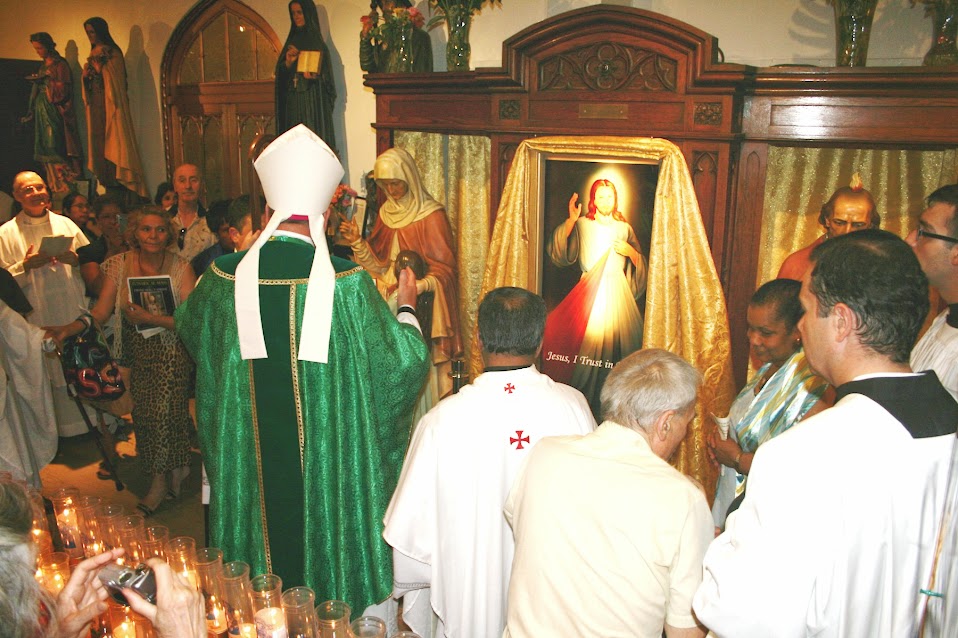
Please Sign The Petition And Keep The Church Of The Holy Innocents, New York, Open.


There is disturbing news of the possible closure of The Church of The Holy Innocents, New York,
on the Blog, RORATE CAELI


Looking West across 37th Street,
at Holy Innocents Church,
New York,
on a sunny morning.
Photo: 3 June 2012.
Source: Own work.
Author: Jim.henderson.
(Wikimedia Commons)


Please pop over and read the Article and consider signing the Petition to keep this beautiful Church, and its vibrant Congregation, as a wonderful beacon of Christianity in a wonderful City.


The, then, Archbishop Dolan (now, Cardinal Dolan)
visits the Church of The Holy Innocents, New York, 17 July 2010.


The, then, Archbishop Dolan (now, Cardinal Dolan)
visits the Church of The Holy Innocents, New York, 17 July 2010.


The High Altar, and the monumental Mural created by Constantino Brumidi, the celebrated 19th-Century painter and artist, who is best known for his works in the United States Capitol Building. Constantino Brumidi was engaged by the first Pastor of Holy Innocents, Fr. John Larkin.

The Church of the Holy Innocents,
128 West 37th Street, New York, NY 10018.
Phone: (212) 279-5861 Fax: (212) 714-9313.


Please consider signing this Petition at CHANGE.ORG
to keep The Church of The Holy Innocents open.

Visiting A Carthusian Monastery (Part One).


English: Saint Bruno. Founder of The Carthusians.
Deutsch: Hl. Bruno, der Kartäuser.
Date: 1643.
Current location: Galleria Nazionale di Capodimonte, Neapel.
National Gallery, Capodimonte, Naples, Italy.
Source: The Yorck Project: 10.000 Meisterwerke der Malerei.
DVD-ROM, 2002. ISBN 3936122202.
Distributed by DIRECTMEDIA Publishing GmbH.
(Wikimedia Commons)

The following Paragraph is from Wikipedia - the free encyclopaedia.


Saint Bruno of Cologne (circa 1030 – 6 October 1101), the Founder of the Carthusian Order, personally founded the Order's first two Communities. He was a celebrated teacher at Reims, and a close Advisor of his former pupil, Pope Urban II.


Visiting a Carthusian Monastery
(Part One).
Available on YouTube at


16 August, 2014

Saint Joachim. Father Of The Blessed Virgin Mary. Feast Day 16 August.


Text and Illustration from The Saint Andrew Daily Missal,
unless otherwise stated.


Saint Joachim.
Father of The Blessed Virgin Mary.


Confessor.


Double of the Second-Class.


White Vestments.


Saint Joachim. Father of The Blessed Virgin Mary.


Français: Saint Joachim, Sainte Anne (avec l'enfant Jésus et Marie), Saint Joseph, statues au dessus d'un porche de la cathédrale, Aix-la-Chapelle, Allemagne.
English: Saint Joachim, Saint Anne (with Mary and Jesus, as children), Saint Joseph, statues on Aachen Cathedral, Germany.
Photo: 21 December 2013.
Source: Own work.
Author: Jebulon.
(Wikimedia Commons)


The following paragraph is taken from Wikipedia - the free encyclopaedia.

Joachim ("he whom YHWH has set up", Hebrew: יְהוֹיָקִים Yəhôyāqîm, Greek Ἰωακείμ Iōākeím) was the husband of Saint Anne and the father of Mary, the Mother of Jesus. The story of Joachim and Anne first appears in the apocryphal Gospel of James. Joachim and Anne are not mentioned in the Bible.


Saint Joachim, Our Lady and Saint Anne.
Church of Saint Anne,
Butajnove, Slovenia.
Artist: Josip Egartner (1809–1849).
Date: 1846.
Source: www.restavratorstvo-sentjost.si
(Wikimedia Commons)


Desiring to associate the name of Joachim with the triumph of his Blessed Daughter, the Church has transferred his Feast Day from 20 March to the day following The Assumption.

Pope Leo XIII, whose Baptismal name was Joachim, in 1879 raised Saint Joachim's Feast, and that of Saint Anne, to the Rank of Double of the Second-Class.

"Joachim and Anne," says Saint Epiphanes, "earned Divine Favour by an irreproachable life and merited that their union should bear for its beautiful fruit, The Blessed Virgin Mary, the Temple and Mother of God. Joachim, Anne, and Mary, offered manifestly together a sacrifice of praise to The Holy Trinity. The name of Joachim signifies preparation of The Lord. Is it not he, in fact, who prepares the Temple of the Lord, the Blessed Virgin ? " [Fourth Lesson at Matins.]

Wherefore, the Introit and Gradual enhance the virtues of this great Confessor and recall the frequent Almsgiving of the Saint, for, according to tradition, he divided what he had into three parts, of which the first was given to the Temple and its ministers, the second to the Poor, and the third was all he kept for himself.


Church of Saint Anne,
Butajnova, Slovenia
(see painting, above)
Photo: 2 July 2012.
Source: Own work.
Author: Doremo.
(Wikimedia Commons)


"Most Blessed Couple," says in his turn Saint John of Damascus, "the whole creation is in your debt. For it is through you that it has been enabled to offer the Creator a present above all presents, the chaste Mother, who alone was worthy of the Creator. Rejoice, Joachim, for unto us a Son is born of thy daughter." [Fifth and Sixth Lessons at Matins.]

And the Gospel selected shows us the Royal Lineage of this Son, for by his marriage with Mary, daughter of Joachim (or Heliachim), Joseph, son of Jacob, made Jesus the legal heir of David.

As Grace perfects nature without destroying it, it may be affirmed that Joachim, united like Saint Joseph and Saint Anne by a very intimate tie to the Mother of God and her Son, is called to exercise his perpetual patronage (Collect) with regard to the Church, the body of Christ, or with regard to our Souls of which Mary is mother.

Let us, on this day, offer to God the Holy Sacrifice in honour of the Holy Patriarch, Joachim, father of The Virgin Mary, in order that his Prayer, added to that of his spouse and of their Blessed Child, may obtain the full remission of our sins and eternal glory (Secret).


The Saint Andrew Daily Missal.


Available (in U.K.) from


Available (in U.S.A.) from


5 February 1953. Gooseberry Eyes Available. Piggy-Banks Emptied. Swarms Of Youngsters Heading For The High Street.


Smarties.
Date: 16 September 2007.
Source: http://www.flickr.com/
photos/alazaat/2357636026/
Author: St0rmz.
(Wikimedia Commons)


This Article first appeared on 15 May 2008 in the SALISBURY JOURNAL

For children all over Britain, 5 February 1953 was an important day.

Piggy-Banks were emptied and swarms of youngsters headed for their local High Street.

The Government had ended Sweet Rationing and the sugar rush was on.

It wasn't the first time that Sweets had come off Ration - the first attempt to de-Ration in 1949 had been derailed after four months, when demand outstripped supply.


Sweet Monster Super Shrimps - 250g Jar
Super Shrimps.
Image: TRADE SWEETS


But, four years later, with promises from the Government that sugar stocks were sufficient to cope with any feeding frenzy at the Sweet Shop, confectionery was back on the shelves and dentists were back in business.

For years, Pocket Money was mis-spent at the Pick'n'Mix counter, where shop assistants filled paper bags, at our direction, with Penny Chews, Shrimps, Black Jacks and Fruit Salads (a farthing each or four for a penny), Liquorice Pipes and Sherbet Fountains, as we eked out Sixpence over as many Sweets as possible.

William Brown, Richmal Crompton's immortal enfant terrible, better known as Just William, understood.

"In the matter of Sweets, William frankly upheld the superiority of quantity over quality," we are told in "William Goes To The Pictures", when, armed with a Shilling, he decides to spend half of it on Sweets.


Retro Sweets Assortment Gift Hamper - Medium

Image: TRADE SWEETS


"He wandered now to his favourite confectioner and stood outside the window for five minutes, torn between the rival attractions of Gooseberry Eyes and Marble Balls.

"Both were sold at four Ounces for 2d.

"William never purchased more expensive luxuries."

Gooseberry Eyes, it turned out, were the sort of Sweets, not unlike Sherbet Lemons, that grow sticky over time and collect fluff from the insides of Blazer pockets, where they eventually ended up paper bag-less.

I'm not convinced that Gooseberry Eyes existed - not in the way I know that Aniseed Balls, Cough Candy Twists, Pineapple Cubes and Chewing Nuts did.


A packet of Black Jacks.
Date: 26 June 2008.
Source: Own work.
Author: DineshAdv.
(Wikimedia Commons)


And what about the white Candy Sticks, with red tips, that used to be sold in packs of ten as Sweet Cigarettes, and "smoked" by kids copying their parents?

Or Sherbet Crystals, that you dipped your wet finger into and sucked like a Lollipop?

Or Gobstoppers, so huge they made your mouth bulge like a hamster?

Etched forever on my memory they might be, but, for a time, it seems these very important symbols of my childhood had disappeared, along with Ounces and Pennies in £.s.d. form.


Flying Saucers.


But now they are back - Jarred Sweets, that is, not Ounces or pre-decimal currency - and young and old, alike, are preparing to ruin their teeth in an orgy of sucking and chewing, that brings back memories, for some, and creates them, for others.

Old-fashioned Sweets like Clove Balls, Bulls' Eyes, Humbugs, Acid Drops and Lemon Bon-Bons have acquired a certain trendy kudos, and there are any number of sites, on the Web, where you can buy "Retro" Sweets.

But that's not as good as nipping into your local Sweet Shop, and buying a little of what you fancy off the shelves.

Shops, like Pothecary's, in Fisherton Street, as well as some Newsagents and Village Stores, keep a small selection of Jarred Sweets behind the Counter, but for a Sweetie Emporium, you will have to travel to Tisbury, Porton or Ringwood.


ABC Letters.


Go into Jenny and Greg's "Chocolate Box", in Ringwood, or "Sweets Galore", in Tisbury, and it's like stepping back in time.

Sue Bracken has just opened "Sweets Galore", her second Shop, in Tisbury's High Street. Her first is in a Shopping Centre in Swindon.

"But I didn't want a Shopping Centre, again, and I picked a Village because Village-life is old-fashioned," says Sue, whose sister lives in Tisbury.

"You see lots of Sweet Shops, up North, but not many in the South."


Fizzers.


She opted for Sweets with a nostalgic twist, because, she points out, "you can get Mars Bars anywhere in the Country".

In "My Favourite Things", attached to the Pet and Aquatic Centre, in Porton, there are ranks of Jarred Sweets at the entrance to the Shop.

The Shop has recently re-opened, after the last owner tried, unsuccessfully, to re-position what was an old-fashioned Sweet Shop.


Fizzy Sherbet Twists.
Image: SWEETS GALORE


One of the directors, Gareth Allen, said: "People wanted old-fashioned Sweets - that's what they were asking for."

So, modern confectionery was swept aside and Jars of Coconut Mushrooms, Tom Thumb Drops, Liquorice Comfits, Jelly Babies, restored to the shelves.

When it comes to getting your "five a day", I doubt if the Government had Rhubarb and Custard, Pear Drops, Sherbet Lemons, Strawberry Bon-Bons and Fruit Salads in mind, but memories are made of this.


15 August, 2014

On The Feast Of The Assumption Of The Blessed Virgin Mary. Ave Maria. Ave Maria.


English: The Assumption of The Virgin Mary.
Deutsch: Maria Himmelfahrt, Hochaltar für
St. Maria Gloriosa dei Frari in Venedig.
Français: L'Assomption de la Vierge.
Artist: Titian (1490–1576).
Date: 1516-1518.
Source/Photographer: The Yorck Project: 10.000 Meisterwerke der Malerei.
DVD-ROM, 2002. ISBN 3936122202.
Distributed by DIRECTMEDIA Publishing GmbH.
(Wikimedia Commons)


Ave Maria
by Sarah Brightman.
Available on YouTube at

The Assumption Of The Blessed Virgin Mary. Feast Day 15 August.


English: The Assumption of The Virgin Mary.
Deutsch: Maria Himmelfahrt, Hochaltar für
St. Maria Gloriosa dei Frari in Venedig.
Français: L'Assomption de la Vierge.
Artist: Titian (1490–1576).
Date: 1516-1518.
Source/Photographer: The Yorck Project: 10.000 Meisterwerke der Malerei.
DVD-ROM, 2002. ISBN 3936122202.
Distributed by DIRECTMEDIA Publishing GmbH.
(Wikimedia Commons)


Text from The Saint Andrew Daily Missal.

The Assumption of The Blessed Virgin Mary.
Feast Day 15 August.

Double of The First-Class
   with a Common Octave.

White Vestments.


On this Feast, the most ancient (6th-Century A.D.) and Solemn of The Cycle of Mary, The Church invites all her children in The Catholic World to unite their joy (Introit) and their gratitude (Preface) with those of The Angels, who praise The Son of God because of that day His Mother, Bodily and Spiritually, entered Heaven (Alleluia).

Admitted to the enjoyment of the delights of Eternal Contemplation, She chose at The Feet of The Master the better part, which shall not be taken away from Her (Gospel, Communion).

The Gospel of The Vigil was, indeed, formerly read after today's Gospel, in order to show that The Mother of Christ is happy among all others, because, better than all others, "She listened to The Word of God". This Word, The Word, The Divine Wisdom, which, under The Old Law, dwelt among the people of Israel (Epistle), dwelt in Mary, under The New Law.


Artist: Rene de Cramer.
“Copyright Brunelmar/Ghent/Belgium”.
Used with Permission.


The Word became Incarnate in the womb of The Virgin, and now, amid the splendour of The Heavenly Sion, He fills Her with the delights of The Beatific Vision.

The Church on Earth, like Martha, has to care for the necessities of this present life, but she also, like her, invokes the help of Mary (Collect, Secret, Postcommunion).

A Procession has always been a part of The Feast of The Assumption. At Jerusalem, it was formed by the numerous Pilgrims who came to Pray at the tomb of The Blessed Virgin and who, thus, contributed to the Institution of this Solemnity.


The Clergy of Constantinople also held a Procession on The Feast of The Rest, or Assumption, of Mary. At Rome, from the 7th-Century A.D., to the 16th-Century, the Papal Cortege, in which the representatives of the Senate and people took part, went on this day from The Church of Saint John Lateran to that of Saint Mary Major. This Ceremony was called The Litany.

[On this occasion, they used to recite over the people, assembled for the Procession, The Collect for Assumption Day, which is first in The Sacramentary and mentions this Mystery, whilst our Collect of The Mass on 15 August was only The Second Collect and has no direct relation to The Feast.

This is The First Collect: "It is our duty to honour The Solemnity of this day, O Lord; The Holy Mother of God did, indeed, suffer temporal death, although the bonds of this death could not hold back Her, whose flesh formed The Body of Thy Son, Our Lord Who liveth and reigneth . . ."]


It is in The Basilica of Saint Mary Major, Rome, that The Station is held at Christmas to Solemnise the Mystery from which flowed all the Glories of The Virgin, and it is also there that was Solemnised The Assumption, in which they culminate. Mary received Jesus, when He came into this World, and it is Jesus Who receives Mary into Heaven.

Every Parish Priest Celebrates Mass for the people of his Parish.

The Introit for the Feast of The Assumption of The Blessed Virgin Mary, Gaudeámus omnes in Dómino . . . (Let us all rejoice in The Lord, . . .) is that of The Feast of Saint Agatha (5 February).

From the 11th-Century, this Introit was also used in seven other Masses which are in The Missal, among which are 15 August (today's Feast) and 1 November (Feast of All Saints).


THE SAINT ANDREW DAILY MISSAL


THE SAINT ANDREW DAILY MISSAL

Available (in U.K.) from

Available (in U.S.A.) from


14 August, 2014

Ave Maris Stella. Hail, Star Of The Sea. The Hymn At First Vespers For The Assumption Of The Blessed Virgin Mary.


Hail, Star of the Sea.


Ave Maris Stella.
Available on YouTube at


The following Text is from Wikipedia -the free encyclopaedia.

Ave Maris Stella ("Hail Star of the Sea") is a Plainsong Vespers Hymn to Mary. It was especially popular in the Middle Ages and has been used by many composers as the basis of other compositions.

The creation of the original Hymn has been attributed to several people, including Saint Bernard of Clairvaux (12th-Century), Saint Venantius Fortunatus (6th-Century) and Hermannus Contractus (11th-Century). The Text is found in 9th-Century Manuscripts kept in Vienna, Austria, and in the Abbey of Saint Gall, Switzerland.

The melody is found in the Irish Plainsong "Gabhaim Molta Bríde", a piece in praise of Saint Bridget. The popular modern Hymn, Hail Queen of Heaven, the Ocean Star, is loosely based on this Plainsong original.

It finds particular prominence in the "Way of Consecration to The Blessed Virgin Mary" by Saint Louis de Montfort.


Madonna and Child
(Galleria Borghese, Rome).
Date: Circa 1742.
Author: Pompeo Batoni (1708–1787).
(Wikimedia Commons)


The Plainchant Hymn has been developed by many composers, from pre-Baroque to the present day. The Roman Rite employs four different Plainchant tunes for the Ave Maris Stella; the first three are designated for Solemnities, Feasts, and Memorials of The Blessed Virgin Mary; a fourth is given in The Little Office of the Blessed Virgin Mary as an alternative to the Memorial Tone. These Plainchant Tones have been used as the cantus firmus for some Polyphonic Settings of the Mass, including those by Josquin and Victoria.

Renaissance Settings include those by Felice Anerio, Palestrina, Dufay and Byrd. Baroque Settings include Monteverdi's Vespro della Beata Vergine 1610. Romantic Settings include those by Dvorak, Grieg, and Liszt. Modern composers who have either set the Text, or used the Hymn as an inspiration, include Grace Williams, Peter Maxwell Davies, Otto Olsson and Trond Kverno.


The Vigil Of The Assumption Of The Blessed Virgin Mary. 14 August.


English: The Assumption of The Virgin Mary.
Deutsch: Maria Himmelfahrt, Hochaltar für
St. Maria Gloriosa dei Frari in Venedig.
Français: L'Assomption de la Vierge.
Artist: Titian (1490–1576).
Date: 1516-1518.
Source/Photographer: The Yorck Project: 10.000 Meisterwerke der Malerei.
DVD-ROM, 2002. ISBN 3936122202.
Distributed by DIRECTMEDIA Publishing GmbH.
(Wikimedia Commons)


Text from The Saint Andrew Daily Missal, unless otherwise stated.

The Vigil of The Assumption of The Blessed Virgin Mary.

14 August.

Violet Vestments.


The Epistle, for The Vigil Of The Assumption of The Blessed Virgin Mary, is "Ego quasi vitis",
(taken from The Book of Wisdom) from the Feast of Our Lady of Mount Carmel (16 July).

As the vine, I have brought forth a pleasant odour,
And my flowers are the fruit of honour and riches.
I am the mother of fair love,
And of fear,
And of knowledge,
And of Holy hope.
In me is all Grace of the way and of the truth,
In me is all hope of life and virtue.
Come over to me,
All ye that desire me,
And be filled with my fruits;
For my spirit is sweet above honey,
And my inheritance above honey and the honeycomb.
My memory is unto everlasting generations.
They that eat me, shall yet hunger;
And they that drink me, shall yet thirst.
He that hearkeneth to me shall not be confounded,
And they that work by me shall not sin.
They that explain me shall have life everlasting.


Christ, after having lain for only three days in the tomb, rose again and ascended into Heaven.

Likewise, the death of The Virgin resembled, rather, a short sleep. Hence, it was called "Dormitio" (Dormition), and before corruption could defile her body.

God restored her to life and Glorified her in Heaven.

These three privileges are celebrated by the Feast of the Assumption, which follows logically from the privilege of The Immaculate Conception and the privilege of The Mystery of the Incarnation.

For sin never having defiled the Soul of Mary, it was right that her body, in which The Word had become Incarnate, should not be tainted by the corruption of the tomb.


Benedictine Abbey Of Saint Mang, Füssen, Bavaria, Germany.


Text and Illustrations from Wikipedia - the free encyclopaedia,
unless otherwise stated.


English: Saint Mang Basilica, Füssen, Bavaria, Germany.
Deutsch: Füssen: Ehemalige Klosterkirche St. Mang.
Photo: 15 June 2011.
Source: Own work.
Author: Taxiarchos228.
(Wikimedia Commons)


English: Saint Mang Basilica, Füssen, Bavaria, Germany.
Deutsch: Kloster Sankt Mang, Füssen.
Photo: 23 February 2008 (original upload date).
Source: Transferred from en.wikipedia;
transferred to Commons by User:Kurpfalzbilder.de using CommonsHelper.
Author: Myke Rosenthal-English Rosenthalenglish.
(Wikimedia Commons)


Saint Mang's Abbey, Füssen, or Füssen Abbey (German: Kloster Sankt Mang Füssen) is a former Benedictine Monastery in FüssenBavaria, Germany.

The Benedictine Abbey of Saint Mang was founded in the first half of the 9th-Century as a proprietary Monastery of the Prince-Bishops of Augsburg. The reason for its Foundation goes back to the Hermit, Magnus of Füssen (otherwise known as Saint Mang), who built a Cell and an Oratory, here, where he died on 6 September, although there is no record of which year.

The Saint's body, amid Miracles, was discovered incorrupt, a proof of his Sanctity, and the Veneration of Saint Mang was the Spiritual basis of the Monastery.


English: Abbey and Basilica Church of Saint Mang, Füssen, Bavaria, Germany.
Deutsch: Kloster und Basilika Sankt Mang von der Lechbrücke.
Date: 2008-01-20 (original upload date).
Source: Transferred from en.wikipedia; transferred to Commons
Attribution: Rosenthalenglish at the wikipedia project.
Author: Original uploader was Rosenthalenglish at en.wikipedia
(Wikimedia Commons)


English: The South-Western part of Saint Mang's Abbey, Füssen, Bavaria, Germany..
Deutsch: Der südwestliche Teil des Benediktinerklosters Sankt Mang, Füssen.
Photo: 2 January 2011.
Source: Own work.
Author: Felix König.
(Wikimedia Commons)


The Foundation was not, however, solely Spiritually motivated; there were practical political reasons underlying it, as well. The Monastery's key position, not only on the important Mediaeval road from Augsburg across the Alps to Upper Italy, but also in the Füssen Gap ("Füssener Enge", the point where the Lech River breaks out of the Alps), gave it an immense strategic value, which made it of political concern, both to the Bishops of Augsburg and to the Holy Roman Emperors.

The history of the Abbey, in the Middle Ages, is principally marked by the efforts of the Religious Community to maintain a life true to the Rule of Saint Benedict, amidst the various pressures caused by external social developments. Over time, therefore, the Monks repeatedly embraced various reforms and reforming movements, intended to bring about a return to the essentials of the Benedictine life. These reforms mostly resulted in Spiritual and economic growth and an increase in the head count, which, in turn, brought more building and commissions of artwork.

The energy of the Counter-Reformation found lasting expression in the construction of an enormous Baroque Abbey complex between 1696 and 1726, commissioned by Abbot Gerhard Oberleitner (1696-1714), which still, today, along with the High Castle (Hohe Schloss), characterises the Town of Füssen.


File:Stifterbild zur Legende des heiligen Magnus Füssen c1570.jpg


English: Picture of the Legend of Saint Magnus (Saint Mang), in Füssen, Bavaria, Germany.
Deutsch: Stifterbild zur Folge der Darstellungen aus der Legende des heiligen Magnus. Wappenschild mit Wappen von Wohltätern des Benediktinerklosters St. Mang in Füssen, darunter Ansicht von Füssen mit dem Kloster und dem Hohen Schloss. Links ist der hl. Magnus mit dem Drachen, rechts der fränkische König Pippin d. J., rechts unten der Stifter, Abt Hieronymus Alber (Schild mit Konventswappen und Abtswappen).
Aus dem Kloster St. Mang in Füssen. Öl auf Holz, 115,3 x 119,5 cm
Staatsgalerie Füssen,- Inv.-Nr. 9858.
Date: Circa 1570.
Author: Allgäuer Meister (Stephan Mair?).
(Wikimedia Commons)


Deutsch: Ehemalige Benediktinerklosterkirche Sankt Mang,
Füssen, Landkreis Ostallgäu, Bayerisch-Schwaben.
Der Hochaltar. Eigene Aufnahme, Sept. 2006.
English: The High Altar,
former Benedictine Monastery
Church of Saint Mang,
Füssen, Bavaria, Germany.
Photo: September 2006.
Source: Own work.
Author: Dark Avenger.
(Wikimedia Commons)


The architect Johann Jakob Herkomer (1652-1717) succeeded in turning the irregular Mediaeval Abbey into a symmetrically organised complex of buildings. The transformation of the Mediaeval Basilica into a Baroque Church, based on Venetian models, was intended to be an architectural symbol of the Veneration of Saint Magnus.

The entire Church represents an enormous Reliquary. For the first time in South German Baroque construction, the legend of the local Saint inspires the suite of frescoes throughout the entire Church. The Community of Monks, at the time, also set out to make the new Church the envy of connoisseurs, for the quality of its artworks. Among the artists, who contributed various forms of decoration for the building, were Anton Sturm, Franz Georg Hermann, Jakob Hiebeler and Paul Zeiller, whose only extant oil paintings are in the Chapter Hall.

Although the Abbey was never able to obtain the coveted Reichsunmittelbarkeit (Independent of all Lords, except for the Holy Roman Emperor), it had a decisive influence as a centre of Lordship and economy, cultural and Faith life, on Füssen and the whole region.


English: Pulpit, by the Sculptor, Anton Sturm,
Deutsch: Kanzel von Anton Sturm in der Stadtpfarrkirche in Füssen.
Date: 30 March 2007.
Author: Sculptor: Anton Sturm (1690–1757).
Photographer: Herbert Wittmann.
(Wikimedia Commons)


English: The High Altar,
by the Sculptor, Anton Sturm,
Deutsch: Hochaltar von Anton Sturm in der
Stadtpfarrkirche St. Mang in Füssen.
Date: 26 April 2007.
Source: Own work.
Author: Sculptor: Anton Sturm (1690–1757).
Photographer: Herbert Wittmann.
(Wikimedia Commons)


On 11 December 1802, during the Secularisation that followed the Napoleonic Wars and the Peace of Lunéville, the Princes of Oettingen-Wallerstein were awarded possession of Saint Mang. On 15 January 1803, Princess Wilhelmine ordered Abbot Aemilian Hafner to Dissolve the Abbey and vacate the premises by 1 March of that year.

The contents of the Library were shipped off to the new owners, down the River Lech, on rafts. Most of the items are now in the Library of the University of Augsburg, except for a small collection of especially valuable manuscripts, which are in the Augsburg Diocesan Archives.


English: The Organ,
Saint Mang Basilica, Füssen, Bavaria, Germany.
Deutsch: Füssen: Ehemalige Klosterkirche St. Mang.
Date: 15 June 2011.
Source: Own work.
Author: Taxiarchos228.
(Wikimedia Commons)


In 1837, the former Abbey Church was transferred, as a gift, to the Parish of Füssen. In 1839, the Royal Bavarian Chamberlain, Christoph Friedrich von Ponickau, bought the remaining Lordship of Saint Mang. In 1909, the Town of Füssen acquired the Ponickau Estate, including the former Abbey buildings (apart from the Church).

The North Wing was used as the Town Hall. In the South Wing, the Füssen Town Museum is now located, with displays on the history of the Abbey and of the Town, particularly of the traditional manufacture of lutes and violins, in Füssen. It is also possible to view the Baroque Reception Rooms of the Abbey, in the Museum.


English: The Organ, Saint Mang Basilica,
Füssen, Bavaria, Germany.
Deutsch: Füssen: Ehemalige Klosterkirche St. Mang.
Date: 15 June 2011.
Source: Own work.
Author: Taxiarchos228.
(Wikimedia Commons)


English: Saint Mang Basilica, Füssen, Bavaria, Germany.
Deutsch: Füssen: Ehemalige Klosterkirche St. Mang.
Date: 15 June 2011.
Source: Own work.
Author: Taxiarchos228.
(Wikimedia Commons)


English: Confessional Box,
by Thomas Seitz,
Saint Mang Basilica, Füssen, Bavaria, Germany.
Deutsch: Beichtstuhl in der Stadtpfarrkirche
St. Mang in Füssen von Thomas Seitz.
Date: 2010. (17 December 2010 (original upload date)).
Transferred from de.wikipedia; transferred to Commons
(Original text : selbst fotografiert).
Author: Herbert Wittmann.
Original uploader was Herzemann at de.wikipedia
(Wikimedia Commons)


Related Posts Plugin for WordPress, Blogger...