Notre Dame de Rouen. The façade of the Gothic Church in France. Photographer: Hippo1947. Licence: SHUTTERSTOCK.

25 June, 2016

Saint William. Abbot. Feast Day 25 June.


Text from The Saint Andrew Daily Missal,
unless otherwise stated.

Saint William.
Abbot.
Feast Day 25 June.

Double.

White Vestments.


Saint William of Vercelli.
Statue at Saint Peter's Basilica, Vatican.
Date: 1878.
Author: Giuseppe Prinzi.
(Wikimedia Commons)


Saint William was born, in 1085, of noble parents, at Vercelli, Piedmont, Italy. Having left his family and renounced his riches (Gospel), he built a Monastery on Monte Vergine.

Like Moses, to whom God gave His Law on the mountain (Epistle), under the guidance of Heaven, he gave to the Congregation of Hermits, whose father he became (Communion), a Rule, inspired, in a great measure, by that of Saint Benedict.

His holy life was entirely spent in the meditation of Divine things (Introit), and became renowned by his numerous Miracles.

After having foretold the moment of his death, he fell asleep in The Lord in 1142, and in Heaven his brow was encircled with "the Crown of Precious Stones" (Gradual, Offertory), the symbol of his virtues.

Let us walk in the footsteps of Saint William, with the help of his Prayers (Collect).

Mass: Os justi.
Commemoration: Of The Octave of Saint John the Baptist.


English: The Abbey of San Guglielmo al Goleto, in what is now Sant'Angelo dei Lombardi, Italy,
was Founded by Saint William of Vercelli in 1114. It was started as a female Cloister, with
a small attached Monastery for the spiritual guidance and economic assistance of the Nuns.
The period 1135-1515 was known as The "Age of the Nuns." The Cloister became wealthy
from 1135 to 1348 until The Black Death struck and the Cloister began to decline.
On 24 January 1506, Pope Julius II declared that, upon the death of the last Abbess,
the Cloister would be closed, which occurred in 1515.
The "Age of the Nuns" was followed by the "Epoch of the Monks" from 1515 to 1807.
When the Cloister closed, the Monastery merged with that on Montevergine and began to grow.
Pope Sixtus V, who was also Superior of The Franciscan Convent of 
Sant'Angelo dei Lombardi, accelerated this growth. The Monastery reached its peak between the 17th- and 18th-Centuries.
In 1807, the King of Naples, Joseph Bonaparte, ordered the Abbey closed. Saint William's body was moved to Montevergine and the furnishings of the Abbey were looted.
The Abbey remained abandoned until 1973, when a Monk of Montevergine, Lucio M. De Marino, obtained permission to relocate to Goleto, re-occuping the Abbey and beginning its restoration.
In 1989, the Abbey was entrusted to The Little Brothers of Jesus.
Español: Abadia de Goleto, Campania, Italia.
Photo: 23 October 2009.
Source: Own work.
Author: Bocachete.
(Wikimedia Commons)


The following Text is from Wikipedia - the free encyclopaedia.

Saint William of Montevergine, or, Saint William of Vercelli, (Italian Guglielmo) (Latin Gulielmus) (1085 – 25 June 1142) was a Catholic Hermit and the Founder of The Congregation of Monte Vergine, or, "Williamites".

He was born into a noble family of Vercelli, in North-West Italy, and brought up by a relation after the death of his parents. He undertook a Pilgrimage to Santiago de Compostela, Spain. Catholic Tradition states that, on his Pilgrimage to Compostela, William encircled his body with iron bands to increase his suffering.

He then lived as a Hermit on the summit of Monte Vergine (then known as Monte Vergiliana), between Nola [Editor: See Saint Paulinus of Nola - Feast Day two days ago, 22 June] and Benevento. Here, he attracted a number of followers and founded the Monastery of Montevergine.


While at Montevergine, William of Vercelli is stated as having performed Miracles. King Roger I of Sicily served as a Patron to William, who Founded many Monasteries for men and women in Sicily. The Catholic Encyclopedia states that King Roger I built a Monastery opposite his Palace at Salerno in order to have William always near him.

Saint William died at Goleto, a Daughter House of Montevergine, near Nusco, Province of Avellino. Catholic Tradition states that William foresaw his own imminent death “by special revelation”


The Feast Day of Saint William was inserted into the Church's Calendar by Pope Leo XIII.

Holy Trinity Church, Stratford-Upon-Avon, Warwickshire, England. William Shakespeare's Place Of Baptism And Burial.


Stained-Glass Window in Holy Trinity Church,
Stratford-upon-Avon, Warwickshire, England.
The Church where William Shakespeare was Baptised and buried.
Date: 18 May 2006 (original upload date).
Source: Transferred from en.wikipedia to 
Commons
(Wikimedia Commons)


Text is taken from Wikipedia - the free encyclopaedia.

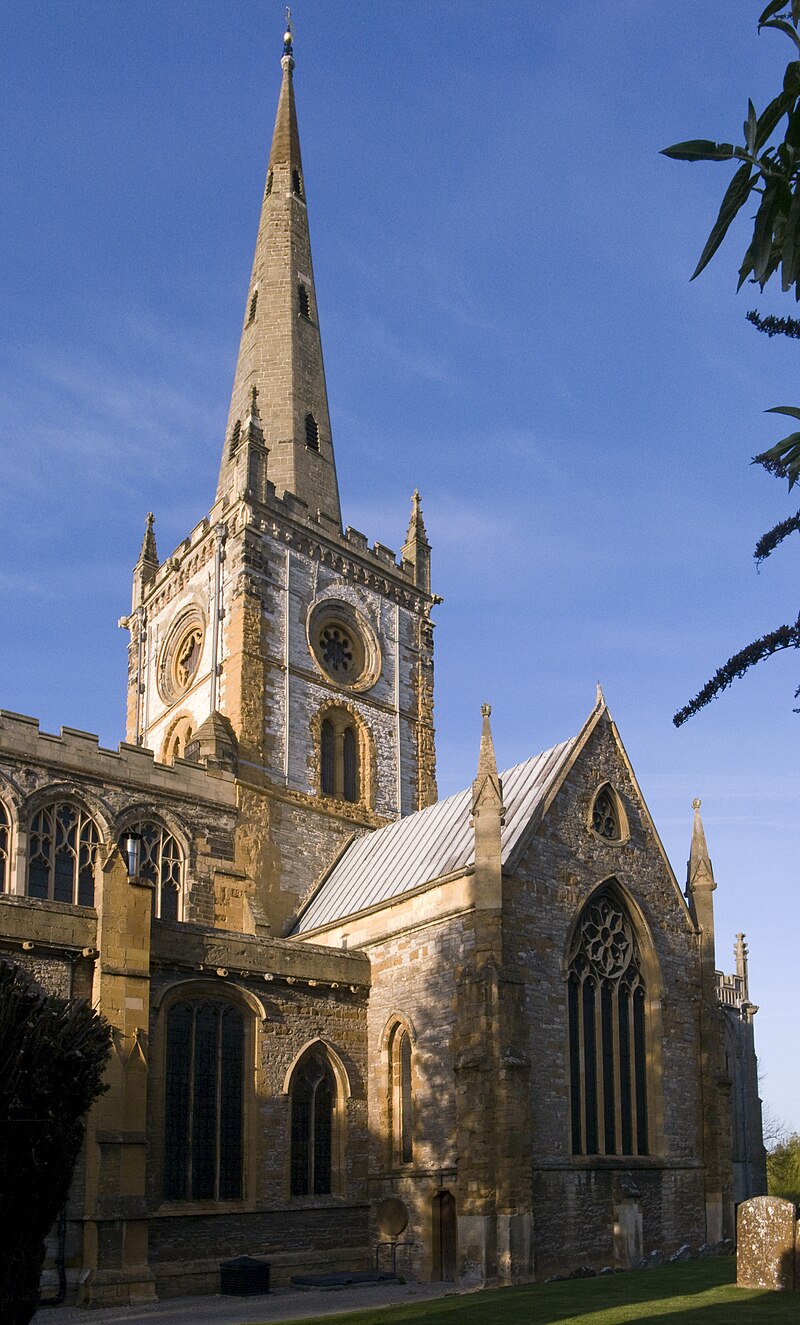
The Collegiate Church of The Holy and Undivided Trinity, Stratford-upon-Avon, Warwickshire, England, is a Grade I Listed Parish Church of The Church of England in Stratford-upon-Avon.

It is often known simply as Holy Trinity Church, or, Shakespeare's Church, due to its fame as the place of Baptism and burial of William Shakespeare. More than 200,000 tourists visit the Church each year.

The building dates from 1210 and is built on the site of a Saxon Monastery. It is Stratford's oldest building and is situated on the banks of The River Avon, and is one of England's most visited Churches.


Holy Trinity Church,
Stratford-upon-Avon,
Warwickshire, England.
Photo: 8 April 2009.
Source: Own work.
Author: Oosoom.
(Wikimedia Commons)


In the 14th-Century, John de Stratford founded a Chantry, which was rebuilt between 1465 and 1491 by Dean Thomas Balshall, who is buried at the Church. The building is believed to have originally had a Wooden Spire, which was replaced by William Hiorne in 1763.

Holy Trinity Church contains many interesting features, including:

A 14th-century Sanctuary Knocker in the Church's Porch (built circa 1500);

Twenty-six 15th-Century Misericord Seats in The Chancel, with Religious, Secular and Mythical carvings;

Several large Stained-Glass Windows featuring major English and Biblical Saints at the Church's East and West Ends.


Shakespeare's Funerary Monument,
Holy Trinity Church, Stratford Upon Avon, England.
Photo: 23 April 2006.
Source: Cropped from Image:ShakespeareMonument.JPG
released to PD by Tom Reedy.
Author: Cropped from original by current uploader. License as before.
(Wikimedia Commons)


The carved scenes of The Life of Jesus, around Balsall's tomb, were mutilated during The Reformation, as were most images of Christ. Notable 'survivors' include a remarkable Face of Christ, or, possibly, God the Father, within a Sedilia Canopy, and some beautiful Mediaeval Stained-Glass Windows depicting The Resurrection and Ascension of Christ and The Day of Pentecost. The Pre-Reformation Stone Altar slab, or Mensa, was found hidden beneath the floor in Victorian times and has now been re-instated as the High Altar.

The Church has a large three-manual Pipe Organ, which dates from 1841, by the Organ Builder William Hill. It has undergone several restorations by Hill, Norman and Beard, and Nicholson, and now has two separate sections. The Great and Swell 1 and Pedal 1 divisions are high on the wall above the Arch into The Tower Crossing and face West.

The Choir and Swell 2 and Pedal 2 divisions are at ground level between the Saint Peter Chapel and the South Aisle. A specification of the Organ can be found on The National Pipe Organ Register. The Organ Case was designed by George Frederick Bodley and Thomas Garner.


Church of the Holy Trinity, Stratford-upon-Avon 2010 PD 3.JPG

The Church of The Holy Trinity,
Stratford-upon-Avon, Warwickshire, England.
Photo: 25 July 2010.
Source: Own work.
Author: Bin im Garten.
(Wikimedia Commons)


William Shakespeare, Poet and Playwright, was Baptised in Holy Trinity Church on 26 April 1564 and was buried there on 25 April 1616. The Church still possesses the original Elizabethan Register giving details of his Baptism and burial, though it is kept by The Shakespeare Birthplace Trust for safekeeping.

He is buried in the beautiful 15th-Century Chancel, built by Thomas Balsall, Dean of the Collegiate Church, who was buried within it in 1491. Shakespeare was eligible to be buried in the Chancel owing to his position as a 'Lay Rector' of the Church, as Peter Ackroyd explains, this was due to his leasing of Tithes from the Church. This entitlement was taken either at his behest or on his behalf. Shakespeare's Funerary Monument is fixed on a wall alongside his burial place.

Shakespeare would have come to Holy Trinity Church every week, when he was in Town, i.e. all through his childhood and on his return to live at New Place. His wife, Anne Hathaway, is buried next to him along with his eldest daughter, Susanna. The Church witnessed a sad episode shortly before Shakespeare's death. The day after Shakespeare signed his Last Will and Testament on 25 March 1616 in a 'shaky hand', William's son-in-law, Thomas Quiney was found guilty in the Church Court of fathering an illegitimate son by a Margaret Wheler, who had recently died in childbirth. Quiney was ordered to do Public Penance within the Church. The distress and shame for the Shakespeare family must have been immense. Within a month, Shakespeare was dead, his funeral and burial being held at Holy Trinity Church on 25 April 1616.


Church of the Holy Trinity, Stratford-upon-Avon 2010 PD 4.JPG

The grave of William Shakespeare.
The Church of The Holy Trinity,
Stratford-upon-Avon, Warwickshire, England.
Photo: 25 July 2010.
Source: Own work.
Author: Bin im Garten.
(Wikimedia Commons)


Above the grave, a badly-eroded stone slab displays his epitaph:
GOOD FRIEND FOR JESUS' SAKE FOREBEAR,
TO DIGG THE DVST ENCLOSED HERE.
BLESTE BE YE MAN YT SPARES THESE STONES,
AND CURSED BE HE YT MOVES MY BONES.
It has been claimed, by at least one textbook author, that the warning has served to prevent both the removal of Shakespeare's body to Westminster Abbey and the exhumation of his body for examination.

The grave of Shakespeare's wife, Anne Hathaway, is next to her husband's. The inscription states:

"Here lyeth the body of Anne, wife of William Shakespeare,
who departed this life the 6th day of August 1623, being of the age of 67 years."


Holy Trinity, Stratford, E. end.jpg

Holy Trinity Church, Stratford-upon-Avon, Warwickshire, England,
with Shakespeare's Funerary Monument in Bottom Left Corner.
Photo: 23 May 2008.
Source: Own work.
Author: Poliphilo.
(Wikimedia Commons)


A Latin inscription followed, which translates as:
"Breasts, O mother, milk and life thou didst give. Woe is me - for how great a boon shall I give stones? How much rather would I Pray that the good Angel should move the stone, so that, like Christ's Body, thine image might come forth ! But my Prayers are unavailing. Come quickly, Christ, that my mother, though shut within this tomb, may rise again and reach the stars." 
The inscription may have been written by John Hall on behalf of his wife, Anne's daughter, Susanna.

The Church houses Shakespeare's Funerary Monument, which was renovated in 1746 through proceeds from a production of Othello; it is the first recorded performance of a Shakespeare Play in Stratford-upon-Avon.

The official Web-Site of Holy Trinity Church can be found at

24 June, 2016

I Vow To Thee My Country.


Poppy Field in Kent, England.
Photo: 2006.
Source: Own work.
Author: Zephyrinus.


"I Vow To Thee My Country".
Available on YouTube at

The Nativity Of Saint John The Baptist. Feast Day 24 June.


Text from The Saint Andrew Daily Missal,
unless otherwise stated.

The Nativity of Saint John the Baptist.
Feast Day 24 June.

Double of The First Class
   with an Octave.

White Vestments.


English: The Voice in the Desert.
Français: La voix dans le désert.

Artist: James Tissot (1836-1902).
Date: Between 1886 and 1894.
Current location: Brooklyn MuseumNew York City.
Credit line: Purchased by public subscription.
Source/Photographer: Online Collection of Brooklyn Museum;
Photo: Brooklyn Museum, 2007, 00.159.44_PS1.jpg.
(Wikimedia Commons)


English: Interior of Saint John the Baptist Church, 
Konigsberg.
Deutsch: Im Innern der Probsteikirche in Königsberg.

Date: 1904.
Source: http://www.bildarchiv-ostpreussen.de/index.html
Author: Herausgeber: Landsmannschaft Ostpreußen e.V. Parkallee 84/86 20144
Hamburg HRA VR4551 Ust-ID-Nr.: DE118718969Bundesgeschäftsführer:
Dr. Sebastian Husen.
(Wikimedia Commons)


"A Prophet of The Most High" (Alleluia), Saint John is pre-figured by Isaias and Jeremias (Introit, Epistle, Gospel); moreover, he was Consecrated before birth to announce Jesus (Secret) and to prepare Souls for His coming.

The Gospel narrates the prodigies which accompanied his birth. Zachary gives his child the name which Saint Gabriel has brought him from Heaven, which signifies: "The Lord has pardoned". He immediately recovers his speech and, filled with The Holy Ghost, he foretells the greatness of his son: "He shall walk before The Face of The Lord, to give unto the people the knowledge of Salvation."


The Virgin and Child, with The Infant Saint John,
appearing to Saint Jerome and Saint Anthony.
Artist: Andrea Celesti (1637-1712).
Date: Circa 1700.
Current location: Santa Maria dei Derelitti,
Venice, Italy.
Source/Photographer: Web Gallery of Art.
(Wikimedia Commons)


The Angel Gabriel had announced to Zachary that "many would rejoice in the birth of Saint John the Baptist". Indeed, not only "the neighbours and relations of Elizabeth" Solemnised the event, but every year, on its Anniversary, the whole Church invites her children to share in this Holy Joy. She knows that The Nativity "of this Prophet of The Most High", at this "Summer Christmas", is intimately connected with The Advent of The Messias.

After The Feast of The Nativity of Saint John the Baptist, the days become shorter, while, on the contrary, after The Nativity of The Saviour, of which this Feast is the prelude, the days become longer. The Precursor must efface himself before Jesus, Who is The True Light of Faith. "He must increase," says Saint John, "and I must decrease."

The Solstices were the occasion of pagan feasts, when fires were lighted to honour the orb which gives us light. The Church Christianised the Rites, seeing in them a symbol of Saint John, who was "a burning and brilliant lamp".


Artist: Caravaggio (1573-1610).
Date: 1608.
Current location: Saint John's Co-Cathedral, VallettaMalta.
Source/Photographer: The Yorck Project: 10.000 Meisterwerke der Malerei. DVD-ROM, 2002.
ISBN 3936122202. Distributed by DIRECTMEDIA Publishing GmbH.
(Wikimedia Commons)


Indeed, "she encouraged this kind of manifestation, which corresponds so well with the character of the Feast. The Saint John bonfires happily completed The Liturgical Solemnity: They showed The Church and the Earthly City united in one thought." [The Liturgical Year by Dom Guéranger: The Nativity of Saint John the Baptist.]

The name of The Precursor is inscribed in The Canon of The Mass at the head of The Second List.

Formerly, on his Feast Day, three Masses were Celebrated in his honour, and numerous Churches were Dedicated to him. Parents loved to give his name to their children.


Gregorian Chant.
The Life of Saint John the Baptist.
Available on YouTube at


Paul the Deacon, a Monk of Monte Cassino and a friend of Charlemagne, had composed, in honour of Saint John the Baptist, the Hymn: "Ut queant laxis." In the 13th-Century, the Benedictine Monk, Guy of Arezzo, noticed that the notes, sung on the first syllables, formed the sequence of the first six degrees of The Scale. He named each degree by the corresponding syllable: "Ut, re, mi, fa, sol, la, si" and thereby greatly facilitated the study of musical intervals.

Ut queant laxis resonare fibris [Do - Re]
Mira gestorum famuli tuorum [Mi - Fa]
Solve polluti labii reatum [Sol - La]
Sancte Johannes [Si] (S J makes Si)

"Unloose, great Baptist, our sin-fettered lips;
That with enfranchis'd voice we may proclaim,
The Miracles of thy transcendent life,
Thy deeds of matchless fame."

"That thy servants may sing with full voice
the marvels of thy works, purify their sullied lips, O Saint John."

Immediately Zachary made signs that he wished to call his son "John", he recovered his speech; and Lo !, a Hymn composed in honour of The Prophet, whose voice resounds in the desert, becomes the occasion of a new progress in music.

Every Parish Priest celebrates Mass for the people of his Parish.

Mass: De ventre.


English: The Chapel of Saint John and Saint Paul in Szekszárd, Hungary.
Magyar: A barokk stílusú Szent János és Pál kápolna Szekszárdon.
Esperanto: Kapelo Sanktaj Johano kaj Paŭlo en Szekszárd, Hungario.
Photo: 4 October 2010.
Source: Hungarian Wikipedia, file hu:file:SzentJanos esPal.jpg.
Author: Pásztörperc.
(Wikimedia Commons)

Armed Forces Day. Saturday, 25 June 2016.


42 Commando Captain gives a SitRep.
Date: 2007.


"I Vow To Thee My Country".
Available on YouTube at


An 11-foot high bronze statue of a Black Watch soldier, by William Birnie Rhind, commemorates over 200 members of The Regiment who were killed or wounded in The South African War of 1900-1902. The Black Watch, the oldest Highland Regiment, was formed by General Wade in 1739 to police The Highlands at a time when many of the Clans harboured pro-Jacobite sympathies. Their name derived from the contrast of their Dark Green Tartan against the regular Red Tunics of The British Army. The unveiling ceremony for the memorial, planned for 25 May, 1910, was cancelled because the nation was still in official mourning after the death of King Edward VII.
Photo: 9 September 2011.
Source: Own work.
Author: Kim Traynor.
(Wikimedia Commons)


The Union Flag.
Available on YouTube at


Sir Winston Churchill's Funeral.
"I Vow To Thee My Country".
Available on YouTube at


"I Vow To Thee My Country".
Available on YouTube at

I vow to thee, my Country, all earthly things above,
Entire and whole and perfect, the Service of my love;
The love that asks no question, the love that stands the test,
That lays upon the Altar the dearest and the best;
The love that never falters, the love that pays the price,
The love that makes undaunted The Final Sacrifice.

And there's another Country, I've heard of long ago,
Most dear to them that love her, most great to them that know;
We may not count her armies, we may not see her King;
Her fortress is a faithful heart, her pride is suffering;
And Soul by Soul and silently her shining bounds increase,
And her ways are ways of gentleness, and all her paths are peace.

Words by Sir Cecil Spring-Rice.
"Thaxted" tune by Gustav Holst.

ARMED FORCES DAY,
SATURDAY, 25 JUNE 2016.

A CHANCE TO SALUTE OUR ARMED FORCES
AND SHOW YOUR SUPPORT
FOR ALL THEY DO FOR US.

Armed Forces Day Web-Site is at

23 June, 2016

The Vigil Of Saint John The Baptist. 23 June.


Text from The Saint Andrew Daily Missal,
unless otherwise stated.


The Vigil of Saint John the Baptist.
23 June.


Violet Vestments.


The Sermon of Saint John the Baptist (detail).
Artist: Pieter Breughel the Elder (1526-1569).
Date: 1566.
Current location: Szépművészeti Múzeum (Museum of Fine Arts),
Budapest, Hungary.
Source: Own work.
Author: Yelkrokoyade. Taken on 20 July 2013.
(Wikimedia Commons)


Feast Day Procession of Saint John the Baptist,
Patron Saint of Florence,
in Florence, Italy, 24 June 2011.
Available on YouTube at


The Infant Jesus and John the Baptist.
Artist: Bartolomé Esteban Murillo (1617-1682).
Date: 1600s.
(Wikimedia Commons)


In the Gospel of 25 March, we read that The Angel Gabriel announced to Mary that, three months later, Elizabeth, in virtue of a Divine Miracle, would have a son.

This is why The Nativity of Saint John the Baptist is Celebrated towards the end of June.

This important Feast is preceded by a Vigil.

Mass: Ne timias.


Fresco of The Birth of Saint John the Baptist.
Date: 1486-1490.
Current location: Tornabuoni Chapel,
Church of Santa Maria Novella, Florence, Italy.
(Wikimedia Commons)


The Tornabuoni Chapel (Italian: Cappella Tornabuoni) is the main Chapel (or Chancel)
in the Church of Santa Maria Novella, Florence, Italy. It is famous for the extensive
and well-preserved fresco cycle on its walls, one of the most complete in the City,
which was created by Domenico Ghirlandaio and his workshop between 1485 and 1490.


The following Text is from Wikipedia - the free encyclopaedia.

At The Annunciation, when The Angel Gabriel appeared to The Virgin Mary to inform her that she would conceive of The Holy Ghost, he also informed her that Elizabeth, her cousin, was already six months pregnant (Luke 1:36). Mary then journeyed to visit Elizabeth. Luke’s Gospel recounts that the baby “leapt” in Elizabeth’s womb at the greeting of Mary (Luke 1:44).

The Nativity of John the Baptist, on 24 June, comes three months after the Celebration on 25 March of The Annunciation, when The Angel Gabriel told Mary that her cousin Elizabeth was in her sixth month of pregnancy, and six months before the Christmas Celebration of The Birth of Jesus. 
The Nativity of John the Baptist Anticipates The Feast of Christmas.


Vespers for The Feast of Saint John the Baptist.
Recorded on 19 June 2014 at the Church of Saint Jean Baptiste,
New York City, by Tom Durack, Michael McGuinnes,
and video editing by Anthony Indelicato.
Available on YouTube at


The Nativity of John the Baptist is one of the oldest Festivals of The Christian Church, being listed by The Council of Agde, in 506 A.D., as one of that region's principal Festivals, where it was a day of rest and, like Christmas, was Celebrated with three Masses: A Vigil Mass; a Dawn Mass; and a Mid-Day Mass. This Feast of The Nativity of Saint John is one of the Patronal Feasts of The Order of Malta.

Ordinarily, the day of a Saint's death is usually Celebrated as his or her Feast Day, because that day marks their entrance into Heaven. To this rule there are two notable exceptions: The Birthday (Nativity) of The Blessed Virgin Mary (8 September); and The Birthday (Nativity) of Saint John the Baptist (24 June). According to Catholic Tradition and teaching, Mary, already in the first moment of her existence, was free from Original Sin (her Conception itself is Commemorated by a separate Feast (8 December)), while Saint John the Baptist was cleansed of Original Sin in the womb of his mother.

The Nativity of John the Baptist, though not a widespread public holiday outside of Quebec, is a high-ranking Liturgical Feast, kept in The Roman Catholic, Anglican and Lutheran Churches. In the Roman Rite it is Celebrated, since 1970, as a Solemnity. In the 1962 Missal, it is a Feast of The First-Class and, in still-earlier Missals, as a Double of The First-Class with a Common Octave.

Like The Birth of The Virgin Mary, the subject is often shown in art, especially from Florence, whose Patron Saint is John the Baptist.

The Biggest Pro-Life Event Of The Year. The All-Ireland Rally For Life. Belfast. 2 July 2016. Because Every Life Matters. Be There.


Illustration: LIFE INSTITUTE

For more information and updates, please visit the Web-Site at LIFE INSTITUTE

22 June, 2016

Saint Paulinus. Bishop And Confessor. Feast Day, Today, 22 June.


Text from The Saint Andrew Daily Missal,
unless otherwise stated.

Saint Paulinus.
Bishop and Confessor.
Feast Day 22 June.

Double.

White Vestments.


English: Gothic-Revival Stained-Glass Window
showing Saint Paulinus of Nola.
Linz Cathedral, Austria.
Deutsch: Linzer Dom ( Oberösterreich ).
Neogotisches Buntglasfenster
mit Darstellung des heiligen Paulinus von Nola.
Photo: 14 March 2009.
Source: Own work.
Author: Wolfgang Sauber.
(Wikimedia Commons)


Saint Paulinus, born in 353 A.D. of a noble Roman family at Bordeaux, Aquitaine, France, distinguished himself in his studies and became Senator at the age of twenty-five. Elected Consul, he established his residence at Nola, in Campania, Italy, near the tomb of Saint Felix, the Martyred Priest, whose Feast The Church Celebrates on 14 January. Whilst at Campania, Saint Paulinus was suddenly touched by Grace and, soon after, was Baptised.

Following the example of Christ, "Who, being rich, made Himself poor" (Epistle), and Who counselled the practice of the Virtue of Poverty (Gospel), he abandoned his great riches and, at this price, bought the Kingdom of Heaven.


Having separated from his wife, who also gave herself to God, he became a Priest. Later, he was Bishop of Nola (Introit, Gradual, Alleluia, Offertory, Communion).

His former friends blamed him. "He is content with the approval of Jesus" [Poem X. Ad Ausonium]. Soon afterwards, the Goths ravaged Campania and utterly despoiled the rich of Rome, who gained no merit thereby, whereas Saint Paulinus, who had abandoned his riches voluntarily for Christ's sake, is rewarded a hundredfold hereafter in Eternal Life.

He died in 431 A.D. at the age of seventy-eight, and was buried near Saint Felix, at Nola, Italy.

Mass: Sacerdotes tui.

The Newly-Refurbished York Theatre, York, England.


The newly-refurbished York Theatre,
York, England.
This proves that it is not impossible for Modern Architecture
to produce beautiful, sympathetic, well-thought-out designs.
If only Modern Church Architects would apply these same criteria !!!
Illustration: RIBAJ

This Article can be read in full at RIBAJ

21 June, 2016

Armed Forces Day. Saturday, 25 June 2016.


42 Commando Captain gives a SitRep.
Date: 2007.


"I Vow To Thee My Country".
Available on YouTube at


An 11-foot high bronze statue of a Black Watch soldier, by William Birnie Rhind, commemorates over 200 members of The Regiment who were killed or wounded in The South African War of 1900-1902. The Black Watch, the oldest Highland Regiment, was formed by General Wade in 1739 to police The Highlands at a time when many of the Clans harboured pro-Jacobite sympathies. Their name derived from the contrast of their Dark Green Tartan against the regular Red Tunics of The British Army. The unveiling ceremony for the memorial, planned for 25 May, 1910, was cancelled because the nation was still in official mourning after the death of King Edward VII.
Photo: 9 September 2011.
Source: Own work.
Author: Kim Traynor.
(Wikimedia Commons)


The Union Flag.
Available on YouTube at


Sir Winston Churchill's Funeral.
"I Vow To Thee My Country".
Available on YouTube at


"I Vow To Thee My Country".
Available on YouTube at

I vow to thee, my Country, all earthly things above,
Entire and whole and perfect, the Service of my love;
The love that asks no question, the love that stands the test,
That lays upon the Altar the dearest and the best;
The love that never falters, the love that pays the price,
The love that makes undaunted The Final Sacrifice.

And there's another Country, I've heard of long ago,
Most dear to them that love her, most great to them that know;
We may not count her armies, we may not see her King;
Her fortress is a faithful heart, her pride is suffering;
And Soul by Soul and silently her shining bounds increase,
And her ways are ways of gentleness, and all her paths are peace.

Words by Sir Cecil Spring-Rice.
"Thaxted" tune by Gustav Holst.

ARMED FORCES DAY,
SATURDAY, 25 JUNE 2016.

A CHANCE TO SALUTE OUR ARMED FORCES
AND SHOW YOUR SUPPORT
FOR ALL THEY DO FOR US.

Armed Forces Day Web-Site is at

20 June, 2016

Together In Electric Dreams . . . And In Steam Trains . . . And In Carnforth Railway Station.


"Together In Electric Dreams."
Sung by Phil Oakley.
Available on YouTube at


Steam Trains At Speed.
Available on YouTube at


"Brief Encounter".
Celia Johnson and Trevor
Available on YouTube at

19 June, 2016

Saint Juliana Falconieri. Virgin. Feast Day, Today, 19 June.


Text is from The Saint Andrew Daily Missal,
unless otherwise stated.

Saint Juliana Falconieri.
Virgin.
Feast Day 19 June.

Double.

White Vestments.


Illustration: CATHOLIC SPIRITUAL DIRECTION


Born at Florence, Italy, in 1270, of the illustrious family of Falconieri, Juliana, from childhood, gave such signs of Holiness that her uncle, Saint Alexis Falconieri, declared to her mother that she had given birth to an Angel. Never in the course of her life did she raise her eyes to look at a man's face, and to hear sin spoken of made her tremble (Introit).

At the age of fifteen, she Solemnly Consecrated her Virginity to God (Epistle, Gospel). "O, Juliana, only longing for the nuptials of the Heavenly Lamb, you leave your paternal roof and conduct a Choir of Virgins. You sigh night and day for the sorrows of your Spouse, nailed to The Cross, and you shed tears at the feet of The Mother of God, whose heart is pierced by Seven Swords." [Hymn at First Vespers.]


English: The Basilica Santissima Annunziata, Florence, Italy.
Saint Juliana Falconieri's major Shrine is in this Basilica.
Italiano: Basilica della santissima annunziata.
Photo: 3 June 2007.
Source: Own work.
Author: sailko.
(Wikimedia Commons)


Having Founded The Order of Mantellate [They were called Mantellate on account of the short Mantle they wore], she was asked by Saint Philip Beniti to take charge of the whole Order of Servites, which honours in a special manner The Sorrows of The Virgin.

On two days a week her only food was The Bread of Angels. At the age of seventy, not being able to retain any food, she lamented the impossibility of receiving Holy Communion. She asked that at least The Blessed Sacrament should be held near her heart and The Sacred Bread miraculously disappeared, leaving an impression in the shape of a Host representing the image of Jesus crucified (Collect). She then breathed her last and was joyfully conducted to The Throne of The Divine King (Gradual). It was 19 June 1341.

Let us beseech The Holy Ghost to grant that we may, like Saint Juliana, be nourished and strengthened in our agony by The Body of Christ, Which will be our viaticum to The Heavenly Home (Collect).

Mass: Dilexisti.
Commemoration of Saint Gervase and Saint Protase. Martyrs.


Red Cloud, Nebraska, United States of America.
This 1883 Church is Listed in The National Register of Historic Places.
Photo: 4 September 2010.
Source: Own work.
Author: Ammodramus.
(Wikimedia Commons)


The following Text is from Wikipedia - the free encyclopaedia.

Juliana Falconieri, O.S.M., (1270 – 19 June 19, 1341) was the Italian Foundress of The Religious Sisters of The Third Order of Servites (or The Servite Tertiaries).

The Servite Order was approved by Pope Martin V in 1420. Pope Benedict XIII recognised the devotion long paid to her and granted The Servites permission to Celebrate The Feast of The Blessed Juliana. Pope Clement XII Canonised her in 1737, and extended the Celebration of her Feast Day,

19 June, to The Entire Church. Saint Juliana is usually represented in The Habit of her Order, with a Host upon her breast. Truly, a most excellent Saint.

Saint Juliana Falconieri was Beatified on 26 July 1678, in Rome, The Papal States, by His Holiness Pope Innocent XI.

She was Canonised on 16 June 1737, in Rome, The Papal States, by His Holiness Pope Clement XII.

Her major Shrine is in the Basilica of The Santissima Annunziata, Florence, Italy.

Related Posts Plugin for WordPress, Blogger...