Notre Dame de Rouen. The façade of the Gothic Church in France. Photographer: Hippo1947. Licence: SHUTTERSTOCK.

26 April, 2026

The “Solita Oscula” (“With The Customary Kisses”). How, And When, They Are Given.


Chalice in the Vestry of Ipatevskii Monastery
Kostroma, Russia.
Date: 1911.
Source: This image is available from The United States
under the digital ID prok.01289.
Author: Sergei Prokudin-Gorskii (1863–1944).
(Wikimedia Commons)


This Article is taken from, and can be read in full at,

ROMANITAS PRESS


By: Louis J. Tofari.

The Latin words “Solita Oscula” (pronounced soh-lee-tah ohs-coo-lah) mean “with the customary kisses” and refer to some of the Ceremonial kisses made during The Liturgy.

There are actually several kinds of kisses used in The Liturgical Ceremonies, for example those given to the Altar, the Book of the Gospels, the Paten and Chalice, Sacramentals and, even, the “Pax” (Kiss of Peace), but, to keep this Article brief, here we will cover those made by just The Inferior Ministers (i.e., Servers).

Like the Roman custom of genuflecting, the “Solita Oscula” were derived from Royal Court etiquette, and the Rubrician, L. O’Connell, attests to the act as an “ancient sign of respect and reverence”[1], while Wapelhorst expounds that these kisses, given either to Sacred things or The Celebrant, signify respect to The Person of Christ that they represent[2] and The Celebrant’s hands which are a symbol of power, protection, assistance and Blessing.[3]


A Scruple Spoon being used by The Celebrant during
The Divine Holy Mass. He is taking Holy Water from
The Water Cruet prior to putting it in The Chalice.
Illustration: SSPX MANILA (TWITTER)

Callewaert also comments, saying these kisses exist to give Solemnity and signify joy,[4] and we will discover later how this symbolism causes them to be occasionally omitted.

Before we cover what is kissed, let us first examine how the “Solita Oscula” are used. First, they are given only to The Celebrant and never to the other Sacred Ministers (e.g., the Deacon or Sub-Deacon), even if these positions are being exercised by a Priest.

When making the “Solita Oscula”, these should be made inaudibly with closed lips. The order[5] of making the “Solita Oscula” is simple:

When a Server is giving an object to The Celebrant: Kiss the object, first, then The Celebrant’s hand, second.


Thurible.
Illustration: LUZAR VESTMENTS


When a Server is receiving an object from The Celebrant: Kiss The Celebrant’s hand, first, then the object, second.

There is, however, an exception to this rule: When receiving a Sacramental (e.g., a Blessed Candle during Candlemas, or, a Palm on Palm Sunday), it is kissed, first, then The Celebrant’s hand, second. The reason for this is that the Sacramental take precedence over The Celebrant.[6]

Now, the items (and to what part of each) the “Solita Oscula” are given by the Servers:

The Biretta: On one of its four sides;
The Aspergilium: On the end of the handle;
[Editor: And, presumably, The Scruple Spoon, as well, as it is offered to The Celebrant];
The Incense Spoon: On the end of the handle;
The Thurible: On the Disk (where the Chains are attached).


French Antique Baroque
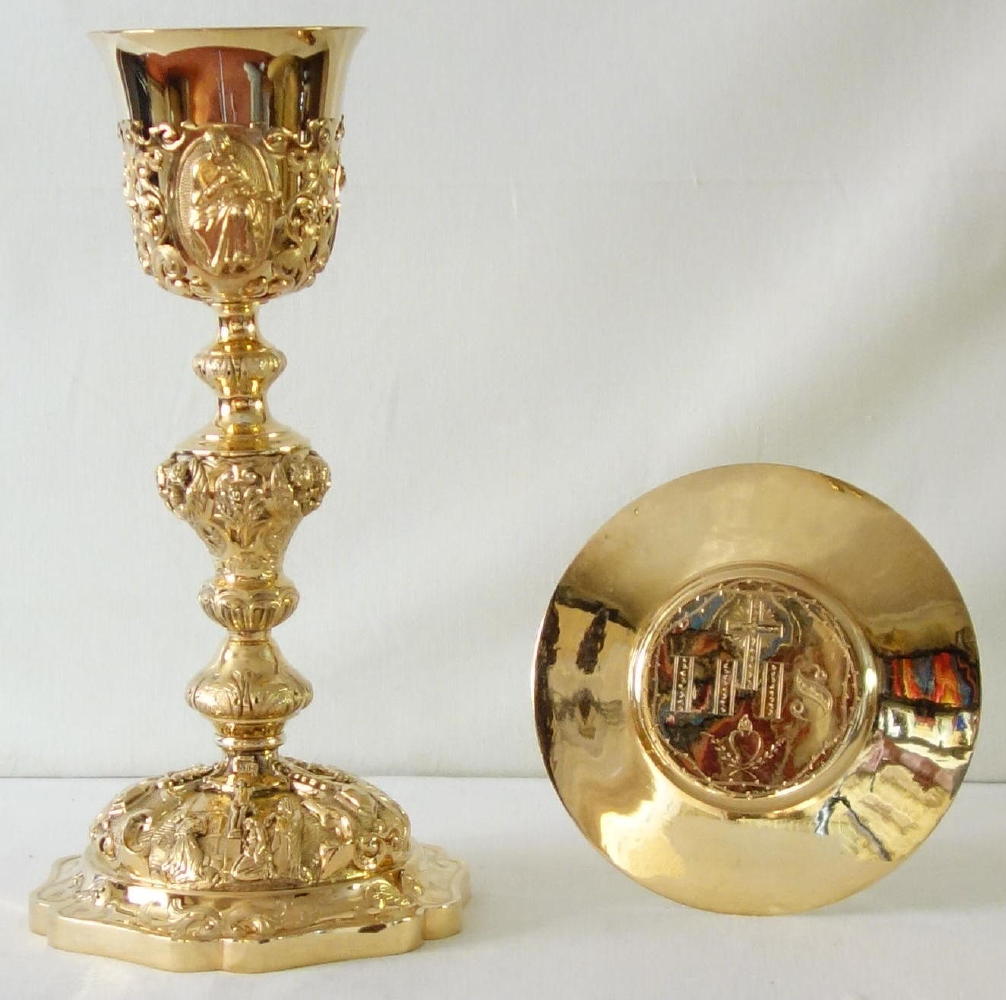
Chalice and Paten.
Illustration: LUZAR VESTMENTS


You may have noticed that I left out the Cruets, and this is due to some special considerations.

First, the Cruets are kissed alone [Editor: The Wine Cruet on its own, when being given to The Celebrant, and The  Water Cruet on its own, when being given to The Celebrant] and just during the Offertory.[7]

They should be kissed on the Cruet side, and never on their pouring channel, as this is unsanitary. Also, the Cruets should be kissed between the bows made to The Celebrant (i.e., bow, kiss, present, receive, kiss, bow).

During the Lavabo and Ablutions however, no kisses are made whatsoever to the Cruets, as the Servers are simply pouring the Cruets and not presenting them to The Celebrant.

There is one other thing to note regarding the “Solita Oscula”. As mentioned, above, these can signify joy, hence they are omitted for Funeral Rites and, also, Mass on Good Friday.


A Server's Cotta (Surplice).
Illustration: LUZAR VESTMENTS

They are also omitted under the condition of “Coram Sanctissimo” [Editor: In the presence of the exposed Blessed Sacrament] as all Reverence is given to Our Lord when He is exposed, or, if the local Ordinary [Editor: Bishop] or a greater Prelate is present (as a mark of hierarchical respect).[8]

Nevertheless, you will notice that some type of kisses are still retained (e.g., the kissing of the Paten and the Chalice) because these form “an intrinsic part of The Mass Ceremonies”.[9]

Footnotes.

1.    L. O’Connell, The Book of Ceremonies (1958), p 40.

2.    It should be remembered that every Sacramental represents Christ in some fashion, e.g., Holy Water as the regenerative Water of Baptism and Blessed Candles as The Light of Christ. 

This includes Consecrated items used during the Liturgy, e.g., the Altar (or Altar Stone), the Chalice and Paten, as well as Blessed items such as Vestments (which, for Servers, includes the Surplice [Editor: Cotta]; so yes, you are supposed to kiss it before putting it on).

3.    Wapelhorst, Compendium Sacræ Liturgicæ (1931), p 414; this is a paraphrased rendering of the Latin Text.

4,    Callewaert, Cæremoniale in Missa, Privata et Solemni (1941), p 38; again, a paraphrased rendering of the Latin Text.


5.    This general principle is mentioned throughout the Cæremoniale Episcoporum (1886), specifically in Liber I, Chap. XVIII, n. 16, and legislated by the SRC’s rescript 3139.

6.    L. O’Connell (p 41, ff 25) gives this (“if the object is Blessed”) as a general principle which makes sense. 

The two regular instances when it is enacted are for the aforementioned Feasts, for which the Cæremoniale Episcoporum, Liber II, Chap. XVI, n. 9, Martinucci, Manuale Sacrarum Cæremoniarum (1879), pp 146 and 166, Le Vavasseur, Haegy & Stercky, Manuel de Liturgie et Ceremonial (1936), p 127, Van der Stappen, Cæremoniale (1935), pp 355-356 & 366) and Stehle, Manual of Episcopal Ceremonies (1961), vol. II, pp 59 & 74, give this as a specific Rubric, while others such as De Herdt in Sacræ Liturgiæ Praxis (1894), p 26, and The Ceremonial For The Use Of The Catholic Churches In The USA (1926), pp 339 and 345, imply this rule.


Biretta.
Illustration: LUZAR VESTMENTS

7.    This is a relic of an old direction, now defunct, that the Inferior Ministers were to kiss the item, but not the Celebrant’s hand, when enacting the “Solita Oscula”.

It is interesting to note that this was specific to the positions of the Acolytes and MCs (Rubricians list at least two during Pontifical and even Solemn Ceremonies) who often had contact with the Celebrant, the former which Rubricians presumed would be enacted by Clerics with that Minor Order, while the latter (during Pontifical functions) would have the first MC position fulfilled by a Priest and the second MC position by a Sub-Deacon.

Callewaert (p 37) explains that this distinction demonstrated the hierarchy of the Liturgical Offices. This distinction was gradually diminished as High Masses (“Missa Cantatas”) without Sacred Ministers, but with Incense, became more frequent (circa 1864, the SRC was already granting such an Indult to various Dioceses).

Another contributing factor was that, during the 20th-Century, a few Rubricians (e.g., Fortescue, The Ceremonies Of The Roman Rite Described; 1917-1962 eds.) and even the Guild of Saint Stephen’s “The Altar Servers' Handbook” (1962) had the Server (including non-Clerics) render the “Solita Oscula” like the Sacred Ministers during Low Mass and High Mass. 

However, SRC’s rescript 4193,2 and The Missale Romanum (1962), “Ritus Servandus”, VII, (4) still prescribe the original practice for presenting the Cruets during the Offertory.

8.    Regarding the four reasons for omitting, this is briefly stated in the “Cæremoniale Episcoporum”, Liber I, Chap. XVIII, n. 16, and all Rubricians agree on these points.

9.    This is more or less the exact wording that the majority of Rubricians give for this reason.

Saint Cletus And Saint Marcellinus. Popes And Martyrs. Feast Day 26 April. Red Vestments.


Text from The Saint Andrew Daily Missal,
unless otherwise stated.

Saints Cletus and Marcellinus.
   Popes and Martyrs.
   Feast Day 26 April.

Semi-Double.

Red Vestments.


Pope Saint Cletus.
Two Popes of The Early Church sit on opposite corners of the Portico Ceiling of Saint Peter’s Basilica. Today, we Celebrate their Feast Day. The two men served as Popes two Centuries apart. What they share is that their Pontificates occurred during times of great torture and persecution for professing Christians under Roman rule. Whilst reflecting on the lives of Pope Saint Cletus (above) and Pope Saint Marcellinus I, it puts into perspective the trials that the Faithful now are facing.
Illustration: THE BRIGHTON ORATORY


English: Church of Saint Marcellinus, Liège, Belgium.
Français: Vue de l'église Saint-Marcellin à Chokier,
dans la commune de Flémalle
(province de Liège, en Belgique).
Photo: 30 April 2017.
Source: Own work.
Author: Jean Housen
(Wikimedia Commons)

Saint Cletus was the third Pope. Born at Rome, he was converted by Saint Peter and succeeded Saint Linus on the Pontifical Throne. He received the Crown of Martyrdom in
91 A.D., under Emperor Domitian and was buried near The Prince of The Apostles.

Saint Marcellinus was also a Roman. He governed The Church from 293 A.D. to 304 A.D., during the terrible persecution of Diocletian, who caused him to be beheaded. The name of Saint Cletus is in The Canon of The Mass (First List).

Their Mass is that of Martyrs in Paschaltide. It shows how Faith in the Virtue of The Resurrection of Christ sustains Souls in the midst of the sufferings they have to undergo on Earth after Christ (Epistle) before sharing in His Triumph in Heaven (Introit, Epistle, Gospel, Offertory, Communion).

Let us glorify Jesus, whose members we are, by producing many fruits of patience, as did these Holy Martyrs (Gospel).

Mass: Sancti tui.

25 April, 2026

Saint Mark The Evangelist. Feast Day 25 April. Red Vestments.


English: Saint Mark the Evangelist.
Español: San Marcos.
Artist: Jusepe Leonardo (1601–1653).
Date: Circa 1630.
Current location: Bowes Museum,
Barnard Castle, England.
This File: 7 June 2010.
(Wikimedia Commons)


Saint Mark The Evangelist.
Artist: René de Cramer.
“Copyright Brunelmar/Ghent/Belgium”.
Used with Permission.

Text from The Saint Andrew Daily Missal,
unless otherwise stated.

Saint Mark the Evangelist.
   Feast Day 25 April.

Double of the Second-Class.

Red Vestments.

Saint Mark, the Disciple of Saint Peter, is one of the Four Evangelists (Collect) who wrote, under the inspiration of the Holy Ghost, an abridgement of the Life of Jesus. 

His narration begins by the mission of Saint John the 
Baptist, whose “voice was heard in the desert”; Saint Mark is represented with a Lion lying at his feet, because the Lion, 
one of the four symbolical animals in the vision of Ezechiel (Epistle), makes the desert re-echo with its roaring.

He was one of the seventy-two Disciples (Gospel). He
went to Egypt, where he was the first to announce Christ at Alexandria. The Preaching of the Gospel, which his Martyrdom confirmed, made him to enter into Glory (Secret), where Saint John shows him to us as one of the four symbolical animals who attend the Triumph of the Immolated Lamb.


Statue of Saint Mark the Evangelist (Copy).
Artist: Donatello
Location: OrsanmicheleFlorence, Italy.
This File: 22 August 2005.
(Wikimedia Commons)

His body was taken to Venice, whose Patron he is since the 
9th-Century A.D. Rome possesses a Church Dedicated to 
Saint Mark, where a Station is held on the Monday of the 
Third Week in Lent.

Let us profit by the teaching of Saint Mark, who wrote the Gospel of Christ and Preached it, and let us have recourse to his Prayers (Collect).

Mass: Protexisti.
Commemoration: Of the Rogations, should the Rogation Mass not be Celebrated.
Credo: Is said.
Preface: Of The Apostles.


English: Venetian merchants,
with the help of two Greek Monks,
take Mark the Evangelist’s body to Venice
Deutsch: Bergung des Leichnams
des Hl. Markus (vor der Restaurierung).
Artist: Tintoretto
Date: 1562-1566.
Current location: Accademia of Venice, Italy.
Source/Photographer: The Yorck Project:
10.000 Meisterwerke der Malerei.
DVD-ROM, 2002. ISBN 3936122202
Distributed by DIRECTMEDIA Publishing GmbH.
(Wikimedia Commons)

“Goodnight”. Arthur J. Elsley (1860-1952).


“Goodnight”.
Artist: 
Arthur J. Elsley (1860-1952).
Illustration: MEISTERDRUCKE

Chauffeur Perkins Is Getting Big Ideas, Again.


“Perkins !!! 

“We need to talk !!!”

1931 CADILLAC V16 IMPERIAL CABRIOLET.
Illustration: HYMAN LTD

Psalm 23: : “The Lord Is My Shepherd”. The Choice Of Her Majesty Queen Elizabeth II (R.I.P.) At Her Wedding In 1947.


Psalm 23.
“The Lord Is My Shepherd”.
 From: “The Sunday at Home”.
Date: 1880.
Illustration: WIKIPEDIA

Illustration from The Sunday at Home, 1880.
Other name: “Dominus reget me”.
Written around 1000 B.C.
Text attributed to King David.
Language Hebrew (original).


Psalm 23.
“The Lord’s My Shepherd, I’ll Not Want”.
Funeral Of HM Queen Elizabeth II (R.I.P.).
Westminster Abbey.
2022.
Available On YouTube


“The Lord’s my Shepherd, I’ll not want”, is a metrical translation of Psalm 23, found in the “Scottish Psalter” of 1650, set to the tune “CRIMOND”, by Jessie Irvine (1836 - 1887). 

The descant used in verses two and five 
was composed by W. Baird Ross (1871 - 1950). 

This Hymn was sung at the State Funeral of 
Her Majesty Queen Elizabeth II (R.I.P.), 
at Westminster Abbey, 
Monday, 19 September 2022. 

May her Soul 
and the Souls of all the Faithful departed, 
through the mercy of God, 
Rest in Peace.
Amen.


This article is about Psalm 23 in Hebrew (Masoretic) numbering. 

Psalm 23 is the Twenty-Third Psalm of the Book of Psalms, beginning in English in the King James Version: “The Lord is my Shepherd”. 

In Latin, it is known by the Incipit: “Dominus regit me”.[1][2][3][4] 


The Book of Psalms is part of the Third Section of the Hebrew Bible,[5] and a book of the Christian Old Testament

In the slightly different numbering system used in the Greek Septuagint and Latin Vulgate translations of the Bible, this Psalm is Psalm 22.

Like many Psalms, Psalm 23 is used in both Jewish and Christian Liturgies. It has often been set to music.

The theme of God as a Shepherd was common in ancient Israel and Mesopotamia. For example, King Hammurabi, in the conclusion to his famous legal code, wrote: 


“I am the Shepherd 
Who brings well-being and abundant prosperity; 
My rule is Just . . . so that the strong 
Might not oppress the weak, 
And that even the orphan and the widow 
Might be treated with justice.”[6] 

This imagery and language were well-known to the community that created the Psalm, and it was easily imported into its Worship.

Psalm 23 portrays God as a good Shepherd, feeding (verse one) and leading (verse three) his Herd

The “Rod and Staff” (verse four) are also the implements of a Shepherd. Some commentators see the Shepherd imagery pervading the entire Psalm. 

It is known that the Shepherd is to know each Sheep by name, thus, when God is given the analogy of a Shepherd, He is not only a protector but also the caretaker. 

God, as the caretaker, leads the Sheep to Green Pastures (verse two) and Still Waters (verse two), because He knows that each of His Sheep must be personally led to be fed. 


Thus, without its Shepherd, the Sheep would die, either by a predator (like the Wolf) or of starvation, since Sheep are known for their helplessness without their Shepherd.

J. Douglas MacMillan argues that verse five (“Thou preparest a table before me”) refers to the “old oriental Shepherding practice” of using little raised tables to feed Sheep.[7]:   

Similarly, “Thou anointest my head with oil” may refer to an ancient form of Backliner [Editor: An externally applied medicine for Sheep] – the oil is poured on wounds, and repels flies.


MacMillan also notes that verse six (“Goodness and Mercy shall follow me”) reminds him of two loyal Sheepdogs coming behind the flock.[7]: 

The header, or first verse, of the Psalm, ascribes authorship to King David, said in the Hebrew Scriptures to have been a Field Shepherd, himself, as a youth.

Taken together, Psalm 22, Psalm 23, and Psalm 24, are seen by some as Shepherd Psalms, where the Good Shepherd lays down his life for the Sheep as a suffering Servant and King.[9]


Psalm 23.
Douai-Rheims Bible.
Bishop Challoner Revision.


A Psalm for David. 

The Lord ruleth me: 
And I shall want nothing.
He hath set me in a place of pasture. 
He hath brought me up, 
on the water of refreshment:

He hath converted my Soul. 
He hath led me on the paths of justice, 
for His own name’s sake.

For though I should walk 
in the midst of the shadow of death, 
I will fear no evils, for Thou art with me. 
Thy Rod and Thy Staff, they have comforted me.

Thou hast prepared a table before me 
against them that afflict me. 
Thou hast anointed my head with oil; 
and my Chalice which inebreateth me, 
how goodly is it !

And Thy mercy will follow me 
all the days of my life. 
And that I may dwell in the house of the Lord 
unto length of days.

Text of Psalm 23, above, is from the 
Douai-Rheims Bible at BIBLE HUB


Uses in Judaism.

Psalm 23 is Traditionally sung during the Third Shabbat Meal[15][16], as well as before the First and Second, and in some Jewish communities during the Kiddush

It is also commonly recited in the presence of a deceased person, such as by those keeping watch over the body before burial, and at the funeral service.[17][18]


“The Lord Is My Shepherd”.
“Crimond”.
Requested by Queen Elizabeth II (R.I.P.) 
at her Wedding in 1947.
BBC Radio 4 Extra Broadcast available at 

Spoiler Alert !!!

Ensure you have a large box of tissues with you, 
when listening to this not-to-be-missed broadcast.

Listen to this wonderful programme from Radio 4 Extra about the much-loved Hymn “Psalm 23”, set to music many times, including “Brother James’ Air” and “Crimond” [Editor: Crimond is a Village in Aberdeen-shire, Scotland].

The Queen (Queen Elizabeth II) requested 
the “Crimond” version at her wedding in 1947. 

Harriet Bowes Lyon tells the story that her mother, Lady Margaret Colville, (formerly Lady Margaret Egerton) taught the descant to the Queen (then Princess Elizabeth) and Princess Margaret, and she (Lady Colville) was summoned to sing it to the Presbyter in Westminster Abbey, when, two days before the Wedding, the descant music could not be found 
and nobody knew what the tune was !!! The Presbyter 
wrote down what he had heard from Lady Colville 
and all went ahead very well.

Howard Goodall, who wrote a new setting for 
“The Vicar of Dibley” television programme, 
describes how he composed it in a taxi. 

Selina Scott says that the “Crimond” always 
puts her in mind of her Scottish grandmother.


Procession And Holy Mass Of The Greater Litanies (25 April). Procession Et Sainte Messe Des Litanies Majeures.


Procession And Holy Mass: The Greater Litanies 2023.
Procession Et Sainte Messe Des Litanies Majeures.
The Church of Saint-Eugène - Sainte-Cécile, Paris.
Available on YouTube


Procession of The Greater Litanies: Pope Saint Gregory the Great has a vision of Saint Michael the Archangel on Castel Sant’Angelo sheathing his sword, marking the end of the plague epidemic in Rome. The Clergy carry in Procession 
the miraculous icon Salus Populi Romani.
Illustration: SCHOLA SAINT CECILE


The following Text is from SCHOLA SAINT CECILE

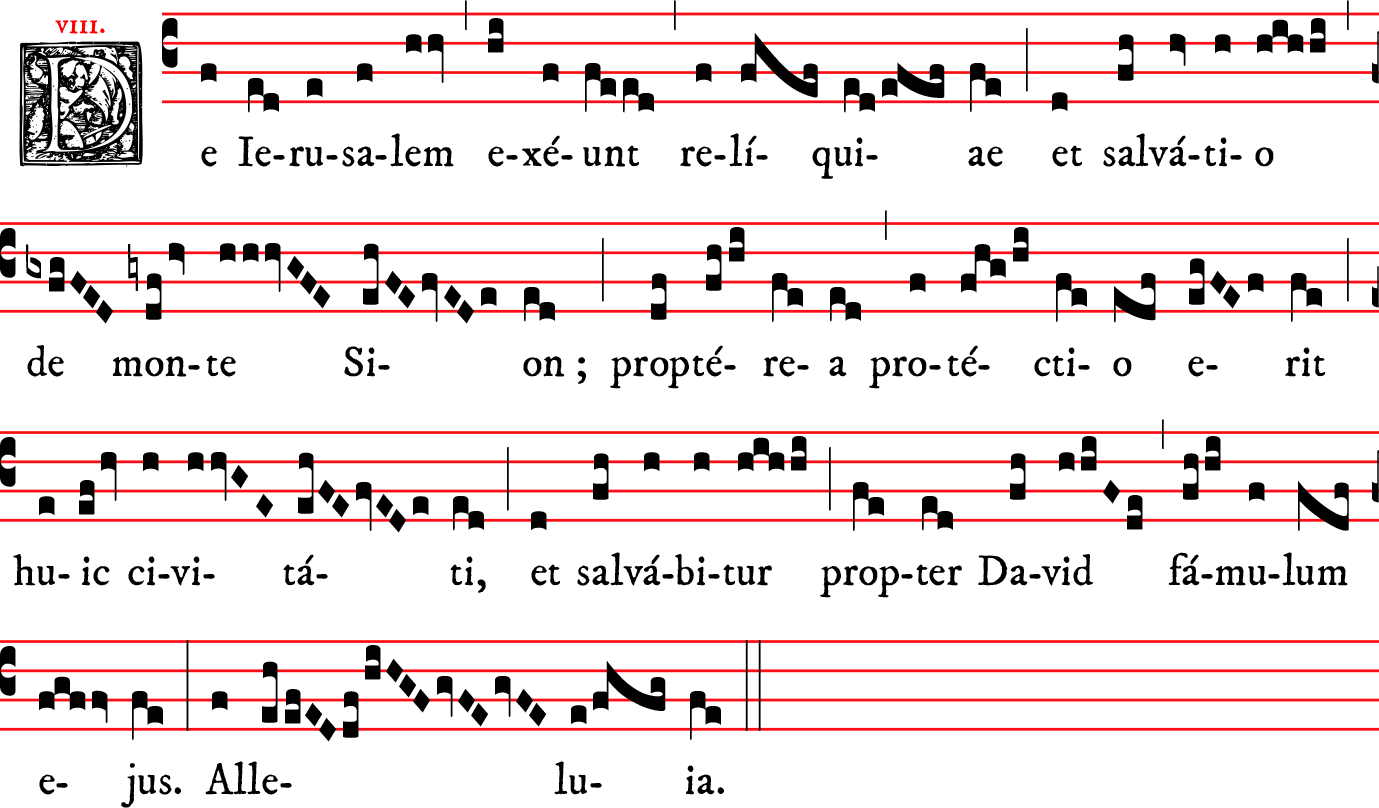
“De Jerusalem exeunt” – First Parisian Processional Antiphon for the Procession of The Greater Litanies on 25 April.


In Litaniæ Majores

In Processione, Prima Antiphona


De Jerusalem * exéunt relíquiæ et salvátio de monte Zion; proptérea protectio erit huic civitáti, et salvábitur propter David fámulum ejus.

Alleluia.

From Jerusalem come the relics, and the salvation of Mount Zion; also this city will be protected and saved because of David, his servant.


This Antiphon, from “De Jerusalem exeunt”, is part of a large series of Processional Antiphons which were sung in Rome during the Procession of The Greater Litanies.

Not having been recorded in the Missale Romanum of Pope Saint Pius V, they have in fact fallen into disuse, despite their great antiquity.

The custom of Paris has preserved a certain number of them and began the procession of The Greater Litanies with this one, “De Jerusalem exeunt”.


These Antiphons were transcribed both in the Missal and in the Processional, they were used not only for The Greater Litanies, Celebrated on 25 April concomitantly with the Feast of Saint Mark, but also for The Lesser Litanies, that is to say three days of Rogation (Rogation Monday, Rogation Tuesday, Rogation Wednesday) immediately preceding the Feast Day of The Ascension.

These Antiphons were called in The Middle Ages “Litaniales Antiphons” – “Antiphonæ Lætanialis” or even “Antiphons of Mercy” – “Antiphonæ de Misericordia” . 

They most likely date back to the time of Pope Saint Gregory the Great (6th-Century A.D. ) or even earlier.

Originally, and before seeing their use specialising in Mediæval manuscripts for The Greater Litanies and The Lesser Litanies, they were used in Rome for all Processions, beginning with those that took place every day of Station between the Collect Church and that of the Station.

The text of our Antiphon “De Jerusalem exeunt” recalls that the Relics of the Saints must be carried to the Processions of The Greater Litanies and The Lesser Litanies (The Rogations Days), as can be seen on all the graphic representations of these Ceremonies.

The Greater Litanies On 25 April. The Lesser Litanies (Rogation Days). Chestnut Sunday (Rogation Sunday). The Litany Of The Saints.


Rogation Sunday.
Ancient Custom of Blessing the Fields,
Hever, Kent, England.
Photo: 9 February 1967.
Author: Ray Trevena
(Wikimedia Commons)


Text from The Saint Andrew Daily Missal,
unless stated otherwise.

The Station is at Saint Peter’s Basilica, Rome.

Violet Vestments.

The Church Celebrates, on 25 April, two Solemnities, which have nothing in common: The Greater Litanies, so called on account of their Roman origin, and the Feast of Saint Mark, which is of later date. The word “Litany” means “Supplication”.

In ancient Rome, on 25 April, used to be celebrated the pagan feast of Robigalia. It consisted, principally, of a procession, which, leaving the City by the Flaminian Gate, went to the Milvian Bridge and ended in a suburban Sanctuary situated on the Claudian Way.


There, a ewe was sacrificed in honour of a god or goddess of the name Robigo (god or goddess of frost). The Greater Litany was the substitution of a Christian, for a pagan, ceremony. Its itinerary is known to us by a convocation of Saint Gregory the Great. It is, approximately, the same as that of the pagan procession.

All the Faithful in Rome betook themselves to the Church of Saint Laurence-in-Lucina, the nearest to the Flaminian Gate. Leaving by this Gate, the Procession made a Station at Saint Valentine’s, crossed the Milvian Bridge, and branched off to the Left towards the Vatican.


After halting at a Cross, it entered the Basilica of Saint Peter for the Celebration of the Holy Mysteries.

This Litany is recited throughout the Church to keep away calamities, and to draw down the Blessing of God on the Harvest. “Vouchsafe to grant us to preserve the fruits of the Earth, we Pray Thee, hear us”, is sung by the Procession through the Countryside.


The whole Mass shows what assiduous Prayer may obtain, when, in the midst of our adversities (Collects, Offertory), we have recourse with confidence to Our Father in Heaven (Epistle, Gospel, Communion).

If the Feast of Saint Mark is Transferred, the Litanies are not Transferred, unless they fall on Easter Sunday. In which case, they are Transferred to the following Tuesday.


Litany of The Saints.
Available on YouTube

The Litany Of The Saints.

The Litany of The Saints is used in connection with:

Holy Mass on the Greater Litanies (25 April);

The Lesser Litanies (Rogation Days);

Holy Saturday;

The Vigil of Pentecost;

Masses of Ordination, before the conferring of Major Orders.


On Saint Mark’s Day and Rogation Days, if the Procession is held, the Litany is preceded by the Antiphon “Exurge, Domine”, (Psalm XLIII. 26), and all Invocations are sung by the Cantors and repeated in full by the Choir [i.e., “Doubled”].

If the Procession cannot be held, the Invocations are not repeated.

On the Vigils of Easter and Pentecost, the Invocations marked with an asterisk (*) in the Missal are omitted; all the remaining Invocations are repeated, either there be a Font and a Procession from the Baptistry, or not.

At Masses of Ordination, only the first five Invocations are repeated.

Litany of the Saints at the Funeral of
Pope Saint John Paul II.
 Available on YouTube

Rogation Days are, in the Calendar of the Western Church, observed on 25 April (the Major Rogation) and the Monday, Tuesday, and Wednesday immediately preceding Ascension Thursday (the Minor Rogations).

The first Rogation, the Greater Litanies, has been compared 
to the ancient Roman religious festival of the Robigalia, a pagan ritual involving prayer and sacrifice for crops held on 25 April. 

The first Rogation is also observed on 25 April, and a direct connection has sometimes been asserted, with the “Christian substitute” following the same processional route in Rome. If Easter falls on 24 April, or on this day (25 April) (the latest possible date for Easter), the Rogations are Transferred to the following Tuesday.


The second set of Rogation Days, the Lesser Litanies, or Rogations, introduced about 470 A.D. by Bishop Mamertus of Vienne and eventually adopted elsewhere, are the three days (Rogation Monday, Rogation Tuesday and Rogation Wednesday) immediately before Ascension Thursday in the Christian Liturgical Calendar.

The word “Rogation” comes from the Latin verb “Rogare”, meaning “to ask”, and was applied to this time of the Liturgical Year because the Gospel reading for the previous Sunday included the passage, “Ask and ye shall receive” (Gospel of John 16:24).

The Sunday itself was often called Rogation Sunday, as a result, and marked the start of a three-week period (ending on Trinity Sunday), when Roman Catholic and Anglican Clergy did not solemnise marriages (two other such periods of marital prohibition also formerly existed, one beginning on the First Sunday in Advent and continuing through the Octave of Epiphany, or 13 January, and the other running from Septuagesima until the Octave of Easter, the Sunday after Easter (Low Sunday)).

In England, Rogation Sunday is called “Chestnut Sunday”.


The Faithful typically observed the Rogation Days by Fasting in preparation to Celebrate Ascension Day, and farmers often had their crops Blessed by a Priest at this time. 

Violet Vestments are worn at the Rogation Litany and its associated Mass, regardless of what colour Vestments were being worn at the ordinary Liturgies of the day.

A common feature of Rogation Days, in former times, was the Ceremony of “Beating the Bounds”, in which a Procession of Parishioners, led by the Minister, Churchwarden, and Choirboys, would proceed around the boundary of their Parish and Pray for its protection in the forthcoming year. This was also known as “Gang-Day”.


The reform of the Liturgical Calendar for Latin Roman Catholics, in 1969, delegated the establishment of Rogation Days, along with Ember Days, to the Episcopal Conferences . . .

the observance in the Latin Church subsequently declined . . .

[Editor: Can you believe that !!! Surely not !!! Surely the Episcopal Conferences would ensure the continuation of these most beautiful and effective Ceremonies, which had existed for over a thousand years !!! They would preserve them, and ensure their continuance and use . . . SURELY ???]

. . . but the observance has revived somewhat, since 1988, (when Pope Saint John Paul II issued his Decree “Ecclesia Dei Adflicta”) and especially since 2007 (when Pope Benedict XVI issued his Motu Proprio, “Summorum Pontificum”), when the use of older Rites was encouraged.

Churches of the Anglican Communion reformed their Liturgical Calendar in 1976, but continue to recognise the three days before Ascension [Editor: the Rogation Days (the Lesser Litanies)] as an Optional Observance.

“Ladies In Lavender”. Joshua Bell.


“Ladies in Lavender”.
Joshua Bell.
Available on YouTube
Related Posts Plugin for WordPress, Blogger...